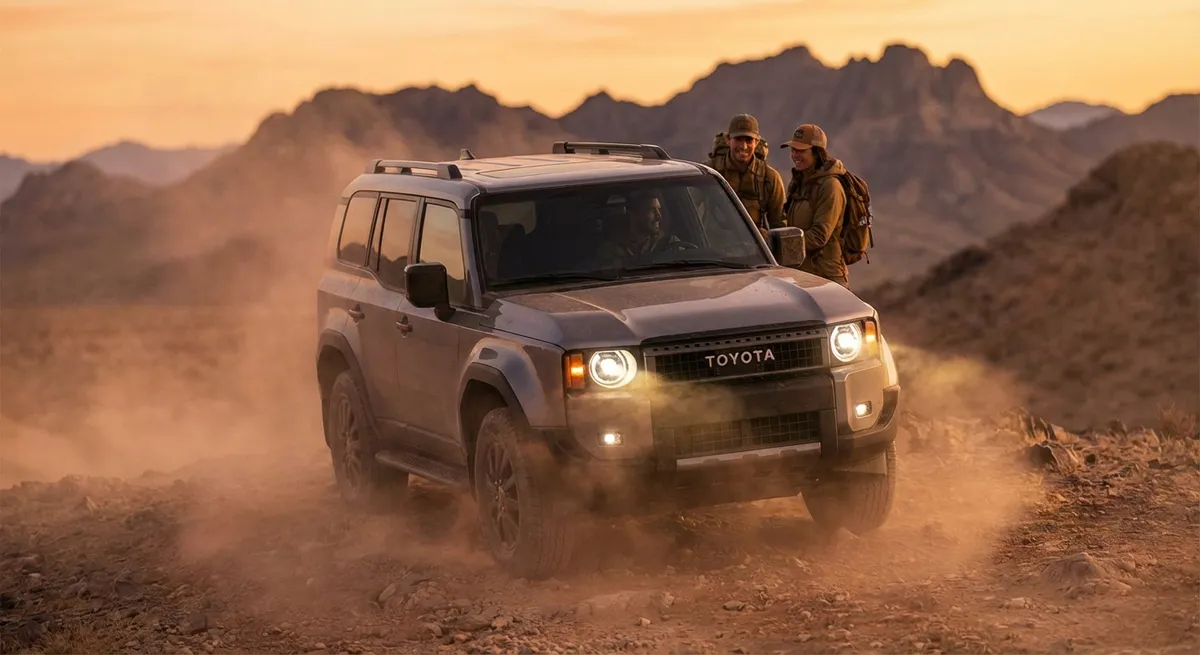
Toyota’s Land Cruiser nameplate returns to the U.S. for 2025 with a dramatically different mission. After years as a six-figure luxury SUV, the new Land Cruiser pivots toward its roots: a more attainable, durable, and off-road-focused machine built on serious hardware. This isn’t just a badge-engineering exercise—it’s a ground-up rethink using Toyota’s latest TNGA-F truck platform, hybrid tech, and trail hardware tuned for real-world abuse. For enthusiasts and shoppers alike, the key question is simple: does this “right-sized” Land Cruiser still feel like a Land Cruiser?
Design & Packaging: Classic Box, New Priorities
Visually, the 2025 Land Cruiser leans hard into squared-off nostalgia, but the proportions are carefully calibrated for modern buyers. At 193.7 inches long and 84.2 inches wide (with mirrors), it’s notably more compact than the outgoing 200 Series, and closely related to the global Land Cruiser Prado. That smaller footprint pays dividends in maneuverability, especially in tight urban streets and forest access roads where the old model felt oversized.
The front end wears a near-vertical grille and upright fascia, framed by either round or rectangular LED headlights depending on trim—an intentional callback to classic 40- and 60-Series Land Cruisers. The slab-sided profile, prominent fender flares, and nearly flat roofline aren’t just aesthetic; they maximize interior volume while supporting good outward visibility, roof rack compatibility, and approach angles.
Ground clearance is about 8.7 inches, with approach, breakover, and departure angles tailored for legitimate off-road use (exact figures vary slightly by trim and wheel/tire combination). Short overhangs and squared wheel wells reduce the risk of snagging on rocks or ruts. Toyota offers 18- or 20-inch wheels, but the lower-profile tires on the 20s are more vulnerable off-road; the 18s with higher sidewalls are the better choice for buyers who plan to air down for trail work.
Inside, the packaging reflects a clear shift from plush, Land Rover–rivaling luxury to robust, daily-usable durability. Harder, grained plastics dominate high-touch areas that would have been wood or leather in the prior generation, but the layout is ergonomically sound and purpose-built. Large, knurled rotary dials for climate and drive modes are glove-friendly, and physical buttons remain for critical functions, avoiding the “all-touchscreen” trap that can be infuriating on washboard trails.
Passenger space in both rows is generous, with supportive front seats and a rear bench that comfortably accommodates adults. Unlike the previous 3-row U.S. Land Cruiser, the 2025 model launches as a 2-row only, prioritizing cargo space and reducing weight. With the rear seats up, there’s ample room for luggage and camping gear; with them folded, the load floor is wide and relatively flat, making it easy to haul bikes, overlanding equipment, or home-improvement supplies.
Powertrain & Performance: Hybrid Torque with Truck DNA
Under the hood, the rebooted Land Cruiser moves away from large-displacement naturally aspirated V8s in favor of Toyota’s i-FORCE MAX hybrid system. The powertrain pairs a 2.4-liter turbocharged inline-four gasoline engine with an electric motor integrated into an 8-speed automatic transmission, fed by a small 1.87 kWh battery pack. System output is approximately 326 horsepower and 465 lb-ft of torque.
While purists may miss the effortless, linear character of the old 5.7-liter V8, the hybrid setup delivers a wall of low-end torque that’s actually better suited to off-road driving and towing. Peak torque arrives low in the rev range, helping the Land Cruiser crawl over obstacles and pull confidently from a standstill with minimal throttle input. The turbo-four can sound a bit gruffer under heavy load than the old V8, but the electric assistance masks turbo lag and keeps the transmission cycling through gears smoothly.
The 8-speed automatic is tuned for seamless shifts and intelligent gear selection rather than aggressive performance. In mixed driving, it tends to hold higher gears to leverage electric torque and improve fuel efficiency. When towing or climbing steep grades, the gearbox willingly downshifts to keep the engine in its torque band without hunting excessively, a prior weak spot on some older Toyota trucks.
Perhaps the most consequential aspect of the hybrid powertrain is efficiency. While official EPA figures can vary slightly by configuration, the Land Cruiser’s combined fuel economy is significantly higher than the outgoing V8—on the order of mid-20s mpg combined versus the previous generation’s mid-teens. For a body-on-frame SUV with full-time four-wheel drive, that’s a noteworthy improvement, especially for long-distance overlanding where fuel range dictates route planning.
Towing capacity is rated up to approximately 6,000 pounds. That puts the new Land Cruiser below half-ton pickups and some larger SUVs, but squarely in the sweet spot for compact travel trailers, dual-axle utility trailers, or a car hauler with a lightweight track car. Importantly, the hybrid system’s torque helps maintain stability and composure under load, and the cooling system has been engineered to handle sustained high-load operation in hot climates.
On-road, the TNGA-F platform’s increased rigidity (compared with the prior ladder frame) and multi-link rear suspension with coil springs deliver a more composed ride. Body motions are well controlled for a tall, body-on-frame SUV. Steering remains light and somewhat numb, prioritizing predictability over feedback, but lane changes and highway cruising feel secure and unhurried. Think “confident truck” rather than “crossover-like agility.”
Off-Road Hardware: Real Capability, Not Just Marketing
The 2025 Land Cruiser is built to be used off-road, not just posed next to trailheads. Every U.S. model comes standard with full-time four-wheel drive, a two-speed transfer case, and a center-locking differential. This alone sets it apart from crossovers or part-time systems that depend heavily on electronics to compensate for hardware limitations.
The available off-road suite includes:
- Rear locking differential: Mechanically locks the rear axle to ensure both wheels turn at the same speed, essential for maintaining forward motion when one wheel is off the ground or on a low-traction surface.
- Multi-Terrain Select: Adjusts throttle mapping, traction control aggressiveness, and braking strategy based on surface type (e.g., mud, sand, rocks). In the latest implementation, it works in both 4-High and 4-Low, broadening its usefulness.
- Crawl Control: Acts as an off-road cruise control at low speeds, automatically modulating throttle and braking so the driver can focus on steering. Early versions in older Toyota trucks were noisy and abrupt; the newer calibration is quieter and smoother, though still noticeable.
- Downhill Assist Control: Manages braking during steep descents to maintain a controlled pace without overworking the driver or heating the brakes excessively.
- Multi-Terrain Monitor: A camera system that provides a virtual view of the area around and under the vehicle, invaluable for placing tires precisely when cresting ridges or threading between rocks.
Suspension tuning strikes a balance between articulation and on-road stability. The Land Cruiser’s coil-sprung rear and independent front setup cannot match the extreme articulation of a solid-axle rock crawler, but travel is generous enough for serious trail use. Skid plates protect major components like the engine, transfer case, and fuel tank, though buyers intending heavy rock use will likely still look to aftermarket armor for added protection and better coverage.
Tire selection is critical. Models equipped with all-terrain tires from the factory offer better grip on loose surfaces and more puncture resistance than highway tires, at the cost of some noise and rolling resistance. For buyers who expect to regularly tackle remote trails, factory all-terrains are worth prioritizing at purchase—or upgrading to later.
One important nuance: the hybrid powertrain’s battery pack is relatively small and protected within the ladder frame. This keeps the vehicle’s center of gravity manageable and reduces the risk of damage off-road, but it also means you’re not getting plug-in hybrid levels of pure-electric range. The hybrid system here is about torque assist and efficiency, not silent electric-only trail crawling.
Interior Technology & Driver Assistance: Useful, with Some Caveats
Toyota equips the 2025 Land Cruiser with its latest infotainment architecture, centering around a large touchscreen (up to 12.3 inches in many trims) with a straightforward interface. Wireless Apple CarPlay and Android Auto are typically standard, minimizing the need to rely on the native navigation systems, which—while improved—still lag the dynamic flexibility of smartphone apps.
The digital instrument cluster (where equipped) offers configurable layouts, including off-road views showing steering angle, transfer case status, and vehicle pitch/roll. For buyers who actively use low-range and locking differentials, this real-time data is more than just a visual gimmick; it helps make informed decisions when cresting obstacles or approaching steep breakovers.
Physical redundancy remains for critical climate and drive mode functions. Large knobs and switches can be operated with gloves or without taking eyes off the trail for long, which is essential in rough conditions where a finger slip on a touchscreen can have outsized consequences. The blend of digital and analog controls here is one of the cabin’s strengths.
On the safety side, the Land Cruiser incorporates Toyota Safety Sense (TSS) with features such as:
- Pre-collision system with pedestrian detection
- Adaptive cruise control
- Lane departure alert with steering assist
- Lane tracing assist
- Road sign assist
- Automatic high beams
Calibrations have improved over earlier TSS generations, but lane-keeping assistance can still feel intrusive on narrow mountain roads or poorly marked rural highways. Fortunately, most systems can be partially or fully disabled via steering wheel controls or menu settings, allowing drivers to tailor the experience. Adaptive cruise control functions well in steady freeway traffic, maintaining following distance with minimal abrupt braking.
Audio and connectivity options vary by trim, with higher trims offering branded premium audio systems and more USB-C ports for passengers. For buyers who camp or work remotely, the availability of multiple 12V outlets, household-style power outlets, and a robust electrical system is a practical advantage, although this is still not the same as the dedicated inverter capacity seen in some full-size trucks.
The overriding theme inside is “robust modernity” rather than opulence. Materials will not impress shoppers cross-shopping high-end European SUVs, but they feel built to endure dirt, sand, pets, and kids—arguably more aligned with the Land Cruiser’s intended use case this time around.
Ownership, Value, and Who This SUV Suits Best
The 2025 Land Cruiser’s repositioning targets a different buyer profile than the outgoing generation. Pricing (varying by trim and options) undercuts the six-figure territory of its predecessor, landing it squarely in competition with mid- to upper-trim Jeep Wrangler Unlimited, Ford Bronco, Land Rover Defender 110, and 4Runner TRD Pro, as well as some three-row crossovers for buyers prioritizing ruggedness over seating capacity.
Total cost of ownership is where Toyota aims to regain its traditional advantage. Historically, Land Cruisers have been renowned for their longevity, high resale value, and global serviceability. The move to a smaller displacement turbocharged hybrid will raise legitimate questions about long-term complexity, especially for enthusiasts accustomed to simple, naturally aspirated engines. However, Toyota’s hybrid systems have a strong reliability record across millions of vehicles and multiple decades, and TNGA-F underpins several current Toyota trucks, spreading component commonality and reducing parts risk.
For buyers who plan to keep a vehicle for 10–15 years, the hybrid’s improved fuel economy offers meaningful savings over time, particularly at higher fuel prices or in regions where long-distance driving is the norm. Insurance costs are likely to be competitive with similarly priced body-on-frame SUVs, and Toyota’s extensive dealer network simplifies routine service—even in smaller towns where some luxury brands have no presence.
The Land Cruiser will appeal most strongly to:
- Overlanding and remote-travel enthusiasts who need authentic off-road hardware, strong aftermarket support, and a reputation for durability.
- Buyers in rural or snowbelt regions where full-time 4WD and ground clearance are everyday tools, not just weekend toys.
- Former 4Runner, GX, or older Land Cruiser owners who want a modernized version of what they already trust, but can accept the move away from V8 power.
- Adventure-focused families of four who value cargo space, towing capability for moderate trailers, and rugged interior materials over a third row or ultra-lux amenities.
On the flip side, shoppers primarily seeking luxury, ultra-quiet ride quality, or cutting-edge in-cabin tech may find more satisfying options in unibody crossovers or European luxury SUVs. And drivers craving sports-sedan-like handling will not find it here; the Land Cruiser remains unapologetically a truck-based SUV.
Conclusion
Toyota’s 2025 Land Cruiser doesn’t try to be everything to everyone. Instead, it doubles down on the core attributes that built the name’s reputation—durability, off-road competence, and practicality—wrapped in a smaller, more efficient, and more affordable package than the outgoing model. The shift to hybrid power, the emphasis on real off-road hardware, and the utilitarian-leaning interior all signal a reorientation toward enthusiasts and adventure-minded buyers rather than luxury-seekers.
For car enthusiasts and potential buyers, the key takeaways are clear: you’re getting serious off-road hardware rooted in a modern truck platform; a torque-rich hybrid powertrain that meaningfully reduces fuel costs; a cabin that favors function over flash; and an ownership proposition backed by Toyota’s long-standing reliability record. If your priorities center on going farther, with more confidence, into places where crossovers tap out, the new Land Cruiser earns its heritage badge in a thoroughly 2025 way.
Sources
- [Toyota USA – 2024/2025 Land Cruiser Product Information](https://www.toyota.com/upcoming-vehicles/landcruiser/) - Official specifications, features, and technical details direct from the manufacturer
- [Toyota Global – TNGA-F Platform Overview](https://global.toyota/en/mobility/tnga/vehicle_structure/) - Background on the ladder-frame architecture underpinning the new Land Cruiser and related models
- [U.S. Department of Energy – Fuel Economy Data & Comparisons](https://www.fueleconomy.gov/feg/byclass.htm) - Reference for SUV fuel economy class averages and efficiency context
- [IIHS – Vehicle Safety and Crash Test Ratings](https://www.iihs.org/ratings) - Current and future safety ratings resource for body-on-frame SUVs and competitor models
- [Consumer Reports – Hybrid and SUV Reliability Trends](https://www.consumerreports.org/cars/hybrids-evs/hybrid-cars-and-suvs-reliability-a9098090769/) - Long-term reliability insights for hybrid powertrains and SUVs across the industry
Key Takeaway
The most important thing to remember from this article is that this information can change how you think about Reviews.