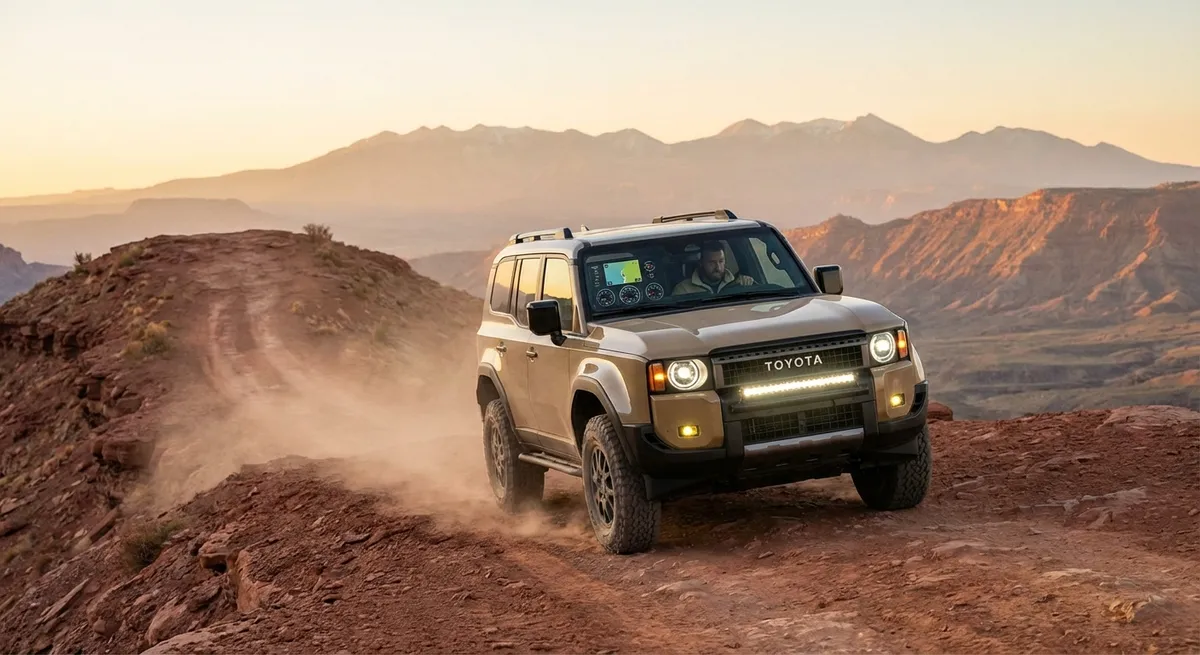
Toyota’s decision to bring the Land Cruiser back to the U.S. market for 2025 is more than a nostalgic move—it’s a strategic reset of one of the most important nameplates in SUV history. Now downsized, electrified (via hybrid assist), and repositioned below the Lexus GX, the 2025 Land Cruiser targets enthusiasts who want real off-road capability, Toyota-grade durability, and just enough modern tech to keep it current.
This review takes a detailed, enthusiast-focused look at how the new Land Cruiser drives, what’s changed under the skin, and whether its new mission makes sense for buyers who care about both trail performance and long-term ownership.
Powertrain and On-Road Dynamics: Turbo-Hybrid with a Different Mission
Toyota moves the Land Cruiser away from the V8 tradition to a turbocharged four-cylinder hybrid setup, known as the i-FORCE MAX powertrain. It’s a deliberate trade: more efficiency and torque density, less displacement and cylinder count.
Under the hood, you’ll find a 2.4-liter turbocharged inline-four paired with a 1.87 kWh nickel-metal hydride (NiMH) hybrid battery and an electric motor integrated into the 8‑speed automatic transmission. System output is around 326 hp and 465 lb-ft of torque, roughly matching or exceeding the outgoing V8’s torque while arriving lower in the rev range. Enthusiasts will notice the immediate low-end shove; the electric motor fills in turbo lag and helps the SUV feel decisive when merging or passing. The 8‑speed gearbox is tuned more for smoothness than aggression, but manual control via the shifter gate is predictable enough for downhill engine braking or towing situations.
Compared with traditional body-on-frame SUVs, the 2025 Land Cruiser feels lighter on its feet—because it is. Built on Toyota’s TNGA-F global truck platform, it shares underlying architecture with the Tundra and Sequoia but in a smaller, more tightly tuned package. Steering is still on the slow and steady side, prioritizing stability over quick turn-in, but body motions are better controlled than the previous U.S. Land Cruiser. There’s a moderate amount of body roll in sharp corners, which is appropriate for an off-road-oriented suspension; it’s not a carved-from-aluminum German crossover, and it doesn’t try to be.
Noise, vibration, and harshness (NVH) are well managed, but you’ll hear the four-cylinder more than the old V8 under heavy throttle. The hybrid system’s transitions are mostly seamless, with only slight shudder when the gas engine kicks in at low speeds. For buyers used to large, naturally aspirated engines, it’ll feel different—more modern, slightly busier—but the payoff is improved fuel economy and range, especially in stop-and-go or mixed driving.
Off-Road Hardware and Real-World Trail Performance
Toyota clearly intends the 2025 Land Cruiser to earn its badge in dirt, not just on brochures. The hardware package backs up the marketing in ways that matter to serious off-roaders as well as weekend explorers.
Ground clearance sits in the mid-8-inch range (varies slightly by trim and tire spec), enough for moderate rock gardens and deep ruts without constant skid-plate contact. Approach, breakover, and departure angles are competitive in the mid-size off-road SUV segment, especially when compared to more road-biased crossovers. A full-time 4WD system with a lockable center differential is standard, and most trims include a locking rear differential as well—a key advantage when you’re cross-axled or dealing with loose, off-camber surfaces.
Toyota’s Crawl Control functions as a low-speed off-road cruise control, managing throttle and braking to maintain a set speed over technical terrain. It’s more refined than earlier versions, with less of the on-off “ABS pump” feel that some owners complained about on previous generations. Multi-Terrain Select tailors wheel slip and traction control intervention for different surfaces (Mud, Sand, Rock, etc.), and the Multi-Terrain Monitor uses underbody and forward cameras to help place your wheels where they belong. For drivers newer to off-roading, these systems shorten the learning curve significantly.
The body-on-frame TNGA-F platform uses a double-wishbone front suspension and a multi-link solid rear axle. This combination delivers wheel articulation that’s genuinely useful on uneven surfaces, aided by the available stabilizer bar disconnect feature on some trims. Disconnecting the front sway bar increases front axle articulation, allowing each wheel to move more independently and maintain contact with the terrain. This improves traction and reduces the need to attack obstacles with extra speed, which can stress components and increase the risk of damage.
Underbody protection is thoughtfully applied, with skid plates for key drivetrain components and decent routing of exposed lines and harnesses. Factory tow hooks and recovery points are present and usable, important for group trail runs or solo adventures where self-recovery might be necessary. While it’s not as extreme as some dedicated rock crawlers, the 2025 Land Cruiser is a genuinely trail-ready platform out of the box, and an excellent base for aftermarket suspension, tire, and armor upgrades.
Interior Layout, Technology, and Everyday Usability
Toyota has repositioned the Land Cruiser as more functional and less opulent than its predecessor. That’s not cost-cutting so much as a recalibration: the role of “luxury overlander” is now largely occupied by the Lexus GX, while the Land Cruiser aims for durability and practicality with a modern edge.
The cabin design leans toward upright, truck-like ergonomics with physical controls for critical functions such as climate and drive modes. Materials are robust—more hard-wearing than plush in some areas—but tactically placed soft-touch surfaces and quality switchgear keep it from feeling austere. Seat comfort is excellent in the front row, with broad cushions, good thigh support, and sufficient lateral bolstering to keep you in place on rough trails. Depending on market and configuration, the Land Cruiser is set up as a two- or three-row SUV, but the U.S.-spec 2025 model leans toward a practical two-row layout with generous cargo capacity.
Toyota’s latest infotainment system is integrated via a central touchscreen (size varies by trim) and supports wireless Apple CarPlay and Android Auto. The interface is generally responsive, with logical menu layouts and quick access to navigation, audio, and vehicle settings. Over-the-air (OTA) software update capability keeps the system more future-proof than prior generations. An important usability detail: essential off-road controls are not buried in on-screen menus; lock switches, drive mode selectors, and camera activation buttons are placed near the shifter, where you can find and operate them with gloves or without taking your eyes off the trail for long.
Storage solutions are thoughtfully implemented: deep door pockets sized for water bottles, a large center console bin (often with available cooling in other TNGA-F variants, depending on market), and configurable rear cargo space with fold-flat seats. The boxy rear profile pays dividends in real-world utility—loading bulky gear, coolers, or camping equipment is significantly easier than in coupé-style crossovers with sloping rooflines.
Noise isolation is good at highway speeds, with wind and road noise well controlled for a body-on-frame SUV. The hybrid system’s ability to shut off the engine at idle enhances refinement in traffic, though keen ears will occasionally notice engine start-stop cycles. Overall, daily drivability is very livable: it feels like a serious SUV, not a soft crossover, but it isn’t punishing or crude.
Safety, Driver Assistance, and Long-Term Durability Considerations
The 2025 Land Cruiser launches with Toyota Safety Sense (latest generation) as standard, bringing a comprehensive suite of driver-assistance technologies. This typically includes adaptive cruise control with full-speed range, lane departure alert with steering assist, lane tracing assist (which can center the vehicle in its lane on highways), road sign assist, and a pre-collision system with pedestrian and cyclist detection. For an SUV likely to spend time on long highway trips and remote two-lane roads, these systems are practical rather than purely marketing-driven.
Blind-spot monitoring with rear cross-traffic alert and a high-resolution surround-view camera setup are particularly valuable in an SUV with upright lines and substantial C-pillars. The camera system is calibrated for both urban maneuvering and trail use, with off-road specific views that can display underbody perspectives and wheel placement. Enthusiasts may be skeptical of driver-assistance tech in off-road rigs, but the Land Cruiser’s systems can often be dialed back or disabled when you want full manual control.
Toyota has a globally recognized reputation for durability and reliability, especially with body-on-frame trucks and SUVs. The TNGA-F platform has already seen extensive real-world use under Tundra and Sequoia applications, giving engineers valuable data on frame integrity, suspension components, and hybrid system longevity. The i-FORCE MAX hybrid system, though more complex than a naturally aspirated V8, is engineered conservatively with thermal management and component robustness in mind. Heavy use of proven NiMH battery chemistry (as opposed to newer, higher-energy-density chemistries) favors durability over absolute weight savings.
From a maintenance perspective, the Land Cruiser’s traditional mechanical systems—transfer case, driveshafts, differentials—are serviceable and familiar to off-road shops and Toyota dealers alike. For buyers planning to keep the vehicle for 10–15 years, the combination of a global parts network, mature platform, and Toyota’s reliability track record makes the Land Cruiser an appealing long-term bet. Routine fluid changes, proper hybrid cooling system maintenance, and attention to suspension bushings (especially if you lift or re-gear) will be important to sustaining performance over high mileage.
Value Proposition and Who the 2025 Land Cruiser Makes Sense For
Historically, the Land Cruiser was priced and equipped like a luxury vehicle, which limited its audience to buyers willing to pay premium money for Toyota durability and off-road credentials. The 2025 reboot shifts that formula by offering a leaner, more focused package targeted at serious SUV shoppers who don’t necessarily want or need full luxury trimmings.
The new positioning places the Land Cruiser in competitive territory with vehicles like the Ford Bronco (in higher trims), Jeep Wrangler Unlimited Rubicon, and certain configurations of the Jeep Grand Cherokee and Land Rover Defender. Where it stands out is its blend of daily livability, genuine off-road hardware, and expected long-term durability. It’s less customizable than a Wrangler or Bronco in terms of factory roof/door configurations, but more refined and easier to live with as a singular “do everything” family SUV.
Fuel economy gains from the turbo-hybrid powertrain significantly improve cost of ownership compared with older V8 models, particularly for drivers covering high yearly mileage or who tow or haul frequently. The trade-off is a different character—more torque-rich than sonorous—and slightly more mechanical complexity. For most buyers, the lower fuel and potential maintenance costs (thanks to Toyota’s widely available service network) will outweigh any nostalgia for the V8, especially if the vehicle is used as a primary daily driver.
The 2025 Land Cruiser makes the most sense for:
- Enthusiasts who want a serious, body-on-frame off-road SUV with Toyota reliability.
- Buyers who prioritize longevity and resale value over cutting-edge luxury.
- Adventurers who need an SUV that’s as comfortable on long highway drives as it is on fire roads, snow, or desert two-tracks.
- Families who want two-row practicality, ample cargo space, and modern safety tech without stepping into full luxury-brand pricing.
For shoppers cross-shopping unibody crossovers and softer SUVs, the Land Cruiser offers a substantial capability jump with acceptable compromises in ride and refinement. For hardcore rock crawlers, it’s an excellent, robust platform—even if some will still look to solid-axle specialty rigs for the most extreme terrain.
Conclusion
The 2025 Toyota Land Cruiser is not a simple continuation of the old formula; it’s a re-engineered interpretation of what a modern, globally relevant Land Cruiser should be. The turbo-hybrid powertrain brings torque and efficiency, the TNGA-F platform delivers real off-road capability, and the refocused interior and pricing strategy broaden its appeal beyond the traditional luxury-leaning crowd.
For SUV enthusiasts and serious buyers, the new Land Cruiser’s story is one of intentional compromise: less opulence and cylinder count, more usability, tech integration, and long-term practicality. If you want an SUV that can commute comfortably, tackle real backcountry trails, and still feel like a long-haul partner a decade from now, the 2025 Land Cruiser deserves a close, hands-on test drive.
Sources
- [Toyota Global Newsroom – Land Cruiser Product Information](https://global.toyota/en/newsroom/toyota/39821015.html) – Official technical and product details on the latest Land Cruiser generation
- [Toyota USA – TNGA-F Platform Overview (Tundra/Sequoia Technical Info)](https://www.toyota.com/tundra/features/mpg_other_price/8504/8506) – Background on the TNGA-F architecture and related powertrain technologies
- [U.S. Department of Energy – Hybrid Electric Vehicles Explained](https://www.energy.gov/eere/vehicles/articles/hybrid-electric-vehicles) – Technical overview of hybrid systems and their efficiency benefits
- [IIHS – Crashworthiness and Safety Ratings Overview](https://www.iihs.org/ratings) – Methodology and information on how modern SUVs are evaluated for safety
- [Consumer Reports – Body-on-Frame vs. Unibody SUVs](https://www.consumerreports.org/cars/suvs/what-you-need-to-know-about-suvs-a3519848847/) – Context on platform design, ride, handling, and durability implications
Key Takeaway
The most important thing to remember from this article is that this information can change how you think about Reviews.