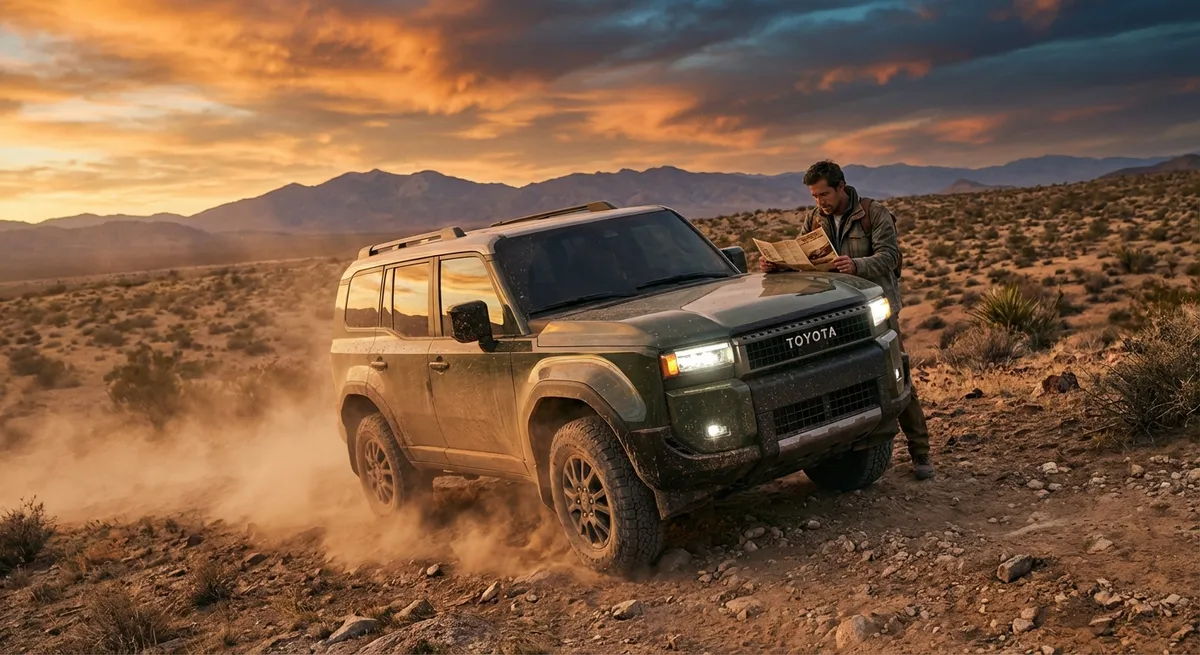
Toyota’s decision to bring the Land Cruiser back to the U.S. in a smaller, more efficient, and more affordable form is one of the biggest SUV stories of 2025. The new Land Cruiser (J250) walks a tightrope: it has to respect decades of off-road heritage while competing with tech-laden, fuel-conscious modern SUVs. This review breaks down how well it hits that mark for both hardcore enthusiasts and everyday buyers who simply want a durable, capable family rig.
Platform, Powertrain, and Drivetrain: What’s Under the Boxy Sheetmetal
Toyota has fundamentally rethought the Land Cruiser’s recipe without abandoning its core. Instead of the old naturally aspirated V8 and conventional automatic, the 2025 model rides on Toyota’s TNGA-F body-on-frame architecture—shared with the new Lexus GX and Tundra—and introduces a downsized, electrified powertrain.
The U.S.-spec Land Cruiser uses Toyota’s i-FORCE MAX 2.4‑liter turbocharged inline‑four hybrid, producing around 326 hp and 465 lb‑ft of torque. That torque figure actually surpasses the old 5.7‑liter V8 used in the previous 200‑Series, and, crucially, it comes in much lower in the rev range thanks to turbocharging and electric motor assist. An 8‑speed automatic gearbox sends power through a full‑time four‑wheel‑drive system with a center locking differential, and most trims include a locking rear differential as well.
This architecture yields a stiffer frame, improved crash performance, and better packaging for both suspension and battery components. Combined with electric assistance, it allows Toyota to target meaningfully better fuel economy than the outgoing V8 while preserving the low‑range gearing and robust drivetrain hardware that define the Land Cruiser name. Enthusiasts will notice the familiar solid rear axle paired with independent front suspension—an arrangement that balances off‑road articulation and on‑road manners for a vehicle that must be both expedition‑ready and school‑run friendly.
Off‑Road Capability: Where the Land Cruiser Still Earns Its Badge
The Land Cruiser’s off‑road credentials are the centerpiece of this reboot and the clearest link to its lineage. Ground clearance is generous, and the combination of short overhangs and a relatively compact footprint compared to the prior generation results in improved approach and departure angles. Hard numbers will vary by wheel and tire package, but Toyota is clearly targeting serious trail use rather than just a rugged aesthetic.
Standard full‑time 4WD with a 2‑speed transfer case gives the Land Cruiser authentic low‑range capability for steep climbs and technical rock work. A locking center differential is standard, and many configurations add a locking rear differential, which dramatically improves traction when diagonally opposite wheels lose grip. Toyota’s Multi‑Terrain Select system fine‑tunes throttle, traction control, and ABS intervention for surfaces like mud, sand, and rock, while the Crawl Control off‑road cruise function maintains a steady low‑speed pace so the driver can focus on line choice and steering.
The suspension tune is softer than that of many crossovers, allowing for better wheel articulation over uneven terrain and more comfort on corrugated or broken surfaces. While the 250‑Series Land Cruiser is smaller and lighter than the outgoing 200‑Series, its chassis is designed to handle the continuous punishment of off‑road driving, including heat management for the turbo‑hybrid powertrain under low‑speed, high‑load operation. Skid plates protect critical components, and the boxy body design helps with both outward visibility and fitting aftermarket accessories such as roof racks, snorkels, and off‑road bumpers.
On‑Road Dynamics, Comfort, and NVH: Daily Usability vs. Heritage Toughness
For many buyers, the Land Cruiser will spend far more time on pavement than on rocky trails, and here the changes for 2025 are especially noticeable. The TNGA‑F platform, combined with improved body mounting and additional sound insulation, yields a more refined ride than older generations without erasing the “truck‑like” feel that long‑time fans expect. The solid rear axle can still transmit some vertical motion over sharp bumps, but body control is better managed, and roll in corners is reduced compared to prior models.
The steering is electrically assisted and tuned for a deliberate, substantial feel rather than light, hyper‑boosted responses. That suits the Land Cruiser’s mission: stability and confidence at highway speeds over outright agility. Braking performance benefits from modern ABS, brake‑force distribution, and regenerative braking integration from the hybrid system. Toyota has tuned the brake pedal to feel as consistent as possible despite the handoff between friction and regenerative braking, though sensitive drivers may still detect mild variation in pedal feel during low‑speed stops.
Noise, vibration, and harshness (NVH) are restrained for a body‑on‑frame SUV. The downsized turbocharged 4‑cylinder doesn’t deliver the same naturally aspirated V8 character; instead, you get a more subdued, slightly gruff turbo note under load and a quiet background hum at cruise. Wind noise is well controlled despite the upright windshield and squared‑off pillars, owing to better door sealing and aero tuning at the mirrors and roofline. For long‑distance drives on mixed surfaces—highways, broken secondary roads, gravel—the overall tuning feels tailored to the “overlanding” use case: calm, predictable, and composed even when the surface deteriorates.
Interior Design, Technology, and Practicality: Classic Form, Modern Function
Step inside the 2025 Land Cruiser and the design brief becomes apparent: blend a functional, almost retro aesthetic with the tech expectations of a modern family SUV. The dash layout is upright and squared, with large physical controls for climate, drive modes, and key vehicle functions—welcome news for buyers tired of digging through submenus on touchscreens. Materials lean more toward durable than ultra‑luxurious, especially in lower trims, but high‑touch surfaces are soft, and stitching details give a subtle premium feel.
Central to the cabin is an available large touchscreen (screen size varies by trim) running the latest Toyota multimedia system, with wireless Apple CarPlay and Android Auto as standard. The system supports over‑the‑air updates, cloud‑based navigation, and connected services, though Toyota still offers traditional physical volume and tuning knobs—a significant usability advantage over fully digital interfaces. A configurable digital instrument cluster provides off‑road information such as steering angle, vehicle pitch/roll, and torque distribution, especially in off‑road modes.
Seating is configured strictly for two rows in the North American Land Cruiser, reflecting Toyota’s intent to distinctively position it relative to the three‑row Sequoia and some Lexus models. This simplifies interior packaging and frees up cargo space, making it easier to fit camping gear, recovery equipment, or a family’s luggage for extended trips. Rear seat legroom is reasonable but not cavernous; the Land Cruiser is slightly more compact than some full‑size SUVs but remains comfortable for adults in both rows. The boxy roofline yields excellent headroom and a large, squared cargo opening that works well for bulky items like coolers, storage boxes, or mountain bikes with the front wheel removed.
Overall, the interior successfully balances analog usability—big knobs, clear buttons, logical layout—with the connected features and safety tech that modern buyers expect. It is not a leather‑lined luxury lounge; instead, it feels like a purposeful command center designed to withstand daily wear and serious use.
Ownership Value, Reliability Outlook, and Who the Land Cruiser Really Suits
Where the 2025 Land Cruiser becomes especially compelling is in its long‑term ownership proposition. Toyota’s reputation for durability and conservative engineering choices remains a key selling point, especially for buyers planning to keep the vehicle beyond typical lease terms or to use it in demanding conditions. The hybrid powertrain adds complexity, but Toyota has deep experience with hybrid systems dating back to the original Prius, and many of the core components and software strategies are shared with higher‑volume models like the Tundra and Tacoma hybrids.
Fuel economy is markedly better than the outgoing V8‑powered 200‑Series, bringing the Land Cruiser closer to modern expectations for a mid‑size SUV without sacrificing genuine 4WD hardware. That can significantly reduce operating costs over time, particularly for owners who log high annual mileage. Resale value is expected to be strong, continuing the trend of prior Land Cruiser generations that often retained high residuals thanks to global demand and a reputation for longevity in harsh environments.
The Land Cruiser is not the right choice for everyone. Buyers who prioritize maximum interior space, third‑row seating, or the light, car‑like driving experience of a unibody crossover may find more suitable options elsewhere in Toyota’s lineup or among competitors. Likewise, those seeking ultra‑luxury appointments and a quieter, more isolated cabin might gravitate to Lexus or other premium brands.
However, for enthusiasts and practical buyers who want:
- A body‑on‑frame SUV with authentic low‑range 4WD
- Proven Toyota engineering and a focus on long‑term durability
- A balance of off‑road capability with daily comfort and refinement
- A simpler two‑row layout with real cargo usability
- Modern tech and safety without sacrificing analog controls
…the 2025 Land Cruiser lands in a sweet spot that few competitors directly match. It is less an oversized status symbol and more a carefully considered tool—one that respects its lineage while finally acknowledging the realities of emissions, fuel costs, and modern expectations.
Conclusion
The 2025 Toyota Land Cruiser represents a strategic reset for an iconic nameplate. By downsizing the engine but boosting torque with hybrid assistance, refining the chassis, and focusing the interior on functional comfort instead of outright opulence, Toyota has translated the Land Cruiser’s core values into a more relevant package for today’s buyers.
For car enthusiasts, it is an intriguing blend: a genuinely capable, body‑on‑frame off‑roader with serious hardware and a powertrain that reflects current engineering trends rather than nostalgia. For families and adventure‑oriented buyers, it offers real‑world practicality, improved efficiency, and a strong reliability outlook. It may not satisfy every traditionalist who misses the V8, but it successfully repositions the Land Cruiser as a purposeful, modern SUV that still feels like it could carry you far beyond the pavement—and bring you back again.
Sources
- Toyota USA – 2024–2025 Land Cruiser Product Information – Official specifications, features, and trim details direct from Toyota
- Toyota Global Newsroom – Land Cruiser 250 Series Announcement – Technical overview, platform information, and global engineering intent for the J250
- U.S. Department of Energy – Fuel Economy Guide – Comparative fuel‑economy data and hybrid technology background
- IIHS – Vehicle Ratings and Safety Information – Independent crash‑test protocols and SUV safety assessments relevant to body‑on‑frame designs
- Toyota – TNGA‑F Platform Technical Overview – Background on the TNGA architecture that underpins the new Land Cruiser and related models
Key Takeaway
The most important thing to remember from this article is that this information can change how you think about Reviews.