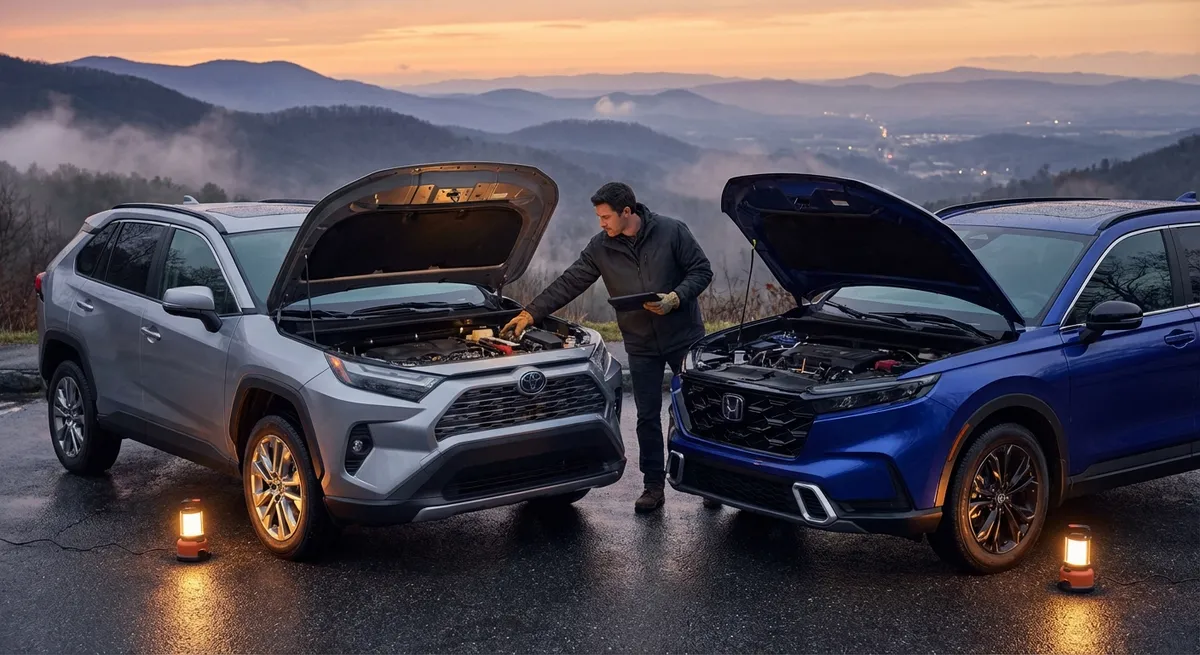
The compact SUV segment has never been more competitive, and two nameplates still dominate the conversation: the Toyota RAV4 and Honda CR‑V. For 2025, both models sharpen their focus on efficiency, everyday usability, and long-term durability—while quietly embedding more advanced tech than most shoppers realize. This review goes beyond brochure language, breaking down how these two leaders actually compare where it matters most: powertrains, chassis tuning, interior execution, safety systems, and total ownership experience.
1. Powertrain Engineering: Efficiency vs. Effortless Refinement
Both SUVs prioritize efficiency, but they take slightly different engineering paths to get there.
The 2025 Toyota RAV4 continues with a 2.5‑liter naturally aspirated four-cylinder in its gasoline models, paired with an 8‑speed automatic. Power is adequate rather than thrilling, with an emphasis on reliability and predictable response. The RAV4 Hybrid and Prime (plug‑in hybrid) variants are where Toyota’s powertrain strategy really shines. These use a planetary gearset-based e‑CVT and dual (or triple, with rear motor in AWD) electric motors, delivering strong low‑end torque and real-world fuel economy frequently exceeding EPA estimates in mixed driving. Toyota’s hybrid system is mature, with a well-developed thermal management strategy for both the engine and battery, and a conservative state-of-charge window to preserve long-term battery health.
The 2025 Honda CR‑V follows a different route. Its 1.5‑liter turbocharged four-cylinder uses direct injection and variable valve timing to deliver torque lower in the rev range than the RAV4’s base engine, but it’s paired with a CVT rather than a conventional automatic. The CR‑V’s hybrid setup (marketed as a two‑motor hybrid system) marries an Atkinson-cycle 2.0‑liter engine with dual electric motors. At lower speeds, the system functions primarily as a series hybrid (engine driving a generator, motors driving the wheels); at higher speeds it mechanically links the engine to the wheels through a lockup clutch. This yields excellent efficiency in urban and suburban use with a more “direct” feel under steady highway cruising compared with earlier Honda hybrids.
For enthusiasts or analytical buyers, the contrast is clear: Toyota’s hybrids favor bulletproof simplicity and consistent behavior, while Honda’s two‑motor system feels more natural in commuting and light highway work. RAV4 Hybrid and Prime retain an advantage for buyers who value strong electric assistance under load (e.g., hills and passing), whereas the CR‑V’s turbo base engine offers better perceived punch than the RAV4’s non-hybrid four-cylinder, albeit with more sensitivity to fuel quality and maintenance (carbon buildup and oil dilution have been known concerns in earlier 1.5T implementations).
2. Chassis Dynamics and Ride: How They Actually Drive
On paper, ride and handling specs are similar—MacPherson strut front suspensions, multi-link rears, and available all-wheel drive. In practice, their characters diverge.
The RAV4’s chassis tuning leans toward a slightly firmer, more “SUV‑like” feel. The steering is direct but not especially communicative, with an electric power steering rack tuned more for stability than feedback. Body roll is kept well in check, particularly on higher trims with sportier suspension calibrations, but the downside is a ride that can feel busy on imperfect pavement, especially with larger wheel options. Ground clearance is generally higher than the CR‑V, which benefits light off-pavement driving, snow, and unpaved roads. Off-road-oriented trims with torque-vectoring AWD and additional terrain modes further support this utility focus.
The CR‑V adopts a more car-like ride philosophy. Its suspension is tuned for compliance first, with a softer initial response over small bumps and a more settled, controlled motion at highway speeds. The steering weighting is natural and linear, providing a touch more confidence in quick lane changes or on winding roads. While the CR‑V doesn’t match the RAV4’s ground clearance or off-road oriented drive modes, it rewards drivers who prioritize comfort and consistency on paved surfaces. The chassis balance is particularly noticeable in hybrids, where the added battery weight is integrated low in the platform, aiding overall stability.
Enthusiasts will likely find neither model “sporty” in the traditional sense, but both are significantly more composed and refined than previous generations. The key difference: RAV4 feels more rugged and upright, CR‑V more refined and sedan‑like. If your typical routes involve broken rural roads or occasional gravel, the RAV4’s tuning and extra clearance may be the better fit; for daily commuting and long highway stretches, the CR‑V’s damping and noise isolation have a slight edge.
3. Interior Execution, Space, and Usability
Interior quality and packaging are where compact SUVs win or lose family buyers, and both models are strong in different ways.
The RAV4’s cabin design emphasizes a more rugged, geometric aesthetic with chunky knobs, prominent grab handles, and a dashboard that visually reinforces its “outdoorsy” positioning. Materials are generally solid, with soft-touch surfaces in major contact areas, though some harder plastics show up in lower panels and cargo areas—prioritizing durability. Seat support is good, and higher trims offer ventilation, memory settings, and synthetic leather that is easy to clean. Rear seat space is competitive, but the CR‑V usually feels a bit airier thanks to its slightly more upright glass area and smart packaging. Cargo capacity is generous, and hybrid battery placement minimally impacts cargo volume, a benefit of Toyota’s long experience integrating battery packs into mass-market platforms.
The CR‑V’s interior is more restrained and upscale in feel. Honda leans into horizontal design themes, a clean dash layout, and a distinctive metal mesh trim that conceals air vents while providing visual interest. Ergonomics are a strong point: the driving position is natural, controls fall easily to hand, and visibility is excellent. Rear seat legroom is one of the CR‑V’s standout strengths in this class, and the load floor in the cargo area is low and wide, making it easy to slide bulky items in and out. Material quality is generally a half-step more premium than the RAV4 in mid trims, with attention to switchgear feel and consistent textures.
From a usability standpoint, both offer multiple USB‑C ports, wireless charging options (depending on trim), and smartphone integration. However, the user interface philosophy differs: Toyota’s newer infotainment system focuses on simplified menus and cloud-connected features, while Honda emphasizes a more straightforward, less flashy interface with clearly labeled physical controls for climate and key functions. For buyers planning to keep the vehicle 8–10 years, button and knob availability for core functions can be a real advantage in day-to-day use and long-term satisfaction.
4. Safety Technology and Driver Assistance: Depth Beyond the Acronyms
Both SUVs come standard with a robust suite of driver-assistance systems, but the underlying technology and calibration matter more than the marketing names.
The RAV4 ships with Toyota Safety Sense (TSS), which includes adaptive cruise control, lane departure alert with steering assist, lane-tracing (on properly marked roads), automatic high beams, and pre‑collision braking with pedestrian detection. Recent updates have improved camera resolution and radar capability, enhancing detection of smaller or partially obscured objects. Lane-centering performance is competent, though it can still feel “ping‑pongy” if lane markings are poor. Toyota continues to be conservative with automated lane-change features and hands-free claims, prioritizing reliability over aggressiveness.
The CR‑V includes Honda Sensing, which bundles adaptive cruise, lane keeping assist, road departure mitigation, and collision mitigation braking. Honda has progressively refined its tuning to reduce the sometimes abrupt braking and steering corrections seen in earlier generations. The latest hardware uses a single camera system with improved field of view and better object classification, enhancing the system’s ability to identify vehicles, pedestrians, and road edges. Lane centering tends to feel a bit more natural than Toyota’s in steady conditions, though like all systems in this class, it remains an assist—not a replacement for active driver control.
Both models earn strong crash-test ratings from NHTSA and IIHS when properly equipped, often with “Top Safety Pick” status depending on specific trim and headlights. Side-impact structure, airbag coverage, and pedestrian protection engineering are all at a high level, reflecting years of continuous incremental improvements. Buyers should pay close attention to headlight ratings and availability of blind-spot monitoring and rear cross-traffic alert on lower trims, as these vary by market and equipment package.
For technically minded shoppers, it’s worth recognizing that both brands treat driving assistance as an evolving software platform. That means refinements can arrive via mid-cycle updates or, increasingly, over‑the‑air updates (Toyota is further along here). Still, neither vehicle should be considered semi-autonomous; hands-on, eyes-up driving is required at all times.
5. Long-Term Ownership, Reliability, and Real-World Value
Compact SUV buyers frequently keep their vehicles for 8–12 years, making long-term durability and total cost of ownership as critical as the initial test drive impression.
Toyota’s RAV4 benefits from a long track record of reliability, particularly in hybrid configurations. Toyota’s hybrid architecture has been in mass production for over two decades, with millions of units on the road and robust field data guiding incremental improvements. Battery degradation has generally been slow and predictable, with replacement rates low relative to the size of the fleet. Routine maintenance schedules are conservative, and parts availability is excellent. Resale values for RAV4—especially hybrids and the plug‑in Prime—are among the strongest in the segment, which meaningfully offsets the higher initial transaction price when viewed over 5–10 years.
Honda’s CR‑V also has a solid reliability reputation, and its hybrid system has evolved quickly in recent years. The naturally aspirated engines in earlier generations are known for longevity, and Honda’s current Atkinson‑cycle 2.0‑liter hybrid engine is built on lessons learned from both the Accord Hybrid and earlier Insight. The 1.5‑liter turbo base engine provides strong performance but has a more complex thermal and lubrication profile, making adherence to maintenance intervals and quality oil changes more critical. Honda’s resale values are also strong, often just slightly behind Toyota but still ahead of many competitors, and insurance and parts costs remain reasonable compared with European rivals.
From a pure cost-of-ownership perspective, hybrids from both brands significantly reduce fuel spend versus their non-hybrid counterparts, especially in city-heavy driving. Over 100,000 miles, even modest per‑mile fuel savings translate to thousands of dollars, which can more than compensate for the hybrid’s upfront price premium. For buyers in regions with regular traffic congestion or long commutes, both the RAV4 Hybrid/Prime and CR‑V Hybrid represent some of the most rational choices in the segment.
The decision between the two ultimately comes down to your usage profile and priorities:
- Choose the RAV4 if you value higher ground clearance, proven hybrid longevity, slightly more rugged dynamics, and top-tier resale, or if you want a plug‑in option (Prime) for short all-electric commutes.
- Choose the CR‑V if you prioritize cabin comfort, rear-seat space, more refined on-road manners, and a balanced combination of turbo or hybrid performance with strong efficiency.
Conclusion
The 2025 Toyota RAV4 and Honda CR‑V are not just “safe bets” in the compact SUV market—they are case studies in different engineering philosophies aimed at the same target: efficient, dependable, and highly usable daily transport. The RAV4 leans into durability, rugged image, and hybrid depth, while the CR‑V presses its advantages in packaging, ride quality, and interior execution.
For car enthusiasts and analytical buyers, the right answer isn’t which model “wins” overall, but which aligns more precisely with your actual use case: urban commuting, highway touring, light trail use, or long-term cost minimization. Understand the powertrain tech under the sheet metal, evaluate chassis tuning through your own driving priorities, and consider ownership over a full decade—not just the first weekend of ownership. When viewed through that lens, both the 2025 RAV4 and CR‑V remain benchmark choices for the compact SUV segment, each with a distinct, well-engineered character.
Sources
- Toyota USA – 2025 RAV4 Specifications and Features - Official technical and feature information for current RAV4 models, including hybrid and Prime variants
- Honda – 2025 CR‑V Specifications and Features - Factory specs, powertrain details, and equipment breakdown for the latest CR‑V and CR‑V Hybrid
- U.S. Department of Energy – Fuel Economy: Compact SUVs - EPA fuel economy data for compact SUVs, useful for comparing real-world efficiency across trims and powertrains
- IIHS – Vehicle Ratings for Small SUVs - Independent crash-test results, headlight ratings, and safety evaluations for RAV4, CR‑V, and key competitors
- Consumer Reports – Reliability and Owner Satisfaction: Small SUVs - Long-term reliability trends, owner satisfaction scores, and comparative testing across the compact SUV segment
Key Takeaway
The most important thing to remember from this article is that this information can change how you think about Reviews.