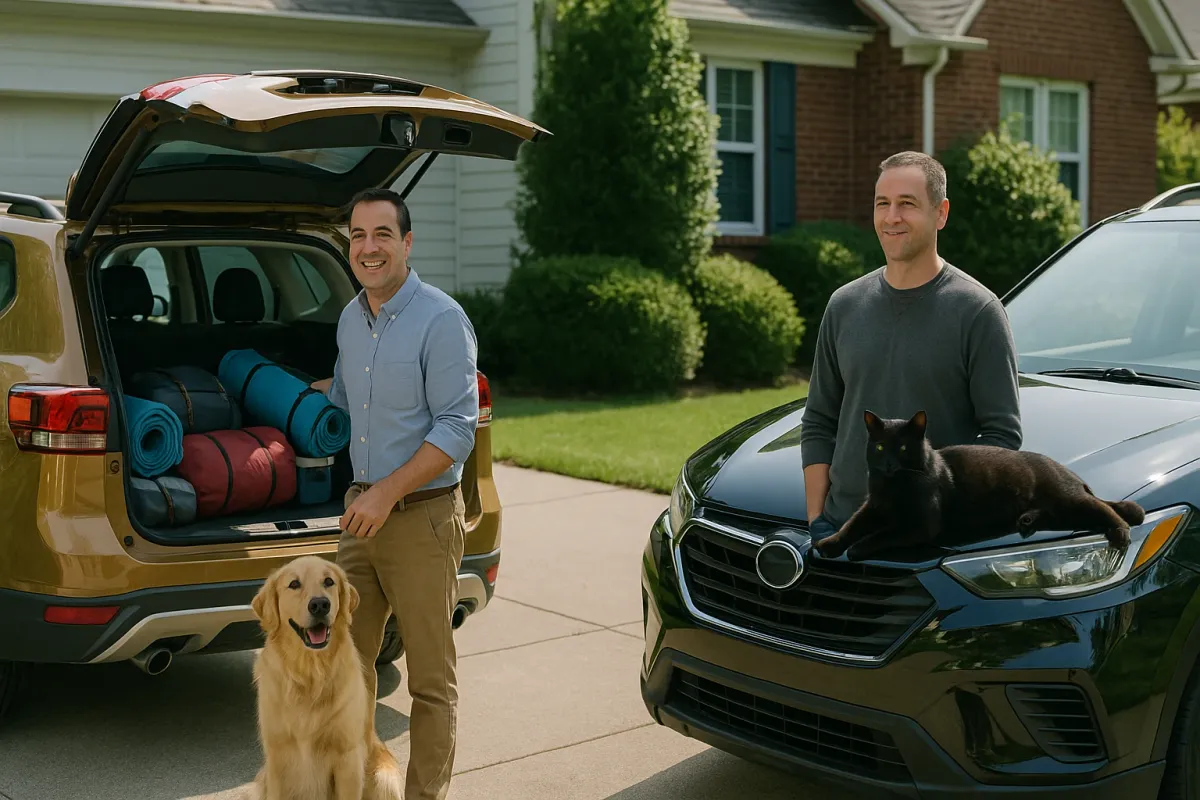
The internet is obsessed with “Golden Retriever vs. Black Cat” personality quizzes right now, and it’s not hard to see why. That same playful framework translates surprisingly well to how people choose SUVs. Some drivers want warm, approachable, easygoing vehicles that put comfort first. Others prefer sharp, stealthy, almost aloof machines that prioritize performance and poise over friendliness.
Inspired by the trending “Golden Retriever vs. Black Cat” quiz that’s taking social media by storm, we’re applying that lens to today’s SUV market. Instead of asking which animal you are, we’re asking: what kind of SUV personality fits you—and which real-world models reflect it best?
Below, we break down five review-focused points that help match your driving style, tech expectations, and daily needs to the right “personality” of SUV.
1. Ride Comfort vs. Road Feel: Do You Want to Be Cuddled or Challenged?
If you’re a “Golden Retriever” driver, you probably prioritize comfort, predictability, and a sense of calm. In SUV terms, that means:
- A compliant suspension tuned to soak up potholes and expansion joints
- Light steering effort that’s easy in tight parking lots
- Quiet cabins with strong sound insulation
- Powertrains that shift smoothly and unobtrusively
This is the territory of mainstream crossovers like the Toyota RAV4, Honda CR-V, Hyundai Tucson, and Subaru Forester. They’re calibrated to make every commute feel low-stress. For example, the latest CR-V uses a comfort-biased suspension with relatively soft spring and damper rates, plus extensive door and floor insulation to keep road and wind noise in check. You’ll feel secured, not stimulated.
On the other side, “Black Cat” drivers want more feedback and engagement, even at the cost of a firmer ride. Performance-oriented SUVs like the Mazda CX-5/CX-50, BMW X3, Genesis GV70, or Porsche Macan run stiffer suspension setups, with more direct steering and sharper throttle calibration. You feel more of the road surface, and body roll is more tightly controlled in corners. Adaptive dampers, when available, can bridge the gap—letting you soften things for daily use and firm them up for spirited driving.
The key review metric to watch: suspension tuning and steering feel. Comfort-first buyers should look for phrases like “plush ride,” “well-isolated,” and “composed over rough pavement.” Enthusiast buyers should prioritize reviews that highlight “precise steering,” “controlled body motions,” and “engaging dynamics,” even if accompanied by a note that the ride is on the firmer side.
2. Powertrain Personality: Smooth and Friendly vs. Quick and Intense
Personality shows up immediately when you press the accelerator. A “Golden Retriever” SUV feels eager but not urgent—smooth, refined, and predictable. Power builds progressively, and the transmission prefers seamless shifts to aggressive downshifts.
Examples:
- Honda CR-V Hybrid / Toyota RAV4 Hybrid: Both use hybrid systems that prioritize efficiency and refinement. Electric assist fills in low-end torque, and the power delivery is tuned to be linear, making them easy to drive in traffic.
- Hyundai Santa Fe / Kia Sorento (gas or hybrid variants): Multiple engine choices allow buyers to choose modest power with better fuel economy or step up slightly without entering “performance SUV” territory.
For these vehicles, test-drive impressions often mention how they “fade into the background” and how the engine “rarely calls attention to itself.” That’s exactly what many family buyers want.
“Black Cat” SUVs, by contrast, announce themselves. Turbocharged 4-cylinder or 6-cylinder engines, stronger torque curves, and transmissions tuned for quick response define this group:
- BMW X3 M40i: Inline-6 turbo with abundant midrange torque; the 8-speed automatic downshifts quickly in Sport mode, giving an immediate response when you prod the throttle.
- Genesis GV70 3.5T: Twin-turbo V6, all-wheel drive, and drive modes that dramatically alter throttle mapping and transmission behavior.
- Mazda CX-50 Turbo: A torquey turbo 2.5L that feels closer to a sporty hatchback in character than a traditional relaxed crossover.
Technical specs to watch in reviews:
- Torque at low RPM (this drives real-world feel more than peak horsepower)
- Transmission behavior (does it hunt for gears, or respond promptly?)
- Drive modes (do they actually change the character, or are they mostly cosmetic?)
If you want easygoing, lean toward naturally aspirated engines or hybrid systems with more subdued responses. If you want “black cat pounce,” look for words like “brisk,” “punchy midrange,” or “sporty tuning” in professional tests.
3. Cabin Layout and Tech: Welcoming Lounge or Minimalist Command Center?
In the current SUV landscape, interior design is diverging quickly. Personality shows up not only in materials and design language but also in the tech experience.
Golden Retriever-style cabins emphasize warmth and intuitiveness:
- Physical buttons for the most-used controls (climate, volume, defroster)
- Softer materials, warmer colors, and “open” feeling layouts
- User interfaces that prioritize simplicity over raw screen size
Look at vehicles like the Subaru Outback / Forester, recent Honda CR-V, and Toyota Highlander. While screens are present—Toyota’s newer 12.3-inch units, Subaru’s portrait-oriented central display—the critical controls remain straightforward and familiar. Reviews consistently praise them for reduced learning curves and family-friendly ergonomics.
Black Cat cabins lean toward minimalism and tech-forward innovation:
- Larger, higher-resolution central displays (up to 14.5" in some Genesis models)
- Digital instrument clusters, often with configurable layouts
- Touch-sensitive or haptic controls that favor sleek aesthetics over traditional knobs
This is a defining trait of brands like Genesis (GV70, GV80), BMW (latest X3/X5), and especially Tesla’s Model Y, which routes nearly everything through a central touchscreen. While not a traditional SUV in the rugged sense, the Model Y exemplifies the “tech first, buttons last” philosophy. Reviews for these vehicles often mention an initial learning curve but reward buyers with a futuristic feel once acclimated.
When reading or watching reviews, consider:
- Menu depth and logic: Are key features buried under multiple taps?
- System responsiveness: Is there lag? Are over-the-air updates improving things?
- Smartphone integration: Wireless Apple CarPlay/Android Auto is now almost a baseline expectation for many buyers.
If you want your SUV to “feel like home,” prioritize intuitive controls and cabin warmth. If you want it to feel like a modern gadget or a stealthy cockpit, look for minimalism and advanced interfaces, but accept a steeper learning curve.
4. Safety and Driver Assistance: Attentive Companion or Discreet Backup?
Virtually every new SUV now offers advanced driver-assistance systems (ADAS), but the tuning of those systems differs dramatically—and that’s where personality shows up.
Golden Retriever-style safety suites are tuned to be gently proactive, often with names like:
- Toyota Safety Sense
- Honda Sensing
- Subaru EyeSight
- Hyundai SmartSense
These systems pair adaptive cruise control with lane-keeping assistance and automatic emergency braking, but their calibrations are often more conservative and less abrupt. Subaru’s EyeSight, for example, is frequently praised for its “human-like” distance keeping and relatively natural steering assistance on highways. Toyota’s latest Safety Sense iterations have improved lane-centering smoothness, cutting down on the “ping-pong” effect between lane markers.
Black Cat-style systems may tilt toward performance and driver focus, often taking a more “you’re in charge” stance while still offering robust interventions. In some German and premium Korean SUVs, reviewers note that lane-keeping is less intrusive but assumes you’re more engaged. Systems like BMW Driving Assistant Professional or Genesis Highway Driving Assist are increasingly capable on well-marked highways, providing near-hands-free style ease in limited scenarios, but they tend to trust that the driver is paying attention.
Key review aspects to examine:
- Smoothness vs. aggressiveness of braking and lane centering
- Frequency of false alerts (overly nervous systems get tiresome quickly)
- How easy it is to customize or disable specific features
If you like the idea of a caring vehicle that seems to “watch over” you and your family, prioritize brands known for transparent, predictable ADAS behavior. If you find constant beeps and nudges infuriating, look for reviews highlighting calmer, more discreet systems or the ability to fine-tune alert sensitivity.
5. Practicality and Image: Family-Friendly Pack Mule or Stealthy Status Symbol?
The last dimension is where online culture and real-world use collide most clearly. The same way people identify with Golden Retriever or Black Cat vibes in memes, many buyers gravitate toward an SUV that projects the image they want to send.
Golden Retriever SUVs embrace their role: family haulers, road-trip champs, and Costco warriors.
Common traits:
- Boxier rooflines for better headroom and cargo volume
- Sliding or reclining rear seats to balance passenger comfort and cargo needs
- Accessible rear cargo areas with low liftover heights
- Thoughtful small-item storage: real cupholders, door bins, and underfloor compartments
This describes models like the Kia Telluride, Hyundai Palisade, Toyota Grand Highlander, and Honda Pilot. Reviews often describe them as “honest,” “family-focused,” and “class-leading in space.” These are SUVs you buy for what they do, not just how they look.
Black Cat SUVs lean harder into style, brand prestige, and presence:
- More aggressive rooflines that sometimes compromise rear headroom
- Larger wheel options with low-profile tires that look great but can affect ride comfort
- Distinctive lighting signatures and bold grilles, often paired with black-out or “shadow line” trim packages
Examples include the BMW X6, Audi Q8, Genesis GV80, and the sport trims of mainstream models (like R-Line Volkswagens or ST-Line Fords). Reviews highlight curb appeal, interior ambiance, and brand cachet just as much as raw practicality. Cargo space is often “adequate” rather than “best-in-class,” and rear visibility may be compromised by style-driven design decisions.
When comparing reviews, ask:
- How often does the reviewer mention real-life usability—stroller fit, third-row access, anchor points, power tailgate speed, etc.?
- Do they stress styling and presence more than packaging and visibility?
- Are there trade-offs noted between wheel size and comfort or between sloping rooflines and space?
Choose accordingly: if you want a friendly, always-ready family tool, go practical-first. If you want something that looks like it arrived from a design studio at midnight, accept that you might lose some cargo room and simplicity in return.
Conclusion
The current wave of “Golden Retriever vs. Black Cat” personality content trending online is a fun reminder that how we feel in a vehicle matters just as much as 0–60 times or cargo volume. Today’s SUV market is broad enough that you can find a model that matches your driving personality—warm and welcoming, or cool and calculated—without sacrificing core capabilities like safety and reliability.
When you read or watch SUV reviews over the coming months, filter them through this lens:
- Do you want soft suspension or sharp handling?
- Calm power delivery or an eager surge?
- Friendly, button-heavy interiors or sleek screen-driven dashboards?
- Nurturing safety systems or discreet digital backup?
- Maximum practicality or maximum presence?
Answer those questions honestly, and you’ll quickly narrow the field to SUVs that feel like an extension of your personality—whether that’s all Golden Retriever, all Black Cat, or a bit of both.
Key Takeaway
The most important thing to remember from this article is that this information can change how you think about Reviews.