SUVs are no longer just taller family cars; they sit at the center of a rapidly shifting auto industry. From solid-state batteries to bidirectional charging and strict emissions rules, the SUV segment is quietly becoming the test bed for technologies and strategies that will define the next decade of personal transportation. For enthusiasts and buyers, understanding where the industry is headed in the next 24–36 months is increasingly critical to making a smart purchase today.
Below, we unpack five major industry developments shaping the future of SUVs, what each means in technical terms, and how they could influence your next buying decision.
1. Solid-State and High-Nickel Batteries: Why Upcoming SUV Packs Matter
Battery tech is the new displacement war, and SUVs are right at the center of it. Automakers are racing to deploy next-generation chemistries that can deliver more range and performance without adding more mass to already-heavy utility vehicles.
Solid-state batteries, which replace the liquid electrolyte with a solid one, promise higher energy density (potentially 30–50% more than today’s lithium-ion packs), faster charging, and improved thermal stability. Toyota has announced plans to commercialize solid-state technology “in the late 2020s,” initially targeting performance-oriented and premium segments—zones where midsize and full-size SUVs dominate. The implication is simple: early solid-state deployments are likely to arrive first in higher-margin SUVs where pack cost can be absorbed.
In the interim, high-nickel NMC (nickel-manganese-cobalt) and NCA (nickel-cobalt-aluminum) chemistries continue to evolve. These packs can power large SUVs to 300+ miles of EPA range while supporting DC fast charging rates above 200 kW—key for owners towing or regularly driving long distances. However, high-nickel cathodes can be more sensitive to heat and cycling, which is why you’re seeing larger, more sophisticated thermal management systems, multi-circuit coolant loops, and active preconditioning integrated into modern electric SUVs.
On the value side, lithium iron phosphate (LFP) chemistry is making inroads into compact and entry-level SUVs. LFP sacrifices some energy density but offers better cycle life and lower cost per kWh, enabling more affordable electric SUVs. Enthusiasts should watch the market split: premium performance SUVs are likely to get high-nickel or early solid-state packs, while volume sellers move toward LFP for cost stability.
For buyers, the takeaway is to pay attention not just to advertised range, but to battery chemistry, peak and sustained charging rates, and the thermal architecture. These details will increasingly define how your SUV performs—and holds value—over a 10-year ownership cycle.
2. Bidirectional and High-Power Charging: Your SUV as Grid Asset
Charging is moving beyond “how fast can I fill the battery” to “what else can the vehicle do with that energy.” SUVs, with their larger packs, are becoming key players in the spread of bidirectional charging and ultra-fast infrastructure.
Bidirectional charging features like vehicle-to-home (V2H), vehicle-to-grid (V2G), and vehicle-to-load (V2L) allow an SUV to function as a mobile battery. Automakers and utilities are actively exploring programs where an electric SUV can provide backup power during outages or even sell power back to the grid during peak demand. Ford’s Intelligent Backup Power, for example, is built around the F-150 Lightning but is architecturally representative of what’s coming to SUV platforms as 60–100 kWh packs become common.
Technically, this requires onboard inverters and power electronics capable of safe, controllable reverse power flow, along with standardized communication protocols. The emerging North American Charging Standard (NACS) and updates to CCS protocols are enabling better interoperability for both fast-charging and bidirectional use. SUVs that adopt native NACS hardware or robust CCS-to-NACS compatibility will be better positioned to tap into expanding high-power networks and future V2G programs.
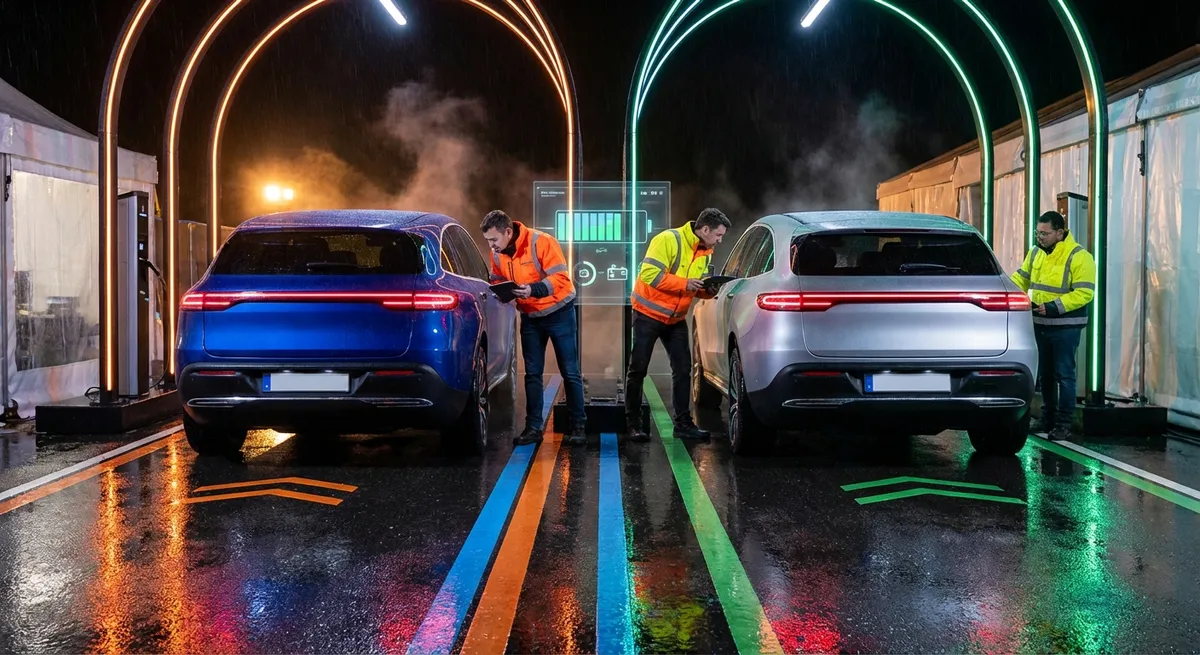
On the infrastructure side, 350 kW DC fast charging is increasingly standard for new installations, but what matters is the vehicle’s charge curve—how long it can sustain 200–250 kW or higher before taper. Larger battery electric SUVs, often with 800-volt architectures, can maintain higher currents longer, translating to real-world 10–80% charge times in the 20–30 minute window. That makes long road trips and towing more realistic for electric SUVs—but only if the pack and cooling system are engineered accordingly.
For prospective buyers, it’s time to start reading spec sheets the way enthusiasts once read cam profiles or turbo boost charts: look for bidirectional capability, 400V vs 800V architecture, peak charge rate, and manufacturer-published 10–80% DC fast-charge times. These specs hint at how flexible and future-proof your SUV will be.
3. Stricter Emissions Rules and the Turbo-Hybrid Tipping Point
Regulators in North America, Europe, and key Asian markets are tightening emissions standards sharply through the end of the decade. SUVs, because of their size and popularity, are under particular scrutiny—and that pressure is dramatically reshaping powertrains.
In the U.S., the Environmental Protection Agency’s final 2027–2032 light-duty vehicle rules target steep reductions in fleet-average greenhouse gas emissions, driving manufacturers toward electrified SUVs in every size class. In the EU, updated Euro 7 rules (though softened from early proposals) still incentivize cleaner combustion and higher EV penetration, while China’s increasingly stringent regulations continue to push global platforms toward electrification.
The result is a rapid industry-wide move to “electrified by default” SUV powertrains. Turbocharged four-cylinders paired with 48-volt mild-hybrid systems are fast replacing naturally aspirated V6s in midsize models, using electric assistance to smooth low-end torque, enable longer engine-off coasting, and reduce real-world fuel consumption. Full hybrids and plug-in hybrids (PHEVs) leverage higher-voltage systems (often 200–400V) to deliver short all-electric ranges and strong transient torque—ideal in heavier SUVs where instant electric boost can mask the workload.
Technical strategies include:
- Atkinson-cycle or Miller-cycle combustion for efficiency in hybrid-specific engines.
- Integrated starter-generators (ISGs) or belt-driven starter-generators (BSGs) to enable seamless stop-start and limited electric assist.
- Electric turbos or e-boosters in some high-performance SUVs to mitigate lag and improve transient response under tighter emissions calibration.
Enthusiasts concerned about the fate of larger-displacement engines should expect them to survive mainly in niche performance or luxury SUVs, often paired with some form of hybridization. For mainstream buyers, it’s increasingly smart to evaluate hybrid system architecture (series, parallel, power-split, or PHEV with usable EV range) rather than focusing solely on cylinder count. The right hybrid system can deliver both better real-world performance and lower total cost of ownership in an era of strict regulatory oversight.
4. Software-Defined SUVs and the Subscription Era
The “software-defined vehicle” is a buzz phrase that translates into concrete changes for SUV buyers. The core idea: much of a modern SUV’s functionality—performance mapping, driver assistance, infotainment, charging behavior—is controlled in software that can be updated over the air (OTA), long after the vehicle leaves the factory.
New SUV platforms increasingly centralize computing into a handful of high-powered electronic control units (ECUs) or domain controllers, replacing dozens of discrete modules. This simplifies wiring harnesses, reduces weight, and, critically, allows automakers to push out OTA updates at scale. You’ve already seen this in practice with EVs that gain additional range, improved DC fast-charging curves, revised adaptive suspension tuning, or new driver-assistance features after purchase.
However, the same architecture enables subscription-based features. Heated seats, adaptive cruise, or additional performance modes can be “locked” in software and activated for a fee. From an industry perspective, this is a strategic revenue stream to support long-term software development and cloud services. From a buyer’s perspective, it raises genuine questions about long-term ownership costs and feature permanence.
Underneath the user-facing layer, there are serious technical stakes:
- Cybersecurity: Larger SUVs often carry more passengers, more connectivity, and more data. Securing centralized vehicle computers from remote intrusion is critical; many automakers now run dedicated security operation centers and employ end-to-end encryption, intrusion detection systems, and secure boot processes.
- Data and diagnostics: OTA updates can fix bugs, recalibrate sensors, and adapt to new regulations without a dealer visit. For complex systems like adaptive suspensions, all-wheel-drive torque-vectoring, and active safety suites, this can significantly extend the functional life of the vehicle.
If you’re shopping for a new SUV, add “software and update policy” to your checklist. Consider the length and scope of OTA support, whether key capabilities are subscription-locked, and how transparent the automaker is about data usage. The technical platform underneath will have as much impact on your long-term experience as the engine choice.
5. Global Platform Strategies and the Changing Shape of SUV Lineups
Behind every new SUV is a platform strategy that dictates everything from suspension geometry to battery packaging. As development costs soar—especially for electrified architectures—manufacturers are consolidating around flexible global platforms capable of underpinning multiple SUV sizes, body styles, and powertrains.
Newer “skateboard” EV platforms use a flat battery pack sandwiched between the axles, with one or more electric drive units at the axles. This configuration offers packaging freedom: long wheelbases for interior space, short overhangs, and a low center of gravity even in tall SUV bodies. It also supports modularity—automakers can vary pack sizes, motor outputs, and even add a third motor for performance variants without redesigning the underpinnings.
For mixed ICE/EV lineups, some manufacturers are opting for multi-energy platforms that can host internal combustion, hybrid, and battery-electric powertrains on the same basic architecture. This lowers per-unit cost and allows rapid response to market demand in different regions. The trade-off is that such platforms are often a compromise; they may not offer the same battery packaging efficiency, interior space, or weight distribution advantages as dedicated EV SUVs.
Suspension and driveline tech is evolving in parallel. Expect to see more:
- Multi-link rear suspensions optimized for both ride comfort and battery packaging.
- Active air suspension and adaptive damping calibrated specifically to compensate for heavy battery packs.
- Advanced all-wheel-drive systems, including dual- and tri-motor setups with precise torque vectoring, giving electric SUVs dynamic behavior that rivals—or surpasses—traditional performance models.
For buyers, it is increasingly relevant to know what platform a given SUV is built on. Dedicated EV architectures typically deliver more interior space, better weight distribution, and often more future-proof electrical systems. Multi-energy platforms might offer lower pricing and familiar service networks but can impose packaging and range compromises. Enthusiasts should also pay attention to whether chassis hardware (brakes, cooling, suspension) was engineered with the full weight and performance envelope of EV variants in mind.
Conclusion
The SUV landscape is being reshaped on multiple fronts at once: advanced batteries, bidirectional fast charging, tightening emissions rules, software-defined architectures, and modular global platforms. For automakers, SUVs are now the proving ground for technologies that will cascade through the rest of the market. For enthusiasts and buyers, that means more capable, more complex, and more differentiated vehicles than ever before.
Evaluating an SUV in 2026 and beyond will require looking past a simple spec sheet to understand battery chemistry, charging architecture, hybrid system design, software strategy, and underlying platform. Those who learn to read these signals now will be better positioned to choose SUVs that not only fit their lifestyle today but remain relevant, upgradeable, and enjoyable well into the next decade.
Sources
- U.S. Environmental Protection Agency – Final Rule for Multi-Pollutant Emissions Standards for Model Years 2027 and Later Light-Duty Vehicles - Details the tightening U.S. emissions standards influencing SUV powertrain strategies.
- Toyota Global Newsroom – Toyota’s Approach to Solid-State Batteries - Outlines Toyota’s roadmap and technical goals for solid-state battery deployment.
- U.S. Department of Energy – Vehicle-to-Grid (V2G) Integration - Provides an overview of bidirectional charging concepts and their role in grid management.
- International Energy Agency – Global EV Outlook - Offers data and analysis on EV adoption trends, battery chemistry, and charging infrastructure relevant to SUVs.
- National Highway Traffic Safety Administration – Cybersecurity Best Practices for the Safety of Modern Vehicles - Discusses cybersecurity considerations for software-defined vehicles, including SUVs.
Key Takeaway
The most important thing to remember from this article is that this information can change how you think about Industry News.