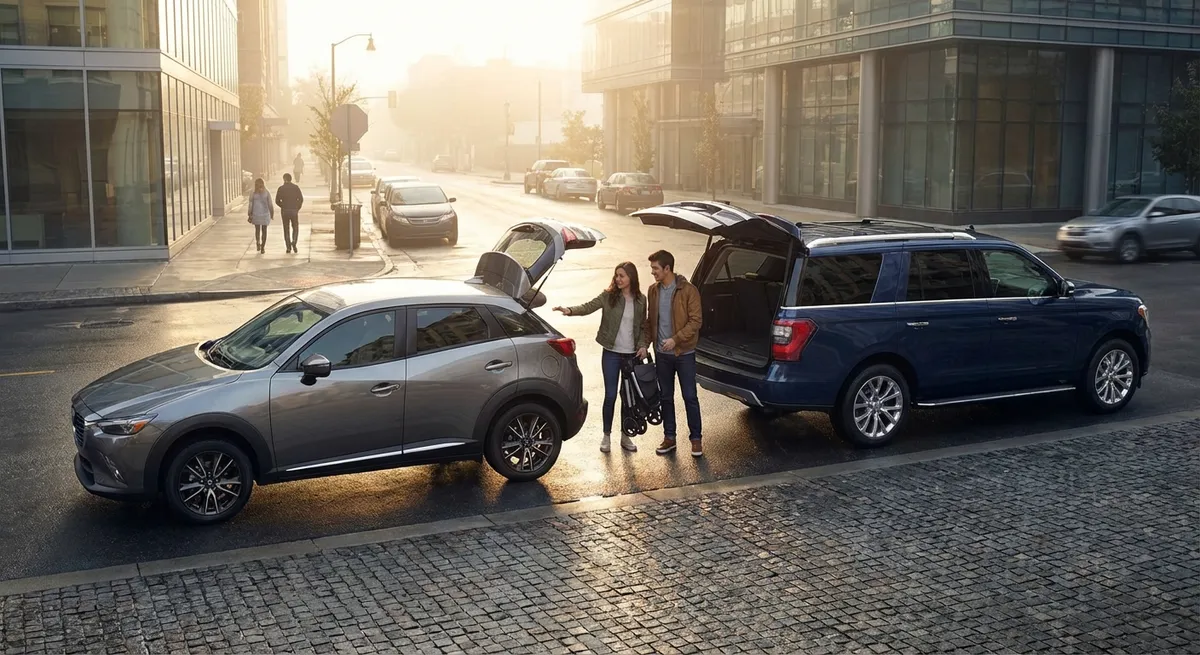
SUV shoppers are no longer picking simply between “small” and “large.” The modern market ranges from subcompact crossovers built on car platforms to body-on-frame giants that can tow a house. For buyers, especially enthusiasts who care about specs as much as styling, the real question is: how do these different SUV classes compare where it actually matters—on the road, at the pump, and in your driveway?
This comparison dives into five core areas that separate city crossovers from full-size SUVs: platform and construction, performance and towing, space and practicality, safety and tech, and cost of ownership. The goal is not to declare a universal “winner,” but to give you the technical insight to match the right type of SUV to your real-world needs.
Platform and Construction: Unibody vs Body-on-Frame
The most fundamental difference between a city crossover and a traditional full-size SUV is what lies underneath: the platform and how the body is constructed.
Most city crossovers use a unibody (monocoque) structure shared with a passenger car. The body and frame are integrated into a single rigid shell. This allows for lower weight, improved crash energy management, and a stiffer structure that benefits both ride and handling. Unibody construction also enables engineers to package the cabin more efficiently, which is why a compact crossover can offer interior space rivaling older midsize SUVs.
Full-size SUVs have historically been built on body‑on‑frame platforms derived from pickup trucks. The frame is a separate ladder-like structure onto which the body is mounted. This configuration excels at handling high loads and twisting forces, making it ideal for heavy towing, payload, and serious off-road use. It also allows for easier modification of wheelbase and body styles across a single platform, which is why many manufacturers build both trucks and large SUVs off the same architecture.
However, there are trade-offs:
- Weight: Full-size body-on-frame SUVs often weigh 800–1,500 pounds more than similarly sized crossovers. That extra mass impacts acceleration, braking distances, fuel economy, and tire wear.
- Ride and Noise: Unibody crossovers typically deliver better NVH (noise, vibration, harshness) control and a more car-like ride, especially over broken pavement. Body-on-frame SUVs can feel more “trucky,” though modern designs use hydraulic body mounts, sophisticated dampers, and multi-link rear suspensions to narrow the gap.
- Ground Clearance and Geometry: While some crossovers provide respectable ground clearance and approach/departure angles, full-size SUVs usually have the edge in rugged geometry, reinforced underbodies, and provision for low-range transfer cases.
Enthusiasts should pay close attention to the platform lineage. A crossover derived from a well-sorted sedan platform will likely prioritize road manners, while a full-size SUV sharing DNA with a heavy-duty truck will be tuned for durability and load management.
Performance, Drivetrain, and Towing: Power With a Purpose
Powertrain choices differ sharply between small crossovers engineered for urban life and full-size SUVs meant to haul and tow. Understanding how engines, transmissions, and drivetrains are calibrated for each use case can keep you from over- or under-buying.
City crossovers often feature:
- Smaller-displacement turbocharged engines (e.g., 1.5–2.5L inline-4) optimized for low- and mid-range torque, paired with:
- 8–10 speed automatics, or
- Continuously variable transmissions (CVTs) tuned for efficiency.
- Front-wheel drive (FWD) as standard, with on-demand all-wheel drive (AWD) that engages the rear axle only when slip is detected.
- Modest towing ratings, commonly 1,500–3,500 pounds when properly equipped—enough for small trailers, light boats, or a pair of motorcycles.
Full-size SUVs tend to offer:
- Larger-displacement engines (e.g., V6, V8, turbocharged straight-six, or turbo-diesel) that deliver higher continuous torque for sustained towing and payload.
- Heavy-duty automatic transmissions with robust cooling systems and specific tow/haul shift logic to manage heat and downhill braking.
- Traditional 4WD systems with a 2‑speed transfer case and selectable drive modes (2H/4H/4L), including low range gearing for steep, technical off-road sections.
- Substantial towing capacities, often 7,000–8,500+ pounds when properly equipped, depending on axle ratios, cooling packages, and receiver class.
For buyers, the critical comparisons are:
- Real-World Acceleration: A smaller turbo four in a crossover can feel punchy in city traffic due to boost at low rpm, but may run out of breath at highway speeds when loaded with passengers and cargo. A full-size SUV’s larger engine provides more effortless passing and merging when fully loaded or towing.
- Towing Margin: You should not operate at the “max tow rating” constantly. A good rule is to target a trailer weight around 70–80% of the rated capacity for comfort and brake performance. If your use case sits near the upper limit of a crossover’s rating, a full-size SUV is the safer and more stress-free choice.
- Drivetrain Durability: Short trips at light load favor the simpler, more efficient setups of crossovers. Regular towing, long highway grades, and hot climates favor the heavier-duty components in full-size platforms.
Enthusiasts will also want to consider gear ratios, torque curves (peak torque rpm matters for towing), and whether the manufacturer offers integrated trailer brake controllers and trailer stability assist in the full-size SUV.
Space, Packaging, and Everyday Practicality
On the surface, bigger seems better: more cubic feet, more passengers, more capability. But when you compare city crossovers and full-size SUVs in terms of how that space is used—and how it fits into daily life—the picture is more nuanced.
Interior Volume and Seating:
- City crossovers usually offer two rows of seats, though some compact and midsize models offer a tight third row. These are ideal for small families, couples, or urban dwellers who mostly carry 1–4 people.
- Full-size SUVs typically provide three rows with adult-usable rear seating and more generous shoulder and hip room, especially in the second row. If you regularly transport six or more people, the full-size category becomes more compelling.
However, technology and packaging efficiencies mean that many compact crossovers now rival previous-generation midsize SUVs in passenger volume. Cabin floors are often lower due to the car-based platform, aiding ingress and egress, particularly for children and older passengers.
Cargo and Access:
- Crossovers excel in load floor height and cargo versatility. The rear load lip is often lower, and flat-folding rear seats create a long, continuous floor that’s ideal for bulky but relatively light items (furniture, sports equipment, home improvement runs).
- Full-size SUVs provide sheer volume, especially with extended-wheelbase variants, but the higher floor and tailgate height can make loading heavy items more cumbersome. On the plus side, body-on-frame SUVs may offer higher roof load ratings for cargo boxes or roof tents.
Maneuverability and Parking:
- Compact crossovers shine in tight city streets, parallel parking, and low-clearance garages, with shorter overall length and tighter turning circles.
- Full-size SUVs can be challenging in urban environments, often requiring larger turning radii and more care in multi-story garages or older parking facilities. Features like surround-view cameras and front/rear parking sensors are highly recommended—and increasingly standard—on these vehicles.
When comparing the two, think in terms of usage patterns rather than absolute numbers. If 90% of your driving is solo or with one passenger, and you carry a full cabin only a few times a year, a crossover will likely offer a better daily compromise. If your family or work regularly fills all seats and cargo space, a full-size SUV’s packaging benefits will justify its footprint.
Safety, Technology, and Driver Assistance
Both city crossovers and full-size SUVs benefit from advances in active and passive safety, but there are meaningful differences in how those systems are implemented and how vehicle mass plays into crash outcomes.
Crash Safety and Physics:
- From a physics standpoint, larger, heavier vehicles (like full-size SUVs) tend to offer better protection to their occupants in multi-vehicle collisions due to mass and ride height advantages. However, this can come at the expense of occupants in smaller vehicles, which is a broader road-safety concern.
- Modern crossovers, despite being lighter, employ high-strength steels, optimized crumple zones, and multi-stage airbags to achieve top crash ratings from organizations like the IIHS and NHTSA. Many earn “Top Safety Pick+” designations, reflecting excellent protection in both crashworthiness and crash avoidance.
Advanced Driver Assistance Systems (ADAS):
- City crossovers often lead with the latest ADAS tech earlier in the product cycle because they are high-volume, mass-market products. Standard or widely available features include:
- Automatic emergency braking with pedestrian and cyclist detection
- Lane departure warning and lane-keeping assist
- Adaptive cruise control with stop-and-go functionality
- Rear cross-traffic alert and blind-spot monitoring
- Full-size SUVs also offer these features, but some manufacturers roll them out first on crossovers or luxury-badged siblings before filtering them down to truck-based platforms. Nonetheless, top trims on full-size SUVs typically match or exceed the ADAS suite of their crossover counterparts.
Stability and Roll-Over Considerations:
- Higher center of gravity and larger tires on full-size SUVs increase rollover risk in extreme maneuvers compared to lower, car-based crossovers. To counter this, manufacturers implement:
- Electronic stability control and traction systems tuned for high center-of-gravity vehicles
- Trailer sway control that adjusts engine torque and individual brake application
- Crossovers, with their lower ride height and lighter mass, generally offer more forgiving dynamics in emergency lane changes and sudden steering inputs.
For safety-conscious buyers, both segments can be excellent choices when equipped with up-to-date tech. The key is to compare not just size, but specific crash-test results, standard safety packages, and the availability of advanced assistance features on the exact trim and configuration you’re considering.
Efficiency, Running Costs, and Long-Term Ownership
Total cost of ownership is where the divide between city crossovers and full-size SUVs becomes most apparent. Beyond initial purchase price, fuel, maintenance, insurance, and depreciation tell the long-term story.
Fuel Economy and Powertrain Technology:
- City crossovers usually post significantly better fuel economy, with EPA combined ratings often in the mid-20s to low-30s mpg for gasoline models, and higher for hybrids or plug-in hybrids.
- Full-size gasoline SUVs typically report combined ratings in the mid-teens to low-20s mpg, depending on engine choice and drivetrain. Some newer turbocharged six-cylinder and diesel options can narrow this gap, but physics—primarily aerodynamic drag and mass—still limits efficiency.
- Electrified options (mild hybrids, full hybrids, and plug-in hybrids) are expanding rapidly in the crossover space and are beginning to appear more in full-size SUVs, particularly in the premium segment. If you drive mostly in urban environments, a hybrid crossover may offer the lowest running costs and best stop-and-go performance.
Maintenance and Wear Items:
- Full-size SUVs typically need larger quantities of oil, coolant, and transmission fluid, and their brake pads and tires are often more expensive due to size and load ratings.
- Heavier vehicles also tend to wear suspension components and tires faster, particularly under towing or heavy-load conditions.
- Crossovers, built off car platforms, often share parts with high-volume sedans and hatchbacks, which can reduce part costs and improve availability.
Insurance and Depreciation:
- Insurance premiums are influenced by vehicle value, repair costs, and safety record. Full-size SUVs, with more expensive bodywork and components, can cost more to insure, though strong safety records and driver-assist features can sometimes offset this.
- Crossovers, especially in popular mainstream segments, generally enjoy stable resale values, but they also face intense competition and frequent updates, which can accelerate depreciation on certain models.
- Full-size SUVs with specialized capabilities (serious off-road packages, heavy towing ratings, or strong brand equity) can retain value well in markets where those features are in demand, but their absolute depreciation in dollars is often higher simply because they start from a higher MSRP.
When comparing these two categories, run realistic cost-of-ownership scenarios. Estimate your annual mileage, fuel prices, insurance quotes, and likely holding period. A full-size SUV may make sense if you fully utilize its capabilities; otherwise, a city crossover can deliver most of the perceived SUV benefits at a much lower long-term cost.
Conclusion
Choosing between a city crossover and a full-size SUV is fundamentally about aligning capability with reality. Unibody crossovers prioritize efficiency, maneuverability, and daily comfort, making them ideal for urban and suburban lifestyles where towing and maximum cargo are occasional needs. Full-size SUVs, with robust frames, powerful drivetrains, and expansive cabins, are built for families and professionals who regularly tow, haul, or travel with full passenger loads.
Car enthusiasts and serious shoppers should look beyond marketing labels and focus on platform construction, powertrain tuning, real-world space utilization, safety tech, and total cost of ownership. When you match these technical differences to how you actually drive, park, and travel, the “right” SUV segment usually becomes clear—and you avoid paying for performance and capability you’ll never use, or regretting not having it when you truly need it.
Sources
- U.S. Environmental Protection Agency – Fuel Economy Guide - Official EPA fuel economy ratings and energy impact scores for crossovers and full-size SUVs
- National Highway Traffic Safety Administration (NHTSA) – 5-Star Safety Ratings - Crash test and safety ratings for a wide range of SUV models in different size classes
- Insurance Institute for Highway Safety (IIHS) – Vehicle Ratings - Detailed crashworthiness, crash-avoidance, and headlight evaluations for crossovers and full-size SUVs
- U.S. Department of Energy – Alternative Fuels Data Center - Side-by-side comparisons of vehicle classes, including fuel type, efficiency, and operating costs
- Ford Motor Company – SUV Towing Guide - Manufacturer towing charts and technical information illustrating the differences in ratings between crossover and full-size SUV platforms
Key Takeaway
The most important thing to remember from this article is that this information can change how you think about Comparisons.