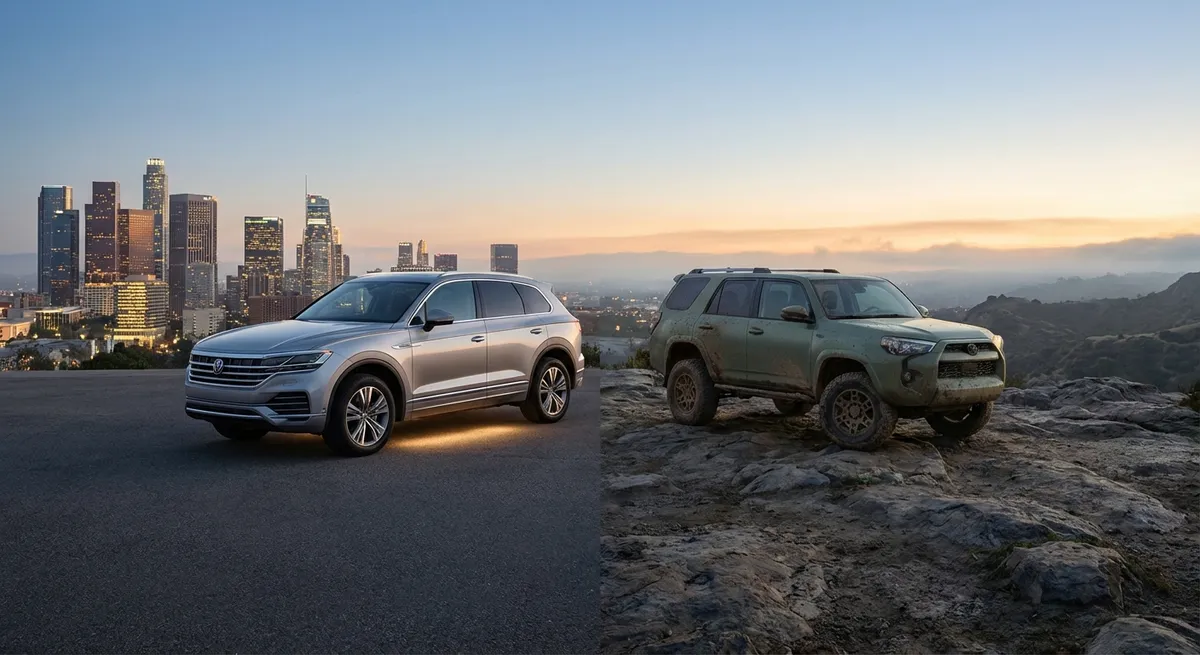
SUV shoppers today aren’t just choosing between brands—they’re choosing between two fundamentally different philosophies. On one side are urbane, tech-laden crossovers designed to glide through city life. On the other are rugged, body-on-frame machines engineered to survive punishment off-pavement. Many models try to straddle both worlds, but the underlying engineering usually reveals where an SUV truly belongs.
This comparison breaks down how “city luxury” and “trail-ready” SUVs diverge where it really matters. Whether you’re a spec-obsessed enthusiast or a buyer trying to avoid an expensive mismatch, understanding these differences will help you pick an SUV that actually fits how you drive.
1. Platform and Construction: Unibody Comfort vs Body-on-Frame Strength
The split between city-oriented and trail-focused SUVs starts with the platform—what’s underneath the styling and marketing.
Most urban luxury SUVs and crossovers use unibody construction, where the body and frame are integrated into a single structure. This is how passenger cars are built and it:
- Lowers weight, improving fuel economy and responsiveness
- Increases torsional rigidity, which helps ride comfort and handling
- Allows a lower floor, improving ease of entry and cargo usability
- Supports advanced crash structures and crumple zones more easily
Think of models like the Mercedes-Benz GLE, Audi Q7, or Toyota RAV4—all fundamentally car-based, even when they offer AWD and modest “off-road” modes.
Trail-focused SUVs, by contrast, often use body-on-frame construction, derived from pickup trucks. Here, the body is bolted onto a separate ladder or boxed frame. This approach:
- Tolerates twisting forces from rough terrain better over time
- Simplifies the addition of skid plates, recovery points, and heavy-duty tow hardware
- Makes it easier to repair or modify for off-road use (lift kits, bumpers, winches)
- Often supports higher tow ratings due to frame strength and cooling capacity
Examples include Toyota 4Runner, Ford Bronco, and Jeep Wrangler, plus more upscale offerings like the Land Rover Defender. The trade-off: body-on-frame SUVs typically ride less smoothly, feel less precise in quick maneuvers, and can be noisier on pavement.
For buyers, the key question is use-case honesty. If 95% of your miles are on pavement, a well-tuned unibody SUV will feel significantly more refined. If you’re routinely on rutted fire roads, rock gardens, or towing heavy trailers in rough conditions, body-on-frame architecture becomes a long-term durability asset, not just a spec sheet talking point.
2. Suspension and Clearance: Adaptive Comfort vs Articulation and Angles
Once you understand the platform, look underneath at the suspension and ground clearance. This is where intent turns into real-world behavior.
City luxury SUVs frequently offer:
- Multi-link independent rear suspension and often double-wishbone or multi-link fronts, tuned for composure at speed and a supple ride
- Adaptive dampers that vary stiffness based on drive mode or road conditions
- Optional air suspension that can lower at highway speeds for efficiency and stability, and slightly raise for speed bumps or light trails
- Relatively moderate ground clearance (often 7–8.5 inches) to maintain a low center of gravity
These setups shine on broken city pavement, highway expansion joints, and fast on-ramps. Air suspension, in particular, can smooth out impacts and keep the body level during aggressive driving, but it adds complexity and long-term maintenance considerations.
Trail-ready SUVs prioritize something different:
- Higher static ground clearance, often 9–11 inches in serious off-road trims
- Better approach, departure, and breakover angles, crucial for clearing rocks and ledges without destroying bumpers or underbody components
- More wheel travel and sometimes solid axles (especially at the rear, and in some hardcore models at the front) for articulation—keeping tires in contact with the ground over uneven surfaces
- Heavy-duty shocks, sometimes remote-reservoir or long-travel units, designed to dissipate heat under sustained impacts (washboard roads, desert running)
Models like the Jeep Wrangler Rubicon or Ford Bronco Badlands can look similar in brochure photos to a sporty crossover, but the calibrated priorities are opposite. On pavement, they feel taller, with more body motion, and can be less precise in quick lane changes. Off pavement, they can crawl, climb, and absorb hits that would leave a city-focused crossover scraping or stranded.
For buyers, review not just “ground clearance” but also the approach/departure/breakover angles and whether the suspension is optimized for comfort, control, or punishment. If you’re mostly on-road, air suspension with modest lift is usually more valuable than extreme clearance you’ll never use.
3. Drivetrain and AWD Systems: Predictive Grip vs Mechanical Redundancy
The marketing term “all-wheel drive” hides a wide spectrum of capability. City luxury SUVs and trail-ready machines often use fundamentally different philosophies.
In city luxury and performance SUVs, you’ll commonly see:
- Primarily front- or rear-wheel-drive-based AWD systems with electronically controlled clutches to send power to the other axle when slip is detected or predicted
- Active torque vectoring using brakes or electronically controlled rear differentials to sharpen on-road handling and stability
- Sophisticated integration with stability control, traction control, and drive modes for snow, sport, or economy
- Often single- or dual-speed transfer cases without low range, focusing on traction rather than torque multiplication
These systems excel in rain, light snow, and spirited driving on twisty roads. They’re quick to react, efficient, and tuned to make the SUV feel neutral and composed.
Trail-focused SUVs often employ more robust hardware:
- Two-speed transfer cases with low range (e.g., 2.72:1 to 4:1 reduction), essential for slow, controlled crawling over obstacles without overheating brakes or transmissions
- Available or standard locking differentials (rear, and sometimes front) that can mechanically synchronize wheel speeds to push through deep mud, sand, or rocks when traction is asymmetric
- Available full-time 4WD systems with a center differential (or clutch pack) that can split torque more evenly, plus a locked 4-high mode for slippery surfaces and a dedicated low-range 4-low mode
- Heavy-duty driveline components (driveshafts, axles, U-joints) sized for shocks and high load at low speed
This hardware is unnecessary weight and cost for the average commuter, but it’s the difference between turning around and pushing through when the terrain turns serious.
For buyers who simply want surefootedness in bad weather, a refined on-demand AWD system is often the smarter, more efficient choice. For those who plan to run technical trails or tow heavy in low-traction environments, a true 4WD system with low range and available lockers moves from “nice-to-have” to non-negotiable.
4. Tires, Brakes, and Steering: Urban Precision vs Off-Road Survivability
Wheels and tires are among the easiest tells of an SUV’s real-world intent. So too are the brakes and steering calibration—areas enthusiasts notice immediately behind the wheel.
City-focused SUVs typically emphasize:
- Larger diameter wheels (19–22 inches) with lower-profile, high-speed-rated tires
- All-season or performance tires with high lateral grip, shorter braking distances, and sharper turn-in on pavement
- Bigger brake rotors and multi-piston calipers on higher trims, sometimes with performance options, to handle repeated high-speed stops
- Steering tuned for quick response and precise centering, often with variable ratios or assist levels depending on drive mode
The result: high confidence and composure on highways and mountain roads, along with shorter stopping distances and crisp feedback. The downside is vulnerability—large wheels with short sidewalls are easier to damage on rocks and potholes, and performance tires lose effectiveness quickly in deep snow, mud, and sharp gravel.
Trail-ready SUVs, by design, go the other way:
- Smaller wheels with taller sidewalls, improving compliance and providing a bigger “cushion” over rocks and ruts
- All-terrain (A/T) or mud-terrain (M/T) tires with more aggressive tread blocks, deeper voids, and reinforced sidewalls
- Braking systems designed to operate reliably when wheels and tires are heavier and covered in mud or debris, often with tuning to avoid lockup on loose surfaces
- Steering that prioritizes stability over razor-sharp turn-in, so the SUV isn’t twitchy when tires dig into soft surfaces or ruts
On dry pavement, off-road tires are noisier and offer less ultimate grip, and steering can feel slower and less precise. In return, they provide superior traction on unpaved surfaces and resist punctures.
Enthusiasts and buyers should treat tire choice as part of the vehicle’s identity. A luxury crossover with large wheels and performance tires is optimized for tarmac. A factory off-road package with A/T tires, skid plates, and recovery points signals real trail intentions—even if the brochure photos look similar.
5. Interior, Tech, and Durability: Polished Urban Lounges vs Functional Toolboxes
Step inside and the divergence continues—not just in materials and design, but in how technology and durability are prioritized.
City luxury SUVs typically deliver:
- High-end materials: Nappa leather, open-pore wood, metal switchgear, and multi-color ambient lighting
- Advanced infotainment with large touchscreens, digital instrument clusters, connected services, and app integration
- Comprehensive driver-assistance suites: adaptive cruise control, lane-centering, traffic-jam assist, 360-degree cameras with parking aids, and advanced navigation overlays
- Refinement-focused engineering like active noise cancellation, acoustic glass, and extensive sound deadening, often with engine mounts tuned for smoothness
- Climate, seating, and comfort features aimed at daily ease: ventilated and massaging seats, four-zone climate control, power-folding seats, and soft-close doors
These cabins are optimized to make commuting and long-distance travel effortless. They’re less concerned about being hosed out or enduring years of contact with mud-covered gear and pets.
Trail-ready interiors are increasingly comfortable, but often incorporate:
- More robust, easy-to-clean materials: rubberized floor coverings, washable surfaces, and trim less susceptible to scratching and UV damage
- Switchgear and controls designed for use with gloves or dirty hands, sometimes with physical buttons for critical off-road modes instead of burying them in a touchscreen
- Auxiliary switches and pre-wiring for aftermarket accessories like light bars, winches, and air compressors
- Seat and interior configurations that prioritize cargo flexibility, tie-downs, and space for recovery gear, full-size spare tires, and tools
- Still-advanced camera systems, but with special modes: underbody views, off-road “spotter” cameras, pitch/roll displays, and off-road trail mapping features
You’ll often find a philosophical compromise in premium off-roaders (e.g., Land Rover Defender or certain trims of the Ford Bronco and Jeep Wrangler), which mix upscale materials with rugged functionality. But even here, engineers must choose: maximize luxury or ensure long-term survivability under harsh use.
For buyers, the deciding factor is not whether a cabin feels nice on a test drive; nearly all modern SUVs do. The better questions: Will you constantly worry about mud, sand, dogs, kids, and gear damaging delicate materials? And do you need your tech stack optimized for dense traffic and parking garages, or for remote trail nav and situational awareness off-grid?
Conclusion
The modern SUV market looks crowded and confusing until you realize it’s largely split into two worlds: city luxury crossovers engineered for daily comfort and confidence, and trail-ready machines designed to shrug off punishment where there are no lane markings.
Both can wear aggressive styling, LED light signatures, and big wheels. Both can claim “all-wheel drive” and “off-road modes.” The difference lies deeper—in platform, suspension geometry, driveline hardware, tire choice, and how interiors balance polish against durability.
Enthusiasts and shoppers who look beyond marketing language and focus on these core engineering decisions will end up with SUVs that actually match how they live and drive. Choosing between city luxury and trail-ready muscle isn’t about image; it’s about buying the right tool for your real world, not the one in the brochure.
Sources
- [NHTSA – Light Truck and SUV Safety and Design](https://www.nhtsa.gov/vehicle-safety) - Provides background on vehicle safety, crashworthiness, and design considerations relevant to SUV platforms and construction
- [Toyota – 4Runner Engineering & Off-Road Features](https://www.toyota.com/4runner/features/performance/8664) - Official overview of a body-on-frame SUV’s off-road hardware, including suspension, 4WD systems, and crawl capabilities
- [Jeep – Wrangler 4x4 Systems Explained](https://www.jeep.com/wrangler/capability.html) - Details various 4x4 systems, transfer cases, and off-road technologies used in a trail-focused SUV
- [Mercedes-Benz – GLE SUV Technical Highlights](https://www.mercedes-benz.com/en/vehicles/passenger-cars/gle/gle-suv/) - Illustrates unibody, luxury-focused SUV engineering, including suspension, AWD, and interior tech
- [Ford – Bronco Off-Road Technology and Hardware](https://www.ford.com/suvs/bronco/features/capability/) - Describes platform, suspension, 4x4 systems, and terrain management features in a modern off-road-oriented SUV
Key Takeaway
The most important thing to remember from this article is that this information can change how you think about Comparisons.