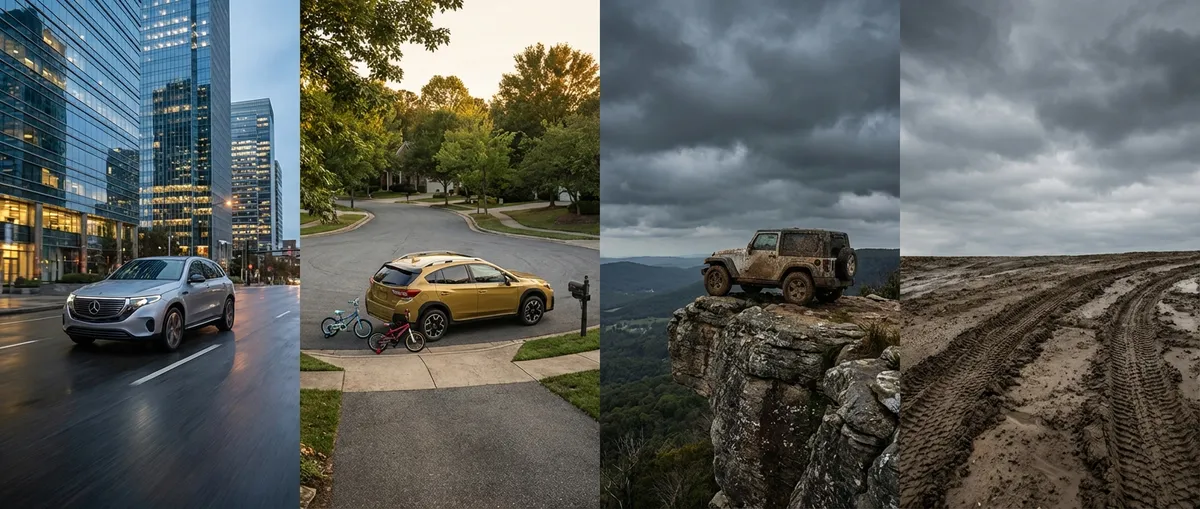
Choosing between SUVs can feel straightforward—until you start matching very different use cases: cramped city streets, long suburban commutes, or rough-country weekends. On paper, these vehicles might share similar horsepower and cargo volume, but in real life their architectures, drivetrains, and packaging deliver very different experiences.
This comparison isn’t about naming a single “best” SUV. Instead, it breaks down five core decision points that genuinely change how an SUV behaves in urban, suburban, and off‑pavement environments. If you’re cross‑shopping everything from compact crossovers to rugged body‑on‑frame rigs, these are the technical differences that matter most once the novelty wears off.
1. Platform and Drivetrain: Crossover Comfort vs. True Off‑Road Bones
The first meaningful split in SUVs is platform: unibody crossovers vs. body‑on‑frame trucks. Where and how you drive should dictate which side you choose.
Most city and suburban buyers end up in unibody crossovers. These use a car‑like structure with the body and frame integrated into a single unit. This design typically offers:
- Lower curb weight and better fuel economy
- More precise, sedan‑like handling
- Lower step‑in height for easier ingress/egress
- Better crash energy management thanks to a more rigid integrated structure
Examples include the Honda CR‑V, Toyota RAV4, Hyundai Tucson, and most luxury compact SUVs. For stop‑and‑go traffic, narrow parking structures, and long freeway commutes, their balance of refinement and efficiency is hard to beat.
Body‑on‑frame SUVs (think Toyota 4Runner, Ford Bronco, Jeep Wrangler, full‑size Tahoes and Expeditions) are built more like pickup trucks: a separate ladder frame with the body mounted on top. This brings clear advantages for rural and off‑road use:
- Higher ground clearance and more robust underbody protection
- Stronger frame rails for towing and heavy loads
- More suspension articulation potential for rough trails
- Easier repair and modification of running gear for serious off‑roading
The trade‑off is that body‑on‑frame vehicles usually feel heavier and less agile on pavement. They can exhibit more body roll, longer stopping distances, and less precise steering compared to unibody crossovers of similar size.
For most buyers who rarely leave the pavement, a unibody crossover with available all‑wheel drive (AWD) is the right match. For frequent backcountry trips, towing over rough terrain, or deep‑snow cabin access, the extra weight and complexity of a body‑on‑frame SUV start to make sense.
2. AWD, 4WD, and Drive Modes: What You Actually Need for Grip
“AWD” and “4WD” badges are everywhere, but they’re not interchangeable—and modern drive modes add another layer of complexity. Matching the system to your actual traction needs can save you money and avoid frustration.
Typical crossover AWD systems are front‑biased and use an electronically controlled clutch pack to send power to the rear wheels when slip is detected or predicted. Advantages:
- Lower parasitic losses and better fuel economy when mostly in FWD
- Seamless operation for rain, light snow, and gravel
- Integration with stability control to redistribute torque pre‑emptively
These systems are ideal for city and suburban drivers who see wet weather, moderate snow, and occasional unpaved roads. Some more advanced setups add:
- Rear axle torque vectoring to improve cornering stability
- Pre‑set modes (Snow, Mud, Sand) that adjust throttle mapping, traction control, and torque split
True 4WD systems—more common on body‑on‑frame SUVs—use a transfer case with selectable modes: 2H (rear drive), 4H (high‑range 4WD), and 4L (low‑range 4WD). Key benefits for serious off‑road or mountain use:
- Mechanical low range (often ~2.5:1 to 3:1 reduction) for controlled crawling
- Locked front–rear torque split in some modes for consistent traction in deep mud, sand, or snow
- Often combined with solid rear axles and more robust driveline components
For buyers who tackle challenging trails, steep unpaved grades, or tow in demanding conditions, low‑range 4WD and mechanical locking differentials (center, rear, or both) are more valuable than an extra inch of screen size.
Drive modes deserve attention, too. In many modern SUVs, these aren’t just marketing labels. They can alter:
- Throttle sensitivity (so you’re smoother on slippery surfaces)
- Transmission shift logic (holding lower gears off‑road or on steep descents)
- Power split front/rear and side‑to‑side (where torque vectoring is available)
If you’re mostly a city driver, a sophisticated AWD system with “Snow” and “Eco” modes is probably overkill compared with good all‑season or winter tires. For frequent backroad explorers, prioritize systems with genuine off‑road modes and, ideally, a real low range.
3. Real‑World Packaging: Seats, Cargo, and Visibility vs. the Spec Sheet
On paper, many SUVs in different categories show similar cargo volumes and passenger room. In daily use, seat geometry, glass area, and load‑floor design can make two vehicles with nearly identical specs feel entirely different.
For dense urban environments, consider:
- Overall length and turning radius: Shorter crossovers and subcompact SUVs are dramatically easier to parallel park and maneuver in tight garages. Turning radius figures in spec sheets are a good proxy for how “nimble” a vehicle will feel at low speeds.
- Upright seating positions: A higher hip point relative to the floor makes it easier to get in and out repeatedly—valuable for ride‑share drivers or parents frequently loading kids.
- Sightlines and glass area: Thicker roof pillars for safety can create blind spots. Large rear windows and tall windshields reduce dependency on cameras and sensors in tight quarters.
Suburban families and commuters should focus on flexibility:
- Second‑row adjustability: Sliding and reclining seats can dramatically change comfort on long trips and allow you to balance legroom vs. cargo space depending on the day.
- Actual load floor height: A lower liftover height makes it easier to load groceries, strollers, and sports gear. Numbers don’t always tell the full story; a test load with real items is revealing.
- Third row realism: Many three‑row crossovers technically “seat seven,” but the third row may be tight for adults and leave minimal cargo space with all rows up. If you regularly carry six or more people, prioritize third‑row headroom, hip room, and access, not just total passenger count.
For backcountry and overland use, pay attention to:
- Roof load capacity: Not just whether you can mount a rack, but how much static and dynamic weight it supports if you plan to add rooftop tents, fuel cans, or recovery gear.
- Tie‑down points and under‑floor storage: Essential for securing heavy items off‑road and keeping recovery equipment accessible without compromising interior safety.
- Interior trim durability: Harder‑wearing plastics and easily cleanable seat materials matter far more on dusty, muddy trails than soft‑touch surfaces that scuff easily.
Ultimately, use the spec sheet as a filter, but confirm daily‑use comfort and practicality with an in‑person inspection—ideally loading the vehicle with the actual gear, strollers, or boxes you use routinely.
4. Suspension, Tires, and Ride: How Comfort and Capability Trade Places
Drivers who spend most of their time at 25–70 mph on pavement need different suspension and tire setups than those who see washboard dirt and rutted forest roads. The compromises here are structural.
City‑ and commuter‑focused crossovers are usually tuned for:
- Compliance over small bumps: Softer damping at low speeds to smooth broken pavement and speed bumps.
- Controlled body motions in corners: Higher roll stiffness and lower center of gravity for confident highway lane changes and on‑ramps.
- Lower rolling‑resistance tires: Often with higher speed ratings and stiffer sidewalls but limited off‑pavement grip.
This tuning works well for consistent, paved driving, but these vehicles can feel harsh or “crashy” on sharp potholes if the wheel and tire combo leans heavily toward appearance (large diameter wheels with thin sidewalls).
Rural and off‑road‑oriented SUVs take a different path:
- Longer‑travel suspension: To absorb big hits and allow articulation without unseating the tires on uneven ground.
- More sidewall in the tires: Smaller wheels with taller tire sidewalls act as a secondary suspension, protecting rims and smoothing rocks, ruts, and washboard surfaces.
- All‑terrain or mud‑terrain tires: With deeper tread blocks and more voids for grip in loose surfaces—at the cost of more road noise, longer braking distances on dry pavement, and often slightly reduced fuel economy.
Some modern SUVs add adaptive or air suspension, allowing the vehicle to change character:
- Lifted modes for trails and snow, combined with
- Lowered highway modes for reduced drag and body roll
These systems can give you part‑time off‑road capability without fully sacrificing on‑road refinement, but they introduce complexity and potential long‑term maintenance costs.
When comparing SUVs, don’t just look at wheel size in inches. Note the actual tire sidewall height and type. A modest 17‑ or 18‑inch wheel with a proper all‑season tire can be a better “real‑world” choice for mixed‑use driving than a 20‑inch+ wheel dressed in low‑profile rubber that compromises ride and repair costs.
5. Braking, Weight, and Towing: Matching Mass to Your Use Case
SUVs cover a huge weight spectrum—from just over 3,000 pounds for some compact crossovers to well beyond 6,000 pounds for large three‑row and body‑on‑frame models. Where and how you drive plays a major role in how that weight feels, especially when you add passengers, cargo, or a trailer.
For urban and congested suburban driving, curb weight and braking performance are critical:
- Heavier SUVs need longer distances to stop, all else equal. Look for models with appropriately sized brake rotors and multi‑piston calipers when curb weight and towing capacity climb.
- Regenerative braking (on hybrids and EVs) can reduce pad and rotor wear, which is useful in stop‑and‑go traffic, but it doesn’t remove the laws of physics—emergency stops still depend on tires and friction brakes.
- Tire compound and width directly affect braking distances. Wide, aggressive tires improve grip but can worsen hydroplaning resistance and add rolling resistance; narrow high‑quality all‑seasons may perform better in rain and snow.
Suburban buyers who regularly road‑trip and tow recreational gear or small trailers should consider:
- Gross Vehicle Weight Rating (GVWR): The maximum allowable weight of the vehicle plus occupants and cargo. If you routinely fill every seat and pack the cargo area, choose an SUV with a GVWR that leaves a comfortable margin.
- Gross Combined Weight Rating (GCWR) and tow rating: If you plan to tow boats, campers, or utility trailers, match your typical loaded trailer weight, not just the dry weight, to the vehicle’s tow rating. Transmission cooling, axle ratio, and frame stiffness are just as important as engine horsepower.
- Wheelbase length: Longer wheelbase vehicles provide more stable towing dynamics, especially at highway speeds or in crosswinds.
For backcountry and mountain use, descending with heavy loads is as important as climbing:
- Engine braking and transmission logic: Vehicles with smart downhill assist or manually selectable lower gears can help control speed on steep grades without overheating the brakes.
- Brake cooling and rotor size: Long, steep descents with a trailer can expose marginal braking systems quickly. Opting for available towing or off‑road packages often brings upgraded brakes and cooling.
In all environments, remember that curb weight, payload, and tow ratings are interrelated. When you’re close to the limits in one category (max passengers or max trailer), you typically lose capacity in others. Comparing complete weight and braking specs across contenders provides a more realistic picture than simply comparing horsepower or torque.
Conclusion
The SUV that looks best on a dealership lot or in a spec comparison isn’t necessarily the one that will feel right on your daily routes and weekend escapes. Platform type, AWD vs. 4WD, interior packaging, suspension and tires, and weight/braking behavior all interact differently depending on whether you spend most of your time in urban cores, suburban sprawl, or remote backroads.
If you’re cross‑shopping across those worlds, move beyond generic labels like “compact crossover” or “off‑road SUV” and align the underlying engineering with your real driving profile. A well‑matched unibody crossover with intelligent AWD can be far more satisfying in daily use than an overbuilt off‑roader that never leaves the pavement—and the reverse is just as true for drivers who regularly push beyond the end of the asphalt.
Use the five comparison points above as a technical checklist, then test‑drive candidates in conditions as close as possible to your real life. That’s where the differences between “spec‑sheet similar” SUVs become obvious—and where the right choice will stand out quickly.
Sources
- NHTSA – Vehicle Types and Safety Considerations – Explains structural differences and safety aspects of various vehicle types, including SUVs
- IIHS – SUV Size and Safety Research – Discusses how vehicle size, weight, and design affect crash outcomes and real‑world safety
- U.S. Department of Energy – All-Wheel Drive and 4-Wheel Drive – Breaks down AWD and 4WD systems, efficiency impacts, and when they’re beneficial
- Edmunds – Understanding Towing Capacity – Detailed explanation of tow ratings, GVWR, GCWR, and how to match vehicles to trailers
- Consumer Reports – All-Season vs. All-Terrain Tires – Compares tire types and their impact on ride, braking, noise, and off‑road capability
Key Takeaway
The most important thing to remember from this article is that this information can change how you think about Comparisons.