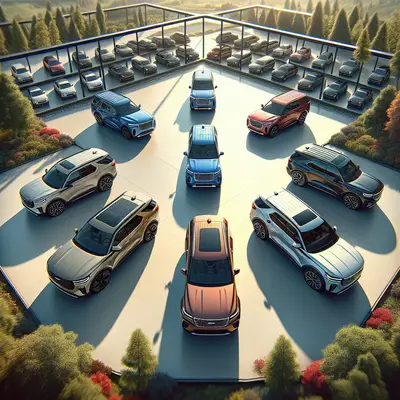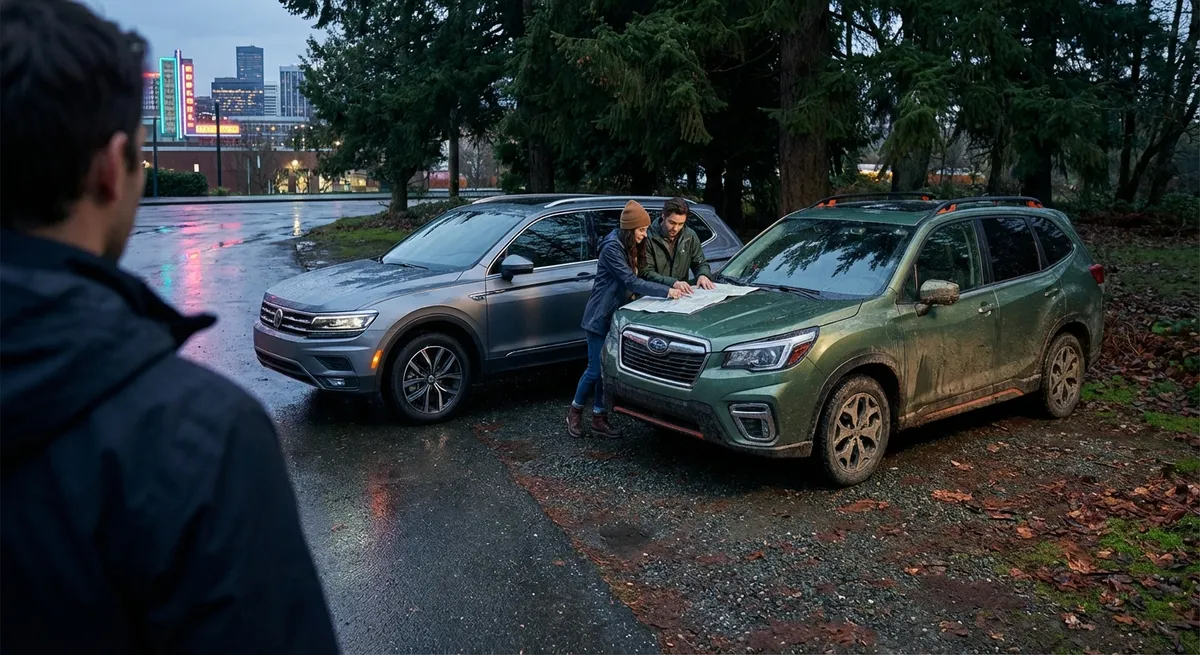
The SUV market is no longer just about “big and practical.” Today’s buyers are effectively choosing between two distinct personalities: the refined, tech-heavy City SUV and the rugged, capability-first Adventure SUV. Both segments can look similar in photos and on spec sheets, but they behave very differently once you account for ride quality, powertrain tuning, chassis setup, and real-world usability. This comparison framework will help you understand what’s really under the skin so you can decide which SUV philosophy better fits your daily life—and your weekend plans.
1. Platform and Chassis: Comfort-Tuned Crossovers vs. True Utility Roots
At the core, most City SUVs are crossovers built on unibody car platforms, while many Adventure SUVs still rely on truck-like architectures—or at least heavily reinforced unibody structures.
City‑oriented SUVs (think Honda CR‑V, Toyota RAV4, Hyundai Tucson) typically use a unibody layout with independent front and rear suspensions. This reduces weight, improves handling response, and allows engineers to tune for a quieter, more compliant ride over expansion joints and rough city streets. Steering is usually lighter, with electric power assist calibrated for easy parking rather than surgical off‑road precision.
Adventure‑oriented SUVs—examples include the Toyota 4Runner, Jeep Wrangler, Land Rover Defender, Ford Bronco—either use body‑on‑frame designs or very robust unibody platforms with off‑road reinforcement. Body‑on‑frame layouts prioritize durability, towing, and resistance to twisting loads during off‑road articulation, but they generally transmit more vibration and can feel less composed in quick lane changes. Suspension designs may incorporate solid rear axles, longer travel dampers, and off‑road oriented bushings that allow greater wheel movement at the expense of sharp on‑road handling.
For buyers, the chassis distinction translates directly into character: City SUVs excel in everyday comfort, stable highway manners, and easy drivability, while Adventure SUVs trade some refinement for durability, load capacity, and the ability to cope with punishing surfaces that would have a crossover backing off long before the vehicle reaches its limits.
2. Powertrain and Drivetrain: Efficiency Bias vs. All‑Terrain Confidence
Under the hood, City SUVs prioritize fuel economy, emissions compliance, and smooth power delivery, while Adventure SUVs emphasize low‑speed control, torque availability, and robustness under heavy load.
City SUVs increasingly rely on small displacement turbocharged engines, high‑compression naturally aspirated units, or hybrid powertrains. Common setups include 1.5–2.5L inline‑fours paired with CVTs or multi‑speed automatics designed to keep revs low for efficiency. Full and plug‑in hybrids add electric torque fill, allowing brisk initial acceleration while significantly lowering fuel consumption in stop‑and‑go traffic. Front‑wheel drive is usually standard, with on‑demand all‑wheel drive available to improve traction in rain or light snow, but with limited sustained torque transfer and modest thermal capacity for continuous heavy use.
Adventure SUVs frequently offer larger displacement engines, more robust torque converters, and gearboxes with dedicated off‑road modes. Many include low‑range transfer cases for crawling over rocks, steep descents, or deep sand. Full‑time four‑wheel drive systems with locking or limited‑slip differentials are common, allowing torque to be mechanically directed to the wheels with actual grip, even when diagonally opposed tires are off the ground. While some Adventure SUVs are adopting electrified powertrains, these tend to be tuned for high torque output and towing, with battery and motor cooling engineered for heavy‑duty cycles rather than purely urban efficiency.
From a buyer’s perspective, City SUV powertrains shine in fuel bills, refinement, and urban drivability. Adventure SUV powertrains are about controllability and durability under extremes—towing a trailer up a long grade, climbing loose surfaces, or maintaining traction in deep snow—often at the cost of higher consumption and more drivetrain noise.
3. Suspension, Tires, and Ride Quality: Asphalt Precision vs. Trail Compliance
Suspension tuning and tire choice may be the most immediately noticeable differences between City and Adventure SUVs during a test drive.
City SUVs are engineered to feel composed on well‑paved surfaces with limited body roll and short stopping distances. Multi‑link rear suspensions, relatively stiff anti‑roll bars, and lower ride heights contribute to more car‑like handling. Tires are typically all‑season touring or performance‑oriented options with lower rolling resistance and shallower tread blocks, optimized for wet grip, braking, and quiet operation. The result is a predictable, low‑fatigue driving experience during commutes and long highway cruises.
Adventure SUVs often increase ride height and wheel travel to avoid underbody contact and to keep tires in contact with uneven terrain. Suspension components may include off‑road tuned shocks (sometimes with position‑sensitive or adaptive damping), taller spring rates to handle accessories and cargo, and more compliant bushings to tolerate articulation. Tire selection skews toward all‑terrain or mud‑terrain designs with aggressive tread, reinforced sidewalls, and higher load ratings. These provide better traction on gravel, mud, and rock, but they typically increase road noise, lengthen braking distances on dry pavement, and can reduce steering precision.
The trade‑off is straightforward: City SUVs deliver better braking, quieter cabins, and more precise steering on pavement; Adventure SUVs provide superior control and confidence once you leave the asphalt, particularly when surfaces are loose, rutted, or deeply rutted—but you will feel more of the road and hear more from the tires every day.
4. Practicality, Cargo, and Towing: Urban Family Tool vs. Multi‑Role Workhorse
Both SUV types market themselves as “practical,” but how that practicality manifests is quite different.
City SUVs tend to focus on interior packaging efficiency. Because their floorpans sit lower and suspensions often intrude less into the cabin, they can offer generous rear legroom, easily accessible child‑seat anchors, and low liftover heights for cargo. Seats are frequently optimized for comfort and adjustability, with fold‑flat mechanisms that transform the space into a large, level load area suitable for strollers, luggage, and flat‑packed furniture. Roof rails and integrated crossbar options further extend everyday capacity for bikes and cargo boxes. Towing capacities in this segment are often in the 1,500–3,500 lb (680–1,587 kg) range, adequate for small trailers, jet skis, and lightweight campers.
Adventure SUVs prioritize structural capability and payload alongside interior space. High‑strength frames or reinforced unibody structures allow higher roof loads, greater payload ratings, and significantly higher towing capacities, sometimes exceeding 7,000 lb (3,175 kg) in properly equipped models. Interiors may offer modular seating, cargo tie‑downs, and configurations that accept aftermarket drawers, water tanks, and recovery gear. However, higher floors and chunkier underpinnings can make third‑row access and cargo loading less graceful, and seats may be firmer to withstand heavy use.
If your daily life is about passengers, groceries, school runs, and the occasional road trip, a City SUV typically offers more comfort‑oriented practicality. If you routinely haul equipment, tow boats or large campers, or plan extended backcountry trips with gear and auxiliary fuel, an Adventure SUV’s payload and tow ratings become critical assets.
5. Technology, Safety, and Ownership Costs: Urban Tech Hubs vs. Purpose‑Built Tools
Finally, City and Adventure SUVs diverge in how they deploy technology, especially when you look beyond the spec sheet headlines.
City SUVs frequently debut the latest infotainment ecosystems, digital instrument clusters, and driver‑assist bundles. Large touchscreens, smartphone integration (Apple CarPlay, Android Auto), over‑the‑air software updates, and configurable ambient lighting are now commonplace. Advanced driver assistance systems (ADAS)—adaptive cruise control, lane‑keeping assist, traffic‑jam assist, automated parking—are often tuned for dense urban traffic and highway commuting. These vehicles tend to adopt new tech quickly as automakers compete for tech‑savvy buyers.
Adventure SUVs deploy technology with a different emphasis. Infotainment and ADAS are present and increasingly sophisticated, but there’s a parallel investment in off‑road‑specific systems: hill descent control, off‑road cruise control, terrain‑select modes (sand, rock, mud, snow), off‑road cameras with underbody views, and inclinometer readouts. Electronics must be hardened to withstand vibration, dust, and sometimes water ingress. Some models offer switchable sway‑bar disconnects and electronically controlled locking differentials, all coordinated through integrated drive‑mode logic.
Ownership costs follow the usage profile. City SUVs generally deliver superior fuel economy, lower tire and brake wear (assuming normal driving), and more affordable routine servicing. Insurance can be lower due to their positioning and safety ratings. Adventure SUVs, especially when fitted with heavy‑duty tires, off‑road packages, and accessories, often incur higher fuel costs, faster tire wear, more expensive components, and potentially higher insurance if classified as specialty or off‑road capable. However, their robust construction can pay dividends in longevity if you actually use them in demanding environments rather than pushing a lighter crossover beyond its design envelope.
In essence, City SUVs are rolling technology hubs focused on comfort, connectivity, and efficiency in crowded environments; Adventure SUVs are tools engineered to perform reliably when conditions are unpredictable and the margin for error is small.
Conclusion
Choosing between a City SUV and an Adventure SUV is less about which is “better” and more about which personality aligns with how you truly drive. The City SUV excels in comfort, efficiency, maneuverability, and cutting‑edge urban tech, making daily life easier and more economical. The Adventure SUV trades some refinement for structural robustness, off‑road traction, and higher towing and payload capabilities that matter when the road ends—or when you’re pulling serious weight.
The key is to be honest about your use case. If your “off‑roading” is mostly curbs, snowstorms, and the occasional gravel parking lot, a well‑equipped City SUV will likely serve you better and cost less to own. If your weekends involve remote trailheads, overlanding, boats, or work trailers, the engineering baked into a genuine Adventure SUV isn’t overkill—it’s the difference between merely reaching your destination and doing so repeatedly, safely, and with confidence.
Sources
- [U.S. Department of Energy – Fuel Economy Guide](https://www.fueleconomy.gov/feg/findacar.shtml) – Official fuel economy data for comparing SUVs, including hybrid and conventional powertrains
- [National Highway Traffic Safety Administration (NHTSA)](https://www.nhtsa.gov/ratings) – Crash test ratings and safety information for various SUV types
- [IIHS – Vehicle Ratings](https://www.iihs.org/ratings) – Independent safety evaluations and crashworthiness ratings for crossovers and body‑on‑frame SUVs
- [Toyota Global Newsroom – Vehicle Technologies](https://global.toyota/en/newsroom/toyota/vehicle_technology/) – Technical overviews of platforms, powertrains, and 4WD systems used in city and adventure‑oriented SUVs
- [Jeep Official Site – 4x4 Systems](https://www.jeep.com/jeep-capability/4x4.html) – Detailed descriptions of different four‑wheel‑drive systems and off‑road technologies used in adventure SUVs
Key Takeaway
The most important thing to remember from this article is that this information can change how you think about Comparisons.