For SUV shoppers, the hardest decision often isn’t the brand—it’s the size. Compact, midsize, and full-size SUVs can look similar on a spec sheet, yet feel completely different in the real world. The wrong choice can mean wasted money, cramped passengers, or fuel bills that sting every time you fill up. This comparison breaks down how each class truly behaves in day-to-day use, with five detailed points that matter most to enthusiasts and serious buyers: space, performance, efficiency, technology, and ownership costs.
1. Space and Packaging: How Much Room Do You Really Gain?
On paper, moving from a compact to a midsize or full-size SUV seems like a straightforward upgrade: more inches, more seats, more cargo. In practice, the differences are more nuanced and depend heavily on packaging efficiency.
Compact SUVs (think Honda CR-V, Toyota RAV4) typically offer 37–41 inches of rear legroom and around 27–40 cubic feet of cargo behind the second row. For a couple or small family, that’s often sufficient, especially if you fold seats for occasional bulkier loads. Their shorter overall length—usually 178–183 inches—makes them far easier to maneuver and park in tight urban spaces.
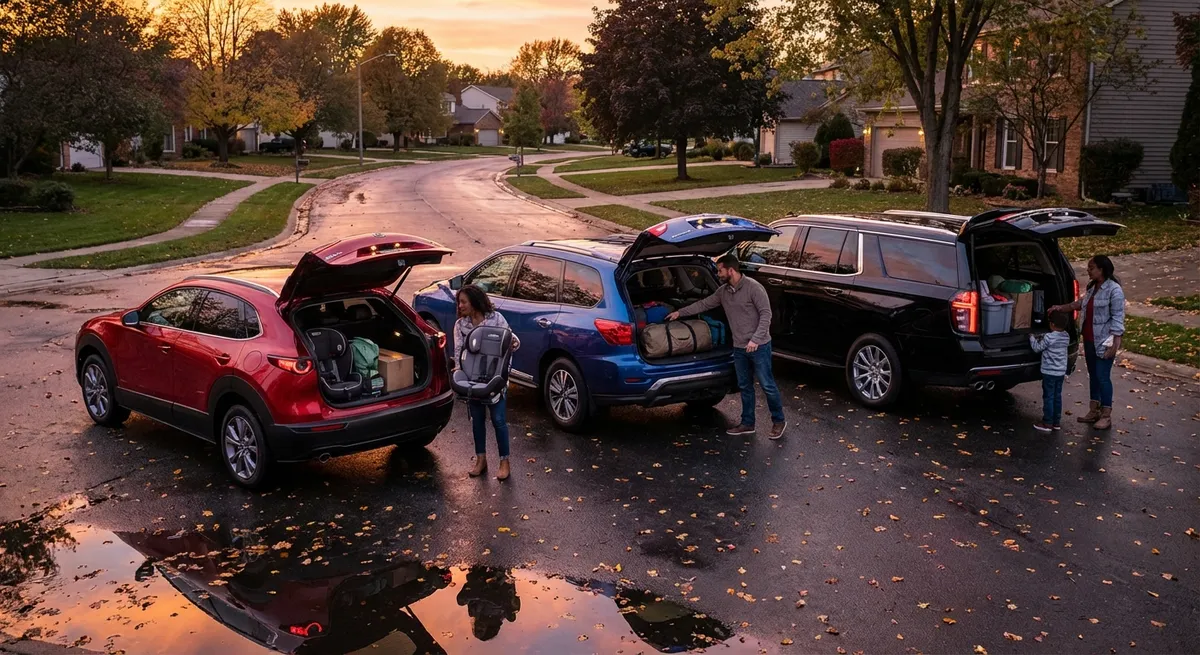
Midsize two-row SUVs step up interior width and rear legroom, often hitting 38–40+ inches of rear legroom with wider seats and more comfortable door openings. They’re notably better for installing child seats and for adult rear passengers on longer trips. Three-row midsize models add theoretical seating for 6–7, but the third row is often best for kids or short-hop use, with cargo space shrinking dramatically when all seats are in use.
Full-size SUVs (Chevrolet Tahoe, Ford Expedition) are where volume becomes truly abundant. Third rows can be adult-usable, and cargo capacities of 25+ cubic feet behind the third row are common. However, their 210+ inch length and substantial width make tight parking garages and narrow city streets a daily compromise. Before buying purely for space, measure your garage, check your usual parking environments, and consider how often you actually need three full rows plus luggage.
2. Performance, Powertrains, and Towing: Matching Muscle to Mission
Performance differences between SUV classes are not just about “more is faster.” Vehicle mass, aerodynamic drag, and powertrain strategy all reshape how each category feels.
Compact SUVs frequently use 4-cylinder engines, often turbocharged, in the 180–250 hp range. Paired with relatively low curb weights (3,300–3,800 lb), they can feel quite sprightly around town. However, when fully loaded with passengers and cargo, or merging onto highways at elevation, you may notice longer acceleration times and more frequent downshifts—especially with CVTs or small-displacement turbos working hard to keep up.
Midsize SUVs introduce more variety: naturally aspirated V6s, stronger 4-cylinder turbos, and an increasing number of hybrid options. Curb weights often climb into the 4,200–4,800 lb band, but the additional power and upgraded transmissions (8- to 10-speed automatics) compensate. This is also the class where towing becomes more realistic: 3,500–5,000 lb tow ratings are common, making it viable to haul small boats, pop-up campers, or utility trailers without overtaxing the vehicle.
Full-size SUVs are built on more robust platforms—often truck-based body-on-frame architecture—with engine outputs frequently north of 350–400 hp and substantial torque. They can tow 7,500–8,400+ lb when properly equipped, with heavy-duty cooling, integrated trailer brake controllers, and rear load-leveling systems. The trade-off is more mass to accelerate and stop, longer braking distances, and a more truck-like driving feel. Enthusiasts should consider not only peak power but also the torque curve, transmission gearing, and cooling systems if towing or mountain driving is part of the plan.
3. Fuel Economy and Aerodynamics: The Hidden Cost of Size
SUV size correlates strongly with fuel consumption for straightforward physical reasons: more mass and frontal area require more energy to move and push air aside. Even with efficiency technologies, physics is hard to cheat.
Compact crossovers typically deliver combined EPA ratings in the mid-20s to low 30s mpg (or roughly 7–9 L/100 km in many markets). Their smaller frontal area and lower curb weight give them a significant advantage in real-world city and mixed driving, especially for commuters who rarely exceed moderate speeds. Hybrids in this class can push efficiency even higher, making them compelling for high-mileage drivers.
Midsize SUVs often land in the low-20s combined, with some efficient 4-cylinder or hybrid variants reaching into the mid-20s. The aerodynamics worsen with larger frontal area and higher rooflines, but careful underbody smoothing, active grille shutters, and low-rolling resistance tires help mitigate the hit. For many families, the slight efficiency penalty versus a compact is an acceptable trade for extra comfort and capability.
Full-size SUVs are where fuel economy drops most sharply. Combined ratings in the mid-teens to high-teens are common for gasoline models, especially those with V8 engines and 4WD. Some newer models use downsized turbos, 10-speed transmissions, cylinder deactivation, and even diesel or hybrid systems to claw back a few mpg. However, on long highway trips at higher speeds, the large frontal area and heavier weight still punish fuel consumption. Buyers should run the math: even a 4–6 mpg difference can equate to hundreds of dollars per year in fuel for high-mileage use.
4. Ride, Handling, and Tech: How Size Shapes the Driving Experience
Driving feel is one of the most underestimated differences between SUV sizes, and it’s where enthusiasts will notice the biggest contrast.
Compact SUVs, built on car-like unibody platforms, often feel nimble and confidence-inspiring. Shorter wheelbases yield quick responses, though they can become a bit choppy over broken pavement. Steering is usually light and precise enough for city driving. However, smaller SUVs may use simpler rear suspensions (torsion beam instead of multi-link) on lower trims, affecting ride sophistication and cornering grip.
Midsize SUVs benefit from longer wheelbases and wider tracks, improving high-speed stability and ride comfort. Multi-link rear suspensions and frequency-selective dampers are more common here, helping balance comfort with control. For enthusiasts, this category frequently offers sport-tuned trims, adaptive dampers, and larger brake packages. Noise insulation also tends to improve—thicker glass, more sound-deadening, and active noise cancellation make long drives less tiring.
Full-size SUVs introduce a distinct “command” driving position with higher eye point and a substantial sense of mass. Modern models use independent rear suspensions or sophisticated solid-axle arrangements, with available air suspension and adaptive damping to keep body motions in check. While they can be remarkably composed for their size, physics still limit agility—tighter corners, quick lane changes, and spirited backroad driving will always feel more natural in smaller, lighter vehicles. On the technology front, larger SUVs often debut the brand’s most advanced driver-assistance systems, large-format infotainment displays, and premium audio—though this is increasingly trickling down to compact and midsize segments.
5. Long-Term Ownership Costs and Resale: Thinking Beyond the Test Drive
The purchase price is just the opening act. Over a 5–10 year ownership period, size class influences insurance, maintenance, repair costs, and depreciation patterns.
Compact SUVs generally have the lowest entry price and the most favorable fuel bills. Many share components with high-volume compact cars, which can keep parts and service costs in check. Insurance companies may rate them lower risk due to smaller repair bills compared with larger, more complex vehicles. In popular, reputable models, resale values can be strong, especially as demand for efficient crossovers remains high.
Midsize SUVs occupy a middle ground financially. They cost more to buy and insure, but they also appeal to a broad, stable market of family buyers. This often translates to solid residuals, particularly for well-known models with strong reliability reputations. Hybrids and plug-in hybrids may command price premiums but can repay some of that through fuel savings and potentially higher resale if fuel prices rise.
Full-size SUVs have the highest acquisition and operating costs. Larger tires, more complex suspension systems, and heavier-duty components can mean pricier maintenance and repairs. Fuel and insurance bills often scale up as well. However, certain full-size models consistently maintain high resale values, particularly those favored for towing, off-road use, or fleet and commercial applications. Enthusiasts and buyers who truly use the towing or passenger capacity can justify these costs, but for light suburban duty, much of the capability may go unused while still being paid for.
Conclusion
Choosing between compact, midsize, and full-size SUVs isn’t just about “bigger is better” or chasing the highest trim level. It’s about aligning real-world needs—passenger space, towing, driving environment, and annual mileage—with the characteristics of each class. Compact SUVs win on efficiency and maneuverability, midsize models balance comfort and utility, and full-size SUVs deliver maximum space and capability at a premium.
Serious buyers should go beyond the spec sheet: test each size in the environments you actually drive, simulate a family road trip or towing scenario, and run long-term fuel and ownership cost calculations. When the vehicle’s capabilities and your lifestyle are in sync, the size class becomes an asset instead of a compromise.
Sources
- U.S. Environmental Protection Agency – Fuel Economy Guide - Official EPA fuel economy ratings for comparing compact, midsize, and full-size SUVs
- National Highway Traffic Safety Administration (NHTSA) - Detailed safety ratings and vehicle information by class and model
- Insurance Institute for Highway Safety (IIHS) – Vehicle Ratings - Crash test results and safety evaluations across different SUV sizes
- Honda Official Site – CR-V Specifications - Example of typical compact SUV dimensions and powertrains
- Ford Official Site – Expedition Specifications - Representative full-size SUV data for towing, size, and powertrain configuration
Key Takeaway
The most important thing to remember from this article is that this information can change how you think about Comparisons.