Choosing an SUV today is no longer just about size and styling—what’s under the hood and beneath the floor can dramatically change how the vehicle drives, what it costs to own, and how long it fits your needs. From traditional gas engines to full EV platforms, the powertrain you pick will determine everything from towing confidence to winter traction and long-term reliability. This guide breaks down what matters most in modern SUV powertrains so you can match engineering details to real-world use, not just brochure buzzwords.
1. Engine Architectures: Matching Cylinder Count to How You Actually Drive
Modern SUVs largely revolve around three engine families: turbocharged four-cylinders, naturally aspirated V6s, and high-output turbo V6s or V8s. Each has distinct trade-offs that go beyond simple horsepower numbers.
Turbocharged inline-fours (often 1.5–2.5 liters) dominate compact and many midsize crossovers. They deliver strong low- to mid-range torque thanks to forced induction, which makes them feel punchy in city traffic and at highway merge speeds, even with modest displacement. Look at peak torque RPM: a turbo four that hits its torque plateau around 1,800–2,000 rpm will feel more responsive at everyday engine speeds than a larger engine that doesn’t wake up until 3,500+ rpm.
Naturally aspirated V6 engines (commonly 3.5–3.8 liters) favor linear power delivery and high-RPM strength, which is beneficial for sustained highway grades, heavier loads, and towing. They’re typically smoother than turbo fours because of their inherent balance and additional cylinders, and often have higher maximum tow ratings in similarly sized SUVs. However, they may return lower real-world fuel economy in stop-and-go use, especially if paired with older automatic transmissions.
High-output turbo V6s and V8s are most relevant in performance and heavy-duty SUVs. They offer exceptional torque—often 400 lb-ft and beyond—which is useful for serious towing or rapid acceleration but tends to push purchase price, insurance, and potential maintenance costs upward. Enthusiast buyers should pay attention to cooling capacity (auxiliary coolers, additional radiators) and oil specifications, as high-specific-output engines can be more sensitive to heat and lubrication quality.
Beyond cylinder count, examine the engine’s specific output (hp per liter), compression ratio, and whether it uses direct injection, port injection, or a combination. Dual-injection setups can mitigate carbon buildup on intake valves, a known concern on some direct-injection-only designs. If you plan to keep the SUV beyond 150,000 miles, research known long-term issues for the specific engine code, not just the model line, as design details like timing chain layout and turbo location can significantly affect reliability and repair cost.
2. Transmissions and Driveline Layout: How Gears and Axles Shape the Drive
The gearbox and driveline layout can make the same engine feel either lethargic or lively. Today’s SUVs typically use one of four transmission types: conventional torque-converter automatics, continuously variable transmissions (CVTs), dual-clutch automatic manuals (DCTs), or, rarely, traditional manuals.
Conventional automatics (often 8–10 speeds) remain the best choice for most buyers. A well-tuned 8-speed offers a good balance of shift speed, smoothness, and durability. More gears are not always better; overly aggressive shift logic in 9- or 10-speed units can lead to “gear hunting” on rolling terrain. When test-driving, pay attention to part-throttle upshifts, downshifts on mild hills, and low-speed creep behavior in traffic—these situations expose poor calibration.
CVTs are common in compact crossovers with four-cylinder engines. Their main advantages are efficiency and seamless ratio changes, but driving feel can be rubber-band-like, with engine revs rising before speed catches up. Look for models that simulate stepped “gears” and have robust cooling, especially if you live in hot climates or tow occasionally. Not all CVTs are created equal: some automakers design heavy-duty units with metal belt/pulley improvements and enhanced fluid cooling for SUV duty, while others simply transplant car-based CVTs with minimal reinforcement.
Dual-clutch transmissions offer very quick shifts and can feel engaging at speed, but they sometimes stutter or hesitate at parking-lot speeds because they operate more like automated manual gearboxes. If most of your driving is urban and stop-and-go, a traditional automatic may be more pleasant long term, even if a DCT appears sportier on paper.
Equally important is driveline layout—front-wheel drive (FWD), rear-wheel drive (RWD), or all-wheel drive (AWD). Many crossovers are FWD-based with on-demand AWD systems that send torque rearward only when slip is detected. These are fine for rain and light snow but can struggle in deep snow, sand, or when towing on loose surfaces because they’re reactive rather than predictive. RWD-based platforms with full-time or more advanced AWD often have higher tow ratings, better weight distribution, and superior dynamics when loaded. Examine the system’s torque split capability and whether it can preemptively bias torque to the rear or lock axles for off-pavement use.
3. Gas, Hybrid, Plug-In, or EV: Drivetrain Types and Ownership Realities
Choosing between gasoline, hybrid, plug-in hybrid (PHEV), and full electric (EV) SUVs involves more than just fuel economy charts; it’s fundamentally about your daily patterns and infrastructure.
Conventional gasoline SUVs remain the simplest option with the broadest fueling network. They’re ideal for high-mileage highway drivers in rural areas or for owners who tow regularly at or near rated limits. However, city-dominant usage reveals their worst fuel economy, especially with larger-displacement engines and heavier vehicles.
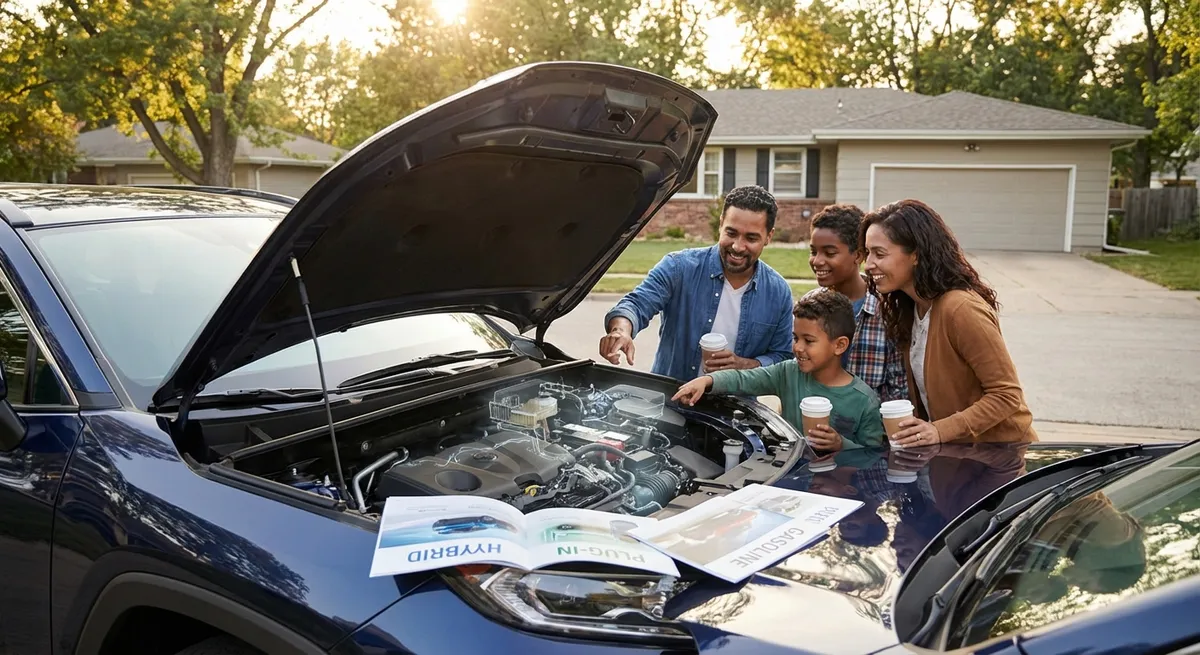
Conventional hybrids pair a smaller gasoline engine with one or more electric motor-generators and a relatively small battery (typically 1–2 kWh). These systems excel at urban and suburban driving, where frequent deceleration recovers energy through regenerative braking. Hybrids can deliver huge real-world gains in stop-and-go traffic, often outperforming their EPA city ratings when driven smoothly. Because the battery is small, there’s no need to plug in, and most hybrid systems are designed to last the lifespan of the vehicle with minimal additional maintenance beyond occasional cooling system service.
PHEV SUVs add a larger battery (10–25+ kWh) that supports meaningful all-electric range, typically 20–40 miles. For many commuters, this can cover the daily round trip on electricity alone, with the gasoline engine acting as a range extender on longer journeys. This architecture can significantly reduce fuel consumption if you charge regularly at home or work. However, PHEVs are heavier and more complex; their real-world benefit diminishes if owners seldom plug in. When evaluating a PHEV, check how cargo space and spare tire packaging are affected by the battery and whether tow ratings are reduced compared with non-PHEV trims.
Full EV SUVs eliminate the engine entirely and rely on one or more electric motors with a high-voltage battery pack. Their advantages include instant torque, quiet operation, fewer moving parts in the driveline, and very low “fuel” cost when charged at home off-peak. Key metrics to assess are usable battery capacity (kWh), EPA range ratings, DC fast-charging peak rate (kW), and charging curve behavior (how long the vehicle can sustain high charging speeds). If you regularly road-trip, prioritize EVs with robust fast-charging networks and efficient highway consumption; range drops more rapidly at high speeds, in cold weather, and when towing.
In all electrified options, pay close attention to thermal management. Liquid-cooled battery systems with active temperature regulation are generally more robust in extreme climates than air-cooled packs. Also consider resale horizon: markets with strong EV and hybrid incentives may see faster depreciation on gas-only SUVs over the next decade, while regions with weak charging infrastructure may still favor traditional powertrains.
4. Towing, Payload, and Cooling: Looking Beyond the Brochure Numbers
SUV shoppers often overestimate what their vehicle can safely tow or carry. Two identical-looking SUVs with different equipment can have meaningfully different capabilities once you dig into the data label on the door jamb and the fine print in the owner’s manual.
Maximum tow rating is only part of the story. You also need to consider gross vehicle weight rating (GVWR) and payload capacity—the latter is the amount of weight you can add in passengers, cargo, and tongue weight from a trailer. Tongue weight is typically 10–15% of the trailer’s total weight; for a 5,000-pound trailer, that’s 500–750 pounds pushing down on the hitch. That load counts against payload along with everyone and everything inside the SUV. A vehicle with a 1,300-pound payload may technically be rated to tow 5,000 pounds, but be effectively overloaded once you add a family of five, luggage, and a full fuel tank.
Engine and transmission cooling is another critical factor. Factory tow packages typically upgrade the radiator, add transmission and/or engine oil coolers, fit higher-capacity alternators, and revise final drive gearing. These upgrades matter for long uphill grades or hot climates, where fluid temperatures can spike. If you see a big difference in tow rating between trims with and without the tow package, that’s a strong sign the upgraded hardware is doing real work, not just a marketing flourish.
For buyers considering frequent towing, examine the SUV’s wheelbase and rear overhang. Longer wheelbases generally provide better directional stability with trailers, especially at highway speeds and in crosswinds. Short crossovers with high tow ratings can technically pull substantial weight but may feel less planted under duress. Also confirm whether the manufacturer approves using weight-distributing hitches; some unibody crossovers limit or prohibit their use due to frame-load considerations.
Braking capability is often overlooked. Larger rotors, multi-piston calipers, and integrated trailer brake controllers can significantly improve control when descending grades under load. If your trailer has electric brakes, confirm that the SUV either includes a factory brake controller or can accept an aftermarket one without compromising safety systems. For EV and hybrid SUVs, recognize that sustained downhill grades with heavy trailers can saturate regenerative braking capacity, shifting more work to the friction brakes and increasing heat load.
5. AWD and Traction Systems: Understanding Real-World Grip and Control
Not all AWD badges represent the same capability. Underneath, you’ll find a spectrum ranging from simple part-time systems to highly sophisticated torque-vectoring architectures with multiple clutches and differentials. Matching system design to climate, road conditions, and driving style is more important than simply checking an AWD box.
On-demand FWD-based AWD systems typically use an electronically controlled clutch pack at the rear to engage the back axle when front-wheel slip is detected. These systems are efficient and lightweight, but some react only after slip occurs. Look for claims of “preemptive” or “predictive” AWD; these designs may factor in steering angle, throttle input, and yaw sensors to engage rear torque before the front wheels lose traction, improving stability in corners and on mixed-friction surfaces.
More advanced systems, especially on RWD-based platforms, can distribute torque front-to-rear and side-to-side using one or more clutch packs or limited-slip differentials. True torque-vectoring rear axles can send more torque to the outside rear wheel in a turn, enhancing agility and reducing understeer. These setups shine in spirited driving and in low-µ conditions (snow, wet, gravel), but they may require more frequent fluid changes due to the work done by the clutches.
If you regularly encounter deep snow, off-road trails, or unpaved mountain roads, prioritize systems that offer selectable drive modes (Snow, Mud, Sand, Rock) and real mechanical aids. Features like a low-range transfer case, a rear locking differential, and substantial ground clearance (8–10+ inches) fundamentally change what an SUV can traverse. Crossovers lacking these features are best thought of as all-weather road vehicles, not true trail tools, regardless of aggressive styling or “rugged” package names.
For EVs, dual-motor setups effectively provide AWD without a mechanical driveshaft. The control software can apportion torque between axles nearly instantaneously, improving both traction and energy efficiency. However, calibration philosophy still matters: some EVs emphasize efficiency by staying primarily FWD or RWD until slip occurs, while others default to a more balanced split. If you live in harsh winter regions, read owner reports about cold-weather traction, stability control behavior, and the effectiveness of all-season versus dedicated winter tires on specific EV models.
Finally, tire choice often matters more than the AWD system itself. Even the most sophisticated torque-vectoring setup can be hamstrung by low-grip all-season tires. If winter is a recurring reality or off-pavement driving is part of your routine, budget for a dedicated second set of wheels and tires tailored to those conditions. No drivetrain technology can fully compensate for an inadequate tire contact patch.
Conclusion
The right SUV powertrain is less about chasing the highest horsepower figure and more about aligning engineering with how and where you drive. Engine type, transmission design, driveline layout, degree of electrification, towing hardware, and AWD sophistication all interact to shape daily usability, long-term costs, and capability margins when conditions deteriorate. By reading beyond the spec sheet—examining torque curves, payload labels, cooling hardware, and traction system details—you can select an SUV that not only feels good on a short test drive but remains the right tool years down the road. Approach your purchase like an informed systems engineer, and you’ll end up with a vehicle that fits your life rather than forcing your life to fit the vehicle.
Sources
- U.S. Department of Energy – Fuel Economy and Powertrains - Detailed fuel economy, engine, and drivetrain data for hundreds of SUV models
- Environmental Protection Agency (EPA) – Vehicle Emissions and Fuel Economy - Explains EPA testing, hybrid/EV efficiency metrics, and factors affecting real-world consumption
- National Highway Traffic Safety Administration – Towing and Vehicle Ratings - Guidance on tow ratings, GVWR, and safe trailering practices
- Society of Automotive Engineers (SAE International) - Overview of SAE J2807 towing standard, used by many manufacturers to rate SUV towing capacity
- U.S. Department of Energy – Alternative Fuels Data Center - Technical explanations of hybrid, plug-in hybrid, and electric powertrains and their components
Key Takeaway
The most important thing to remember from this article is that this information can change how you think about Buying Guide.