Electric and electrified SUVs have moved from niche experiments to the center of the global car business. What’s changing now is not just that more SUVs have plugs—it’s how regulations, battery breakthroughs, supply chains, and new players are reshaping what you’ll be able to buy over the next three to five years.
For SUV enthusiasts and serious buyers, this is no longer a distant future story. The decisions automakers and regulators make in 2024–2026 will directly impact performance, pricing, capability, and even resale value of the SUVs you’re considering today.
Below are five key developments shaping the next generation of electric and electrified SUVs—and what they actually mean for you as an informed buyer.
1. Stricter Emissions Rules Are Forcing SUVs to Go Electric Faster
Governments across major markets are tightening CO₂ and emissions rules, and SUVs are squarely in the crosshairs due to their size, weight, and fleet impact.
In the U.S., the EPA has finalized new tailpipe standards that push automakers toward significantly higher adoption of EVs and plug‑in hybrids late this decade. While the rules don’t ban gasoline SUVs, they make it increasingly expensive for brands to rely on high-emitting models to meet fleet averages. Many manufacturers will respond by prioritizing electrified SUVs—battery‑electric (BEV), plug‑in hybrid (PHEV), and strong hybrid variants—rather than discontinuing popular nameplates entirely.
Europe is moving even faster. The EU’s fleet CO₂ targets and the planned 2035 ban on new ICE-only car sales are making electric SUVs mandatory rather than optional in future lineups. Brands that once sold mostly diesel SUVs are aggressively retooling toward BEV platforms, often starting with crossovers and midsize family SUVs where volumes are highest.
For you as a buyer, this regulatory backdrop has two major implications. First, the variety of electric SUVs in almost every size class will expand rapidly, giving you more choice than ever. Second, there will be strong incentives—from dealers and manufacturers—to steer buyers into electrified SUVs to help hit compliance targets, potentially translating into better lease terms or finance deals on plug‑in models versus equivalent ICE trims.
2. New Battery Chemistries Are Reshaping Range, Cost, and Performance
The battery pack is the most expensive and technically critical component in an electric SUV. The industry is now shifting on two major fronts: chemistry and architecture.
On the chemistry side, you’ll see more lithium iron phosphate (LFP) packs in mainstream and entry‑luxury SUVs. LFP batteries have lower energy density than nickel‑manganese‑cobalt (NMC) packs, but they are cheaper, more thermally stable, and generally more tolerant of frequent fast charging. For compact and midsize SUVs used primarily for commuting and family duty, LFP can deliver real‑world range in the 230–300 mile band at a lower cost, while still providing solid performance.
Meanwhile, NMC and related chemistries are being reserved for higher-end or performance‑oriented SUVs where range and acceleration are paramount. Dual‑motor and tri‑motor setups in sporty electric SUVs lean on these higher‑density packs to deliver both strong power output and long‑distance capability, often targeting 300+ miles of EPA range and sub‑4‑second 0–60 mph acceleration.
On the architecture side, automakers are moving toward 800‑volt (and higher) electrical systems in more premium SUVs. Compared with conventional 400‑volt systems, these high‑voltage platforms enable faster DC fast‑charging (often from 10–80% in under 30 minutes when the charger supports it), thinner cabling, and improved efficiency under high load. That translates into quicker road‑trip charging, more consistent performance under repeated hard acceleration, and, in some cases, better towing behavior because the system can handle high current demands more gracefully.
For buyers, understanding which battery chemistry and system voltage your next SUV uses will increasingly matter. It affects not just range and charging speed, but also how the vehicle ages, how tolerant it is of fast‑charging habits, and how competitive it will feel five to ten years from now as newer tech arrives.
3. Charging Networks and Standards Are Converging—Especially for SUVs
Electric SUVs put unique stress on charging infrastructure: they’re larger, heavier, often tow, and usually carry families and cargo on longer trips. That’s why the current shake‑out in charging standards and networks is crucial for SUV shoppers.
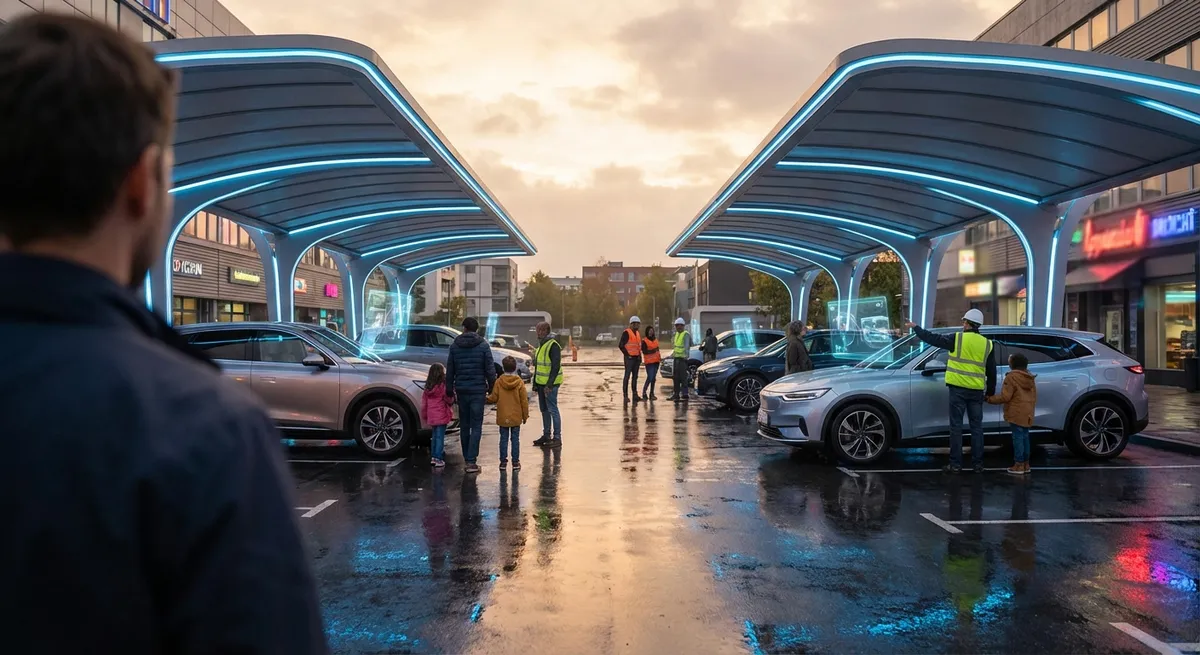
The biggest shift is the industry‑wide move in North America toward the North American Charging Standard (NACS), originally developed by Tesla. A long list of major automakers has announced plans to adopt NACS ports on future EVs, while also gaining access to Tesla’s Supercharger network. For electric SUV drivers, this convergence reduces “charging anxiety” by expanding the number of reliable, high‑power stations available on key routes.
At the same time, public and private investment is flowing into highway and urban DC fast‑charging in the U.S. and Europe. Government programs, such as those funded under the U.S. Infrastructure Investment and Jobs Act, are specifically targeting gaps in fast‑charging coverage, with a focus on major corridors where larger SUVs are more likely to travel. The objective is to support predictable spacing between chargers (often every 50 miles or so on key interstate routes) and to ensure a minimum power level suitable for modern, large‑battery vehicles.
From a practical standpoint, this evolving landscape means SUV buyers should evaluate more than just peak charging speed claims. You’ll want to consider:
- Whether the vehicle supports NACS or comes with reliable adapters.
- How its charging curve behaves in the 10–80% window, where most real‑world fast‑charging happens.
- The automaker’s partnerships with specific networks and any integrated route‑planning that can precondition the battery for fast‑charging stops.
As standardization improves, electric SUVs will become far more viable for towing, ski trips, and multi‑state family road travel, not just local commuting.
4. Legacy Brands and New Entrants Are Redefining What an “SUV” Is
The SUV label has become elastic in the electric era, and both established manufacturers and newcomers are taking advantage of that flexibility.
Traditional brands are electrifying familiar nameplates to keep loyal customers on board—think of popular gas SUVs gaining BEV or PHEV counterparts. These models often preserve recognizable design cues and driving positions while integrating dedicated EV platforms underneath. They aim to deliver familiar practicality—cargo space, roof‑rack compatibility, towing capability—while improving efficiency and refinement.
At the same time, new EV‑only brands and startups are experimenting with configurations that don’t neatly fit older SUV categories. You’ll see:
- Coupe‑style electric crossovers optimized for aerodynamics more than boxy cargo capacity.
- “Adventure” EV SUVs with integrated roof systems, off‑road‑oriented drive modes, and emphasis on torque vectoring and underbody protection.
- Multi‑row electric family haulers that leverage skateboard platforms to maximize interior space with flat floors and short overhangs.
Underpinning many of these vehicles are highly modular platforms with shared components across sizes and segments. For performance‑minded buyers, that means common motor units, inverters, and suspensions can be tuned or scaled to create anything from an efficiency‑focused rear‑drive crossover to a high‑output, dual‑motor off‑road SUV.
The competitive dynamic between long‑established brands and aggressive new entrants is pushing the entire SUV market toward faster iteration cycles. Expect mid‑cycle updates to bring meaningful hardware changes—larger batteries, more efficient motors, upgraded driver‑assist hardware—rather than just cosmetic tweaks, especially in the EV space.
5. Software, Safety, and Over‑the‑Air Updates Are Becoming Core SUV Features
While our prior coverage has touched on ownership models and software trends at a high level, what’s changing now is how deeply software defines the day‑to‑day behavior of modern SUVs.
Over‑the‑air (OTA) update capability is moving from novelty to baseline expectation in new electric and electrified SUVs. Beyond infotainment tweaks, manufacturers are increasingly using OTA to adjust:
- Battery management systems, which can improve usable range or charging behavior.
- Torque distribution between axles and stability control logic for better traction, towing stability, or off‑road performance.
- Driver‑assist algorithms for lane‑keeping, adaptive cruise control, and automated lane changes, often bringing better performance over time.
On the safety front, regulators and rating agencies are evolving their test procedures to account for advanced driver‑assistance systems (ADAS) and the heavier weights typical of battery‑electric SUVs. Organizations like Euro NCAP and the IIHS are refining their crash tests and active safety evaluations to ensure large electric SUVs manage crash energy effectively and protect occupants of smaller vehicles in collisions. Automakers, in turn, are responding with stronger body structures, improved crumple‑zone tuning, and more sophisticated sensor suites (radar, LiDAR in some cases, and higher‑resolution cameras).
For enthusiasts and serious buyers, the key change is that your SUV’s dynamic behavior, safety features, and efficiency are no longer frozen at the moment of purchase. The vehicle you buy in 2025 might drive and charge noticeably better in 2027 due to software and calibration updates. That makes it crucial to evaluate each automaker’s track record on OTA support, transparency about update content, and how long they commit to delivering critical software and security updates after sale.
Conclusion
The SUV segment is undergoing one of the most intense periods of transformation in its history, driven by regulatory pressure, rapid advances in battery and charging technology, and a wave of new competitors. Electric and electrified SUVs are moving from compliance afterthoughts to the core of global product strategies.
For car enthusiasts and informed buyers, that shift creates both opportunity and complexity. The best choices over the next few years will come from understanding not just horsepower and cargo volume, but also battery chemistry, charging standards, software support, and the regulatory forces driving automakers’ product plans.
Whether you’re cross‑shopping plug‑in hybrids against full battery‑electric SUVs, or simply trying to time your next upgrade, keeping an eye on these five industry trends will help you choose an SUV that stays relevant—technically and financially—well into the next decade.
Sources
- U.S. Environmental Protection Agency – Multi‑Pollutant Standards for Light‑Duty Vehicles – Details on new U.S. emissions regulations influencing automaker powertrain strategies
- European Commission – Reducing CO₂ Emissions from Cars – Overview of EU CO₂ fleet targets and 2035 internal combustion phase‑out plans
- U.S. Department of Energy – Alternative Fuels Data Center: Electric Vehicle Batteries – Technical background on EV battery chemistries and performance characteristics
- Joint Office of Energy and Transportation – National Electric Vehicle Infrastructure (NEVI) Formula Program – Information on U.S. federal investments in fast‑charging corridors
- IIHS – Electric Vehicles and Safety – Research on crash safety, weight, and crashworthiness trends for electric vehicles, including SUVs
Key Takeaway
The most important thing to remember from this article is that this information can change how you think about Industry News.