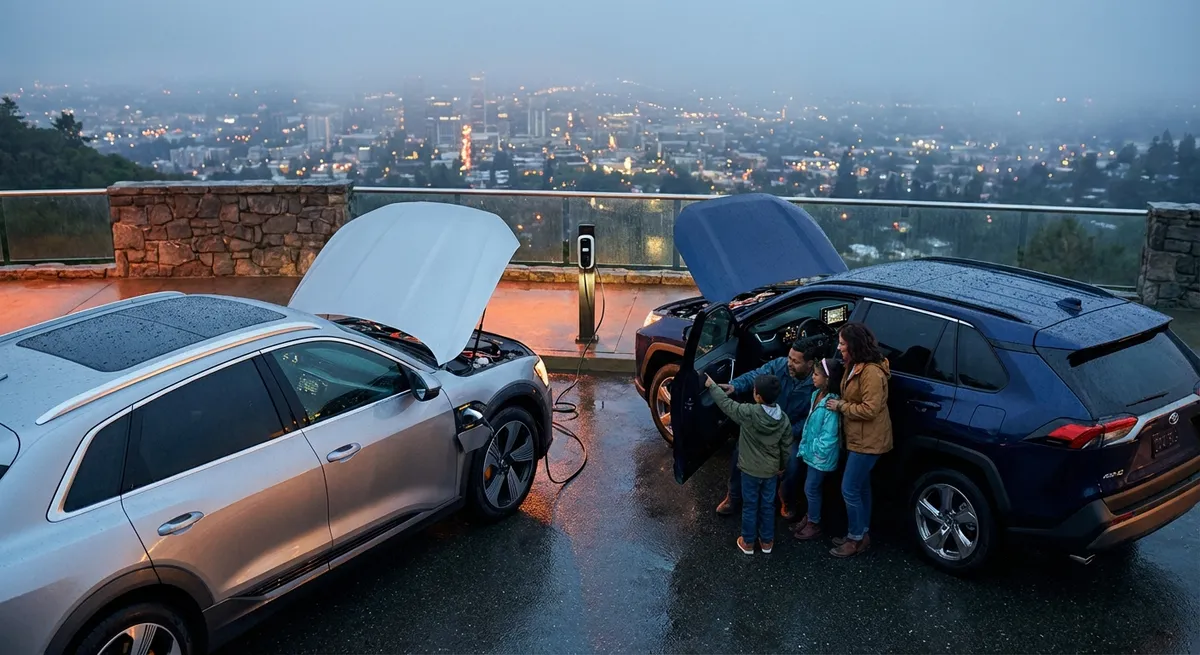
Electric and hybrid SUVs are no longer niche experiments—they’re central to how automakers are reshaping lineups for the next decade. Yet for many buyers, the choice between a full battery-electric SUV (EV) and a hybrid (HEV or PHEV) is still confusing. Both promise lower running costs, advanced tech, and environmental benefits, but they deliver those advantages in very different ways.
This comparison breaks down the real-world trade-offs that matter to SUV shoppers: performance, range and charging, ownership costs, long‑term reliability, and how well each type suits different driving profiles. The focus is on practical, technical insight you can actually use before signing a lease or writing a check.
Powertrain Architecture and Performance Feel
From the driver’s seat, the most obvious difference between electric and hybrid SUVs is how they deliver power—and how that feels on the road.
A battery-electric SUV uses one or more electric motors powered solely by a large traction battery (typically 60–120 kWh in mainstream models). There’s no engine, transmission in the traditional sense, or fuel system. Instead, most EV SUVs use a single-speed reduction gear and deliver peak torque from 0 rpm. This is why models like the Tesla Model Y, Kia EV6, or Ford Mustang Mach-E feel instantly responsive off the line, even in non-performance trims.
A conventional hybrid SUV (like a Toyota RAV4 Hybrid or Honda CR‑V Hybrid) combines a smaller battery (usually 1–2 kWh) with an internal combustion engine and one or more electric motors. These systems are optimized for efficiency rather than pure electric driving. At low speeds and light loads, the electric motor handles more of the work; at higher speeds or under heavy acceleration, the engine and motor blend power. The hand-off between them has become smoother with each generation, but you still feel—and hear—the engine engage, especially under hard acceleration.
Plug-in hybrid SUVs (PHEVs) occupy the middle ground. They use a significantly larger battery (typically 10–25 kWh) that can support 20–50 miles of electric-only driving in real conditions. Once that battery is depleted, they revert to operating like a regular hybrid. PHEVs like the Toyota RAV4 Prime, Hyundai Tucson PHEV, or BMW X5 xDrive50e can feel very EV‑like in urban use, then behave like efficient gasoline SUVs on road trips.
From a performance standpoint:
- EV SUVs typically deliver more consistent, linear acceleration, particularly for passing and merging, because peak torque is available instantly and there’s no shifting.
- Hybrids balance power delivery through software, engine tuning, and electric boost. They’re often quick enough for daily use but rarely match the immediate shove of a comparable EV.
- PHEVs can feel the most complex: electric-only mode is smooth and quiet, but when the engine cuts in, you can sometimes feel the transition and hear a step change in noise and vibration, especially under load.
Enthusiast drivers often prefer EVs for instant throttle response and low center of gravity (batteries in the floor lower the SUV’s mass), which improves stability in corners. However, hybrids can feel lighter and more agile in certain cases simply because they typically carry smaller, lighter battery packs, which matters on tighter back roads.
Range, Refueling, and Real-World Usability
Range anxiety is still a deciding factor for SUV buyers—especially those coming from large gas tanks and 400+ mile highway ranges. Understanding how range and refueling differ between EVs, HEVs, and PHEVs is crucial.
Electric SUVs:
- Typical EPA-rated ranges for mid-market EV SUVs now sit in the 240–330 mile bracket, depending on battery size, aerodynamics, and drive configuration (single vs dual motor).
- Real-world range can vary significantly with temperature, speed, and load. Highway driving at 75 mph, winter conditions, rooftop boxes, or towing can trim 15–35% off the rated range.
- DC fast charging infrastructure is improving rapidly, but charge times and availability still vary by region. Many modern EVs can charge from ~10% to 80% in 25–35 minutes on a high-power charger (150 kW+), but that assumes ideal station power and optimal battery temperature.
Conventional hybrids:
- Generally maintain gas-SUV-comparable ranges of 500+ miles on a tank, because efficiency gains from hybridization reduce fuel consumption while tank size remains similar to non-hybrid models.
- Refueling is identical to a standard ICE SUV—3–5 minutes at any gas station, with no dependency on charging networks.
- Electric-only driving is limited; the battery is constantly cycling between small state-of-charge windows, so you’re never relying on electricity for long stretches.
Plug-in hybrids:
- Offer a short EV range (commonly 25–45 miles EPA) for commuting and errands, which covers daily driving for many owners.
- After the battery is depleted, they function like a regular hybrid with full gas range, eliminating range anxiety on longer trips.
- Can be charged on Level 2 (240V) at home in 2–4 hours for most current PHEVs; fast charging is uncommon on PHEVs and usually not as high-powered as BEVs even when available.
In practice:
- If your daily mileage is modest and you can charge at home or work, a full EV SUV can cover 90–95% of your driving conveniently, especially in areas with strong charging infrastructure.
- If you routinely drive long highway distances or live far from urban centers, a hybrid or PHEV offers more flexibility and reduces dependence on public charging.
- PHEVs reward owners who plug in consistently; if you don’t, you carry the weight and complexity of the battery and electric hardware without gaining full efficiency benefits.
Ownership Costs, Energy Prices, and Incentives
Total cost of ownership (TCO) is more nuanced than “electric is cheaper” or “hybrid is safer.” It’s a combination of purchase price, energy costs, maintenance, insurance, and incentives, and it can vary widely by region.
Upfront pricing:
- EV SUVs often carry a price premium over comparable gasoline models, though that gap has been narrowing as battery costs decline.
- Conventional hybrids add modest cost over non-hybrid versions, while PHEVs generally sit between hybrids and EVs due to their larger battery packs and more complex hardware.
- In some markets, tax credits or rebates can substantially reduce EV and PHEV purchase prices, and certain hybrids may also qualify depending on local rules.
Energy and fuel costs:
- Per mile, electricity is usually cheaper than gasoline when charging at home, especially off-peak. For instance, running an EV SUV that averages 30 kWh/100 miles at $0.14/kWh is roughly $4.20 per 100 miles; a gasoline SUV at 30 mpg with fuel at $3.80/gal is about $12.70 per 100 miles.
- Public fast charging can be two to three times more expensive per kWh than home charging, narrowing or even erasing the fuel-cost advantage if you rely heavily on rapid chargers.
- Hybrids benefit from significantly improved mpg—many hybrid SUVs achieve mid‑30s mpg in mixed driving versus low‑20s for similar non-hybrids—so they still deliver concrete fuel savings without needing a plug.
- PHEVs offer the lowest energy cost if you use most of your miles in electric mode and charge at home, but can be less efficient than standard hybrids once running solely on gasoline due to added weight.
Maintenance and wear items:
- EVs eliminate oil changes, exhaust systems, spark plugs, and complex multi-speed transmissions. This typically results in lower routine maintenance costs and fewer mechanical failure points.
- Hybrids and PHEVs retain most ICE‑related service needs (oil, filters, coolant, etc.), but use regenerative braking extensively, which can extend brake pad and rotor life.
- All electrified powertrains rely on high-voltage battery systems, which are expensive to replace out of warranty but are generally covered 8–10 years or 100k–150k miles by manufacturers.
Insurance costs can be higher for EVs and PHEVs due to higher vehicle values and repair complexity, particularly for collision repairs involving battery enclosures or advanced driver assistance sensors. However, long-term fuel and service savings often offset this, especially for high-mileage drivers.
Durability, Battery Life, and Long-Term Reliability
A major question for SUV buyers planning to keep a vehicle 8–12 years is how the battery and electrified components will hold up over time.
Battery longevity:
- Most modern EV and hybrid batteries are designed to retain 70–80% of their original capacity by the end of their warranty period, typically 8 years or 100k–150k miles.
- Hybrids use their batteries in a narrower state-of-charge window and cycle them more frequently but less deeply, which has contributed to strong real-world longevity in models like the Toyota hybrid lineup.
- EV SUVs with large packs are more sensitive to fast charging habits, extreme heat, and sustained high-SOC storage. Frequent DC fast charging at high power can accelerate degradation compared to mostly Level 2 home charging.
- PHEVs can see a range of outcomes depending on usage: consistent plug‑in behavior and moderate temperature exposure generally support healthier batteries long-term.
Mechanical complexity:
- EV SUVs have fewer moving parts mechanically (no engine pistons, valves, turbochargers, or conventional transmission), which can reduce the number of potential failure points.
- Conventional hybrids and PHEVs are more mechanically complex than either a pure ICE or pure EV. They combine both systems plus power-split devices or multi-clutch transmissions, inverters, DC-DC converters, and multiple cooling loops.
- Proven hybrid systems from long-running platforms (e.g., Toyota Hybrid System, certain Honda or Ford hybrids) now have strong reliability records, but newer or more complex designs can have a steeper reliability learning curve.
Software and electronics:
- All electrified SUVs depend heavily on software, battery management systems (BMS), inverters, and power electronics. Software updates and recalls can significantly affect user experience, especially range estimation, charging behavior, and driveability.
- Over-the-air (OTA) updates—common on EV SUVs—can improve features or efficiency over time, but also add reliance on manufacturer support and connectivity.
From a long-term ownership perspective:
- If your priority is long-proven durability with some electrification benefits, conventional hybrids from brands with multi-decade hybrid experience remain a conservative choice.
- If you’re comfortable with a newer, software-rich platform and plan to maximize the advantages of electrification, an EV SUV can age well, provided its battery and charging strategy are managed intelligently.
- PHEVs can be excellent bridges, but their dual-system complexity means choosing a model with solid reliability data and a strong warranty is especially important.
Matching Powertrain to Your Driving Profile and Use Case
The best choice between electric and hybrid SUVs depends less on generic pros and cons and more on how—and where—you drive.
An electric SUV is usually the better fit if:
- You have reliable Level 2 home charging (or workplace charging) and don’t depend on public fast charging every day.
- Your typical daily driving is under 150–200 miles, with only occasional longer trips.
- You value smooth, quiet operation and strong off-the-line performance, and you’re attracted to the latest in-car tech ecosystems.
- You often drive in urban or stop-and-go conditions, where EVs are most efficient and regenerative braking is maximized.
A conventional hybrid SUV is often ideal if:
- You drive long distances regularly, especially in areas with limited charging networks.
- You want better fuel economy without changing your fueling routine or installing home charging equipment.
- You prioritize proven reliability and lower risk over cutting-edge tech.
- Your region has cold winters and you frequently face sub‑freezing temperatures, where hybrids’ dependence on gasoline avoids some winter EV range penalties and charging challenges.
A plug-in hybrid SUV makes the most sense if:
- You can plug in at home and your daily round-trip fits mostly within the electric range, but you still take regular long highway trips.
- You’re not fully comfortable going all‑electric yet but want to minimize gasoline use and test real-world EV living.
- Local incentives treat PHEVs favorably (e.g., access to HOV lanes, parking benefits, or purchase subsidies).
- You’re willing to manage charging actively to capture the full benefit; PHEVs reward engaged owners more than set‑and‑forget drivers.
For many households, the smartest move may be to combine powertrains across vehicles: an EV SUV as a primary commuter and family hauler for local use, and a hybrid or conventional ICE vehicle for long-distance travel and towing. Thinking about your annual mileage, trip patterns, climate, and home infrastructure up front will lead you to a powertrain choice that feels effortless in daily life rather than constrained by compromises.
Conclusion
Electric and hybrid SUVs are converging in the showroom, but they remain fundamentally different tools. Electric SUVs excel in refinement, performance, and low running costs—particularly for buyers with access to home charging and mostly predictable daily driving. Hybrids and plug-in hybrids provide flexibility and familiar refueling, while still delivering meaningful efficiency gains and lower emissions.
Choosing well is less about chasing the latest technology and more about aligning a powertrain with your real-world usage, infrastructure, and long-term ownership plans. When those pieces are matched correctly, both electric and hybrid SUVs can offer a driving experience that’s smoother, quieter, and more efficient than traditional gasoline-only models—just tailored to different kinds of drivers.
Sources
- U.S. Department of Energy – Fuel Economy: Electric Vehicles – Technical overview of EV efficiency, energy use, and operating cost comparisons
- U.S. Department of Energy – Fuel Economy: Hybrids – Explains how hybrid powertrains work, including efficiency and technology details
- EPA – Green Vehicle Guide – Official information on electric and plug-in hybrid vehicles, emissions, and environmental impacts
- International Energy Agency – Global EV Outlook 2024 – Data-driven analysis of EV adoption, charging infrastructure, and market trends worldwide
- Consumer Reports – Guide to Car Hybrid & EV Batteries – Practical insights into battery longevity, warranties, and long-term reliability considerations
Key Takeaway
The most important thing to remember from this article is that this information can change how you think about Comparisons.