Choosing a modern SUV isn’t just about size or badge anymore—it’s about what kind of driver (and family) you are. Some models are tuned for comfort and cargo, others for steering feel and acceleration, and many try to walk the line between both. In the crosshairs for a lot of buyers: the choice between a mid-size two-row SUV and its three-row counterpart, often built on the same platform but engineered with very different priorities. This comparison framework is one of the most useful ways to cut through the spec-sheet noise and find the SUV that actually fits your life.
Below, we break down five detailed comparison angles that help car enthusiasts and serious shoppers evaluate these two SUV paths with clarity: packaging, powertrain and dynamics, technology, ownership costs, and long-term flexibility.
1. Packaging Trade-Offs: Space, Seating, and Everyday Usability
When comparing two-row and three-row SUVs—especially siblings built on the same architecture (think Honda Passport vs. Pilot, Hyundai Santa Fe vs. Palisade, or Ford Edge vs. Explorer)—the core difference is how engineers allocate the same basic footprint.
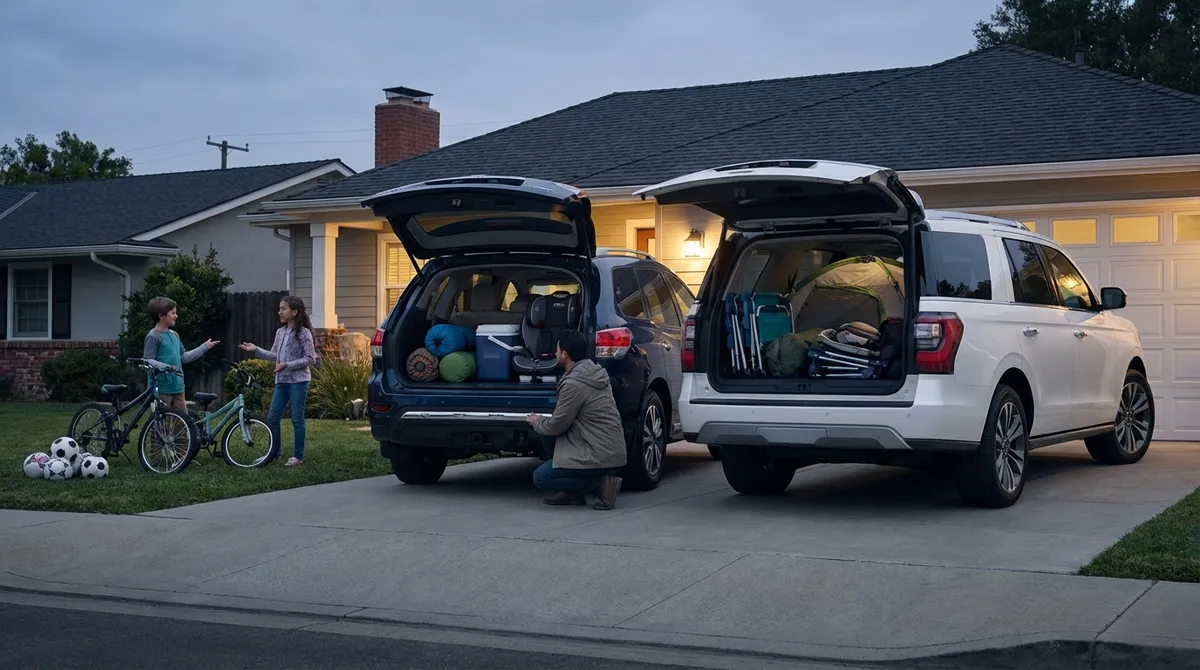
A two-row mid-size SUV usually gives you a more generous second row and a larger, more usable cargo area behind it. With no third-row hardware to package, automakers can lower the cargo floor, expand under-floor storage, and optimize the rear suspension geometry for both ride comfort and load capacity. This often translates into easier loading angles for strollers, mountain bikes, and bulkier home-improvement runs. Cargo volumes with seats up in two-row mid-size SUVs often rival or exceed three-row models with their third row in use.
Three-row SUVs prioritize passenger capacity, but that doesn’t automatically equal better practicality. The third row is frequently best suited for children or shorter trips, given limited legroom and a higher hip point. Access is another consideration: some models offer tilt-and-slide second-row seats that can still allow access with child seats installed, while others require more contortions. Families should test how easily kids can get in and out on their own, and whether adults can tolerate the third row for more than 20–30 minutes.
The weight and bulk of a three-row SUV also affect tight parking situations and garage fit. A two-row SUV on the same platform will often be a few inches shorter and slightly narrower, which can matter in urban settings, older garages, or tight driveways. For buyers who rarely need more than five seats, the packaging advantages of a two-row layout—more cargo per inch of length, better rear visibility, and less complex folding-seat mechanisms—are often the more rational choice.
2. Powertrain and Dynamics: How Size and Weight Change the Drive
Comparing SUVs within the same family is an efficient way to understand how added seats and structure change the driving experience. A three-row version built on the same chassis usually carries an extra 200–500 pounds, sometimes more, due to added body structure, seats, glass, and sound-deadening. That weight affects everything—acceleration, braking distances, cornering behavior, and fuel economy.
With shared powertrains, the lighter two-row SUV typically feels noticeably more responsive. Turbocharged four-cylinders that feel just adequate in a three-row can feel genuinely energetic in a two-row configuration, thanks to a better power-to-weight ratio. For example, a 2.5L or 2.0L turbo in the 250–280 hp range can deliver brisk passing performance in a mid-size two-row, while the same engine in a loaded three-row may need to downshift more often and work harder on grades or when fully loaded with passengers.
Suspension tuning also diverges. Three-row SUVs often run slightly firmer spring rates and different damper calibration to control body motions with seven passengers and luggage on board. That can make them feel more substantial and planted on the highway, but also a bit less agile in tight corners. Two-row counterparts can be tuned with more emphasis on turn-in response and mid-corner composure, resulting in a more “driver’s SUV” feel even when they share the same basic MacPherson-strut front and multi-link rear suspension layouts.
Wheel and tire choices further accentuate the differences. Three-row family haulers often ship with taller-sidewall tires to protect ride quality and durability when fully loaded, while sportier two-row variants may get lower-profile rubber and larger wheels for more precise steering and more immediate feedback. Shoppers comparing these should look closely at curb weight, torque curves, and tire sizes, and—crucially—test drive back-to-back on the same roads.
3. Technology, Safety Suites, and Cabin Experience
From a tech perspective, two-row and three-row SUVs from the same brand usually share infotainment platforms and driver-assistance suites, but implementation can differ in ways that matter to both enthusiasts and families.
Three-row SUVs frequently offer more rear-seat tech: additional USB-C ports in the third row, rear climate control zones, optional ceiling or seatback entertainment, and higher-output AC inverters. Families who routinely run multiple tablets, laptops, and gaming devices should check how many charging points are available behind the first row, and whether the rear climate system has independent controls or only basic vents.
The front-row experience can diverge too. Some brands reserve their highest-end audio systems and full-width digital displays for the larger, more expensive three-row models, while the two-row variant might offer a slightly smaller center screen or fewer premium options. Others treat the two-row as the more “lifestyle” or enthusiast product and outfit it with more heavily bolstered seats, driver-focused interfaces, and sports steering wheels, while the three-row leans into softer seating and more wood or brightwork trim.
On the safety side, advanced driver-assistance systems (ADAS)—such as adaptive cruise control with lane centering, blind-spot monitoring, rear cross-traffic alert, and automatic emergency braking—are increasingly standard across both configurations. However, towing-oriented three-row SUVs may offer more sophisticated camera systems (surround-view with trailer guidelines, hitch view) and more robust stability-control logic for trailer sway mitigation. Larger SUVs sometimes also integrate more extensive parking aids, like automated parking or active rear braking, to compensate for longer overall length and reduced rear visibility.
The cabin acoustics are another subtle but important comparison point. Three-row SUVs have more interior volume to manage, which can introduce more resonance and require extra sound insulation. Two-row versions can feel quieter with the same level of insulation, particularly in the rear. Conversely, some high-end three-row models add laminated glass in more positions and extra underbody sealing that the two-row sibling might not receive. Look at sound-insulation details in spec sheets and take test drives on coarse pavement at highway speeds to evaluate noise intrusion.
4. Ownership Costs, Efficiency, and Real-World Towing
Running costs are where the platform sharing between two-row and three-row SUVs becomes especially clear in comparative shopping. With similar engines and drivetrains, routine maintenance pricing tends to be close, but fuel consumption and consumables (tires, brakes) often diverge.
The heavier three-row configuration usually carries a modest fuel-economy penalty—often 1–3 mpg combined versus its two-row counterpart with the same engine and drivetrain. For commuters logging 15,000–20,000 miles per year, that difference can add up over a typical 8–10 year ownership cycle. Insurance premiums may also be marginally higher for higher-MSRP three-row models, particularly if they include more expensive driver-assist sensors and additional glazing.
Tires and brakes are another differentiator. Three-row SUVs, especially those with higher tow ratings, may be equipped with larger-diameter brake rotors and higher-load-rated tires, which can cost more to replace. They may also wear slightly faster if the vehicle is regularly loaded close to its gross vehicle weight rating (GVWR). When comparing models, buyers should check tire sizes and load ratings as well as scheduled maintenance intervals for brake inspections and fluid changes.
Towing is one category where three-row SUVs often take the lead, but not universally. Some two-row variants are actually tuned as the towing specialists in the lineup, with available heavy-duty cooling, factory trailer-brake controller integration, and rear-axle gearing optimized for pulling. In either case, the critical numbers are maximum tow rating, payload capacity, and tongue-weight limits. SUV shoppers who plan to tow campers, boats, or enclosed trailers should look beyond headline tow ratings and compare gross combined weight rating (GCWR), axle-load ratings, and whether the available tow package changes suspension or cooling components.
Hybrid and plug-in hybrid variants complicate this comparison further. In many lineups, the electrified powertrain is initially offered in the two-row vehicle first, making it the more efficient choice and sometimes the quicker one, too, thanks to the instant electric torque. As three-row hybrids become more common, their combined output and battery packaging can significantly affect both efficiency and usable cargo space, so buyers should pay attention to underfloor storage and spare-tire provision in addition to EPA ratings.
5. Long-Term Flexibility: Resale, Upgrades, and Life-Stage Changes
SUV comparisons shouldn’t stop at what you need this year. The more insightful approach is to ask how each configuration will fit your life five or ten years down the road—and how the market tends to value them over time.
Three-row SUVs often command stronger demand on the used market in family-heavy regions, thanks to their seating capacity. However, they are also more likely to have been used at or near full load, which can accelerate wear on suspension components, seats, and interior trim. Two-row SUVs may have slightly smaller buyer pools but can appeal strongly to empty-nesters, outdoor enthusiasts, and drivers who want space without bulk. In some markets, this translates into very similar real-world resale values between two-row and three-row siblings when you normalize for original MSRP.
For enthusiasts, the two-row SUV frequently offers more modification headroom. Less weight and simpler rear packaging can make them more receptive to upgraded dampers, sway bars, performance tires, and even mild powertrain tuning while preserving daily usability. Three-row SUVs can be upgraded too, but the focus often shifts to overlanding builds—roof racks, all-terrain tires, air springs, and auxiliary power for camping setups—rather than aggressive handling packages.
Life-stage flexibility is the most personal factor. A young couple planning to start a family might find a three-row to be “future-proof,” but if they live in a dense city with limited parking, the penalty in maneuverability and running costs might not be worth it. Conversely, buyers who only occasionally need extra seats might find that a mid-size two-row SUV plus occasional rentals of a minivan or full-size SUV for big trips is a more cost-effective and enjoyable strategy.
The key is to compare not just specs, but scenarios. Map out how often you’ve actually needed more than five seats in the past year (or two), versus how often you’ve wished for more cargo room, better fuel economy, or easier parking. Use that real-world data as the lens through which you view the two-row vs. three-row comparison—on paper and behind the wheel.
Conclusion
Lining up a two-row SUV against its three-row counterpart from the same brand is one of the most revealing comparisons a shopper can make. It highlights how seemingly small differences in weight, packaging, and tuning cascade into noticeable changes in performance, comfort, operating costs, and day-to-day practicality. For some buyers, a three-row SUV is an indispensable family tool; for others, the added seats are more burden than benefit compared to a more agile, efficient two-row.
Enthusiasts and careful buyers should systematically evaluate packaging, driving dynamics, technology, ownership costs, and long-term flexibility. Test-driving comparable models back-to-back on the same route, loaded the way you actually drive, will confirm what the numbers suggest. In a market crowded with options, this focused comparison approach brings clarity—and makes it much more likely that the SUV you pick will still feel like the right choice years down the road.
Sources
- U.S. Department of Energy – Fuel Economy Guide - Official fuel-economy data for comparing two-row and three-row SUVs across model years
- National Highway Traffic Safety Administration (NHTSA) - Crash-test ratings and safety information for SUVs of different sizes and seating configurations
- Insurance Institute for Highway Safety (IIHS) - Detailed safety ratings, including child-seat anchor ease-of-use, helpful when comparing family-focused SUVs
- Honda – Pilot vs. Passport Comparison - Example of how a brand differentiates two-row and three-row SUVs on the same platform
- Hyundai – Palisade vs. Santa Fe Overview - Manufacturer comparison illustrating packaging and feature differences between related SUVs
Key Takeaway
The most important thing to remember from this article is that this information can change how you think about Comparisons.