Choosing a three-row SUV in 2025 isn’t just about badge prestige or brochure horsepower. For families, road-trip warriors, and car enthusiasts who double as weekend shuttle drivers, the real value shows up in the details: how the drivetrain behaves in traffic, how the third row feels after an hour, how much tech you get without locking vital features behind subscriptions. This comparison-focused deep dive breaks down the critical dimensions where modern three-row SUVs genuinely diverge—beyond the marketing slogans.
Powertrain Character: Turbo V6, Hybrid, or Full EV?
For many buyers, the first big fork in the road is the powertrain. On paper, three-row SUVs increasingly look similar: 250–400 hp, automatic transmissions, optional all-wheel drive. In practice, their personalities differ dramatically.
Turbocharged four-cylinders and V6s remain the dominant choice in mainstream and premium models. They typically offer strong mid-range torque, which matters when merging onto freeways with a full load of passengers and cargo. A turbocharged 2.0–2.5L four-cylinder may deliver 270–300 hp, but the real story is torque curves that peak as low as 1,600–2,000 rpm, giving responsive acceleration without constant downshifts. V6 options often feel smoother at higher rpm and may be better suited for sustained highway passing or towing, thanks to more displacement and more effortless power delivery.
Hybrids add electrical assistance that can completely change the driving experience in city conditions. Many modern three-row hybrid systems can pull away from a stop in near-silence under electric power and then blend in the gasoline engine as speed builds. Beyond EPA fuel-economy numbers, attention should be paid to system integration: some hybrids suffer from noticeable transitions between electric and gas power, while others are nearly seamless. Enthusiasts should look at combined system output (hp and lb-ft) and also note the battery’s capacity and placement, which can affect cargo space and third-row packaging.
Full electric three-row SUVs are finally emerging, appealing to buyers who want instant torque and near-silent operation. For these, compare not just peak horsepower but also usable range at highway speeds with passengers and gear on board—real-world range often falls 15–25% below official ratings when fully loaded and traveling at typical freeway speeds. DC fast-charging capability (peak kW and charge curves) is crucial if the SUV will be used for long road trips. Additionally, consider how the heavy battery pack (often 1,000+ lb) affects suspension tuning, ride, and braking distances.
Drivetrain and Towing: AWD Systems Aren’t Created Equal
The “AWD” badge conceals significant differences in hardware and software. Traditional mechanical all-wheel-drive systems rely on a center differential or a clutch pack to distribute torque front-to-rear, sometimes aided by a locking function for low-traction situations. More advanced systems incorporate torque-vectoring differentials or use selective braking to send power to the wheel with the most grip. Technical spec sheets may list “torque vectoring,” but real-world performance depends on the speed and intelligence of the control algorithms.
Some three-row SUVs are front-wheel-drive-based platforms with on-demand AWD that primarily sends power to the rear only when slip is detected. These setups are efficient and adequate for rain and light snow, but they may feel less confidence-inspiring if you frequently drive unpaved roads, steep gravel driveways, or heavy snow. Rear-drive-based architectures with full-time AWD generally provide better balance under power, more consistent traction, and often higher tow ratings.
Towing capability is another major differentiator that spec sheets can oversimplify. You’ll often see tow ratings of 3,500 lb, 5,000 lb, and 6,000+ lb across the segment. Beyond the headline rating, examine the following:
- Cooling capacity: Higher tow ratings typically require specific packages (heavy-duty cooling, trailer wiring, and sometimes upgraded alternators).
- Torque delivery: Low-end torque and transmission gearing matter more than peak hp when pulling a trailer up grades.
- Wheelbase and suspension tuning: Longer wheelbases and firmer rear suspensions tend to provide better trailer stability.
- Integrated trailer tech: Trailer sway control, integrated brake controllers, and camera systems (hitch-view, surround-view while maneuvering a trailer) can drastically improve user confidence.
Full EV three-row SUVs often have impressive torque but may have significantly reduced range while towing—often cutting rated range nearly in half—so compare real-world towing tests where available.
Cabin Packaging and Real Third-Row Usability
Two three-row SUVs with similar exterior dimensions can feel vastly different inside because of clever (or not-so-clever) packaging. Enthusiasts who care about chassis dynamics tend to prioritize low seating positions and a natural driving posture, but families also need genuinely usable second and third rows.
Judge third-row usability by more than just spec-sheet legroom:
- H-point (hip-point height): A higher hip point can make ingress/egress easier for adults and older passengers.
- Toe room: Even with decent legroom, limited space to slide feet under the second-row seats can make the third row uncomfortable on longer trips.
- Seat base height and angle: A low, flat cushion will leave adults with knees uncomfortably high (“knees to chest”), while a better-angled seat base and slightly raised floor can improve long-term comfort.
- Access mechanisms: Tumble-and-slide second-row seats (even with child seats installed, where possible) are a major convenience; some SUVs only partially slide or require removing child seats entirely.
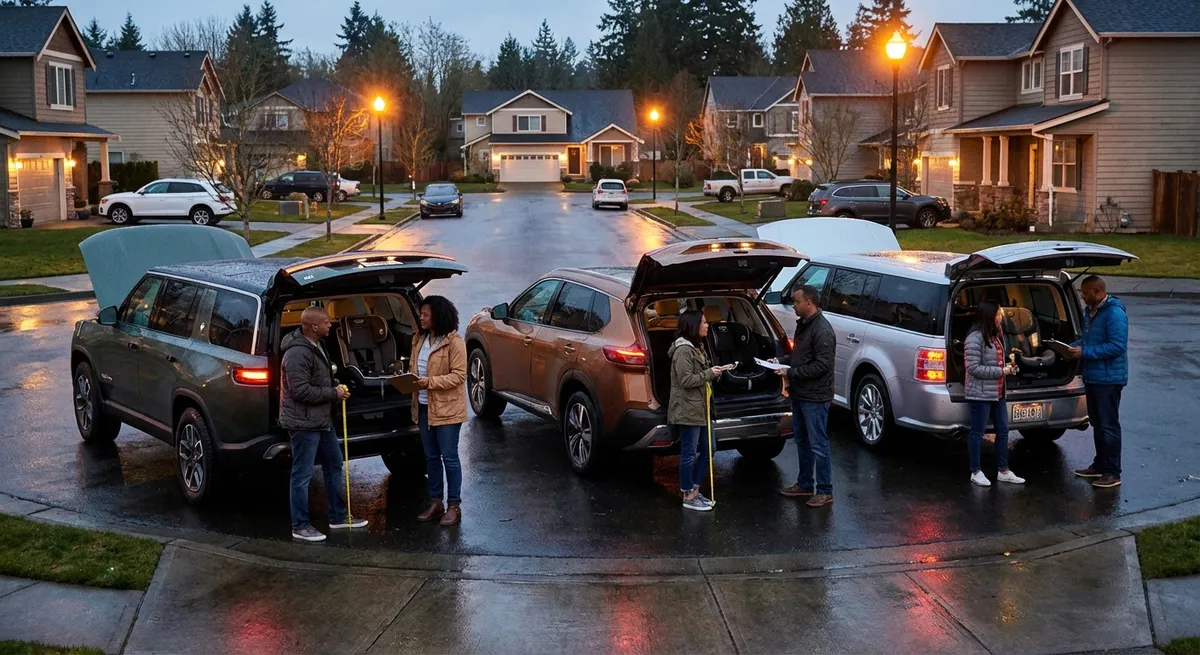
Cargo volume behind the third row is another place where the numbers can be misleading. Manufacturers may quote volume to the roofline, which isn’t practical for visibility or safety. Look for how many carry-on suitcases or standard grocery bags fit with all seats up, and examine the shape of the cargo area: a long floor with a low liftover height is more useful than an oddly shaped, shallow well. Split-folding seatbacks with an almost-flat load floor turn the SUV into a pseudo-cargo van when needed; check if any power-fold system is fast and robust rather than gimmicky and slow.
Ride, Handling, and NVH: Where Comfort and Control Diverge
Three-row SUVs face a difficult compromise: they must carry seven or eight people comfortably yet still satisfy drivers who care about steering feedback and body control. Under the skin, platform choices, suspension hardware, and noise-control strategies all play important roles.
Suspension layout is a good starting point. Independent rear suspensions typically offer a better blend of ride and handling than solid rear axles, especially when the third row is occupied. Higher-end three-row SUVs may offer adaptive dampers or air suspension, allowing the vehicle to switch between softer, comfort-oriented tuning and firmer, more controlled settings for spirited driving or heavy loads. Air suspensions can also adjust ride height, lowering for easier entry and loading or raising for mild off-road use; pay attention to whether ride quality changes noticeably when height is altered.
Body control—how the vehicle manages pitch and roll—is critical in a tall, heavy three-row SUV. Models with well-tuned anti-roll bars, wider tracks, and low-mounted batteries (in the case of EVs) may corner surprisingly flat, instilling more confidence in evasive maneuvers. On the flip side, overly soft setups can lead to excessive body motions over undulating highways, which may cause motion sickness for rear passengers.
NVH (noise, vibration, and harshness) is more than just decibel levels. Wind-tunnel-optimized shapes, acoustic laminated glass (often on front side windows as well as the windshield), active engine mounts, and improved door seals all contribute to a cabin that stays calm at 70–80 mph. Hybrids and EVs remove much of the powertrain noise, which makes other sounds—road roar from the rear wheel wells, suspension thumps, or poorly isolated third-row areas—more obvious.
Test drives should include highway segments and imperfect pavement with the third row occupied whenever possible. Some three-row SUVs that feel solid up front can reveal booming or resonance in the rear-most section, which is important if you regularly carry passengers back there.
Technology, Safety, and Long-Term Ownership Considerations
Comparison charts often reduce technology to screen sizes and speaker counts, but for three-row SUVs that may be kept for 8–10 years, software architecture and upgrade policies matter just as much. Infotainment systems now control everything from navigation to climate, and some manufacturers are moving more features behind software-based subscriptions.
Look at whether the SUV supports both Apple CarPlay and Android Auto (wired or wireless) and whether the native navigation system includes EV routing (for electric models), over-the-air (OTA) map updates, and real-time traffic. Pay attention to how quickly the system boots from a cold start and how responsive the interface feels; lag and crashes become tiresome over daily use. Rear-seat entertainment options, USB-C ports in all three rows, and robust Wi‑Fi hotspots are increasingly important for family road trips.
Advanced driver-assistance systems (ADAS) are another key comparison point. Many three-row SUVs now include standard features like automatic emergency braking, lane-keeping assist, blind-spot monitoring, and adaptive cruise control. The differentiation is in the execution: systems that gently assist and clearly communicate their status tend to earn owner trust, while overly aggressive or inconsistent lane-keeping can lead drivers to turn features off entirely. For buyers considering partial hands-free systems on limited-access highways, examine whether the vehicle uses live driver monitoring (camera-based) and what road networks are supported.
Long-term ownership considerations go beyond warranty coverage. For ICE and hybrid models, look at recommended service intervals, transmission fluid-change requirements, and timing-belt vs. timing-chain designs. For EVs, consider battery warranty terms (often 8 years/100,000 miles or more), the manufacturer’s track record with software updates, and whether the platform supports future improvements in fast-charging technology. Also note how dependent critical features are on cloud connectivity; navigation and media can safely degrade when offline, but climate control or seat adjustments should not rely on remote services.
Resale value and reliability histories from independent sources can round out the comparison. Some three-row SUVs with modest sticker prices may cost more in the long run due to depreciation, frequent repairs, or expensive wear items (such as large, low-profile tires that wear quickly and cost more to replace). Evaluating total cost of ownership means balancing purchase price, fuel or electricity costs, insurance rates, maintenance, and expected residual value.
Conclusion
Three-row SUVs occupy a demanding niche: they must be capable family haulers, comfortable long-distance cruisers, and, for many buyers, satisfying machines to drive. A meaningful comparison looks past surface-level specs to powertrain character, AWD and towing engineering, real third-row livability, chassis tuning, and the robustness of their tech and safety ecosystems. By focusing on these deeper points, enthusiasts and family buyers alike can differentiate between models that simply look similar on paper and those that truly match their priorities in the real world.
Sources
- U.S. Department of Energy – Fuel Economy Guide - Official fuel economy data and powertrain details for SUVs, including hybrids and EVs
- IIHS – Vehicle Ratings - Independent crash-test and safety ratings for a wide range of three-row SUVs
- NHTSA – 5-Star Safety Ratings - Federal safety evaluations and recall information relevant to family-oriented SUVs
- SAE International – Vehicle Electrification Resources - Technical background on hybrid and EV systems, charging, and standards
- Consumer Reports – SUV Road Tests and Reliability - Comparative road tests, owner-reported reliability, and long-term ownership insights for SUV shoppers
Key Takeaway
The most important thing to remember from this article is that this information can change how you think about Comparisons.