Choosing a midsize SUV today is less about “how big is the trunk?” and more about “what kind of life do I want this vehicle to support?” The segment has split into two clear personalities: comfort‑first family haulers and driver‑focused SUVs with real performance credentials. On the surface they look similar—two or three rows, elevated seating, all-wheel drive—but under the sheet metal the priorities, engineering decisions, and long‑term ownership experience can be very different. This comparison framework is designed to help both enthusiasts and everyday buyers decode where each SUV truly fits and how to match one to your use case.
1. Chassis & Suspension: Comfort Tuning vs Driver Engagement
At the core of the family vs driver’s SUV divide is the chassis philosophy—how rigid the body is and how the suspension is tuned. Family‑oriented models tend to prioritize isolation and predictability: softer spring rates, higher sidewall tires, and bushings engineered to filter out harshness rather than transmit road feel. Their steering racks are often tuned for light effort at parking speeds, with slower ratios that reduce the need for constant corrections on the highway but limit feedback through the wheel.
Driver‑focused midsize SUVs, by contrast, start with a stiffer structure and more aggressive suspension geometry. Multi‑link rear setups with firmer dampers, thicker anti‑roll bars, and lower‑profile performance tires help control body roll and sharpen turn‑in. You’ll commonly see adaptive dampers with selectable drive modes, allowing the same vehicle to range from compliant to genuinely taut. Steering racks may use variable ratios and higher effort, giving clearer feedback about front‑end grip. Enthusiasts should look for specifications like available adaptive or air suspension, dynamic chassis control systems, and tire sizing (width and aspect ratio) to gauge where a model really sits on the comfort‑sport spectrum.
2. Powertrains: Torque Curves, Towing, and Real‑World Responsiveness
While marketing materials fixate on peak horsepower, the more telling numbers for midsize SUVs are torque delivery, gearing, and how they align with intended usage. Family‑centric SUVs often rely on naturally aspirated four‑cylinders or modest‑output turbo engines tuned for smoothness and efficiency. Their torque curves may peak higher in the rev range, with transmissions programmed to upshift early and keep revs low. This favors quiet cruising and fuel economy but can make highway passing or steep grades feel labored when fully loaded.
Performance‑oriented SUVs, even within the same size class, typically use higher‑output turbocharged four‑cylinders, V6s, or performance‑hybrid systems. Their torque peaks earlier—often below 2,000–2,500 rpm—and stay flat across a broader band, which gives stronger mid‑range punch. Multi‑gear automatic transmissions (8–10 speeds) or dual‑clutch units can be calibrated for faster, more decisive shifts in sport modes. Enthusiasts should compare not just 0–60 mph times, but also:
- Torque peak (rpm) and curve shape, not just the maximum number
- Final drive ratios and transmission gear spread
- Towing ratings and GCWR (gross combined weight rating) if they plan to haul
A family‑tuned SUV may tolerate more load with less drama—thanks to conservative tuning and better thermal management—while a performance SUV may prioritize short bursts of acceleration over continuous heavy towing. Reading between the lines of engine and transmission specs will reveal which mission the powertrain is truly optimized for.
3. Drivetrain & Traction Systems: All-Wheel Drive Is Not Created Equal
Both family and driver’s SUVs often advertise all‑wheel drive, but their systems can be fundamentally different in hardware and logic. Many family‑oriented models use front‑biased, on‑demand AWD with a simple electronically controlled clutch pack sending power rearward when slip is detected. This is efficient and predictable in poor weather, but less capable of proactive torque distribution during aggressive driving or off‑road use. Traction and stability control systems here are tuned primarily to prevent wheelspin and maintain understeer for safety.
Driver’s SUVs frequently employ more sophisticated AWD architectures: rear‑biased systems, active center differentials, or dual‑clutch rear axles capable of true torque vectoring side‑to‑side. In practice, this can send more torque to the outside rear wheel in a corner to rotate the vehicle and reduce understeer. Some performance models offer fully variable torque distribution (e.g., 0–100% to the rear axle) depending on drive mode and conditions. These setups support higher cornering speeds and more playful handling, though with complexity that can impact long‑term maintenance and tire wear.
Potential buyers should review:
- Whether the AWD system is front‑ or rear‑biased by design
- Availability of selectable off‑road or performance drive modes
- Presence of a mechanical limited‑slip differential or electronically simulated torque vectoring
Family users in snowbelt regions may be well served by a simpler, proven on‑demand AWD. Enthusiasts who prioritize balance and dynamic capability should lean toward rear‑biased or torque‑vectoring systems, accepting the trade‑offs in cost and complexity.
4. Interior Packaging: Third-Row Reality, Cargo Utility, and Driving Position
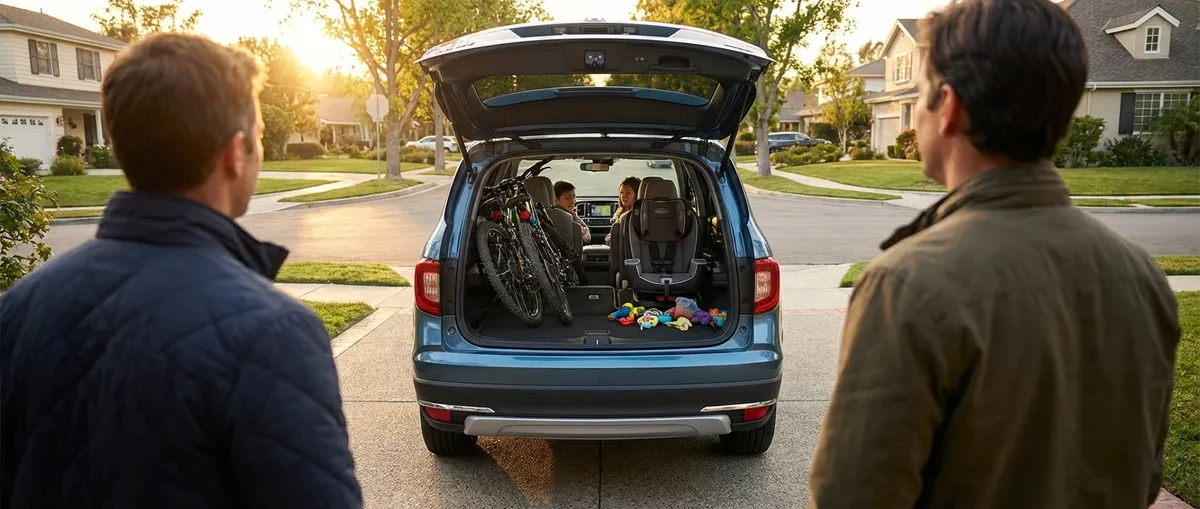
On paper, many midsize SUVs appear similar in volume, but how that space is allocated reveals their priorities. Family SUVs tend to maximize vertical space, headroom, and ease of access. Second rows may slide and recline generously, with wide door openings and low step‑in heights. Third‑row seating, when offered, is often designed for frequent use by children: slightly raised seat cushions, cupholders, and rear climate controls. Materials are chosen for durability—harder plastics in high‑touch areas, stain‑resistant fabrics, and straightforward mechanical seat mechanisms to reduce the risk of failures.
Driver‑centric SUVs usually favor a more cocooned, cockpit‑like front row. You’ll see lower hip points, more bolstered seats, and center consoles that bring controls closer to the driver. Rooflines can be lower and more tapered, which may limit third‑row headroom or relegate that row to occasional use. Cargo areas might sacrifice ultimate cubic feet for a lower, flatter load floor that improves handling (by lowering the center of gravity) and practicality for luggage rather than bulky family gear.
Enthusiasts and buyers should scrutinize:
- Seating geometry (hip point height, thigh support, lateral bolstering)
- LATCH anchor locations and ease of installing child seats vs. adult comfort
- Cargo capacity behind the second and third rows, measured in liters or cubic feet
- Fold‑flat seat designs vs. “theater” seating that improves visibility but raises the center of gravity
For maximum family versatility, a truly usable third row and simple, robust folding mechanisms matter more than a raked roofline. For drivers who rarely carry more than four passengers, better driving position and front‑row ergonomics may rightly take precedence.
5. Technology & Long-Term Ownership: Software, Safety, and Total Cost
Both family haulers and performance SUVs are now software‑defined products to a degree, but the tech focus can differ in ways that affect ownership. Family‑oriented models often lead with advanced driver assistance systems (ADAS) bundled as standard: adaptive cruise control, lane‑keeping assistance, automatic emergency braking, and rear occupant alerts. Their infotainment is typically tuned for straightforward operation, multiple device support, and rear entertainment options rather than complex performance data.
Driver’s SUVs may emphasize configurable drive modes, performance telemetry, and head‑up displays showing rpm, g‑forces, and lap times. Their ESC (electronic stability control) and traction systems sometimes allow multi‑level intervention, from fully on to track‑friendly settings. Over‑the‑air (OTA) update capability is increasingly common across both types, but performance‑leaning models may see software changes that alter throttle mapping, shift logic, or even power output, whereas family SUVs prioritize bug fixes and new connectivity features.
From an ownership cost perspective:
- Insurance: Performance‑tuned SUVs with higher power outputs and expensive wheel/tire packages generally carry higher premiums.
- Maintenance: Larger brakes, performance tires, and complex AWD/torque vectoring hardware can increase routine costs.
- Depreciation: Family‑leaning models with mainstream powertrains and strong reliability reputations often retain value better, while niche performance variants may be more volatile.
Shoppers should review crash‑test ratings from independent agencies, ADAS availability across trims, and whether critical safety features are standard or paywalled. At the same time, enthusiasts should confirm that performance software features are not subscription‑locked or limited to top trims, as this can materially alter both experience and value over time.
Conclusion
Midsize SUVs now span everything from quiet, appliance‑like family transport to genuinely engaging driver’s tools wrapped in practical bodies. The key to choosing well is understanding that many of the differences hide in calibration and hardware details rather than just brochure headlines. Chassis tuning, torque characteristics, AWD architecture, interior packaging, and software strategy all reveal whether an SUV was engineered primarily for comfort, capability, or driving enjoyment.
By looking past marketing labels and focusing on the underlying technical and packaging choices, car enthusiasts and everyday buyers can quickly sort contenders into “family hauler” and “driver’s SUV” camps—and, in some cases, identify the rare models that manage to do both convincingly. Matching those engineering realities to your real‑world use cases will yield a vehicle that feels purpose‑built for your life rather than a compromise you outgrow in a few years.
Sources
- IIHS – Ratings for Midsize SUVs - Independent crash-test results and safety evaluations across the midsize SUV segment
- NHTSA – 5-Star Safety Ratings - U.S. government safety scores and recall information for specific SUV models
- EPA – Fuel Economy Guide - Official fuel economy data for midsize SUVs with different powertrains
- SAE International – Vehicle Dynamics and Handling - Technical reference on suspension design, chassis stiffness, and handling characteristics
- Consumer Reports – Midsized SUVs Buying Guide - Comparative overview of comfort, reliability, and ownership costs in the midsize SUV class
Key Takeaway
The most important thing to remember from this article is that this information can change how you think about Comparisons.