Choosing an SUV in 2025 is no longer just about size and price; it’s about how you plan to live with the vehicle every single day. Two clear philosophies dominate the market: the “family hauler” tuned for comfort, space, and safety, and the “driver’s SUV” built around performance, handling, and engagement. Many models now blur the lines, but the underlying engineering and feature choices still reveal where each SUV truly belongs. This comparison-focused guide breaks down how to evaluate modern SUVs through both lenses so you can match the vehicle to your real-world priorities—not just the brochure highlights.
Performance vs. Comfort: Understanding the Chassis and Powertrain Trade-Offs
Whether an SUV is optimized for family duty or driving enjoyment usually starts with how the chassis and powertrain are tuned. Family-focused SUVs generally prioritize ride isolation, using softer spring rates, more compliant bushings, and taller tire sidewalls to absorb impacts from poor roads, speed bumps, and potholes. Damping is often tuned for comfort, allowing more body motion but reducing harshness; electric power steering tends to be light for effortless low-speed maneuvering, especially in parking lots and school zones.
Driver-centric SUVs take almost the opposite approach. Stiffer springs, firmer dampers, and more aggressive anti-roll bars reduce body roll and keep the vehicle flatter in corners, which inspires confidence at higher speeds. The steering is usually heavier with quicker ratios to deliver better feedback and sharper turn-in. Powertrains also diverge: family haulers often favor naturally aspirated or small turbocharged engines tuned for smooth, low-end torque and quiet operation, while performance SUVs employ higher-output turbocharged or hybrid-assisted powertrains with sportier throttle response, shorter gearing, and transmission mapping that holds gears longer under acceleration.
All-wheel-drive (AWD) systems also reveal intent. Family-oriented systems are typically front-biased and reactive, sending power to the rear wheels only when slip is detected—good for fuel economy and traction in bad weather. Driver’s SUVs lean on more advanced, often rear-biased AWD or torque-vectoring setups that proactively send power where it can best aid cornering and acceleration. When comparing spec sheets, pay close attention to power-to-weight ratio, torque curve (where peak torque arrives), suspension type (torsion beam vs. multi-link vs. air), and whether adaptive dampers are available—these details tell you far more about on-road character than peak horsepower alone.
Space and Packaging: How Interior Layout Reflects the SUV’s Mission
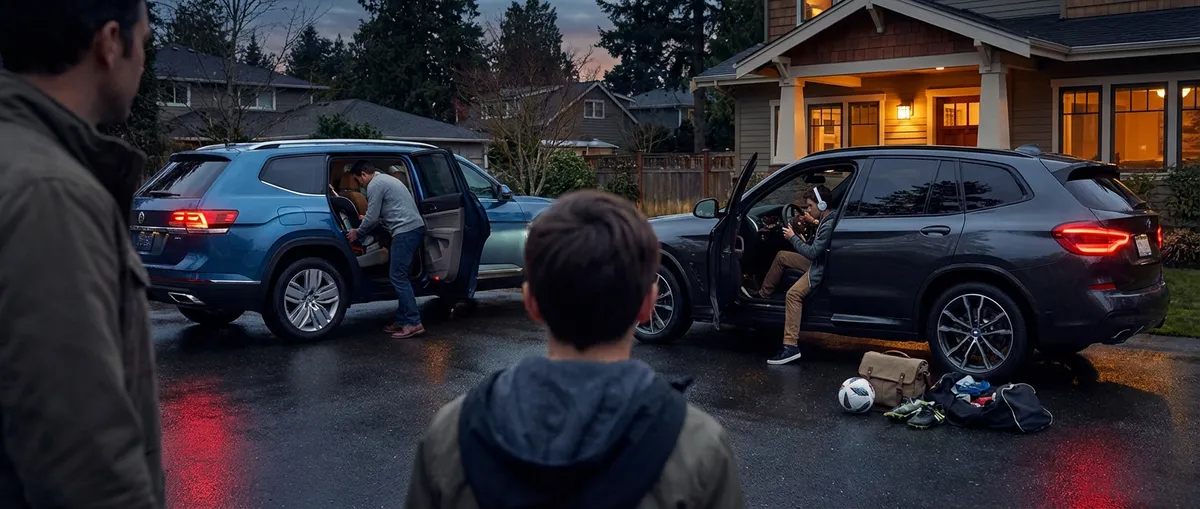
A quick sit in the cabin often reveals whether a model is intended as a family hauler or a driver’s SUV, even before you start the engine. Family-focused SUVs maximize usable volume and flexibility. Expect higher rooflines, more upright seating, and generous headroom to make child seat installation and rear-passenger ingress easier. Sliding and reclining second-row seats, available captain’s chairs, and a genuinely usable third row (with adequate knee and toe room) are common priorities. Cargo areas are typically more squared-off with low lift-over heights and wide openings to accommodate strollers, sports gear, and bulk shopping.
In driver-centric SUVs, the priority often shifts toward a more cocooned cockpit for the front occupants. You’re more likely to find a lower seating position, a higher center console, and more aggressive seat bolstering that holds you in place during spirited driving. The roofline may taper for style and aerodynamics, compromising some rear headroom and visibility. Cargo spaces might trade boxy practicality for sleeker design, with higher liftover heights or more pronounced wheel-arch intrusions that eat into usable width.
Seat configuration choices are critical for buyers torn between the two philosophies. If you regularly use all three rows, look for details like how easily the second row tilts and slides with child seats installed, whether the third row folds flat into the floor, and how much cargo remains with all seats up. For driver-focused buyers who only need occasional rear seating, a two-row SUV or a tighter third row might be a worthwhile trade for improved proportions, reduced weight, and better handling. Measured interior dimensions (legroom, headroom, shoulder room, cargo volume) are helpful, but real-world usability—door opening angle, step-in height, and seat ergonomics—should weigh just as heavily.
Safety, Driver Assistance, and the Different Priorities of Each Buyer
Family haulers and driver’s SUVs often share the same underlying safety technologies, but the emphasis and calibration can feel very different. For family-first shoppers, standard active safety is paramount: automatic emergency braking (AEB) with pedestrian and cyclist detection, lane-keeping assist, blind-spot monitoring, rear cross-traffic alert, and adaptive cruise control with stop-and-go are increasingly must-haves. Some family-focused models layer in driver-attention monitoring, rear-seat reminder systems, and wide-angle surround-view cameras to aid in tight parking lots and busy driveways.
In driver-oriented SUVs, these same systems may be present but tuned less intrusively so they don’t interfere with spirited driving. Lane-keeping systems might be less aggressive, and traction/stability control systems often feature sport modes or reduced intervention thresholds. Advanced adaptive cruise systems can double as semi-automated driving aids on highways, but on a driver’s SUV, the buyer may value easy on/off access and customizable levels of steering assist so the tech complements, rather than replaces, engagement.
Passive safety—crash structures, airbags, and occupant protection engineering—is identical or very close across all variants of a given model line, but ratings from organizations like the IIHS and NHTSA are still important when cross-shopping entirely different platforms. Look closely at small overlap crash test scores, headlight performance ratings, and rear-seat safety assessments, which can differ significantly between otherwise similar SUVs. For family haulers, rear-seat belt pretensioners, side-impact performance, LATCH anchor accessibility, and child-seat compatibility should be heavily weighted. For driver’s SUVs, braking performance, stability at the limit, and tire selection (all-season vs. high-performance) are equally relevant aspects of overall safety.
Infotainment, Controls, and the “Human-Machine Interface” Divide
Cabin technology is now a major differentiator, and the interface philosophy often reflects the SUV’s intended role. Family-centric SUVs tend to emphasize ease of use, minimal learning curve, and redundancy in controls so any driver in the household can quickly operate key functions. Large physical buttons for climate, volume knobs, and shortcuts for frequently used features are still common. Rear-seat entertainment options, multiple USB-C ports, wireless charging pads, and robust smartphone integration (Apple CarPlay/Android Auto) help keep passengers engaged and devices powered on long trips.
Driver’s SUVs may favor a more cockpit-like environment with integrated digital displays and a design emphasis on reducing perceived clutter. You’re more likely to see fully digital gauge clusters, head-up displays (HUDs), and multi-mode instrument layouts that change with drive modes. Some brands move most functions into a single central touchscreen or haptic interface; this can look sophisticated and feel premium, but it can also increase distraction if key controls are buried in menus. Enthusiast buyers may appreciate dedicated controls for drive modes, suspension settings, and exhaust sound, often placed on the steering wheel or center console for quick access.
When comparing models, evaluate not just the feature list but how quickly you can execute common tasks: adjusting temperature without taking eyes off the road, switching between audio sources, entering navigation destinations, and toggling driver-assistance features. Responsiveness (processor speed), screen glare in sunlight, voice recognition accuracy, and the quality of the backup and 360-degree cameras all impact daily usability. Family haulers demand predictability and simplicity for multiple drivers; driver’s SUVs should deliver fast, intuitive access to performance information—oil temp, boost pressure, G-meter—without compromising core usability.
Ownership Experience: Operating Costs, Resale, and Long-Term Fit
The long-term experience of owning a family hauler versus a driver’s SUV can diverge significantly, even if the initial purchase price is similar. Family-focused models often prioritize mainstream tire sizes, more relaxed brake specifications, and engines tuned for regular fuel, which helps contain running costs. Ride-comfort-oriented suspensions may be less expensive to maintain than adaptive or air systems, and parts availability tends to be higher for volume-selling family SUVs. Insurance costs may also be lower due to less aggressive performance and typically lower incidence of high-severity claims.
Performance-oriented SUVs often incur higher operating expenses. Larger wheels with performance tires not only cost more to replace but can wear more quickly, especially if you drive enthusiastically. Bigger brakes and more complex suspension systems can increase service costs. High-output turbocharged engines or performance hybrids may require premium fuel and more frequent maintenance under severe-use conditions. Some sporty SUVs also come with specialized parts that can be expensive outside warranty, particularly if they use unique performance hardware versus the rest of the lineup.
Resale value trends can cut both ways. Well-regarded family SUVs from mainstream brands often hold value strongly due to broad demand in the used market, especially with full service histories and clean accident records. Niche performance SUVs from prestige brands can retain value based on desirability but may be more sensitive to economic cycles, fuel price spikes, and maintenance records. When cross-shopping, analyze total cost of ownership (TCO): fuel consumption (EPA ratings or WLTP equivalents), average insurance quotes, scheduled maintenance intervals, and known long-term reliability patterns. Then layer on your usage profile—annual mileage, typical load, and how long you intend to keep the vehicle—so you’re not overpaying for performance hardware you rarely exploit, or underestimating the value of a more engaging daily drive if you genuinely enjoy being behind the wheel.
Conclusion
Modern SUVs sit along a spectrum that stretches from uncompromising family haulers to unapologetic driver’s machines, with many models now occupying the space in between. Instead of starting with brand loyalty or marketing slogans, begin by clarifying your actual use case: number of passengers, driving style, commute type, and how much you value engagement versus effortless comfort. Then evaluate each candidate’s chassis tuning, packaging, safety philosophy, cabin tech, and ownership costs through that lens. The right SUV isn’t simply the one with the longest feature list; it’s the one whose underlying engineering and day-to-day behavior align with how you and your passengers truly live—and drive.
Sources
- [IIHS – Ratings & Safety Data for SUVs](https://www.iihs.org/ratings) - Crash test results, headlight evaluations, and safety technology assessments to compare family and performance-oriented SUVs
- [NHTSA – New Car Assessment Program (NCAP)](https://www.nhtsa.gov/ratings) - Official U.S. government crash test ratings and safety information for SUVs of all sizes
- [U.S. Department of Energy – Fuel Economy Guide](https://www.fueleconomy.gov/feg/findacar.shtml) - EPA fuel economy data and estimated fuel costs for cross-shopping family haulers and performance SUVs
- [SAE International – Vehicle Dynamics and Chassis Engineering Overview](https://www.sae.org/binaries/content/assets/cm/content/learn/education/academy/vehicle-dynamics-vd1001.pdf) - Technical foundation on how suspension and chassis tuning affect ride, handling, and performance
- [Consumer Reports – Guide to Advanced Driver Assistance Systems](https://www.consumerreports.org/cars/car-safety/guide-to-advanced-driver-assist-systems-a6559323828/) - Explains the behavior and benefits of modern safety and driver-assist features relevant to SUV buyers
Key Takeaway
The most important thing to remember from this article is that this information can change how you think about Comparisons.