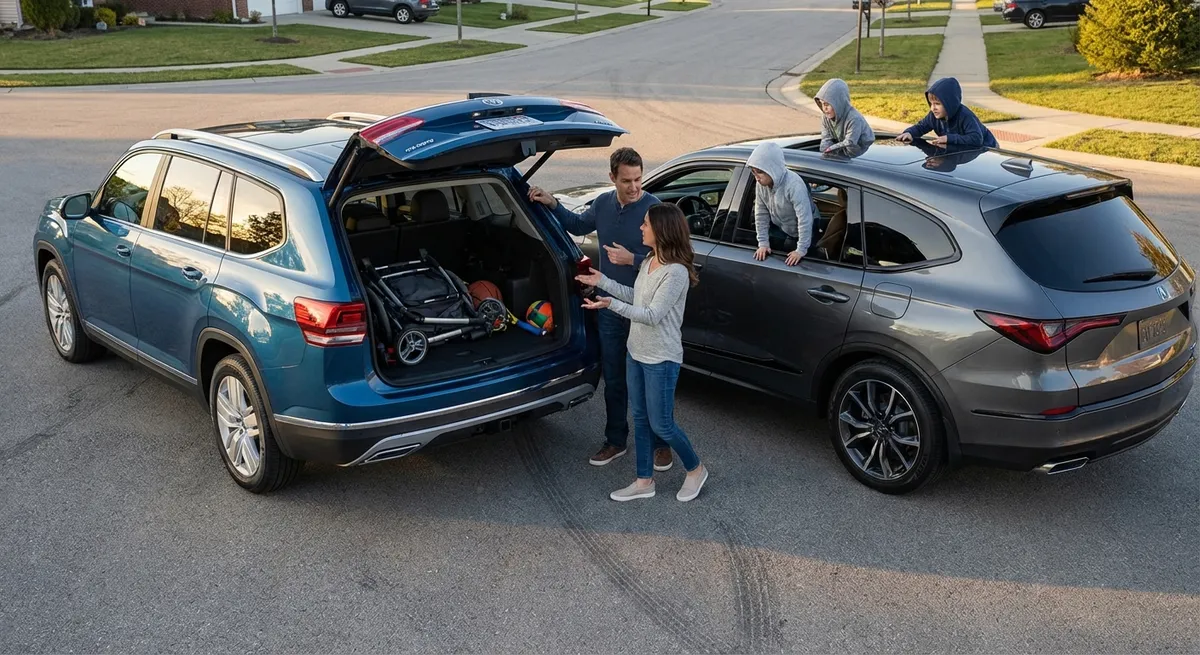
Modern SUVs all promise comfort, capability, and technology—but the way they deliver those things can be radically different. For shoppers comparing models across brands, sizes, and powertrains, spec sheets alone rarely tell the full story. The real differences emerge when you look at how each SUV is engineered to prioritize space, performance, efficiency, and long-term ownership costs.
This comparison-focused guide breaks down five core dimensions enthusiasts and serious buyers should evaluate when cross-shopping SUVs. Instead of narrowing in on a single model, it shows you how to read between the lines of manufacturer claims and marketing language so you can tell when an SUV is truly built for your priorities—and when it only looks the part.
1. Chassis Philosophy: Comfort-First vs. Dynamics-First SUVs
Underneath every SUV is a basic engineering choice: build it to feel like a soft-riding family appliance, a driver-focused machine, or something in between. Understanding chassis philosophy helps you compare models that may look similar on paper but drive very differently.
A comfort-first SUV typically uses soft spring and damper rates, taller sidewall tires, and bushings tuned to isolate vibration. These models favor neutral to understeer-heavy handling, light steering effort, and compliance over sharpness. On-road behavior is relaxed, but body roll will be more noticeable in quick transitions or emergency maneuvers.
Dynamics-first SUVs bias toward flatter body control and sharper response. Engineers dial in firmer springs, sport-tuned dampers, stiffer anti-roll bars, and more direct steering ratios. Tires often have lower sidewalls and performance-oriented compounds. This tuning allows better weight transfer management under braking and cornering, but you’ll feel more of the road and imperfections, especially on uneven pavement.
Adaptive suspension systems blur the lines between these philosophies. Many modern SUVs offer continuously variable or multi-mode dampers that alter compression and rebound characteristics on the fly based on drive mode, speed, and steering input. When comparing two models, don’t just ask whether they have “sport mode”—look at the suspension hardware (adaptive vs. fixed dampers, air suspension vs. steel springs) and weight distribution instead. A vehicle with a near 50:50 front-to-rear weight distribution and a multi-link rear suspension will generally behave more predictably and dynamically than a front-heavy SUV with a torsion-beam rear, even if both advertise “sport” drive modes.
For buyers, the key is to align chassis philosophy with actual use. If 90% of your driving is urban commuting with family on board, a comfort-first chassis with well-tuned damping will feel superior day to day. If you live near winding roads or value precision and confidence at speed, an SUV engineered around dynamics will be worth the tradeoff in ride softness.
2. Powertrains Compared: Gas, Hybrid, and Performance-Oriented Setups
Most SUV shoppers now face a spectrum of powertrains: traditional gasoline, mild hybrids (MHEV), full hybrids (HEV), plug-in hybrids (PHEV), and, in performance segments, high-output turbo or twin-turbo engines. Comparing these options requires looking beyond peak horsepower numbers and into how each system delivers torque, efficiency, and long-term durability.
Gasoline-only SUVs often use turbocharged four-cylinders or naturally aspirated/turbocharged V6s. Turbo engines provide strong low-end torque and higher specific output (hp per liter), allowing smaller displacements to match older V6 power figures. However, they can be more sensitive to fuel quality and heat, and under heavy load (towing, high-speed highway climbs) real-world fuel economy can drop sharply compared with EPA ratings.
Conventional hybrids combine a gasoline engine with one or more electric motors and a relatively small battery. When comparing hybrids to gas-only rivals, focus on system torque curves and how early full torque is available. Many hybrids deliver maximum system torque at very low rpm thanks to the electric motor, translating to brisk urban acceleration and smoother stop-and-go performance. They also use electric assistance to reduce fuel consumption in low-load situations, which is where SUVs typically waste the most energy.
Plug-in hybrids add a larger battery pack and higher-output electric motor, enabling meaningful all-electric range. When cross-shopping PHEV SUVs, compare usable battery capacity (kWh), EPA-rated electric range, onboard charger speed (kW), and how the vehicle behaves in blended modes. Some PHEVs retain strong performance even after the battery is depleted; others feel significantly less responsive once they operate mostly as conventional hybrids.
Performance-oriented SUVs—whether gas-only or electrified—usually employ higher boost pressures, upgraded intercooling, and sometimes dual-clutch or sport-calibrated automatics. The tradeoffs are fuel consumption, potential for higher maintenance costs, and, in some cases, reduced tow ratings vs. non-performance trims. Enthusiasts should pay attention to thermal management (oil coolers, transmission coolers) and braking hardware when comparing a “sport” SUV to its regular counterpart; extra power without corresponding upgrades elsewhere is a red flag.
From a buyer’s perspective, it’s essential to map powertrain choice to both usage and infrastructure. If you don’t have regular home charging, a full hybrid may outperform a PHEV in practicality and cost. If you frequently tow or drive at highway speeds for long stretches, a well-tuned gasoline or robust hybrid system may feel more consistent than a smaller turbo heavily dependent on boost.
3. Interior Reality Check: Space, Seating Geometry, and Cargo Usability
Many SUVs advertise three rows, but cabin comfort and cargo usability vary widely. Comparing interior layouts requires looking past overall length and “maximum cargo volume” numbers into how the space is packaged and what compromises each design makes.
First, evaluate seating geometry rather than just legroom figures. A third row can show acceptable legroom on paper but still feel cramped if the seat cushion is low to the floor and knee angle is sharp. Measure hip point (H-point) height relative to the floor: a higher cushion reduces “knees-up” posture and is especially important for adults in the second and third rows. Similarly, check headroom in all rows with and without a panoramic roof; glass roofs often reduce usable headroom by several centimeters.
Second-row flexibility is a key differentiator. Models offering sliding and reclining second-row seats allow you to balance legroom between second and third rows. When comparing two three-row SUVs, note whether the second row is a bench or captain’s chairs, how wide the center position is, and whether child seats can remain installed while accessing the third row. The real-world difference between an SUV that forces you to remove a child seat for rear access and one that doesn’t is substantial for family buyers.
Cargo space comparisons should consider both volume and shape. A boxier rear profile usually yields a taller load area and more usable height for strollers, dogs, or tall items, even if total liters are similar to a more coupe-like SUV. Look at the load floor height (important for lifting heavy items), whether the floor is flat with the seats folded, and how far the rear bumper protrudes (which can make loading awkward). Some SUVs with independent rear suspensions and clever packaging provide deep underfloor storage when the third row is folded; others sacrifice this for fuel tank or battery placement.
Pay close attention to how electrified variants differ from their gas counterparts. In some SUVs, hybrid or PHEV versions lose underfloor storage or have a raised cargo floor due to battery placement. This may not appear obvious in brochure images but has practical consequences if you regularly carry bulky gear.
Material quality and NVH (noise, vibration, harshness) also play a significant role in how the interior feels on the move. When comparing models, consider not just what materials are used, but where. Soft-touch surfaces at knee and elbow contact points, double-pane (acoustic) front glass, and well-isolated rear suspension mounting points can make two similarly priced SUVs feel worlds apart on a long drive.
4. All-Wheel Drive and Towing: Mechanical vs. Software-Managed Capability
Almost every SUV touts some form of all-wheel drive and a tow rating, but the systems behind those numbers vary widely. Enthusiasts and buyers who plan to tow, drive in snow, or venture off pavement should compare not just whether an SUV has AWD, but how it’s implemented.
Entry-level crossovers often use on-demand AWD with a single rear clutch pack. These systems run primarily as front-wheel drive, sending torque rearward only when slip is detected or predicted. They’re efficient and effective for light snow or rain, but their ability to preemptively shift torque in aggressive driving or deep off-road conditions can be limited. Some systems also overheat under sustained heavy load, temporarily reducing rear torque.
More advanced AWD setups add twin rear clutches (often called torque vectoring by braking or torque vectoring by clutch). These can send different amounts of torque to each rear wheel, improving rotation in corners and traction on uneven surfaces. When comparing two AWD SUVs marketed as “sporty,” check whether they have true torque-vectoring hardware or simply ABS-based brake interventions. The former offers more continuous and nuanced control without as much brake wear.
Serious off-road SUVs typically use longitudinal powertrains (engine mounted front-to-back) with a transfer case and, in some cases, low-range gearing. They may also offer locking differentials (center, rear, or both) that mechanically force equal torque distribution between wheels on an axle. Compared to software-only traction systems, mechanical lockers are more robust in extreme conditions such as rock crawling or deep mud. However, they add weight and complexity, and often result in higher fuel consumption.
Tow ratings require similar scrutiny. Two SUVs with similar power outputs can have very different tow capacities depending on frame structure, cooling, brakes, and axle ratios. Body-on-frame SUVs generally support higher maximum tow ratings thanks to their ladder frame construction, but some unibody models with reinforced structures and specific towing packages can be competitive. When cross-shopping, look at whether the higher tow rating requires an optional package (often adding upgraded cooling, hitch, wiring, and sometimes different gearing) and whether tongue weight limits are clearly stated.
Finally, consider how driver-assistance and stability-control systems interact with trailers. Some SUVs offer trailer-sway control, integrated trailer brake controller compatibility, and specific tow/haul drive modes that modify shift maps and engine braking behavior. These features can significantly improve confidence when towing near the upper end of an SUV’s rated capacity, and are worth comparing between models if trailering is part of your plan.
5. Ownership Profile: Resale, Running Costs, and Software Ecosystems
When comparing SUVs that look similar in a showroom, the ownership experience over five to ten years can diverge dramatically. Enthusiasts and analytical buyers should weigh residual value, maintenance demands, and digital ecosystems as carefully as performance metrics.
Resale value is heavily influenced by brand reputation, historical reliability, and segment demand. Certain SUVs—especially those with proven powertrains and strong off-road or luxury cachet—tend to retain a higher percentage of their original MSRP. When comparing models, examine third-party residual projections and historical used-market behavior for similar predecessors. A vehicle that holds its value better can offset a higher upfront price through lower depreciation, which is usually the largest cost of ownership.
Running costs go beyond fuel. Turbocharged engines may require more stringent maintenance, high-quality synthetic oil, and more frequent service under severe use. Hybrids can reduce brake wear thanks to regenerative braking, but may add complexity in cooling and power electronics. Compare service intervals, typical costs for major services, and warranty coverage—especially on hybrid battery packs, high-voltage components, and advanced driver-assistance systems.
The software and infotainment ecosystem is another differentiator that becomes more apparent over time. Some manufacturers commit to regular over-the-air (OTA) updates for maps, apps, and even drive-assistance calibration; others require dealer visits for changes. When comparing SUVs, consider not just screen size, but processor speed, user interface responsiveness, support for wireless Android Auto/Apple CarPlay, and how long the manufacturer typically supports map updates and connected services on prior models.
Advanced driver-assistance systems (ADAS) should be evaluated not only on feature lists (adaptive cruise, lane centering, automated lane changes) but on calibration quality. Two systems can offer “lane keeping,” yet one may be smooth and reliable while the other feels intrusive or inconsistent. Look for independent testing and owner feedback on how these systems behave in real-world conditions, especially on rural roads and in poor weather.
Finally, factor in insurance costs, which are affected by repair complexity, crash-test results, and theft statistics. An SUV with more advanced sensors and radar units in exposed locations (bumper corners, grille) may incur higher repair bills after low-speed collisions, influencing premiums. Combining all these ownership aspects into your comparison can shift the value equation in favor of a model that is less flashy on paper but more rational—and enjoyable—to own.
Conclusion
Comparing SUVs isn’t just about choosing between brands or deciding on a size class. It’s about understanding how each model’s engineering decisions align—or conflict—with your priorities as a driver, traveler, or family hauler. Chassis tuning, powertrain architecture, cabin packaging, AWD and towing hardware, and long-term ownership characteristics all interact to define how an SUV feels and performs in real life.
By looking beneath marketing claims and spec-sheet highlights, you can see which SUVs are truly tuned for comfort, which are built for drivers, which are optimized for towing and off-road use, and which strike a thoughtful balance. That knowledge turns a crowded, confusing market into a set of clear tradeoffs you can evaluate on your own terms—so the SUV you choose doesn’t just look right in photos, but fits your life and driving style for years to come.
Sources
- U.S. Department of Energy – Fuel Economy Guide - Official fuel economy ratings and powertrain details for comparing gas, hybrid, and plug-in hybrid SUVs
- IIHS – Vehicle Ratings - Crash-test and safety ratings that help assess structural design and ADAS effectiveness across SUV models
- NHTSA – Towing and Trailering Safety - Guidance on tow ratings, hitch requirements, and safe towing practices relevant to SUV buyers
- SAE International – All-Wheel Drive Systems Overview - Technical background on different AWD architectures and their performance implications
- Consumer Reports – Car Reliability and Owner Satisfaction - Long-term reliability and ownership data useful for comparing projected running costs and resale value
Key Takeaway
The most important thing to remember from this article is that this information can change how you think about Comparisons.