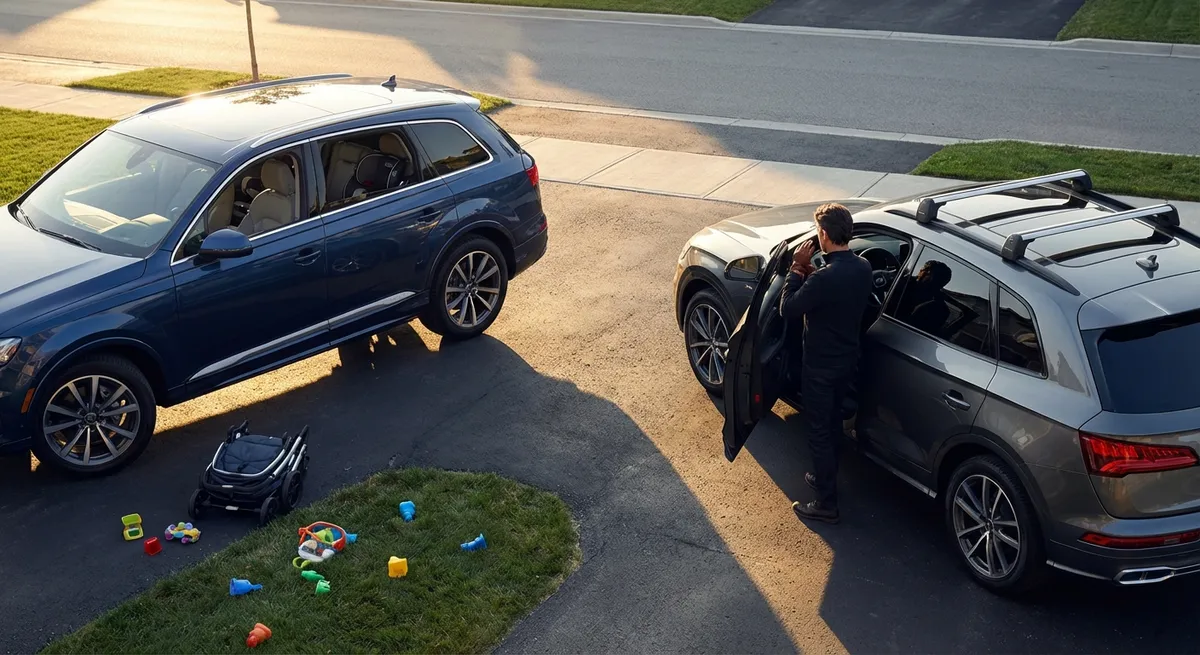
For many buyers, the SUV decision is no longer just about size and price. Today’s market splits sharply between “family haulers” that prioritize space, comfort, and safety, and “driver’s SUVs” tuned for performance, handling, and engagement. On paper, two similarly priced crossovers can look nearly identical. On the road and in daily life, they can feel worlds apart. Understanding the character of these vehicles—how they’re engineered and what compromises they make—can help you choose an SUV that actually fits your lifestyle instead of just your budget.
This guide breaks down five critical comparison points that reveal whether an SUV is truly family-focused or engineered for the enthusiast behind the wheel.
Cabin Layout and Seating Geometry vs. Driver-Centric Cockpit
The most obvious divide between a family hauler and a driver’s SUV shows up the moment you open the door. It’s not just about how many seats it has; it’s how those seats are arranged and prioritized.
Family-oriented SUVs typically emphasize:
- Adult-usable third rows with higher “H-points” (hip points) to ease ingress/egress and improve outward visibility for kids and older passengers.
- Wide-opening rear doors and generous door apertures to make child-seat loading and standing access easier.
- Flat or nearly flat floors in the second row to reduce footwell intrusion and improve comfort for a middle-seat passenger.
- Flexible seating configurations, such as sliding second rows and 40/20/40 or 60/40 split-folding benches allowing a mix of cargo and passengers.
- Cabin storage abundance, from deep door pockets to multiple cupholders and underfloor bins, designed around family paraphernalia: bottles, tablets, toys, and bags.
Driver-focused SUVs instead skew toward the person behind the wheel:
- Prominent bolstering in the front seats to improve lateral support during cornering, sometimes at the expense of wide-body comfort.
- Lower seating position and sportier H-point for a more sedan-like driving posture and a lower center of gravity.
- Driver-angled center stack and instrument panel, with critical controls and screens canted toward the driver for quick access.
- Minimalist rear accommodations, often favoring two-chair-like outboard seats with a compromised middle position and less priority on third-row usability—if a third row is even offered.
When you compare two SUVs, look closely at seat adjustability, step-in height, third-row headroom, and how easy it is to get kids and car seats in and out. If the rear of the cabin feels like an afterthought, you’re probably looking at a vehicle designed to satisfy the driver first and the family second.
Suspension Tuning and Ride Comfort vs. Handling Precision
Underneath the bodywork, suspension design and tuning tell you a lot about the SUV’s true mission. The basics—MacPherson struts up front, multi-link or trailing arm setups at the rear—show up in both family haulers and performance models. The difference lies in calibration and hardware choices.
Family-focused SUVs are typically tuned for:
- Compliance over broken pavement, with softer spring rates and more comfort-oriented damper valving.
- Body-roll management that prioritizes predictability, allowing some lean in corners to avoid harshness and head-toss on uneven surfaces.
- Isolated subframes and bushings designed to filter noise, vibration, and harshness (NVH) so road impacts and tire roar don’t penetrate the cabin.
- Optional adaptive dampers (where available) that favor “Comfort” or “Normal” modes, often defaulting to the softest setting at startup.
Driver’s SUVs shift the balance toward engagement:
- Stiffer springs and anti-roll bars to control body motion and keep the chassis flatter in corners, often at the expense of low-speed ride comfort.
- Sport-tuned or adaptive dampers with more aggressive “Sport” or “Track” profiles that increase compression and rebound damping to sharpen responses.
- More direct steering ratios and firmer steering effort, enhancing feedback and stability at higher speeds.
- Performance-oriented tires with lower sidewall profiles and higher load/speed ratings, which boost grip but can introduce more impact harshness and noise.
When test-driving back-to-back, compare how each SUV manages imperfections: expansion joints, potholes, and sharp edges. A family hauler should absorb and isolate; a driver’s SUV should communicate and control. If you regularly carry sleeping kids or sensitive passengers, prioritize compliance and NVH control over ultimate cornering precision.
Powertrain Character: Smooth Delivery vs. Sharpened Response
Both family haulers and driver’s SUVs can be quick, especially with modern turbocharged engines and hybrid systems. What differs is how the power is delivered and how involved the driver feels in the process.
Family-focused SUVs generally aim for:
- Broad, low-end torque curves tuned for effortless launches, merging, and passing with minimal throttle input. Turbocharged four-cylinders and V6s are often calibrated to deliver peak torque low in the rev band (e.g., 1,500–2,000 rpm).
- Transmission programming that prioritizes smoothness, with early upshifts and low engine speeds to maximize fuel efficiency and reduce cabin noise.
- Refined noise profiles, including active noise cancellation and tuned engine mounts, reducing vibration and masking induction or exhaust sound.
- Hybrid or plug-in hybrid options aimed at fuel savings and electric-only efficiency in city driving rather than maximum performance.
In a driver’s SUV, calibration leans towards engagement and immediacy:
- Higher-output engines (turbocharged fours with uprated boost, turbo or supercharged V6s, and sometimes V8s or performance hybrids) that reward revving and aggressive throttle inputs.
- Sportier transmission logic, holding gears longer, downshifting more readily, and sometimes integrating rev-matching or aggressive shift mapping in sport modes. Dual-clutch transmissions or performance-tuned automatics are more common here.
- Enhanced sound character, using tuned exhaust systems, active exhaust valves, or sound symposers to provide induction/exhaust feedback—audible but sometimes fatiguing on longer trips.
- Performance-oriented hybridization, such as high-output e-motors supplementing turbo engines to boost acceleration, rather than solely pursuing efficiency.
Compare peak torque and horsepower figures alongside where in the rev range they occur. Also pay attention to 0–60 mph times, transmission type (traditional automatic vs. CVT vs. dual-clutch), and how the vehicle behaves in its normal vs. sport drive modes. If the SUV feels lazy unless you floor it, or too aggressive even in normal mode, the underlying calibration may not match your day-to-day needs.
Cargo Solutions and Usability vs. Weight and Packaging Trade-Offs
SUV marketing focuses heavily on cargo volume, but the numbers don’t tell you everything. How that space is shaped, accessed, and integrated with the rest of the vehicle can reveal where the designers placed their bets.
Family haulers typically emphasize:
- Generous, square cargo areas with minimal wheel-well intrusion and low lift-over heights, making it easy to load strollers, coolers, and bulkier items.
- Full usability with all rows up, prioritizing a usable behind-the-third-row depth for groceries and luggage.
- Flexible storage solutions like underfloor compartments, removable load floors, grocery bag hooks, and power-folding rear seats for quick reconfiguration.
- Roof-rail systems engineered for realistic family use—think cargo boxes and bike racks—with clear published dynamic load ratings and accessory ecosystems.
Driver’s SUVs often sacrifice some practicality for performance and style:
- More steeply raked rear rooflines and liftgates, improving aerodynamics and appearance but cutting into vertical cargo space—especially at the rear opening.
- Packaging compromises from performance hardware, such as larger rear differentials, sport exhaust plumbing, or battery packs in performance hybrids that intrude into underfloor storage.
- Heavier wheels, brakes, and driveline components, increasing curb weight and sometimes reducing payload capacity compared with their more modest siblings.
- Lower-profile tires and larger wheel diameters, which can be more vulnerable to curb and pothole damage when the vehicle is fully loaded.
When comparing two SUVs, don’t just check cubic feet; look at how flat the load floor is with seats folded, whether you can slide in long items (e.g., skis, furniture), and if the rear opening allows a large stroller or dog crate. If you regularly carry cargo and passengers together, a more upright family hauler design often pays dividends.
Tech and Safety Priorities: Passive Ease vs. Performance-Focused Assistance
Modern SUVs are packed with driver-assistance and connectivity technology, but the tuning and emphasis often differ strongly between family-first and enthusiast-targeted models.
Family-focused SUVs usually center on ease and safety for every occupant:
- Comprehensive advanced driver assistance systems (ADAS)—adaptive cruise control, lane-keeping assist, blind-spot monitoring, rear cross-traffic alert—often standard across the lineup.
- Conservative ADAS tuning, where lane-keeping assistance, adaptive cruise, and automatic emergency braking favor smooth interventions and comfort over razor-sharp lane placement.
- Rear-seat and child-focused tech, such as rear-seat reminder systems, integrated sunshades, multiple USB-C ports in the second and third rows, and optional rear entertainment screens.
- Simple, intuitive infotainment interfaces, with large physical controls for climate and volume, making it easier for any driver in the family to operate the system without distraction.
Driver’s SUVs often integrate tech around control and performance:
- Selectable drive modes (Normal, Sport, Sport+, Off-road, Track) that adjust throttle mapping, transmission logic, steering weight, damping, and sometimes torque distribution.
- Performance metrics—lap timers, G-meters, boost gauges, and power/torque readouts—geared toward enthusiasts who track vehicle performance.
- More aggressive ADAS calibration, with lane centering that holds the vehicle tightly in the lane and adaptive cruise calibrated for brisker following behavior, sometimes with adjustable sensitivity.
- Advanced all-wheel-drive (AWD) systems with torque-vectoring differentials or clutch-based rear axles that can actively send more torque to the outside wheel in a corner for sharper turn-in.
When cross-shopping, check whether ADAS features are standard or optional, and how intrusive or subtle the systems feel on a test drive. If you want an SUV your partner or teenager will feel instantly comfortable in, prioritize a calmer, more intuitive tech experience. If you care about fine-tuning vehicle dynamics, look for detailed drive-mode configuration and advanced AWD or traction systems.
Conclusion
Choosing between a family hauler and a driver’s SUV is less about badge prestige and more about engineering priorities. Two similarly sized and priced SUVs can differ significantly in cabin ergonomics, suspension tuning, powertrain character, cargo usability, and technology emphasis. The right choice depends on your real world: how many passengers you carry, how far you drive, the roads you frequent, and how much you value driving engagement vs. day-to-day ease.
Make your short list, then drive examples from both ends of the spectrum—the family-biased and the driver-focused configuration of similar models where possible. Pay attention to how the SUV treats your passengers, your cargo, and your senses. When the vehicle’s underlying character aligns with your lifestyle, the comparison stops being technical and starts feeling obvious every time you turn the key (or press the start button).
Sources
- [IIHS – Vehicle Size and Safety](https://www.iihs.org/topics/vehicle-size-and-weight) – Explains how vehicle size and weight affect occupant protection and crash outcomes, relevant to family-SUV considerations.
- [NHTSA – 5-Star Safety Ratings](https://www.nhtsa.gov/ratings) – Official U.S. government crash test and safety ratings database for comparing SUVs on safety performance.
- [SAE International – Fundamentals of Vehicle Dynamics](https://www.sae.org/publications/books/content/r-114/) – Technical reference on suspension, handling, and ride characteristics that underlie SUV tuning differences.
- [EPA – Fuel Economy Guide](https://www.fueleconomy.gov/feg/findacar.shtml) – Official fuel economy and powertrain data to compare SUVs’ engine and efficiency characteristics.
- [Consumer Reports – Guide to Advanced Safety Systems](https://www.consumerreports.org/cars/car-safety/guide-to-advanced-safety-systems-a3298540241/) – Overview and evaluation of modern ADAS features and how they affect daily driving.
Key Takeaway
The most important thing to remember from this article is that following these steps can lead to great results.