Online debate over North West and Blue Ivy Carter—two kids who never asked to be compared—has exploded again after a fresh round of social media commentary questioned celebrity parenting, privilege, and the constant urge to rank one child against another. That same instinct to compare, judge, and “pick a side” shows up just as strongly in the automotive world—especially with SUVs.
Scroll any enthusiast forum or TikTok car review, and you’ll see it: Bronco vs. Wrangler, Model Y vs. Ioniq 5, Escalade vs. Navigator. The specifics differ, but the pattern is identical to the North vs. Blue Ivy conversation—fans taking strong positions, defending their choice, and treating each comparison as a referendum on identity, values, and lifestyle.
Below, we break down how this comparison culture plays out in SUVs right now, and what savvy buyers can learn from it instead of getting lost in the noise.
1. Identity Wars: Bronco vs. Wrangler and the “Team” Mentality
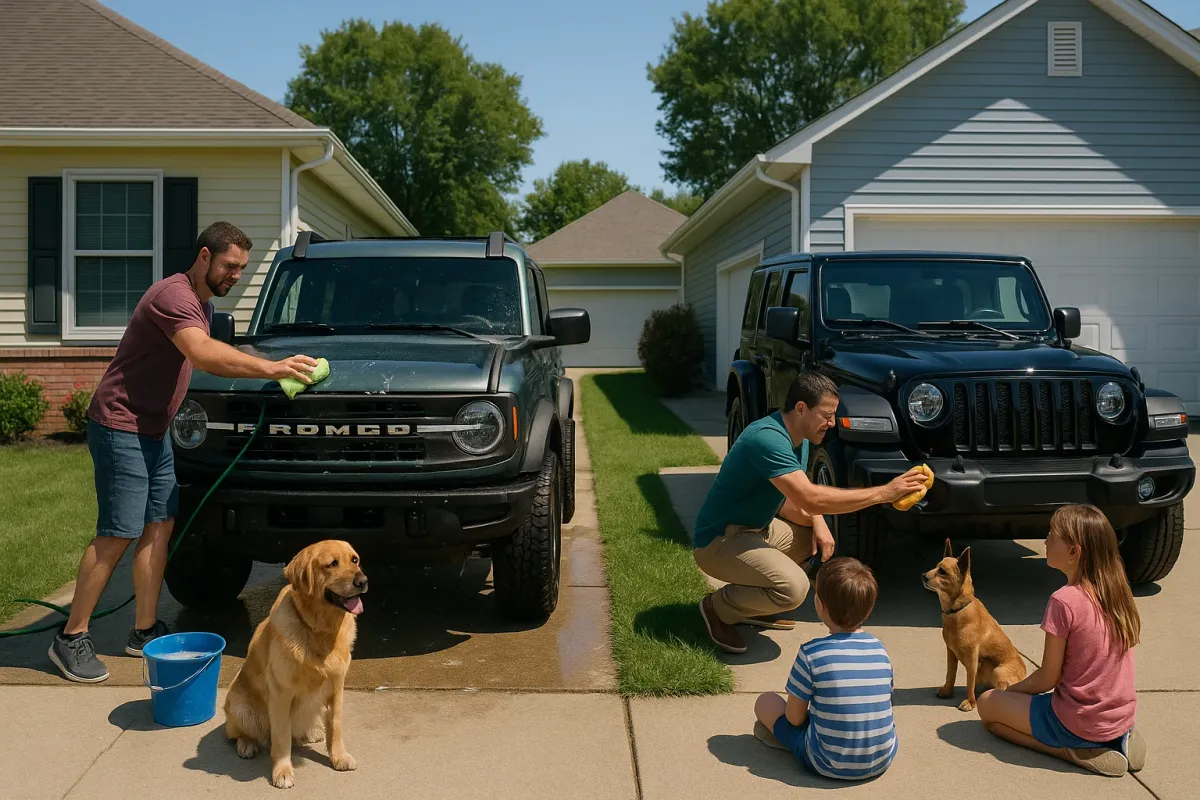
In celebrity culture, comparing North West to Blue Ivy isn’t just about two kids—it’s really a proxy for fandoms, status, and which “side” you’re on. In the SUV world, that dynamic is clearest in the ongoing Ford Bronco vs. Jeep Wrangler rivalry.
The modern Bronco, reintroduced for 2021, was engineered from day one as a Wrangler fighter: body-on-frame construction, removable doors and roof, front and rear locking differentials, disconnecting front sway bar on select trims, and true low-range gearing (up to 94.75:1 crawl ratio on some configurations). Jeep responded by doubling down on ultra-hardcore variants like the Wrangler Rubicon 392 and pushing plug-in power with the Wrangler 4xe, now one of the best-selling plug‑in hybrids in the U.S.
On forums and social media, arguments about which one is “better” often mirror stan culture: Bronco owners point to its independent front suspension for better on‑road manners, more modern interior tech (large SYNC 4 screens, over‑the‑air updates), and aggressive styling. Wrangler loyalists fire back with decades of aftermarket support, simpler solid front axle hardware for extreme rock crawling, and a proven heritage that Ford is still rebuilding.
What matters for buyers is stripping away the emotional “team” element and asking: what are you actually going to do with it? If you spend 90% of your time on pavement and occasionally hit mild trails, the Bronco’s on‑road composure and ergonomics may serve you better. If your weekends involve slow-speed rock crawling, lift kits, and armor, the Wrangler’s ecosystem and architecture remain highly compelling. The internet’s identity war is entertaining—but your use case should decide the winner.
2. Luxury Status Checks: Escalade vs. Navigator vs. GLS
The North West vs. Blue Ivy discussion frequently veers into conversations about wealth, privilege, and optics—who appears “more polished,” “more spoiled,” or “more relatable.” Large luxury SUVs embody a similar kind of coded status comparison: Cadillac Escalade, Lincoln Navigator, and Mercedes‑Benz GLS are more than vehicles; they’re rolling narratives about what kind of luxury you believe in.
The latest Cadillac Escalade leans hard into tech and presence. Its massive OLED curved display (38 inches of total diagonal digital real estate), available Super Cruise hands‑free driver assistance, and bold vertical lighting signals a tech‑forward, show‑stopping persona. The 6.2‑liter V8 and the fire‑breathing 682‑hp Escalade‑V shout power and excess in a way that fits certain markets and personalities perfectly.
Lincoln’s Navigator, refreshed with a quieter design language and updated active safety tech, is more about calm and comfort: soft-touch materials, a focus on second- and third-row comfort, and a smoother twin‑turbo V6 powertrain with strong torque. Its image is less “VIP at the club” and more “executive with a family and a driver.”
Then there’s the Mercedes‑Benz GLS, often compared as the “S‑Class of SUVs.” Its inline‑six and V8 mild‑hybrids prioritize refinement, and its interior design is more European, less overtly flashy than the Escalade. On social feeds, you’ll see owners and reviewers arguing over which one “really” represents luxury—flashy screens, serene cabins, or a three‑pointed star on the hood.
For buyers, the key is to look past the online status jousting and drill into the hardware and package details: towing capacity, real third‑row space, long‑trip comfort, dealer coverage in your region, and long‑term cost of ownership. Like judging celebrity kids by their parents’ image, letting badge prestige alone decide your SUV is a distorted way to evaluate what you actually get.
3. Next‑Gen vs. Old Guard: Model Y vs. Ioniq 5 vs. Traditional Crossovers
Just as the North West vs. Blue Ivy conversation is tangled up in generational shifts (Kardashians vs. Carters, reality TV vs. legacy music royalty), the SUV market is wrestling with its own generational turnover: electric crossovers vs. traditional gasoline models.
Tesla’s Model Y still dominates EV SUV sales, but challengers like the Hyundai Ioniq 5, Kia EV6, and Ford Mustang Mach‑E are increasingly forcing meaningful comparisons. Internet debates rage over real‑world range, charging networks, software quality, and build consistency. Model Y loyalists highlight access to Tesla’s Supercharger network, tight integration of software and hardware, and constant over‑the‑air improvements. Ioniq 5 and EV6 fans counter with 800‑volt architectures enabling ultra‑fast DC charging (often from 10–80% in around 18–20 minutes under ideal conditions), spacious interiors on E‑GMP platforms, and robust warranties.
Meanwhile, many buyers still cross‑shop these EVs against high‑efficiency gas or hybrid SUVs like the Toyota RAV4 Hybrid, Honda CR‑V Hybrid, and Toyota Grand Highlander Hybrid. On paper, EVs can look vastly superior in torque delivery and running costs, but they impose a different lifestyle—home charging, trip planning around DC chargers, and potentially higher insurance and repair costs.
This is where comparison culture can mislead. Viral range tests, one‑off charging horror stories, or a single influencer’s build‑quality rant are like one controversial clip of a celebrity child being replayed endlessly: not necessarily representative. Smart buyers weigh empirical data—EPA range, independent charging tests, five‑year cost of ownership models, and local electricity vs. fuel prices—against the kind of driving they actually do. Doing 18,000 highway miles a year in a charging‑scarce region is very different from suburban commuting with a Level 2 charger in your garage.
4. Design and “Aesthetic Drama”: Coupe SUVs vs. Classics
The social media commentary around North West and Blue Ivy often attaches value judgements to “aesthetic choices”—outfits, hair, poses—which, in reality, are usually curated by adults around them. In SUVs, exterior design has become the new battleground for taste, especially with the rise of coupe‑style crossovers.
BMW’s X6 and Mercedes‑Benz GLE Coupe helped mainstream the idea of a sloping‑roof SUV that sacrifices some practicality for style. Now we see this template everywhere: Audi Q8, Infiniti QX55, even more mainstream entries like the Toyota Crown Signia are pushing aggressively styled rooflines and dramatic light signatures to stand out in social feeds and dealer lots.
Enthusiast communities often split sharply: some call these designs “sporty, modern, premium,” while others deride them as impractical, form‑over‑function fashion statements. The practical differences are real: a coupe‑style SUV can chop 2–4 inches of rear‑headroom and noticeably reduce cargo height at the tailgate compared with its squared‑off sibling. Rearward visibility can suffer, and roof‑rack usability may be reduced.
But as with the celebrity aesthetic debates, some of the loudest online opinions aren’t grounded in the way most people use these vehicles. If you regularly carry tall adults in the back or load bulky gear, a conventional SUV roofline will almost always make more sense. If your typical load is kids in booster seats and grocery runs, a coupe SUV may be perfectly functional—and if you strongly prefer the way it looks, that matters for long‑term satisfaction.
The smart comparison strategy: instead of dismissing a design outright because an influencer calls it “try‑hard,” test real‑world usability. Sit in the second row yourself, measure your stroller or golf bag against the cargo opening, and see how the rear visibility feels. Treat styling as one variable, not the entire verdict.
5. Safety, Tech, and the “Bad Parenting” Narrative
The North West vs. Blue Ivy discourse has morphed into a referendum on “good” vs. “bad” parenting played out in public comments. In the SUV world, a similar moral edge appears in discussions about safety and tech: if you choose a model without the latest advanced driver‑assistance systems (ADAS), some online voices imply you’re “careless” or behind the times.
Most mainstream SUVs now offer a broad safety suite: automatic emergency braking, lane‑keeping assist, blind‑spot monitoring, and adaptive cruise control are becoming table stakes. But implementation quality varies dramatically. Toyota’s Safety Sense, Honda Sensing, Ford Co‑Pilot360, GM’s Super Cruise, and Hyundai’s SmartSense all have different calibration philosophies regarding steering intervention, following distance, and how “hands‑on” they demand the driver to be.
On social media, you’ll see heated arguments: some claim a certain brand’s lane‑centering is “dangerous” or that a given adaptive cruise system “brakes too late.” Others accuse people who rely on ADAS of being inattentive drivers—mirroring the way people confidently judge parenting decisions from a distance. In reality, these systems are tools with clearly defined operating envelopes and limitations; they can dramatically reduce fatigue and help avoid certain crashes but are not substitutes for an attentive driver.
When cross‑shopping SUVs, don’t just tick the “has adaptive cruise” box. Look at independent crash‑test scores (IIHS and NHTSA), test how the ADAS behaves on your own commute, and check whether critical features are standard or hidden in an expensive trim bundle. Also pay attention to update strategies: some brands can refine ADAS behavior via over‑the‑air updates; others require dealer visits or may never improve the system’s tuning once sold. That long‑term support picture should weigh into your comparison more than the latest viral clip of a system behaving badly—or heroically—under unusual circumstances.
Conclusion
The online debates around North West and Blue Ivy show how deeply comparison culture is wired into us. We project far more onto the subjects of those comparisons—kids, celebrities, or SUVs—than the raw facts justify. In the SUV space, that instinct plays out in Bronco vs. Wrangler rivalries, Escalade vs. Navigator status battles, EV vs. gas arguments, coupe vs. conventional styling wars, and safety‑tech moralizing.
For enthusiasts and buyers, the opportunity is to use the energy of those debates without becoming controlled by them. Let the hot takes point you toward meaningful matchups, then step back and evaluate the fundamentals: platform, powertrain, practicality, running costs, safety data, and how the vehicle fits your real life rather than your online persona.
In a world obsessed with picking sides, the smartest SUV comparison isn’t about who “wins the internet.” It’s about which vehicle quietly wins for you—on your driveway, on your daily commute, and on every long trip that never makes it to your social feed.
Key Takeaway
The most important thing to remember from this article is that this information can change how you think about Comparisons.