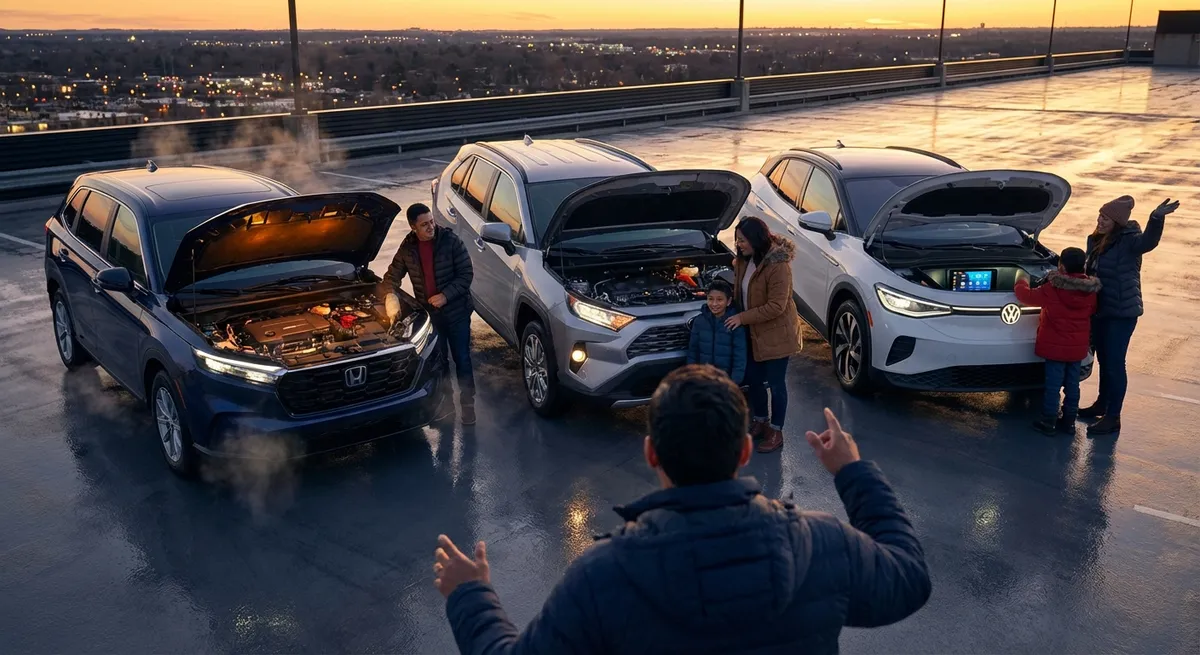
Whether you’re coming from a traditional sedan or replacing an aging SUV, today’s market forces you into a bigger decision than just “which model.” The real question is: which drivetrain—gasoline, hybrid, or fully electric—best fits your life for the next 8–10 years?
This comparison walks through five critical dimensions that matter to enthusiasts and serious shoppers: performance, efficiency, cost of ownership, long-distance usability, and long-term reliability/technology. The goal isn’t to crown a single winner, but to give you a clear, technically informed framework so you can match the right powertrain to how you actually drive.
Performance and Driving Dynamics: How Each Powertrain Really Feels
From the driver’s seat, the difference between gas, hybrid, and EV SUVs is immediately apparent—and not just in straight-line speed.
Modern gasoline SUVs often use turbocharged four‑cylinders or downsized V6s. Turbocharging allows smaller displacement engines to generate higher torque at lower rpm, which is crucial for moving heavier SUV bodies. For example, a 2.0‑liter turbo can easily produce 250–280 hp and 270–310 lb‑ft of torque, enough to propel a midsize SUV from 0–60 mph in the 6–7 second range while maintaining reasonable fuel consumption. The tradeoff: turbo lag under sudden throttle, more complex cooling, and dependence on boost for performance.
Hybrids combine an internal combustion engine (ICE) with one or more electric motors and a battery pack, typically in the 1–2 kWh range for conventional hybrids and 10–20+ kWh for plug‑in hybrids (PHEVs). The electric motor’s instant torque masks ICE weaknesses off the line and during low‑speed maneuvers. In real-world driving, this can make a hybrid SUV feel stronger around town than an equivalent gas model, even if the spec sheet shows similar peak horsepower. PHEVs often run in EV mode at lower speeds, then blend in the engine under higher load; the transition quality depends heavily on software calibration and transmission design (eCVT vs. stepped automatic vs. dual-clutch).
Electric SUVs (BEVs) change the performance equation entirely. Electric motors deliver peak torque from 0 rpm, so even modestly powered models can feel quick in city traffic. Dual‑motor all‑wheel‑drive setups can vector torque between axles far faster than mechanical systems, improving traction in poor conditions and sharpening corner exit response. However, EVs carry significant battery mass—often 1,000+ lbs extra versus comparable ICE models. Engineers typically combat this with low mounting (between the axles in a skateboard architecture), lowering center of gravity and improving stability, but you’ll still feel the weight in rapid direction changes and under heavy braking.
For enthusiasts prioritizing steering feel, weight transfer, and feedback, a well-tuned gasoline or hybrid SUV still offers more character and involvement. For point‑and‑shoot acceleration and smooth, quiet commuting, electric SUVs have the edge—especially in urban and suburban driving.
Efficiency and Real-World Energy Use: Beyond the Window Sticker
Comparing fuel economy between gas, hybrid, and electric SUVs requires looking past simple miles per gallon numbers.
Gasoline SUVs are rated in mpg, but real-world returns depend on drive cycles. Turbo engines tend to deliver their best results in steady-state highway cruising, where they can operate at low rpm with minimal boost. In stop‑and‑go traffic or under heavy loads (towing, mountain driving), fuel consumption can climb quickly as the engine spends more time in higher load regions of its efficiency map. Larger 3‑row SUVs frequently land in the 18–24 mpg combined range, depending on drive type and aero profile.
Hybrid SUVs use two key tools to gain efficiency: engine downsizing and energy recuperation. Regenerative braking turns kinetic energy into electrical energy and stores it in the battery, which the electric motor later uses to reduce engine load or power the vehicle at low speeds. This is why hybrids show their biggest gains in city driving, where frequent deceleration and acceleration cycles allow maximum regen. Conventional (non‑plug‑in) hybrids can deliver 30–40+ mpg combined in compact and midsize SUV segments, outpacing similar gas models by 30–50% in typical mixed driving.
Plug‑in hybrid SUVs introduce a more complex efficiency profile. Their energy use is split between electricity (measured in kWh/100 miles or MPGe) and gasoline (mpg). If your daily driving fits within the electric range (often 20–40+ miles) and you charge regularly, your gasoline consumption can be minimal. However, once the battery is depleted, they effectively behave like heavier conventional hybrids.
Electric SUVs convert onboard electrical energy to motion with much higher drivetrain efficiency (often over 80%, compared with ~30–40% for ICE powertrains). You’ll see combined consumption figures in the 30–45 kWh/100 miles range depending on vehicle size, weight, and aero. However, cold weather, high speeds, roof boxes, and large wheels/tires can significantly increase consumption, and therefore reduce effective range. EPA MPGe ratings are useful for broad comparison, but local electricity rates and charging patterns will determine real-world running costs.
For buyers who commute mostly in traffic or short urban loops, hybrids and EVs leverage regen to maximize efficiency. If your drive is long‑distance highway with minimal stops, gas or diesel (where still available) efficiency narrows the gap, and the decision shifts more to fuel/energy pricing and infrastructure availability.
Cost of Ownership: Purchase Price, Fuel, and Maintenance Over Time
The initial sticker price is only part of the financial equation; you need to analyze total cost of ownership (TCO) across the expected life of the SUV.
Gasoline SUVs generally have the lowest upfront cost for a given size and trim level because the technology is mature, mass‑produced, and simpler than hybrid or EV systems. However, they typically incur higher annual fuel costs, especially if you cover substantial mileage. Service intervals include engine oil changes, transmission fluid (depending on manufacturer), spark plugs, and more complex exhaust aftertreatment for some turbo engines (particulate filters, etc.).
Hybrid SUVs usually command a modest price premium over their gasoline equivalents due to their additional high‑voltage battery, power electronics, and electric motor(s). In many markets, that premium is partially offset by incentives, lower fuel bills, and in some areas, reduced registration or congestion charges. Maintenance can be lower on some wear components (brakes can last longer due to regen), but the hybrid system introduces high‑voltage components that may be costly out of warranty. That said, major brands have strong track records with hybrid longevity when properly maintained.
Plug‑in hybrids and full EV SUVs are generally the most expensive upfront due to larger battery packs. However, incentives and tax credits can be substantial, especially in North America and parts of Europe, narrowing the effective price gap. Operating costs depend heavily on how you charge. Home charging at off‑peak rates can make per‑mile energy cost significantly lower than gasoline; fast charging at commercial DC stations can sometimes approach or exceed gasoline costs per mile, depending on regional pricing.
Maintenance for EVs is structurally lower in many areas: no engine oil, no traditional transmission fluid for many designs, fewer moving parts, and less mechanical complexity. But tire wear can be higher due to weight and instant torque, and battery health becomes a central TCO factor. Most manufacturers offer 8–10 year or 100,000–150,000‑mile battery warranties. Degradation is influenced by climate, fast-charging frequency, and storage conditions.
For a buyer planning to keep an SUV for a decade and drive moderate annual mileage, hybrids and EVs often recover their higher purchase price in fuel and maintenance savings—provided that incentives and reasonable electricity rates remain available. Heavy highway drivers or those without reliable home charging may find that a fuel‑efficient gasoline or conventional hybrid SUV yields a more predictable long‑term cost profile.
Long-Distance Usability, Towing, and Practical Range
One of the most practical comparison points is how each powertrain behaves when you leave the city and load the SUV with passengers, cargo, or a trailer.
Gasoline SUVs currently offer the most straightforward long‑distance experience. Refueling is fast (5–10 minutes), and even in remote regions, gasoline infrastructure is well developed. Towing capacities can range from 3,500 lbs in compact crossovers to 7,500+ lbs in body‑on‑frame models, depending on engine, cooling, and axle ratio. The main tradeoff is fuel economy: towing or driving at high speeds dramatically increases consumption, shrinking effective range and increasing fuel costs, but the time penalty is minimal thanks to rapid refueling.
Hybrid SUVs can be excellent long‑distance machines if tuned properly. Conventional hybrids typically retain similar tow ratings to their ICE counterparts in the same platform, though some manufacturers reduce maximum ratings due to thermal constraints or transmission design. On highways, the hybrid advantage narrows compared to city driving, as there’s less deceleration to recapture energy. Still, you may see a 10–25% fuel benefit versus non‑hybrid trims, which adds up over time.
Plug‑in hybrid SUVs offer an interesting mix: they can operate as EVs around town and traditional hybrids on trips. However, once the battery is depleted, you carry the extra mass of the pack without gaining further EV‑only range unless you recharge en route. On a long highway drive with few charging stops, their advantage becomes similar to a regular hybrid.
Electric SUVs offer strong towing torque characteristics due to their power delivery, but towing is currently where EVs are most disadvantaged. Aerodynamic drag from trailers and the need to power both drivetrain and auxiliary systems (like heating in cold climates) can cut rated range by 40–60% or more. This means more frequent charging stops and careful planning around DC fast‑charging networks. In well-covered corridors, this is manageable but slower than ICE refueling; in sparse regions, it can be prohibitive.
For families who regularly road trip across multiple states or tow heavy loads, gasoline or hybrid SUVs still provide the most flexible solution with minimal planning overhead. For those whose driving is predominantly regional, with only occasional long trips and minimal towing, an EV SUV may fit well—especially if your regular patterns allow consistent home charging and you route longer journeys through high‑power charging infrastructure.
Reliability, Battery Health, and Software: Planning for a Tech-Heavy Future
Modern SUVs are computers on wheels, and the interaction between mechanical reliability and software stability is now central to ownership.
Gasoline SUVs benefit from decades of ICE development. Known failure patterns (timing chain stretch, carbon buildup on direct-injection engines, turbocharger wear) are now well documented. Compliance with modern emissions standards has increased complexity—particularly high‑pressure fuel systems and exhaust aftertreatment—but routine service intervals and diagnostic tools are mature. Long-term reliability comes down to build quality, design choices, and maintenance discipline.
Hybrids add an electrified layer: high‑voltage battery packs, inverters, DC‑DC converters, and electric drive motors. Fortunately, leading manufacturers have over two decades of hybrid field data, and many hybrid systems have demonstrated excellent durability. Features like liquid-cooled batteries, conservative charge windows (not using 0–100% of the pack), and robust power electronics design help extend lifespan. Still, out‑of‑warranty battery replacement in some models can be expensive, so warranty terms and real-world track records should be part of your comparison.
EV SUVs magnify the importance of battery health. Key considerations include:
- Battery chemistry and thermal management: Liquid-cooled packs with sophisticated thermal control typically show slower capacity loss than air‑cooled systems, especially in hot climates.
- Charging behavior: Frequent high‑power DC fast charging and repeated 100% charges can accelerate degradation. Vehicles that intelligently limit charge rates and allow user‑set charge limits (e.g., 80–90% for daily use) generally age better.
- Software and firmware updates: Over‑the‑air (OTA) updates can improve efficiency, add features, or fix bugs—but they also introduce the risk of software regressions. A manufacturer’s track record in software stability and support becomes as important as their engine reliability used to be.
All three powertrain types rely heavily on control software. Advanced driver-assistance systems (ADAS), drive-by-wire controls, adaptive suspensions, and digital cockpits introduce new failure modes—some mechanical, many software-related. For comparison, you should look at:
- Frequency of recalls and software campaigns
- Length and coverage of powertrain and battery warranties
- Availability of independent service and diagnostic support
- How long the manufacturer commits to software and map updates
Enthusiasts and long‑term owners should treat the SUV more like a high‑value tech product than a purely mechanical machine. Understanding update policies, connectivity requirements, and data collection practices is now part of being an informed buyer—especially with hybrids and EVs that rely on more integrated electronic systems.
Conclusion
Choosing between a gasoline, hybrid, or electric SUV in 2025 isn’t a simple matter of “old vs new” technology. Each powertrain offers distinct strengths:
- Gasoline SUVs deliver proven long‑distance usability, broad refueling access, and lower upfront costs—but with higher ongoing fuel consumption.
- Hybrids provide a balanced middle ground, leveraging electric assistance for urban efficiency while retaining ICE flexibility for trips.
- Electric SUVs excel in refinement, instant torque, and low operating emissions where charging is convenient, but they demand more planning for long trips and towing.
Your best choice depends on how far and how often you drive, where you live, your access to charging, and how long you plan to keep the vehicle. By weighing performance, efficiency, cost of ownership, long‑distance practicality, and long‑term reliability as a complete package, you can align the right SUV powertrain with your daily reality—and avoid paying for capabilities you’ll never use.
Sources
- U.S. Department of Energy – Fuel Economy Guide - Official EPA fuel economy ratings and energy consumption data for gasoline, hybrid, PHEV, and electric SUVs
- U.S. Environmental Protection Agency – Green Vehicle Guide - Provides technical background on EV efficiency, MPGe, and common misconceptions
- International Council on Clean Transportation – Hybrid and Electric Vehicle Technology - Research and reports on hybrid and EV performance, efficiency, and policy impacts
- U.S. Department of Energy – Alternative Fuels Data Center - Technical explanations of how electric powertrains work and how they compare to ICE vehicles
- Consumer Reports – EVs, Hybrids, and Conventional Cars: Ownership Costs - Independent analysis of long-term cost of ownership across different powertrain types
Key Takeaway
The most important thing to remember from this article is that this information can change how you think about Comparisons.