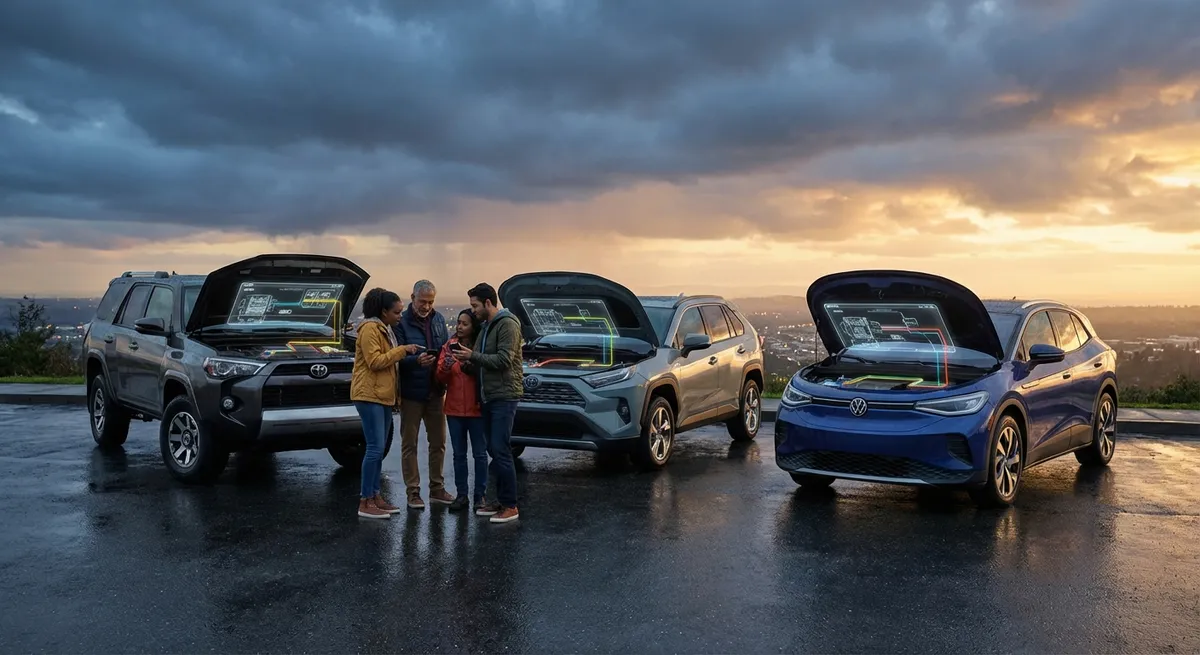
Choosing between a gas, hybrid, or fully electric SUV is no longer a simple question of “what’s cheapest.” Powertrain choice now shapes everything from your monthly costs to how far you can tow, where you can road-trip, and even how often you visit a service bay. This comparison goes beyond brochure talk to look at how each option performs in the real world—helping serious shoppers and enthusiasts match the right SUV to their actual driving lives.
Power Delivery and Performance: How Each SUV Feels on the Road
From behind the wheel, the biggest difference between gas, hybrid, and electric SUVs is how they deliver power, not just how much they make.
Traditional gas SUVs rely on internal combustion engines with peak torque higher in the rev range. Turbocharged four- and six-cylinder engines have improved low-end response, but they still can feel “wound up” under heavy throttle, especially when loaded or towing. Gearboxes—typically 8–10 speed automatics—play a big role in drivability, constantly hunting for the right ratio to balance performance and efficiency.
Hybrid SUVs layer an electric motor or motors onto a gas engine. In a conventional hybrid (HEV), such as a Toyota RAV4 Hybrid or Ford Escape Hybrid, the electric motor smooths low-speed response and fills torque gaps, so off-the-line acceleration feels stronger and more immediate than an equivalent gas-only version. In plug-in hybrids (PHEVs) like the Hyundai Tucson Plug-in Hybrid or Jeep Grand Cherokee 4xe, you can often run purely on electric power for daily commutes, then rely on the gas engine for long trips. The trade-off is weight: batteries and electric hardware add hundreds of pounds, which can slightly blunt agility and braking if the chassis and brakes aren’t engineered accordingly.
Electric SUVs (BEVs) like the Tesla Model Y, Hyundai Ioniq 5, or Kia EV9 deliver maximum torque from 0 rpm. That instant response transforms everyday driving—merging, passing, and short on-ramps feel dramatically easier. Dual-motor all-wheel-drive setups provide both performance and all-weather traction, often out-accelerating traditional performance SUVs in 0–60 mph runs. The downside is sustained high-speed driving: while EVs are extremely quick in bursts, repeated full-throttle runs or towing at highway speeds can trigger thermal limits and reduce available power until systems cool.
For enthusiasts, gas SUVs still lead in engine character (sound, shifting, and rev-happy feel), while EVs own outright launch performance. Hybrids sit in the middle, offering strong real-world acceleration without the drama, favoring efficiency over excitement.
Real-World Range, Refueling, and Charging Time
Range is more than a number on a window sticker; it dictates how you plan road trips, daily commutes, and even where you live or work.
Gas SUVs remain the easiest choice for long-distance drivers. With widespread fueling infrastructure and refuel times typically under five minutes, even a 400–500 mile tank can be quickly “reset” on a road trip. Modern downsized turbo engines and high-efficiency 8–10 speed automatics have improved highway fuel economy, but city mileage for larger three-row SUVs can still fall into the mid-teens mpg, especially in stop‑and‑go traffic.
Hybrid SUVs deliver their biggest advantage in city and suburban driving. Regenerative braking converts kinetic energy back into electricity, recapturing energy normally lost as heat. This is why EPA ratings for hybrids often show higher city than highway mpg, a reversal of many gas-only models. For commuters who see frequent traffic lights and congestion, hybrids can slash fuel use and extend tank range, often pushing real-world figures into the high 30s or better for compact and midsize models.
Plug-in hybrid SUVs add an all-electric range buffer—often 20–40 miles—before the gas engine is needed. For buyers with short commutes and home charging, that can mean using almost no gasoline during the workweek, with full hybrid functionality available when the battery is depleted. However, once the pack is empty, PHEVs typically behave like mildly heavier hybrids. Their total system range still benefits from the gas tank, but long highway trips may not be as efficient as a streamlined non-hybrid counterpart.
Electric SUVs have the most variable real-world range. EPA-rated ranges of 250–330 miles are common, but factors like highway speed, temperature, HVAC use, wheel size, and towing can significantly reduce that number. DC fast charging can mitigate this on road trips, but charge times—even when advertised as 10–80% in 18–30 minutes—depend heavily on charger power, state of charge when you plug in, and thermal management. For many owners who can charge at home or work, daily driving becomes simpler: you “refuel” overnight, start every day with a full battery, and rarely visit public chargers.
The key comparison:
- Gas: Best for unpredictable long-distance use and regions with limited charging.
- Hybrid: Best for mixed driving with consistent fuel availability and limited access to charging.
- PHEV: Ideal for short daily commutes with reliable home charging and regular long trips.
- EV: Strongest for predictable daily routes, home/work charging, and metro/regional travel with growing DC fast-charge coverage.
Ownership Costs, Maintenance, and Long-Term Reliability
The sticker price tells only part of the story; how each SUV type ages and what it costs to keep running can be very different.
Gas SUVs are the most familiar. Maintenance includes oil and filter changes, spark plugs, belts, transmission fluid, differential and transfer case fluids, and more complex exhaust aftertreatment in some models (like particulate filters or selective catalytic reduction in certain turbo or diesel offerings). Over a 10-year ownership period, routine service can add substantially to the total cost of ownership, but repair networks are extensive and parts are widely available. For high-mileage drivers, this predictability can be a plus.
Hybrid SUVs add high-voltage components—battery pack, power electronics, electric motors—but dramatically reduce stress on the gas engine. Engine-off operation at idle, electric assist under load, and regenerative braking all translate to fewer wear events. Brake pads can last significantly longer due to regeneration handling a large portion of deceleration. High-voltage batteries are designed for longevity, and federal regulations in the U.S. require manufacturers to warranty hybrid emission control systems (which often include the battery) for at least 8 years/100,000 miles, with some states requiring 10 years/150,000 miles. When batteries age, they typically lose capacity gradually rather than failing abruptly, though replacement packs can be expensive if needed out of warranty.
Plug-in hybrids use larger batteries and chargers than standard hybrids, but maintenance profiles are similar beyond the larger, more complex battery pack. The gas engine in a PHEV may see less use if the driver stays mostly in EV mode, which can be beneficial, but extended low-use patterns without proper warm-up can create different wear concerns if the engine cycles on only intermittently. Software management and regular, appropriate use are important to keep both sides of the drivetrain healthy.
Electric SUVs simplify mechanical systems by eliminating the gas engine, transmission (in the traditional sense), exhaust system, and many fluid services. Routine maintenance typically centers on tire rotations, cabin filters, brake fluid, and occasional coolant changes for battery and motor thermal circuits. Wheel and tire maintenance becomes more important due to higher curb weight and instant torque, which can accelerate tire wear if driven aggressively. Long-term, the main question mark remains battery life and replacement cost, though large-scale field data is increasingly showing many EV packs retaining substantial capacity well past 100,000 miles when properly managed and cooled.
Insurance costs can vary by powertrain and specific model due to repair costs and crash test performance. High-voltage components and aluminum/advanced high-strength steel body structures in some hybrids and EVs can raise repair bills after a collision. However, many modern SUVs bundle advanced driver assistance systems (ADAS) that can reduce the likelihood and severity of crashes, partially offsetting higher repair costs through claim reductions.
Capability and Use-Case: Towing, Cargo, and Climate Considerations
Capability is where the “spec sheet versus reality” gap is often widest, especially when comparing gas, hybrid, and electric SUVs.
Gas SUVs still carry the broadest range of towing capacities, particularly in body-on-frame models and full-size three-row vehicles. A properly equipped gas-powered midsize or full-size SUV can often tow anywhere from 5,000 to over 8,000 pounds, with consistent performance at highway speeds. Fuel economy drops substantially under load, but refueling remains simple, and range can often be maintained by choosing models with larger fuel tanks or efficient powertrains.
Hybrid SUVs vary. Some are optimized primarily for efficiency and offer modest tow ratings in the 1,500–3,500 pound range, suitable for small trailers or light recreational gear. Others—especially larger hybrid systems tuned for torque—can approach or match their gas counterparts in tow capacity. The benefit is improved unloaded efficiency, but under heavy towing and steep grades, the system may rely more heavily on the gas engine, eroding the efficiency advantage. Battery cooling and motor temperature management are critical during extended towing; well-designed hybrids monitor and limit output to protect components, which can occasionally reduce performance on very long, sustained climbs.
Plug-in hybrid SUVs can be strong towers on paper, with the gas engine taking the lead once the battery is depleted. However, continuous high-load towing may keep the engine running almost constantly, negating most of the intended electric advantage. That said, for owners who tow only occasionally, a PHEV can be an effective compromise—efficient around town, capable for weekend trips.
Electric SUVs are redefining what’s possible in terms of torque and control. The instantaneous torque and precise motor control provide outstanding trailer management at low speed—backing up, maneuvering in tight spaces, or pulling a boat up a ramp feel incredibly controlled. However, towing can dramatically reduce range, sometimes by 40–60% depending on speed, terrain, and trailer shape. This means more frequent charging stops and careful planning of routes that pass high-power DC fast chargers with adequate pull-through access. In cold weather, these penalties can stack with temperature-induced range loss.
Cargo volume and interior flexibility are largely independent of powertrain but can be influenced by packaging. Hybrids usually integrate batteries under the rear seat or cargo floor, sometimes slightly reducing underfloor storage. Many EVs place battery packs under the cabin floor, preserving interior volume and occasionally adding a front trunk (frunk) for additional storage. The weight of batteries also lowers the center of gravity, which can improve stability when loaded.
Climate is a critical factor. In very cold regions, gas and hybrid SUVs maintain range fairly predictably, though warm-up time and winter fuel blends can affect mpg. EVs and PHEVs experience more noticeable range reduction in freezing temperatures due to battery chemistry and increased HVAC load. Heat pumps and preconditioning (warming the battery and cabin while plugged in) can mitigate this, but buyers in harsh climates should plan around seasonal range shifts when evaluating EV suitability.
Driving Experience, Tech Integration, and Future-Proofing
Beyond cost and capability, the choice between gas, hybrid, and electric shapes the overall driving experience and how “future-ready” your SUV feels.
Gas SUVs deliver the most traditional experience—engine noise, gear changes, and a familiar fueling routine. For many enthusiasts, the tactile connection of a responsive gas engine, especially a well-tuned turbocharged inline-four or V6, remains compelling. Performance-oriented models leverage adaptive suspensions, sport modes, and multi-mode exhaust systems to heighten engagement, but they also tend to carry higher fuel and maintenance costs.
Hybrid SUVs emphasize smoothness and efficiency. Transitions between electric and gas power in well-executed systems can be nearly seamless, with the drivetrain prioritizing quiet electric operation at low speeds. For buyers who value a calm, refined cabin over outright performance, this can be ideal. The technology stack in hybrids often includes advanced energy flow displays and eco-driving feedback, encouraging more efficient habits without requiring constant driver attention.
Plug-in hybrids extend this logic by giving drivers more control over how the system behaves. Many allow you to select modes such as EV-only, hybrid auto, or “save” modes that preserve battery charge for later use (for example, city driving at the end of a highway trip). This configurability appeals to tech-oriented drivers who want to optimize their energy use day by day. However, the complexity of dual powertrains and additional buttons/menus can feel overwhelming to those who prefer simplicity.
Electric SUVs provide the most transformative change in day-to-day feel. The quiet cabin, instant acceleration, and lack of gear shifts combine with one-pedal driving modes (strong regenerative braking that allows slowing using mostly the accelerator pedal) to create a fundamentally different dynamic. Many EVs integrate over-the-air (OTA) software updates, improving performance, efficiency, and infotainment features over time—something still relatively rare in gas and many hybrid models. This software-centric design often means more advanced driver-assistance systems, better integrated navigation with real-time charging planning, and more seamless phone/app connectivity.
Future-proofing considerations include:
- Regulation: Many regions are tightening emissions rules and discussing or implementing future restrictions on new internal-combustion vehicle sales. Hybrids and especially EVs are better aligned with these long-term policy trends.
- Resale value: Demand for efficient and electrified SUVs is rising, but resale dynamics vary by market. In areas with strong charging infrastructure and incentives, EVs and PHEVs can hold value well. In regions with limited support, gas and conventional hybrids still command strong resale.
- Energy prices: Electricity and gasoline prices are volatile and highly local. Where electricity is relatively inexpensive and stable, EVs and PHEVs gain a strong cost advantage. Where electricity is costly or heavily time-of-use metered, hybrids can be more attractive.
For shoppers, the decision increasingly comes down to matching the technology to lifestyle. Gas SUVs reward flexibility and familiarity, hybrids deliver efficiency with minimal change in habits, plug-in hybrids optimize for short electric commutes with gas safety nets, and EVs offer the most modern driving experience with the greatest dependency on infrastructure.
Conclusion
Gas, hybrid, plug-in hybrid, and electric SUVs all have clear strengths—but those strengths only matter if they align with how and where you drive. Enthusiasts who value character, sound, and long-distance towing freedom will still gravitate toward gas. Efficiency-minded commuters and urban families gain major real-world returns from hybrids. Plug-in hybrids serve as a strategic bridge for drivers with short daily routes and frequent road trips. Fully electric SUVs deliver the most advanced, refined driving experience, provided your charging access and usage patterns support them.
Instead of asking which technology is “best,” the sharper question is: which powertrain matches your typical week, your longest recurring trips, your climate, and your risk tolerance for infrastructure and regulation changes? Once you answer those honestly, the right SUV configuration usually becomes obvious—and the spec sheet stops being a puzzle and starts being a validation of your choice.
Sources
- [U.S. Department of Energy – Fuel Economy Guide](https://www.fueleconomy.gov/feg/evs.jsp) - Comparative data on gas, hybrid, plug-in hybrid, and electric vehicle efficiency and operating costs
- [U.S. Environmental Protection Agency – Vehicle Emissions and Fuel Economy](https://www.epa.gov/greenvehicles/electric-vehicle-myths) - Technical and regulatory background on emissions, EV range, and common misconceptions
- [National Renewable Energy Laboratory (NREL) – Impact of Vehicle Electrification](https://www.nrel.gov/transportation/electric-vehicles.html) - Research on EV performance, energy use, and infrastructure considerations
- [Toyota – Hybrid Systems Overview](https://www.toyota.com/hybrid/technology/) - Manufacturer-level explanation of modern hybrid drivetrain design and durability
- [U.S. Department of Energy – Alternative Fuels Data Center](https://afdc.energy.gov/fuels/electricity_infrastructure.html) - Up-to-date information on EV charging infrastructure and planning for real-world use
Key Takeaway
The most important thing to remember from this article is that this information can change how you think about Comparisons.