Choosing between a gas, hybrid, or electric SUV is no longer just about fuel economy—it’s about performance characteristics, long-term cost, infrastructure, and how each powertrain aligns with your real-world driving. With nearly every mainstream brand offering multiple options, the “best” choice depends heavily on how and where you drive, how long you keep your vehicles, and what you value most: range, refinement, power, or running costs. This comparison breaks down the decision using five technically grounded points that matter to serious shoppers and enthusiasts.
Power Delivery and Driving Dynamics
From behind the wheel, the powertrain fundamentally shapes how an SUV feels, even when two models share the same platform. Traditional gasoline SUVs use internal combustion engines (ICE), typically inline-4 or V6 turbocharged units in today’s market. They rely on multi-speed automatic or dual-clutch transmissions, and their torque curves build with rpm. That means passing power often requires a downshift and a surge up the rev range, which can be engaging for some drivers but less effortless in city traffic.
Hybrids combine a smaller combustion engine with one or more electric motors and a battery pack, managed by a hybrid control unit and usually paired with an e-CVT or similar setup. The electric motor’s instant torque fills in low-rpm gaps, masking turbo lag and making hybrids feel stronger than their horsepower numbers suggest, especially from 0–30 mph. Full hybrids can operate in electric-only mode at low speeds, reducing engine noise and improving stop-and-go smoothness, while plug-in hybrids (PHEVs) extend that silent running into tens of miles at suburban speeds.
Electric SUVs (BEVs) invert the traditional performance paradigm. Motors deliver peak torque from zero rpm, so initial acceleration is immediate and linear. Single-motor configurations typically drive one axle, while dual-motor layouts provide all-wheel drive and torque vectoring capability through software, not differentials. The absence of gearshifts and engine vibration creates a very different dynamic feel: quiet, smooth, and deceptively quick. However, EVs carry heavy battery packs mounted low in the chassis; this improves center of gravity and roll control but can change the way the suspension has to be tuned to balance comfort and body control, especially on broken pavement.
For enthusiasts, the choice comes down to character. Gas SUVs still offer the mechanical engagement of shifting and engine sound, particularly in performance-tuned variants. Hybrids deliver punchy real-world acceleration with fuel savings, while EVs provide the most immediate response and quiet composure—but with a distinct, almost “appliance-like” character that some love and others find emotionally muted.
Efficiency, Real-World Range, and Use Cases
Efficiency cannot be judged in isolation—you need to pair consumption with range and your driving pattern. Gas SUVs quote fuel economy in miles per gallon (mpg), and modern turbocharged 4-cylinder models can deliver mid-20s to low-30s mpg on the highway, depending on size and drivetrain. Their range advantage comes from dense energy in gasoline: a 15–20 gallon tank can easily provide 350–500 miles of driving, and refueling is fast and universally available.
Conventional hybrids use their electric motor to recuperate braking energy and optimize engine operating points. They typically outperform comparable gas-only SUVs by 25–50% in mixed driving, with city efficiency gains often higher than highway due to regenerative braking and more engine-off time. Because their battery packs are relatively small, they maintain similar cargo space and often similar fuel tank sizes, giving them long range and strong mpg simultaneously.
PHEVs introduce a meaningful electric-only range—commonly 20–50 miles—before switching to hybrid mode. For commuters with a predictable, moderate daily distance and home charging, they can operate mostly as EVs during the week while preserving gas-based range for longer trips. However, their real-world efficiency depends heavily on charging behavior; running a PHEV without ever plugging in often yields only modest gains over a standard hybrid due to the extra weight.
EV SUVs are rated in miles of range and efficiency in miles per kWh (or EPA MPGe). Typical ranges span approximately 230–330 miles for mainstream models, though cold weather, high-speed driving, and heavy use of HVAC can cut usable range significantly. Drivers who primarily do short, predictable trips and can charge nightly will see EV ownership as both efficient and convenient. Conversely, those who regularly tow, drive long highway stretches at high speeds, or live in regions with limited charging infrastructure may find the range and charging profile a more substantial constraint.
Matching powertrain to use case is crucial: high-mileage commuters and urban drivers tend to benefit most from hybrids and EVs, while long-distance highway travelers and those frequently far from fast-charging networks may still find gas or hybrid SUVs the most practical.
Ownership Costs, Maintenance, and Longevity
Total cost of ownership goes far beyond the sticker price, and the three powertrain types diverge meaningfully on maintenance and operating expenses. Gas SUVs have the most mature maintenance patterns: regular oil changes, transmission fluid services, spark plugs, belts, emissions system components, and, over time, potential turbocharger or fuel system work. As mileages climb, the increasing complexity of modern emissions and fuel injection systems can result in higher repair costs.
Hybrids introduce additional elements—traction batteries, inverters, electric motors, and cooling circuits—but reduce stress on the engine and brakes. Regenerative braking significantly extends brake pad and rotor life because the electric motor does much of the deceleration work. Hybrid batteries in modern systems are typically liquid-cooled and engineered to last well over 100,000 miles; many manufacturers back them with extended warranties (often 8 years / 100,000 miles or more, with some regions offering longer coverage). When batteries eventually degrade, replacement costs can be substantial, but reported failure rates in mainstream hybrids have been relatively low compared to early-generation systems.
EVs remove entire categories of maintenance: no oil changes, no exhaust system, no spark plugs, and far fewer moving parts in the drivetrain. The primary periodic service items are tires (which can wear faster due to weight and instant torque), cabin filters, brake fluid, and occasional coolant service for the battery and power electronics, depending on the manufacturer’s schedule. Brake wear is often minimal because regenerative braking does so much work. Battery longevity remains a key concern for many buyers; however, large packs typically degrade slowly when managed well, and most EVs carry similar long-term battery warranties to hybrids. Replacement costs for out-of-warranty batteries are high, but real-world fleet data suggests that many owners will replace the vehicle before a catastrophic battery failure, especially as partial degradation is often manageable for typical daily driving needs.
On the running-cost side, electricity is usually cheaper per mile than gasoline on a pure energy basis, especially when charging at home during off-peak rates. However, frequent use of public DC fast charging can erode that advantage. Hybrids sit in the middle, offering reduced fuel costs without requiring any charging infrastructure, while PHEV economics swing widely depending on how consistently the vehicle is charged and how high local fuel prices are. For drivers planning to keep an SUV for 8–12 years, these cost profiles can strongly favor hybrids and EVs, especially in regions with incentives and high fuel prices.
Charging and Fueling Infrastructure: Practical Everyday Differences
Refueling a gas or hybrid SUV is simple and quick: nearly universal fuel station availability, standardized pump hardware, and fill times measured in minutes. For those frequently on the road in rural or remote regions, this ubiquity remains a major advantage. Hybrids and PHEVs can mitigate fuel consumption but do not change the fundamental refueling pattern—though PHEVs do allow home charging to offset some gasoline use.
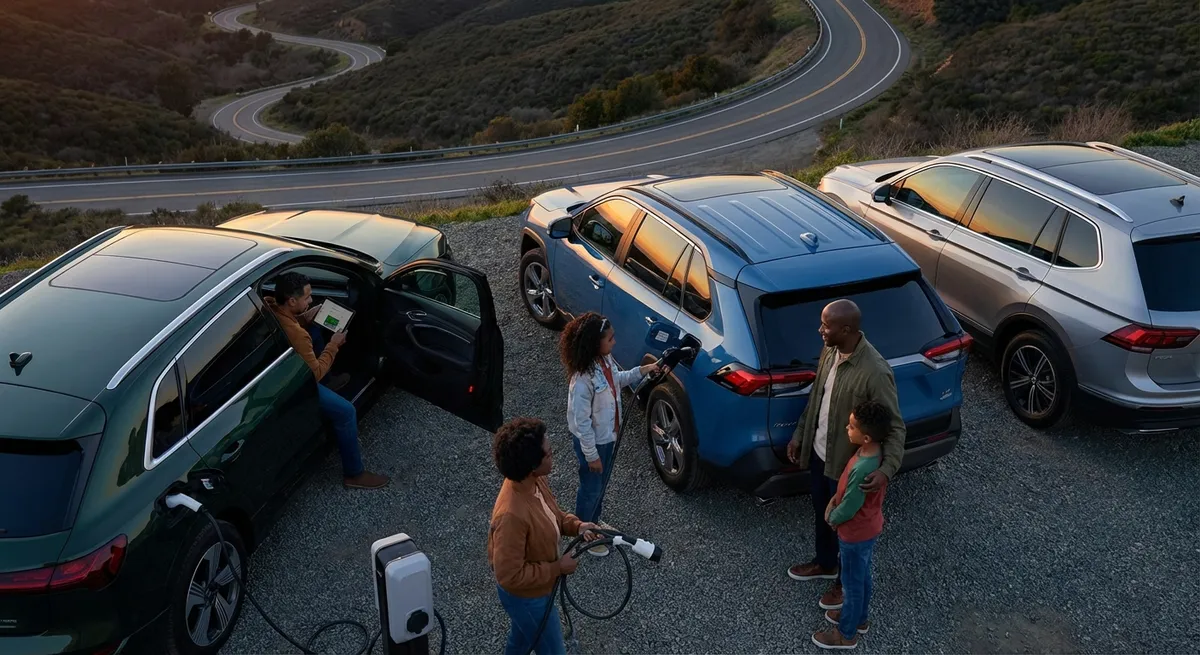
EV owners must think differently about energy planning. Home charging is the cornerstone: a Level 2 charger (240V) installed in a garage or driveway can add roughly 20–40 miles of range per hour, allowing overnight top-ups that effectively “reset” the battery daily for most commutes. Drivers without reliable at-home or workplace charging face a very different experience, relying on public Level 2 and DC fast chargers. While public charging networks are expanding, coverage varies widely by region, and reliability can be inconsistent.
Fast charging can replenish 10–80% of a battery in as little as ~20–45 minutes depending on vehicle and charger capability, but peak charging rates (e.g., 150 kW, 250 kW) are only maintained over a portion of the session due to battery thermal management and charge curves. Long trips in an EV require route planning around fast chargers, factoring in dwell time and potential queues. Cold weather further complicates this, as battery preconditioning and reduced charge acceptance can lengthen stops.
PHEVs occupy a middle ground: owners can treat them like standard hybrids if charging access is poor while taking advantage of overnight charging where possible. However, relying on public chargers for a PHEV with a relatively small battery often makes less practical sense than for a long-range EV, due to the smaller benefit per charging session. When comparing powertrains, serious buyers should be realistic about their access to consistent, convenient charging; it’s the defining factor in whether an EV or PHEV will feel like an upgrade or an ongoing compromise.
Environmental Impact and Future-Proofing Your Purchase
Environmental impact is a critical factor for many buyers and intersects with regulatory trends that will shape the SUV market over the coming decade. Gas SUVs have the highest tailpipe emissions, with CO₂ output directly tied to fuel consumption. While modern engines and aftertreatment systems have drastically reduced pollutants such as NOx and particulates compared to previous decades, CO₂ emissions remain inherent to burning fuel. Regulatory pressure is tightening worldwide, and some regions have proposed or enacted timelines to phase down or heavily regulate new ICE vehicle sales.
Hybrids reduce fuel burned per mile, directly cutting CO₂ emissions. Full hybrids are especially effective in urban driving, where they can spend more time in electric mode and recuperate more braking energy. PHEVs can significantly lower emissions for users who maximize electric driving and plug in daily; however, studies have shown that real-world PHEV emissions can approach traditional vehicles if drivers rarely charge and rely primarily on the combustion engine, hauling around an underused battery pack.
EVs eliminate tailpipe emissions entirely, which is a major benefit for urban air quality and local pollutants. Their full environmental impact depends on the electricity generation mix and the upstream emissions from battery production. Over a typical ownership period, life-cycle analyses from independent researchers and government agencies increasingly show that EVs tend to have lower total greenhouse gas emissions than comparable ICE vehicles, especially in regions where the grid is decarbonizing. As electrical grids integrate more renewable sources, the emissions advantage of EVs grows over time.
From a “future-proofing” standpoint, policy and infrastructure momentum clearly favors electrification. Many automakers have committed large portions of their R&D and product roadmaps to EVs and electrified platforms. That said, hybrids remain a crucial transitional technology, and gasoline SUVs will persist in the market for years, particularly in heavy-duty, towing, or remote-use applications. Buyers who prioritize long-term compatibility with evolving regulations and urban access rules may find EVs and strong hybrids more aligned with where the market is heading, while those needing maximum flexibility in challenging regions might prioritize ICE or hybrid SUVs alongside careful consideration of potential policy shifts in their area.
Conclusion
Gas, hybrid, and electric SUVs each offer distinct strengths—and potential trade-offs—that go far beyond the headline mpg or range numbers. Gas-powered models deliver long-range refueling convenience and traditional driving character but carry higher running emissions and more frequent maintenance. Hybrids, including PHEVs, occupy the middle ground, blending strong real-world efficiency with familiar ownership habits and partial electrification. Full EV SUVs transform the driving experience with instant torque, quiet operation, and simplified maintenance, provided that charging access and range fit your lifestyle.
For serious enthusiasts and informed buyers, the best choice starts with an honest audit of your daily use, long-trip patterns, home charging situation, and how long you intend to keep the vehicle. Align those realities with the powertrain characteristics outlined above, and you’ll be far better positioned to choose an SUV that not only meets today’s needs but remains compelling and practical as the market and infrastructure continue to evolve.
Sources
- U.S. Department of Energy – Fuel Economy Guide - Explains how fuel economy is measured and compares different powertrain types
- U.S. Environmental Protection Agency – Green Vehicle Guide - Provides emissions data and efficiency ratings for gas, hybrid, PHEV, and electric vehicles
- International Energy Agency – Global EV Outlook - Offers data on EV adoption, charging infrastructure, and policy trends worldwide
- Toyota Technical – Hybrid System Basics - Technical overview of how modern hybrid systems integrate engines, motors, and batteries
- U.S. Department of Energy – Vehicle Cost Calculator - Tool for comparing total energy costs of gas, hybrid, PHEV, and EV vehicles based on local fuel and electricity prices
Key Takeaway
The most important thing to remember from this article is that this information can change how you think about Comparisons.