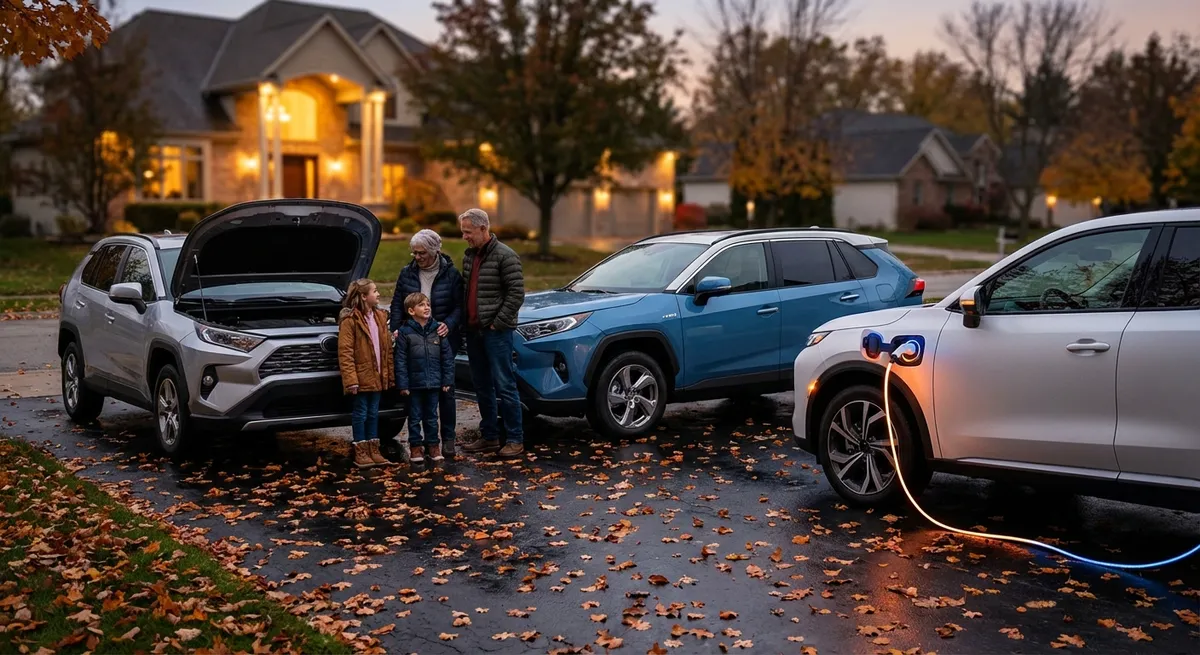
Choosing your next SUV used to be about size, badge, and maybe off-road cred. Today, the far bigger question is what’s under the hood—and how that choice will affect your driving experience, running costs, and long-term ownership. For many enthusiasts and serious shoppers, the real comparison isn’t simply model vs. model, but gas vs. hybrid vs. electric in the SUV space.
This guide looks past the marketing claims and dives into five technical and practical comparison points that matter right now: performance delivery, real-world efficiency, ownership and maintenance, platform and packaging, and future-proofing your purchase.
Power Delivery and Performance: Torque Curves Tell the Real Story
On paper, a 2.0-liter turbo gas SUV, a hybrid SUV, and a dual-motor electric SUV can all claim “quick acceleration” and similar 0–60 mph times. In practice, they feel completely different, and the way they deliver power can be more important than the final number.
Gas SUVs rely on an internal combustion engine whose torque curve typically peaks higher in the rev range. A modern turbocharged four- or six-cylinder builds torque earlier than old-school naturally aspirated engines, but you still feel a deliberate build-up: throttle, spool, surge. Enthusiasts often appreciate the involvement and sound, but you’re operating in a relatively narrow power band where the engine feels at its best.
Conventional hybrids pair a smaller gas engine with one or more electric motors and a battery, optimizing the torque curve for everyday drivability rather than drama. The electric motor fills in low-end torque, masking turbo lag and allowing the gas engine to operate in more efficient RPM zones. You’ll notice smoother launches from a stop and less downshifting drama in city traffic, although some hybrids—especially those with e-CVT setups—can feel less connected or “rubber-bandy” during aggressive acceleration.
Plug-in hybrid (PHEV) SUVs extend this by offering a sizable electric-only mode, often 25–50 miles of EV driving. When the battery is charged, you get near-EV torque off the line with the backup of a gas engine for longer trips. In performance-oriented PHEV SUVs, total system output can be substantial, with electric torque masking gearbox shifts and making overtakes feel almost effortless when the system is fully charged.
Electric SUVs change the experience again: near-instant torque from zero RPM, no gear changes, and a linear power delivery that can feel deceptively calm until you realize how quickly the speedometer has climbed. Dual-motor and tri-motor setups provide torque vectoring capabilities that are difficult to replicate mechanically, dramatically improving traction and corner-exit performance. For enthusiasts, the tradeoff is less engine sound and fewer mechanical cues to work with—but superior throttle response and traction out of tight corners.
When comparing options, don’t just look at 0–60 times. Ask for (or research) torque curves, motor outputs, and system behavior (e.g., when hybrids kick in the engine, whether EVs have torque vectoring, and how strongly PHEVs perform when the battery is low). The real-world driving character is often defined more by how the power arrives than by peak horsepower.
Real-World Efficiency: EPA Numbers vs. How SUVs Are Actually Driven
EPA ratings and WLTP figures are useful, but SUVs are usually heavier, taller, and more wind-sensitive than sedans—and they often get driven in ways that exaggerate those penalties. The comparison between gas, hybrid, and electric becomes clearer once you look at efficiency under typical SUV use cases: commuting, family hauling, and highway trips.
Traditional gas SUVs often show a greater gap between rated and real-world fuel economy, especially if you do a lot of short trips, cold starts, or towing. Turbocharged engines that look efficient on the sticker can consume significantly more fuel when worked hard or when heavily loaded. A boxy, off-road leaning SUV will also pay a noticeable aerodynamic penalty at highway speeds compared with a sleeker crossover, even with the same engine.
Hybrid SUVs tend to shine in mixed or city-heavy driving. Regenerative braking recovers energy in stop-and-go conditions, and the engine can shut off at idle. If your commute is urban or suburban with frequent traffic lights, a hybrid’s effective mpg can significantly exceed that of a comparable gas-only SUV. On pure highway runs at steady speeds, the efficiency advantage still exists but is usually less dramatic, because there’s less opportunity for regeneration and engine-off operation.
PHEV SUVs introduce a more complex equation. If you charge regularly and your daily use fits inside the EV-only range, you might operate as an electric vehicle most days and as a hybrid only for longer trips. That can make the “MPGe” rating (miles per gallon equivalent) more realistic, but only if you’re disciplined about plugging in. If you rarely charge, you’re essentially carrying around a heavy battery pack that offers little benefit—often resulting in real-world fuel economy worse than a simpler hybrid or even some gas SUVs.
Electric SUVs are rated in miles per kWh, and their real-world efficiency is influenced by temperature, speed, load, and wheel/tire choice. At low to moderate speeds, EV SUVs can be remarkably efficient considering their size, because electric powertrains are inherently more efficient than combustion. But at high freeway speeds, the combination of SUV aerodynamics and additional mass can reduce range significantly compared with official ratings. Cold weather further impacts range due to battery chemistry and cabin heating demands.
When cross-shopping, look for independent real-world tests, not just lab figures. Pay attention to:
- City vs. highway splits in fuel economy or range testing
- Performance under heavy loads or towing
- Seasonal range or mpg variations reported by owners
- Whether the driving cycle in tests matches your actual usage
For many buyers, the hybrid or PHEV layout hits the sweet spot for mixed driving, while dedicated road trippers might still favor efficient gas or diesel SUVs, and commuters with home charging can make an electric SUV work brilliantly.
Ownership, Maintenance, and Long-Term Reliability Tradeoffs
Beneath performance and efficiency, the real comparison that affects your wallet over time is complexity vs. durability. Each powertrain type carries a distinct maintenance and reliability profile that’s worth understanding before you sign a long-term finance or lease agreement.
Gas SUVs are mechanically familiar: internal combustion engines, multi-speed automatic or dual-clutch transmissions, and known maintenance schedules. Oil changes, transmission fluid service, spark plugs, timing components, and emissions systems all require periodic attention. Over long-term ownership, potential failure points include turbochargers, high-pressure fuel pumps, and complex emissions control hardware. The upside is that most shops are experienced with diagnostics and repair, and parts availability is generally strong.
Hybrid SUVs add high-voltage battery packs, one or more electric motors, inverters, and power electronics, plus additional cooling systems. The internal combustion side often runs under less strain, which can extend its life, but the total number of components is higher. Modern hybrid systems from established brands have generally demonstrated good long-term reliability, and high-voltage batteries are typically covered by long warranties (often 8 years/100,000 miles or more, sometimes higher in certain states). Routine maintenance remains similar on the engine side—oil, filters, coolant—while the electric side is mostly inspection-based unless a fault arises.
PHEV SUVs are the most complex of all: full hybrid systems plus larger battery packs and onboard chargers. This complexity can bring benefits (true EV commuting with ICE backup), but also more things that must work together seamlessly: charging hardware, battery management, and dual-mode powertrain control. Long-term, battery degradation and out-of-warranty repairs to power electronics or charging components are key considerations—especially if you plan to keep the vehicle beyond the warranty period.
Electric SUVs simplify some aspects and complicate others. There’s no engine oil, exhaust system, or conventional multi-gear transmission. Brake wear can be reduced dramatically by regenerative braking. But the high-voltage battery pack, motor(s), inverter, onboard charger, and thermal management system are mission-critical. Battery health and thermal control are especially important in larger, heavier EV SUVs, where thermal load is higher under towing or spirited driving. While early data suggests fewer routine maintenance items, component repair or replacement outside warranty can be costly, and not all independent shops are equipped to handle high-voltage work yet.
When comparing models, look closely at:
- Battery warranty terms (years, mileage, and degradation thresholds)
- Drivetrain warranty coverage for hybrids and EVs
- Recommended service intervals and typical costs for each powertrain type
- Availability of qualified service centers in your area
For enthusiasts who mod or track their SUVs, also consider how much headroom the platform has for additional stress—forced induction tweaks on a gas SUV, for instance, versus thermal and battery limits on a performance EV SUV.
Packaging, Space, and Driving Dynamics: Platform Differences Matter
Underneath the bodywork, how an SUV is engineered—body-on-frame vs. unibody, longitudinal vs. transverse layouts, and how batteries are integrated—shapes everything from cargo space to handling feel.
Traditional gas SUVs come in both body-on-frame (truck-based) and unibody (crossover) forms. Body-on-frame models typically prioritize towing and off-road durability, with solid rear axles or heavy-duty independent setups, higher ride heights, and often less efficient packaging. The floor can be higher, and the third row (if present) may feel more upright. Unibody gas SUVs and crossovers usually have better space utilization: a lower floor, more legroom for a given exterior length, and more car-like dynamics.
Hybrid SUVs often share platforms with their gas counterparts, but they must find packaging space for battery modules and electric components. In some models, this compromises cargo area or underfloor storage, or slightly raises the rear floor height. In others—especially where hybridization was designed in from the start—the impact is minimal. The additional weight of hybrid hardware can sometimes improve ride quality (more planted feel) but may dull agility compared to a lighter gas-only trim.
PHEV SUVs have larger battery packs, so packaging becomes more critical. If the platform wasn’t designed with a PHEV in mind, space can be stolen from fuel tanks (reducing gas-only range), cargo volume, or underfloor storage. A well-designed PHEV SUV, however, will integrate the battery low and central—often under the floor or rear seats—lowering the center of gravity and improving stability and cornering balance. The tradeoff is overall mass; the vehicle may feel heavier changing direction, even if body control remains good.
Electric SUVs that use dedicated EV platforms have the most flexibility. A “skateboard” design places the battery pack in a structural slab between the axles, with motors at one or both ends. This allows for:
- Flat floors and excellent rear legroom
- Shorter overhangs and more cabin space relative to length
- Lower centers of gravity than comparable gas SUVs
Handling benefits from the low-mounted mass, with reduced body roll and improved stability. However, total weight remains a factor; some electric SUVs weigh 1,000–1,500 pounds more than similar-size gas models. The suspension and brakes must be engineered to cope, which can make ride tuning more challenging—especially on large wheels and low-profile tires often fitted for style or performance.
When test driving, pay attention to:
- Floor height, step-in, and third-row comfort if applicable
- Visibility and driving position, especially in taller off-road-oriented SUVs
- How the SUV responds to quick lane changes, on-ramps, and uneven surfaces
- Whether the extra mass of hybrid/PHEV/EV versions changes the feel vs. gas trims
For enthusiasts, the best-driving SUV may well be a dedicated EV platform with a low center of gravity—or a lighter, unibody gas or mild-hybrid SUV that feels more tossable. The “right” answer depends on whether you value agility, refinement, off-road clearance, or towing capacity.
Future-Proofing: Regulations, Resale, and Charging/Towing Expectations
The final—and increasingly crucial—comparison point is how well each SUV powertrain option positions you for regulatory changes, infrastructure evolution, and resale dynamics over the next decade.
Governments in North America, Europe, and parts of Asia are tightening emissions standards and, in some regions, setting timelines to phase out or heavily discourage new internal combustion engine (ICE) sales. This doesn’t mean gas SUVs will vanish overnight, but it does mean future regulation may become stricter on emissions, fuel economy, and urban access (e.g., low-emission zones in certain cities). Over a 7–10 year ownership window, this could influence everything from fuel costs to where you can drive freely.
Hybrids and PHEVs are often treated more favorably in policy discussions because they reduce local emissions and improve fleet fuel economy. That may support demand and resale value in the medium term. However, as pure EVs become more mainstream and charging infrastructure improves, some PHEVs that offer limited electric range or weak hybrid operation may be viewed as transitional technology rather than long-term solutions.
Electric SUVs are the most aligned with long-horizon emissions goals and are likely to benefit from continued policy incentives, preferential access in urban areas, and ongoing rapid improvements in charging networks. That said, the pace of battery and charging tech development could also make early EVs feel older more quickly, especially in terms of range and charge speed. Over time, buyers may prioritize EVs with modern fast-charging capabilities and robust thermal management systems, particularly in larger SUV formats.
Towing and long-distance touring also shape future usability. Gas and diesel SUVs still hold the edge for heavy towing over long distances, with fast refueling and minimal range penalty compared with rated consumption. Hybrids can tow but may see pronounced efficiency hits under load. PHEVs are attractive if you tow occasionally and use EV mode frequently otherwise, but towing will quickly deplete the battery and shift you into less efficient hybrid or gas operation.
Electric SUVs can tow strongly—instant torque helps—but the range impact can be significant, often cutting effective range in half or more when pulling heavy trailers. Future-proofing for EV towing means watching for:
- Larger battery packs with high usable capacity
- High DC fast-charging rates and stable curves
- Strong thermal management that sustains repeated fast charges
On the resale front, track where regulations and consumer sentiment are going in your region. In markets rapidly moving toward electrification, clean and efficient hybrids, PHEVs with meaningful electric range, and capable EV SUVs may hold value better than thirsty, purely gas-powered models—especially those that don’t offer mild hybrid or other efficiency aids.
If you plan to keep your SUV for a long time, the best future-proof choice often balances infrastructure reality today (Do you have home charging? Is fast charging common on your routes?) with expected policy trends where you live and drive.
Conclusion
Choosing between gas, hybrid, PHEV, and electric SUVs is no longer a simple fuel vs. battery debate—it’s a multi-dimensional comparison involving power delivery, real-world efficiency, long-term ownership, platform engineering, and regulatory trajectory.
Gas SUVs still appeal to enthusiasts who value mechanical feel, sound, and straightforward refueling—especially for heavy towing and remote travel. Hybrids deliver a compelling mix of efficiency and familiarity, particularly for urban and suburban duty. PHEVs reward disciplined drivers who charge consistently and want genuine EV commuting with long-range flexibility. Electric SUVs redefine performance and packaging, offering instant torque and spacious interiors, while asking you to think differently about energy planning and long trips.
For serious buyers and enthusiasts, the smartest move is to match the engineering strengths of each powertrain type to your actual driving patterns, infrastructure access, and how long you plan to keep the vehicle. Drive them back-to-back, study not just the spec sheets but also the long-term implications, and your next SUV will feel less like a compromise and more like a tailored solution.
Sources
- U.S. Department of Energy – Fuel Economy Guide – Explains efficiency metrics for gas, hybrid, PHEV, and EV vehicles, including MPGe and real-world considerations
- U.S. Environmental Protection Agency – Green Vehicle Guide – Provides official fuel economy, emissions ratings, and regulatory background for different powertrain types
- National Renewable Energy Laboratory (NREL) – Vehicle Electrification Research – Technical insights into battery systems, charging, and vehicle efficiency trends
- International Energy Agency – Global EV Outlook – Covers global adoption trends, policy directions, and infrastructure development for electric vehicles
- Toyota Hybrid System Technology Overview – Detailed explanation of hybrid system architecture and reliability considerations from a major hybrid manufacturer
Key Takeaway
The most important thing to remember from this article is that this information can change how you think about Comparisons.