The SUV market is entering one of its most turbulent supply cycles in a decade. Behind the glossy launches and concept reveals, automakers are quietly redrawing production maps, renegotiating battery contracts, and retooling factories at record speed. For buyers, this is more than “industry noise”: it affects what will actually be in showrooms, how much you’ll pay, and which models will be easy—or frustrating—to get your hands on.
This industry news roundup unpacks five critical shifts in SUV production and supply that every enthusiast and serious shopper should understand, with a focus on how these changes will play out over the next 12–24 months.
Factory Retooling: ICE Lines Give Way to Hybrid and EV SUV Production
Across North America, Europe, and Asia, legacy internal-combustion SUV lines are being reconfigured to build hybrids and full EVs, and the timing of this transition has direct consequences for availability.
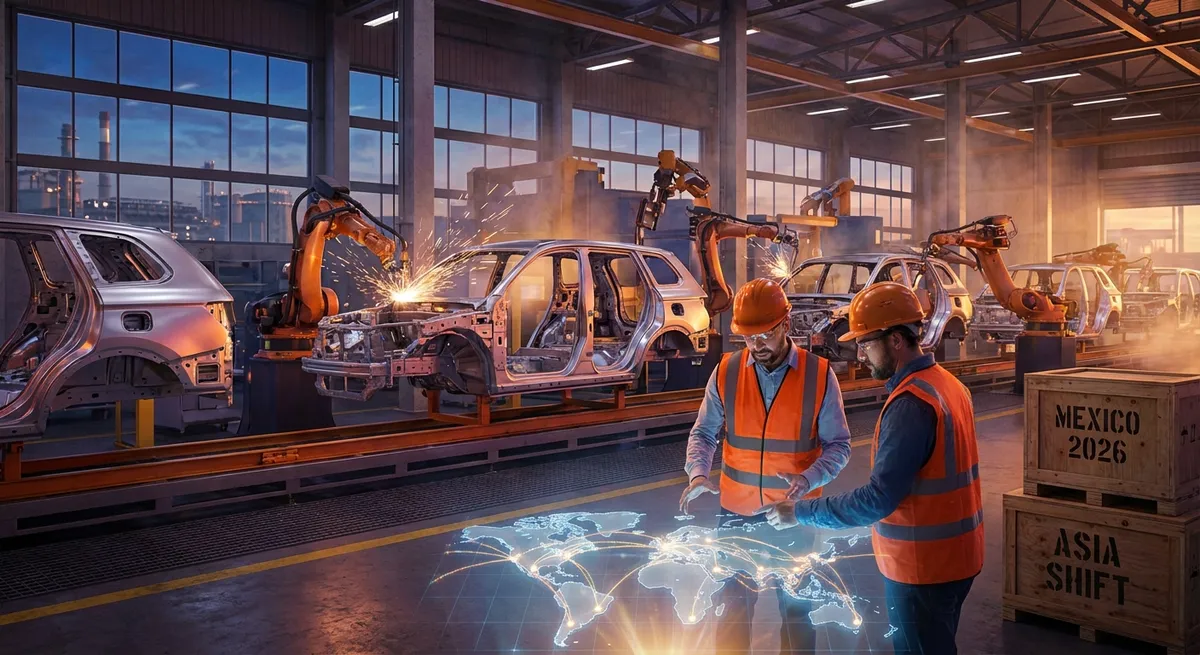
Automakers like Ford, GM, Volkswagen, Hyundai–Kia, Toyota, and Stellantis have publicly committed billions to converting existing plants rather than building entirely new ones. In practice, this means temporary shutdowns or reduced output for some popular gasoline SUVs while lines are rebuilt to handle multi-energy platforms—chassis that can support ICE, hybrid, and BEV versions of the same basic architecture.
These conversions are technically complex. High-voltage battery assembly requires separate, climate-controlled zones and different safety systems. Body shops need revised tooling to accommodate floor-mounted battery packs and redesigned crash structures. Paint shops must adapt to altered body-in-white geometries, especially where EVs use longer wheelbases to package batteries while maintaining overall length.
For buyers, the near-term effect is uneven supply. Some nameplates may see long lead times or reduced trims while their factories are retooled, even as automakers heavily market “next generation” electrified SUVs. You can expect to see transitional strategies: extended runs of current-gen models built in parallel with pilots of hybrid or EV variants, plus strategic allocation of limited early production to markets with stricter emissions rules or better incentives.
Enthusiasts tracking specific models should pay close attention to plant announcements, not just vehicle unveilings. A reveal without a fully prepared production footprint often translates into slower ramp-up and constrained early stock.
Battery and Motor Supply Contracts Now Dictate SUV Launch Cadence
In the EV and plug-in hybrid SUV segment, battery and electric motor contracts are now as important as sheet metal and styling. Automakers’ public filings and announcements make clear: supply chain strategy is increasingly a story about raw materials and cell production.
Global carmakers are signing multi-year agreements with battery giants like CATL, LG Energy Solution, Panasonic, SK On, and BYD, while simultaneously investing in in-house or joint-venture plants (“gigafactories”) in the U.S. and Europe. These deals lock in capacity and, crucially, chemistry types—lithium iron phosphate (LFP) for lower-cost, long-cycle SUVs and nickel manganese cobalt (NMC/NCA) for higher-energy, longer-range models.
Because cell and pack production often becomes the bottleneck, some SUV launches are being phase-staggered by trim and region. High-margin versions (long-range, performance, or luxury-spec SUVs) tend to be prioritized, while entry-level trims or lower-range variants arrive later or in limited volume. The same applies to electric drive units (EDUs): integrated motor–inverter–reduction gear assemblies are capital-intensive to scale and can constrain how many EV or hybrid SUVs a maker can deliver in a given quarter.
Technical details also matter. Switching to LFP packs—now increasingly assembled in or near North America and Europe—changes not only cost, but sourcing compliance under local-content rules. That in turn affects which specific trims qualify for consumer incentives, shaping demand mix and production planning.
For shoppers, this means that advertised starting MSRPs for electrified SUVs may describe trims that are technically in the lineup but scarce in the real world for the first 12–18 months. It also means mid-cycle “silent” updates—like incremental range bumps or chemistry changes—will often reflect revised supply contracts rather than full model overhauls.
Regionalization of Production: SUVs Built Closer to Their Buyers
One of the most important structural changes in SUV manufacturing is the drive toward regionalization—building more vehicles closer to where they will be sold. This strategy is being pushed by logistics costs, geopolitical risk, trade policy, and emissions/incentive regulations.
In North America, major brands are racing to localize SUV and battery production to comply with evolving rules on content origin and to reduce exposure to shipping disruptions and tariffs. Similar dynamics are playing out in Europe, where CO₂ fleet targets and industrial policy are favoring local EV and hybrid production and, increasingly, local cathode/anode material plants.
Technically, regionalization doesn’t just mean a different final-assembly location; it often requires localized supply ecosystems. Stamping plants, Tier 1 electronics suppliers, battery pack lines, and sometimes even dedicated aluminum casting facilities are being located closer to vehicle assembly. This allows shorter lead times and more flexible responses to demand spikes for specific SUV models or trims.
However, regionalization can create short-term friction. Moving a nameplate from an export-based model (e.g., built in one country, shipped globally) to multi-hub regional plants requires tooling duplication, new workforce training, and validation of local suppliers. That can temporarily reduce output or limit trim diversity during the transition phase.
Buyers will increasingly see region-specific variants and equipment. An SUV sold in North America may differ subtly in charging hardware, driver-assistance calibration, or even crash structure from its European or Asian counterpart, reflecting both local regulations and local component sourcing. Enthusiasts comparing specifications should be cautious about assuming global uniformity.
Software-Defined SUVs: Production Lines Now Build Hardware for Features That Arrive Later
SUVs rolling off the line today are increasingly “software-defined”: much of their capability is baked into hardware from day one, but actual features are enabled, refined, or monetized via software updates over time. That shift is changing both production planning and the ownership experience.
From a manufacturing perspective, automakers are standardizing hardware—sensors, cameras, radars, domain controllers, high-speed data networks—across more trims to simplify production, even when not all features are immediately active. A mid-trim SUV might leave the factory with the same lidar or radar suite as a top trim, but with certain advanced driver-assistance functions disabled until a later over-the-air (OTA) update or paid activation.
This architecture relies on powerful central computing platforms and zonal electrical systems capable of handling continuous software updates. It also changes homologation cycles: instead of tying key capabilities to hardware facelifts, OEMs can roll out substantive changes in drive modes, energy management strategies, and even torque vectoring maps via software revisions.
For buyers, the practical impact is twofold. First, real-world capabilities of a given SUV can meaningfully improve—or, in some regulatory cases, be constrained—over its life, well beyond the initial spec sheet. Second, the production status of a model year becomes more nuanced: two vehicles built in the same plant and week can diverge significantly once they’ve had different update paths or option activations.
From a technical standpoint, this is pushing automakers to adopt more robust cybersecurity practices, standardized communication protocols (e.g., automotive Ethernet), and higher-voltage architectures in electrified SUVs. Those changes, in turn, can influence serviceability and long-term parts support, as legacy electronic modules are phased out faster than in previous generations.
Capacity Versus Demand: Why Some SUV Segments May See Tight Supply Through 2026
Even as automakers invest heavily in new capacity, certain SUV segments are likely to remain supply-constrained in the near term due to the mismatch between what factories are optimized to build and what consumers are demanding.
Three areas stand out:
Electrified three-row family SUVs
Global demand for spacious plug-in hybrid and battery-electric three-row SUVs is outpacing planned capacity. These vehicles require large battery packs and more complex thermal management systems, putting pressure on both cell supply and component logistics. Line rates calibrated for sedans or compact crossovers are being pushed to their limits to accommodate bulkier platforms.
Off-road-capable crossovers with advanced 4×4 systems
Manufacturers are seeing sustained demand for SUVs offering serious off-road hardware—dual-range transfer cases, lockable differentials, or sophisticated electronically controlled torque distribution—combined with modern comfort and safety tech. These driveline systems involve additional machining, specialized suppliers, and more complex calibration work, all of which can be harder to scale quickly.
Premium and performance-oriented SUVs
High-margin performance SUVs with powerful turbocharged or hybrid powertrains and advanced adaptive suspension are often built on more flexible but lower-volume lines shared with flagship sedans or coupes. Their production is deliberately limited to maintain pricing power and manage component constraints (e.g., high-spec brake systems, performance tires, or specialty interior materials).
On top of segment-specific limits, logistics and macroeconomic factors still ripple through SUV supply. Port congestion, shipping cost swings, and shifts in labor availability can all impact when specific trims show up at dealers, even when total production volume looks healthy on paper.
For enthusiasts and serious shoppers, this context helps explain why some models are widely advertised yet hard to find in preferred configurations. Lead times for factory orders, especially for electrified three-row models or fully loaded off-road trims, may remain extended. Monitoring production allocation statements, quarterly earnings calls, and plant announcements can offer early clues about which SUVs will be easier—or harder—to secure in upcoming model years.
Conclusion
The SUV industry’s next phase is being defined as much on factory floors and in supply contracts as in design studios. Retooled plants, battery and motor deals, regionalized production strategies, software-defined architectures, and segment-specific capacity constraints are all converging to reshape what ends up in showrooms and at what price.
For car enthusiasts, this is a pivotal moment to look beyond brochures and spec sheets. Understanding where and how your next SUV is built, which components are locally sourced, and how software will evolve over its life can help you read between the lines of marketing claims and make more strategic decisions about timing, trims, and configurations. As the market moves toward 2026, those who follow the production-side story will have a clearer view of which SUVs are truly future-ready—and which are transitional products in a rapidly changing landscape.
Sources
- [International Energy Agency – Global EV Outlook 2024](https://www.iea.org/reports/global-ev-outlook-2024) - Provides data and analysis on EV and plug-in hybrid growth, battery supply chains, and regional production trends.
- [U.S. Department of Energy – Alternative Fuels Data Center](https://afdc.energy.gov/) - Offers technical information on electrified powertrains, charging infrastructure, and vehicle technologies affecting SUV design and production.
- [European Commission – CO₂ Emission Performance Standards for Cars and Vans](https://climate.ec.europa.eu/eu-action/transport-emissions/road-transport-reducing-co2-emissions-vehicles/co2-emission-performance-standards-cars-and-vans_en) - Explains regulatory pressures driving automakers to retool factories and regionalize low-emission vehicle production.
- [Ford Motor Company – Manufacturing & EV Investment Newsroom](https://media.ford.com/content/fordmedia/fna/us/en/news.html) - Contains official announcements on plant retooling, EV production plans, and factory allocations relevant to SUV supply.
- [Volkswagen Group – Strategy and Battery Supply Announcements](https://www.volkswagen-newsroom.com/en/press-releases) - Details VW Group’s battery partnerships, regional production strategies, and platform plans impacting future SUV models.
Key Takeaway
The most important thing to remember from this article is that this information can change how you think about Industry News.