The same artificial intelligence that’s turning Disney characters into startlingly realistic humans is quietly laying the groundwork for a major shift in how future SUVs are designed, engineered, and marketed. A recent viral project—where the artist Toyboyfan used generative AI to reimagine animated characters as photorealistic people—illustrates just how far visual synthesis and pattern recognition have come in just a few years.
For the SUV industry, this isn’t just a fun internet trend. Automakers like BMW, Mercedes-Benz, Hyundai, and General Motors are already deploying similar AI tools in their design studios, product planning, and marketing departments. What looks like digital fan art on social media today is effectively a public-facing demo of the same technologies the auto industry is scaling in the background right now.
Below, we break down how this AI visual boom is about to reshape SUVs—from the way a grille is sketched on Day 1, to how trim levels are configured and advertised on your phone on Day 1,000.
AI-Driven Exterior Design: From Concept Sketch to Virtual Show Car
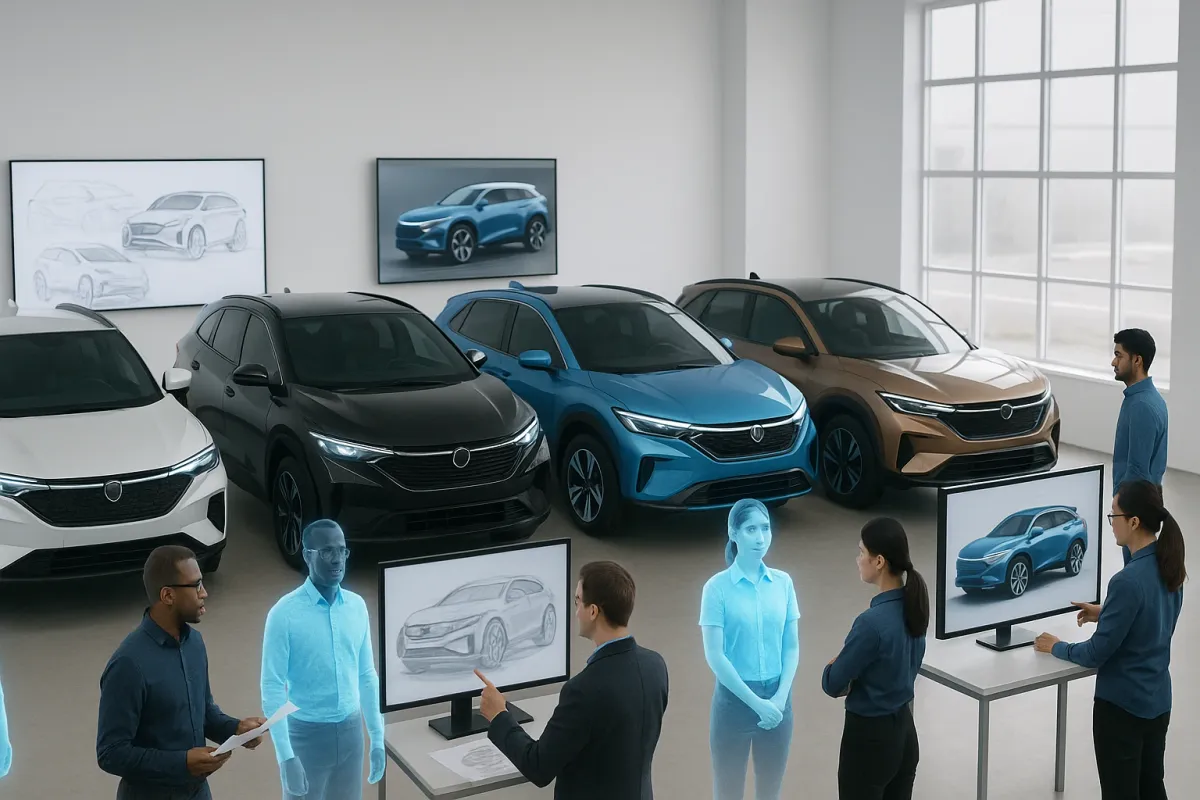
Generative AI models that can turn text prompts into finished artwork are remarkably similar to the tools design teams are now testing for SUV exterior development. Just as Toyboyfan feeds prompt-driven concepts into AI to evolve each character’s face, studio designers are feeding package constraints, brand language, and aero targets into ML-assisted tools to evolve body shapes and surface treatments.
In practice, a design team can iterate through hundreds of front fascia, lighting signatures, and roofline concepts in days instead of weeks. Hyundai’s design group has openly discussed using AI-assisted tools to explore new parameterized grille patterns and lighting elements, especially for its Ioniq and upcoming EV SUVs. Expect future SUVs to have more cohesive “light signatures,” sculpted aero elements around the C- and D-pillars, and more experimental wheel designs because the exploration cost in the digital phase goes way down. The technical payoff is real: better drag coefficients (think Cd in the 0.25–0.28 range vs. 0.30+) and more efficient airflow management around mirrors, wheel wells, and underbodies. Those improvements can add 10–15 miles of real-world range for electric SUVs and trim a few grams of CO₂ per kilometer for combustion and hybrid models.
Hyper-Personalized Interiors: AI Reading Lifestyle, Not Just Demographics
The “In Real Life” AI project takes flat, stylized drawings and adds texture, depth, and personality—freckles, wrinkles, subtle asymmetry—to create characters that feel like real people. The same principle is being applied inside SUVs, where AI is helping automakers move past crude demographic targeting (“young family,” “urban professional”) into much more nuanced lifestyle-based interior concepts.
OEMs are now training models on enormous datasets of customer surveys, usage telemetry (think drive modes, seat positions, climate settings), and option mix. Instead of guessing which cabin layout a “millennial buyer” wants, AI can learn that a cluster of owners who stream a lot of audio content, frequently use third-row seats, and live in colder climates strongly prefers warm-toned interiors, matte finishes, more physical controls for climate, and advanced seat heating distributions. The result is more sharply defined interior personas: adventure-focused SUVs with modular cargo systems and rubberized floors, tech-lounge SUVs with immersive ambient lighting and floating center consoles, and family-first SUVs with multi-point child-seat anchor layouts and seat geometry optimized for easy ingress/egress. From a technical standpoint, expect more AI-optimized human-machine interface (HMI) layouts, reduced reach distances to main controls, and more consistent 95th-percentile accommodation for different body types—because the algorithms are testing scenarios across virtual “crowds” of digital occupants, not just a few static dummy templates.
Visual Configurators Go Cinematic: Real-Time Rendering Meets Social Sharing
The same visual realism that draws millions of views to AI-enhanced character posts is now being directed at online car configurators. Instead of flat 2D color swaps, automakers are increasingly investing in real-time, ray-traced visuals that look almost indistinguishable from professional photography. AI upscaling and generative background tools allow a single SUV model to be previewed in dozens of realistic environments—urban night streets, forest trails, coastal highways—without commissioning separate photo shoots.
This matters for SUV shoppers because the line between “ad” and “tool” will blur. Expect configurators that adapt in real time to your behavior: if you linger on off-road packages and all-terrain tires, the system can automatically recompute your preview scenes to show rocky trails, deeper suspension travel animations, and underbody protection. If you keep toggling between two colors, AI can compose side-by-side or even overlay transitions tailored to your device. Technically, these configurators use a combination of physics-based materials (PBR), HDR lighting models, and AI denoising to render reflections and paint flake accurately on consumer-grade hardware. And because render outputs are social-media ready by design (proper aspect ratios, compression, and metadata), sharing your “build” on Instagram or X is essentially frictionless—turning every enthusiast into a micro-marketer for that SUV.
Predictive Trims and Options: AI as the Silent Product Planner
Where AI-driven visual art predicts what a “real” version of a fictional character should look like, similar models are predicting what “real” trim combinations SUV buyers will actually order. Automakers have historically leaned on past sales data and dealer feedback, but machine learning can now cross-reference macroeconomic indicators, regional tastes, social media trends, and even fuel price volatility when recommending which trims to build and stock.
For buyers, this translates into fewer “orphan” trims that nobody wants, more realistically bundled feature sets, and shorter wait times for popular configurations. If a model’s data suggests that 80% of shoppers in a given region pairing all-wheel drive with heated seats, adaptive LED headlamps, and mid-tier infotainment, the system flags that as the de facto core trim and can nudge production and allocation accordingly. Over-the-air (OTA) upgradable features add another layer: AI can suggest which safety or convenience options should be software-locked and enabled later (for a fee) versus which need to be hardware-standard from Day 1. Technically, these systems are using gradient-boosted decision trees, time-series forecasting, and clustering algorithms running on top of data lakes that blend internal build data with anonymized external signals. For the SUV market, the outcome is leaner inventories, more relevant feature bundles, and better residual values because production better matches actual demand.
AI in Testing and Safety: Virtual Crashes and Smarter Driver Assistance
Behind the scenes, the same computational power that can map subtle facial details onto a cartoon character is being used to simulate thousands of virtual crash and dynamics scenarios for new SUVs. Before a single physical prototype hits a sled, manufacturers now run extensive AI-accelerated finite element and multibody simulations to optimize crumple zones, battery protection structures in EV SUVs, and pedestrian impact geometry on hoods and bumpers. This reduces development cycles and helps automakers achieve stricter global NCAP and IIHS targets more quickly.
AI is also embedded in advanced driver assistance systems (ADAS) that are particularly important in large, heavy SUVs. Camera-based perception stacks now often rely on deep neural networks trained on billions of labeled frames—pedestrians in low light, cyclists at odd angles, animals on rural roads—to cut down on false negatives. Expect more SUVs to ship with well-calibrated lane-centering, adaptive cruise, and cross-traffic automation that feels less abrupt and more “human,” because AI models are increasingly trained on high-quality human driving traces, not just rule-based logic. On the powertrain side, especially in plug-in hybrid and full-EV SUVs, AI is managing energy flow between battery, motors, and climate systems. That means predictive thermal management (pre-conditioning packs before DC fast charging or cold-weather operation), route-aware energy budgeting, and smarter torque vectoring for stability in poor traction. These systems don’t just add convenience—they directly influence range, tire wear, and long-term component health, giving buyers tangible benefits over the life of the vehicle.
Conclusion
AI-generated “real life” versions of fictional characters might look like harmless internet fun, but they’re an accessible preview of how visual and predictive AI models are infiltrating every part of the SUV value chain. From first sketches on a designer’s screen to the virtual build you share on social media, and from the way options are bundled to how the vehicle reacts in an emergency, machine learning is rapidly becoming the invisible co-pilot of the industry.
For car enthusiasts and SUV shoppers, the upside is clear: more distinctive designs, cabins that genuinely reflect how people live, smarter trims, richer digital tools, and safer, more efficient vehicles. The challenge for automakers will be balancing this new AI-driven efficiency and personalization with authenticity—ensuring that, much like those AI-crafted characters, the next generation of SUVs doesn’t just look real, but feels right on the road and in your driveway.
Key Takeaway
The most important thing to remember from this article is that this information can change how you think about Industry News.