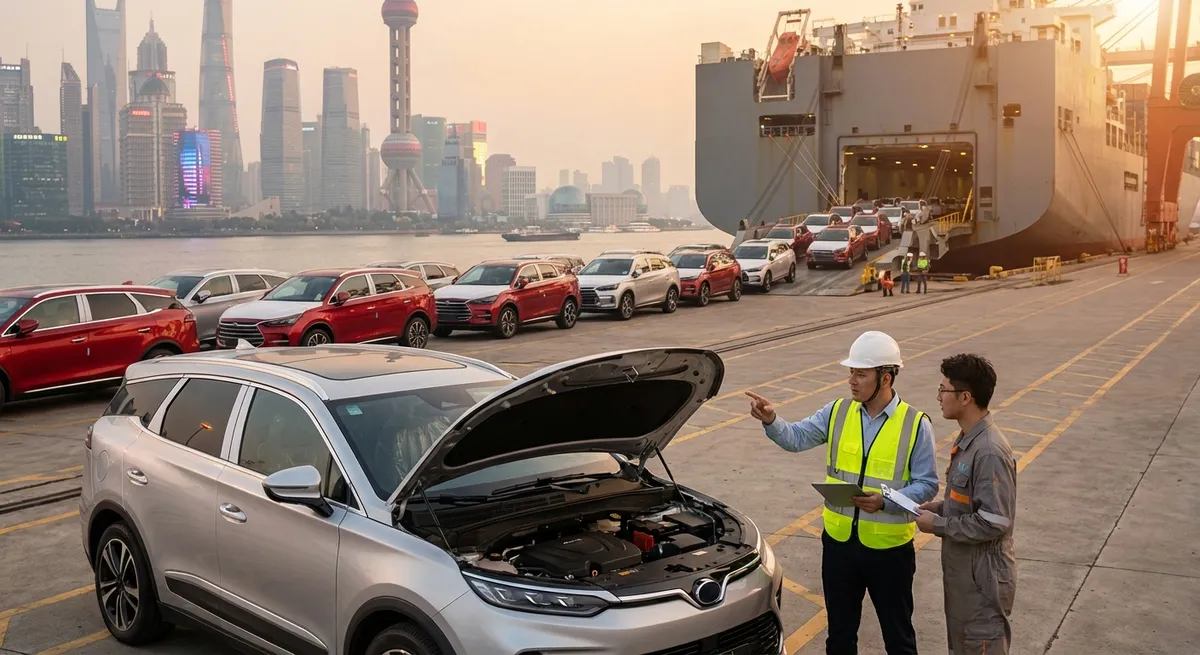
The SUV market is undergoing its most disruptive shift in decades—and it’s not coming from Detroit, Tokyo, or Stuttgart. It’s coming from Shenzhen, Shanghai, and Hangzhou. Chinese automakers, once written off as low-cost, low-quality players, are now exporting SUVs that are fast, tech‑heavy, aggressively priced, and increasingly compliant with Western safety and emissions standards. For car enthusiasts and serious buyers, this isn’t a distant macro story—it’s a change that will directly affect pricing, features, and technology in every showroom, whether the badge says BYD, Ford, Toyota, or BMW.
This report breaks down how the Chinese SUV surge is reshaping the landscape, with five key developments that matter if you care about performance, tech, and long‑term ownership value.
1. Chinese-Built SUVs Are Moving From “Budget” to “Benchmark” in Tech
For years, Chinese SUVs were viewed as budget alternatives. That is rapidly changing as brands like BYD, NIO, Geely, and SAIC (MG, IM, etc.) push into Europe, Southeast Asia, the Middle East, and Latin America with tech stacks that sometimes outclass established brands.
Many of these SUVs now feature 800‑volt electrical architectures for faster DC fast charging, advanced driver‑assist suites with multiple lidar sensors, and integrated infotainment systems running on high-end Qualcomm Snapdragon or domestically developed SoCs. Over‑the‑air (OTA) updates are becoming default, but the underlying capabilities are what stand out: control strategies for battery preconditioning, trackable energy consumption per drive mode, and customizable torque distribution in dual‑motor all‑wheel drive setups.
SUVs like the BYD Tang, NIO ES8, and Zeekr X are being benchmarked not just on price, but on real performance metrics: 0–100 km/h times below 5 seconds, WLTP ranges in the 400–600 km band, and DC charging curves that sustain high power well above 50% state of charge. That’s forcing legacy OEMs to accelerate their own tech roadmaps—particularly in infotainment responsiveness, ADAS capability, and charging performance—simply to remain competitive against Chinese imports or Chinese-built joint‑venture models.
For buyers, this means tech that used to be confined to six‑figure luxury SUVs is now appearing in mid‑priced models. Expect to see more 360‑degree perception suites (camera + radar + lidar), cabin‑integrated app ecosystems, and EV‑specific features like route‑aware range prediction migrating across the SUV market much faster than in prior generations.
2. Price–Performance Pressure Is Forcing Global SUV Repricing
The most disruptive aspect of the Chinese SUV wave isn’t just the tech—it’s the price-to-spec ratio. In many markets, Chinese SUVs undercut established rivals by several thousand dollars while offering higher standard equipment, particularly in electrified powertrains and active safety.
Battery costs are a major driver. Chinese manufacturers benefit from localized cell production, large‑scale lithium iron phosphate (LFP) deployment, and vertically integrated battery supply chains. BYD, for example, is both an automaker and one of the world’s largest battery producers. That allows Chinese brands to sell EV SUVs at price points where Western brands often can only field mild hybrids or low-spec ICE models.
Governments are responding with tariffs and regulatory actions, particularly in the U.S. and EU, citing concerns about subsidies and industrial policy. But even if import volumes remain controlled, the pricing benchmarks set by Chinese SUVs are already altering competitive dynamics:
- Entry-level EV SUVs now face pressure to deliver at least 250–300 miles (400–480 km) of range at mainstream prices.
- Mid‑tier gas SUVs must justify why they lack features like adaptive cruise with lane centering, all‑digital instrument clusters, or heat‑pump HVAC in cold-weather markets.
- Value‑oriented buyers are starting to ask why similarly priced non‑Chinese SUVs carry fewer kilowatt‑hours of battery, fewer cameras and sensors, or less robust standard ADAS.
Enthusiasts and informed buyers should expect more aggressive discounting, richer standard feature sets, and shorter product cycles as incumbents try to realign their SUVs with a new global price–performance baseline set in large part by Chinese competition.
3. Safety and Quality Standards Are Rapidly Converging
A common assumption has been that Chinese SUVs would struggle to meet Western safety and durability expectations. That is becoming outdated, at least for the leading export‑oriented brands. Many Chinese SUVs entering Europe and other advanced markets are being engineered to pass Euro NCAP, Australian ANCAP, and similar protocols from the outset.
This involves body‑in‑white redesigns for improved crash structures, more extensive use of ultra‑high‑strength steels, and the integration of multi‑stage airbags and advanced restraint systems. ADAS systems are also being tuned to meet test protocols such as automatic emergency braking for pedestrians and cyclists, lane keeping, and junction assist scenarios.
Quality perception will lag engineering progress, but the underlying reality is that build quality and material choice are improving quickly. You’re now seeing:
- Tighter panel gaps and improved paint processes from modern Chinese plants.
- NVH (noise, vibration, harshness) optimization leveraging dual‑pane glass and multi‑layer floor insulation in mid‑segment SUVs.
- Interior touchpoints moving from hard plastics to soft‑touch polymers, synthetic leathers, and real stitching.
That said, there is still wide variation within the Chinese sector. Some low-cost exports remain basic in crash protection, corrosion resistance, and long‑term durability testing. Enthusiasts and shoppers should differentiate between major, internationally focused OEMs (e.g., BYD, Geely, SAIC, Great Wall Motor) and small-volume brands targeting only price-sensitive markets. Checking independent crash test data, warranty terms, and long‑term reliability reports in each region will be critical before shortlisting any new brand’s SUV.
4. Platform Partnerships Are Making “Chinese DNA” Harder to Spot
Even if you never intend to buy a Chinese-branded SUV, you may still end up driving one with Chinese engineering under the skin. Global automakers are increasingly partnering with Chinese firms on platforms, EV architectures, and even complete vehicle production.
Examples include:
- Joint ventures where Western brands use Chinese-developed EV platforms and battery packs, then apply their own styling, chassis tuning, and interior design.
- Western SUVs for emerging markets being built in Chinese plants with shared components—such as infotainment systems, battery modules, or electric drive units—sourced from Chinese suppliers.
- European and American brands sourcing entire LFP battery packs from Chinese manufacturers to control cost and improve energy density for specific SUV lines.
This blending of supply chains means traditional perceptions—“Chinese SUV” versus “German SUV” or “Japanese SUV”—are less relevant than the actual component set, platform, and manufacturing quality practices. For drivers, the impact shows up in:
- More advanced EV platforms reaching global markets faster due to shared development costs.
- Wider adoption of LFP chemistry in mainstream SUVs, offering robust cycle life and better thermal stability, albeit with somewhat lower energy density than nickel‑rich chemistries.
- A broader mix of suppliers, which can improve resilience but also complicates service and parts sourcing across different regions.
When considering a new SUV, enthusiasts should pay attention to what platform it uses, where it is assembled, and who supplies its critical systems (battery, motors, inverter, ADAS sensors). These details increasingly determine performance, software capability, and long‑term support far more than the badge alone.
5. Regulatory and Trade Shifts Will Directly Shape Your Future SUV Choices
The Chinese SUV surge isn’t happening in a vacuum. It is intersecting with new emissions rules, EV incentives, and trade policies that will influence which models are available—and at what price—in each region.
In the European Union, stricter CO₂ fleet targets and Euro 7 emissions rules are pushing all OEMs to prioritize EVs and plug‑in hybrids, often using cost‑effective technology partnerships that heavily involve Chinese suppliers or joint ventures. In the United States, federal EV tax credits now favor vehicles assembled in North America with limited content from “foreign entities of concern,” which currently includes many Chinese battery suppliers. That’s already driving reconfiguration of SUV supply chains and local battery plant investment.
Tariffs and anti‑subsidy investigations—especially into Chinese EV imports—may limit the number of Chinese-branded SUVs you see on U.S. dealer lots. However, they won’t stop the flow of Chinese technology into global platforms. In other regions, such as Southeast Asia, Latin America, and parts of the Middle East and Africa, the regulatory environment is more open, allowing Chinese SUVs to compete directly with Japanese, Korean, and European brands on price and spec without the same trade barriers.
For buyers, the practical implications include:
- Model availability: Some Chinese SUVs will be widely available in Europe and developing markets but absent from the U.S. due to policy constraints.
- Feature stratification: Markets with higher tariffs may see de‑contented versions of Chinese SUVs or fewer trims to offset import costs.
- Resale and support: Regulatory risk can affect resale values and long‑term parts availability if trade rules change mid‑cycle. Choosing brands with established global service networks—or strong local partners—mitigates this risk.
Enthusiasts should track not just product announcements but also trade policy and regional incentives, because these factors increasingly define which powertrains and trims make it to your local dealer.
Conclusion
The rise of Chinese SUVs is more than a “new competitor” headline—it’s a structural shock to the global SUV ecosystem. Technology that once trickled down slowly is being pulled forward by aggressive Chinese entrants; price–performance benchmarks are being reset; and platform partnerships are blurring traditional national boundaries in automotive engineering.
For car enthusiasts, this means a wave of SUVs with stronger specs, richer tech, and more sophisticated electrified drivetrains at lower price points—but also a more complex landscape for evaluating quality, safety, and long‑term support. For buyers, it reinforces the need to look beyond the badge and into the platform, the supply chain, and the regulatory context behind each model.
The SUV market of the late 2020s will be shaped as much by decisions in Shanghai and Brussels as by those in Detroit or Tokyo. Understanding how Chinese SUVs fit into that picture is fast becoming a prerequisite for making an informed, future‑proof purchase.
Sources
- International Energy Agency – Global EV Outlook - Data and analysis on EV adoption, including Chinese market trends and global competitiveness
- European Commission – EU Anti-Subsidy Investigation into Chinese EVs - Official information on EU trade actions affecting Chinese-built electric vehicles
- Euro NCAP – Latest Safety Ratings - Independent crash test results for many new SUVs, including models from Chinese brands sold in Europe
- BYD Official Website – Passenger Vehicles - Technical specifications and product details for BYD SUVs and EV platforms
- NHTSA – Corporate Average Fuel Economy (CAFE) Overview - Background on U.S. efficiency regulations influencing SUV powertrain strategies and sourcing decisions
Key Takeaway
The most important thing to remember from this article is that this information can change how you think about Industry News.