Electric SUVs from Chinese automakers have shifted in just a few years from niche curiosities to strategic threats for established brands in North America, Europe, and beyond. Behind the headlines about tariffs and trade disputes, there is a deeper story: an aggressive re‑engineering of the SUV value equation—range, tech, pricing, and manufacturing—that is forcing the rest of the industry to respond.
For serious SUV shoppers and enthusiasts, understanding what’s happening with Chinese EV SUVs isn’t just geopolitical trivia. It’s a preview of the design, technology, and pricing pressures that will shape the next decade of SUV products globally, including what legacy brands will have to offer to stay competitive.
1. Battery Tech and Range: How Chinese SUVs Pulled Ahead
Chinese EV-focused brands—BYD, NIO, XPeng, Li Auto, and others—have used battery innovation as their primary lever to disrupt the SUV market.
A few key technical shifts are driving their advantage:
- LFP and Blade batteries: BYD’s Blade Battery is a structural, lithium iron phosphate (LFP) pack engineered to be thinner, more thermally stable, and less prone to thermal runaway than many conventional NMC (nickel-manganese-cobalt) packs. While LFP chemistry traditionally sacrifices energy density, BYD’s packaging strategy allows competitive range with strong durability and lower cost per kWh. Many mid-size electric SUVs in China now use LFP, especially for base trims.
- High-nickel NMC for premium SUVs: Higher-end Chinese SUVs often use advanced NMC chemistries (e.g., NMC 811) to push energy density higher. Combined with optimized aerodynamics and integrated thermal management systems, this allows some large electric SUVs to realistically achieve 300+ miles (≈480+ km) of rated range in domestic testing cycles, and increasingly competitive figures under WLTP and EPA-style protocols.
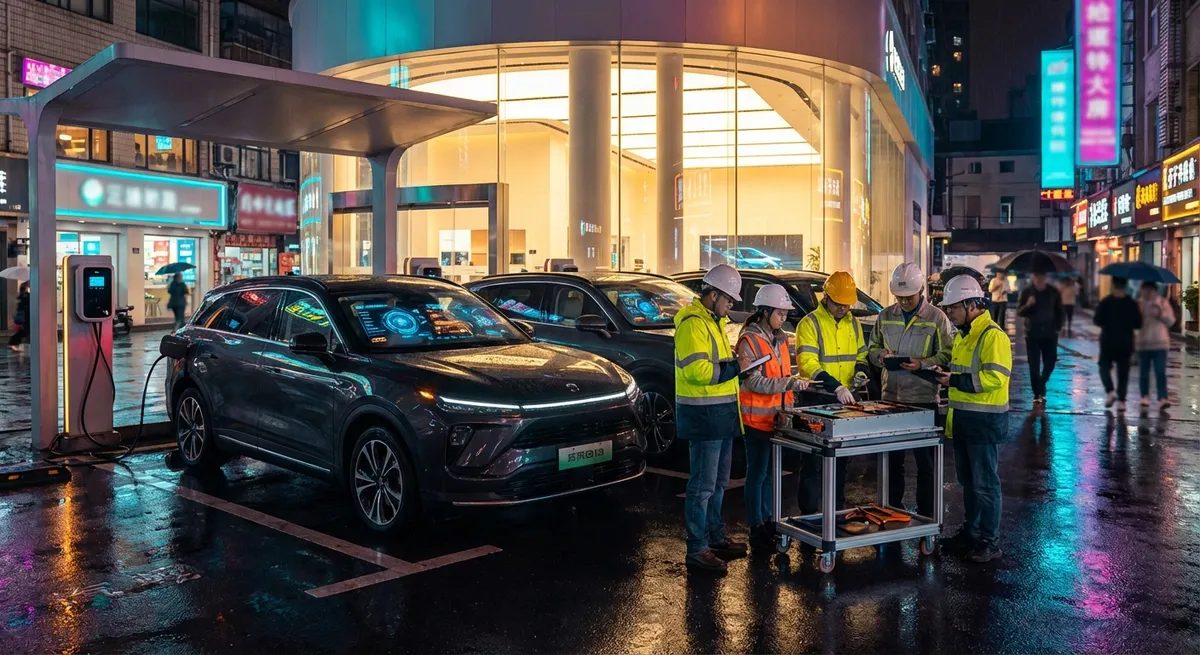
- Battery swap as a differentiator: NIO’s SUV lineup (ES6, ES8, etc.) introduced large-scale battery-swapping stations, allowing a nearly depleted pack to be exchanged for a full one in minutes. This changes the customer experience calculus: drivers get shorter “refueling” times and can upgrade to larger capacity packs later without replacing the entire vehicle. While still mostly limited to China and select European markets, it demonstrates an alternative pathway around charging anxiety for EV SUVs.
- Sophisticated thermal management: To preserve range in extreme climates, leading Chinese EV SUVs integrate liquid-cooled battery packs, heat pumps, and pre-conditioning algorithms that warm or cool the battery ahead of fast charging. Buyers increasingly see these features as must-haves; their rapid adoption puts pressure on global rivals to match efficiency and real-world usability.
For enthusiasts and shoppers, the net effect is clear: Chinese EV SUVs are using battery tech as a weapon, pairing competitive or superior range with aggressive pricing, and defining what “standard equipment” in an electric SUV will need to look like.
2. Software-Defined SUVs: From Infotainment to Autonomous Features
Chinese automakers are treating SUVs as software platforms as much as vehicles, and they’re iterating at consumer-electronics speed.
Key trends shaping the cabin and driving experience:
- High-performance compute platforms: Many Chinese EV SUVs run on powerful domain controllers (from Qualcomm Snapdragon, NVIDIA, or Huawei) that enable rich graphics, advanced voice recognition, and frequent over-the-air (OTA) updates. This allows automakers to push new features to owners regularly, much like a smartphone OS.
- Deep integration with local digital ecosystems: In China, SUV infotainment systems increasingly integrate with super-apps (navigation, payments, food delivery, streaming) and vehicle-specific app stores. While these local services don’t directly translate to North America or Europe, the architecture does. Expect more SUV platforms globally to support third‑party app ecosystems and in-car commerce as a revenue stream.
- Advanced driver-assistance systems (ADAS): Chinese EV SUVs are rapidly adopting sensor-rich ADAS suites, including multiple high-resolution cameras, millimeter-wave radar, ultrasonic sensors, and, on some models, automotive-grade lidar. These setups underpin features such as:
- Highway pilot and lane-centering
- Automatic lane changes
- Intelligent parking and valet-style low-speed autonomy
- Urban pilot features in geofenced zones
- Frequent functional upgrades via OTA: It is not unusual for early buyers of a new Chinese electric SUV to see incremental improvements in range, acceleration response, adaptive cruise behavior, or voice assistant capability over the first year of ownership, all delivered via software updates. This shifts resale value dynamics and owner expectations: the SUV can genuinely improve after purchase.
For global shoppers, the message is that software maturity and update cadence will become just as important as horsepower figures. Western brands that move slowly on OTA and ADAS functionality risk falling behind what Chinese SUVs are already conditioning buyers to expect.
3. Price Disruption and the Tariff Shockwave
The biggest global headline around Chinese EV SUVs is price—and the fallout it’s creating.
- Structural cost advantages: Chinese automakers benefit from tight vertical integration, especially in battery manufacturing (BYD being the most prominent example). Combined with massive domestic scale and a fiercely competitive local EV market, many Chinese SUVs can undercut global competitors on price even when equipped with high-spec batteries and tech.
- Aggressive export pricing: In Europe and some emerging markets, Chinese EV SUVs have entered with pricing that often undercuts established Japanese, Korean, and European rivals while offering larger battery packs and more standard equipment. This has triggered investigations and policy responses across multiple regions.
- Regulatory pushback: The European Union launched an anti-subsidy probe into Chinese EV imports, leading to provisional additional tariffs on some Chinese-made electric vehicles. The United States, for its part, has imposed steep tariffs on EV imports from China, effectively blocking mass-market Chinese SUVs for now. More countries are watching closely as they balance consumer access to lower-cost EVs with domestic manufacturing interests.
- Pricing pressure on other brands: Even in markets where Chinese SUVs are limited by tariffs, their global presence exerts indirect pressure. Legacy automakers must sharpen their EV SUV pricing, simplify trim structures, and push cost-reduction in manufacturing to remain competitive when—or if—tariff regimes change.
For buyers, this means that the arrival (or looming arrival) of Chinese EV SUVs is likely to improve value propositions across the board: more range, more tech, and more equipment for a given price point as competitors scramble to defend market share.
4. Global Expansion Strategies: Partnerships, Local Plants, and Brand Building
Chinese SUV makers are not just shipping finished vehicles out of Chinese ports—they’re evolving their strategies to navigate trade barriers and win over skeptical buyers.
Some of the most significant moves:
- Local assembly and joint ventures: To mitigate tariffs and political risk, several Chinese automakers are exploring or announcing localized production in regions like Europe, Southeast Asia, and Latin America. Building SUVs or key components locally can reduce import duties and help them qualify for local incentives, while also creating jobs that make regulators more receptive.
- Battery and component plants abroad: Chinese battery giants (including CATL and BYD) are investing in overseas battery factories. For SUV production, this matters because local battery production can be critical for meeting “local content” rules in incentive programs, such as those in Europe and North America.
- Multi-brand strategies: Some Chinese conglomerates are launching or acquiring secondary brands targeted at different price bands and regional tastes—similar to how Japanese and European automakers created luxury sub-brands in past decades. This allows more premium-positioned electric SUVs to distance themselves from old stereotypes about “cheap Chinese cars.”
- After-sales and warranty commitments: To reassure buyers unfamiliar with these brands, Chinese EV SUV makers are offering long warranties on batteries and electric powertrains, as well as investing in local service networks and mobile servicing. A strong emphasis on digital diagnostics and telematics reduces service-center dwell time and helps build trust.
- Styling tailored for export markets: Early Chinese exports were often domestic-market SUVs shipped abroad with minimal adaptation. The newer wave is different: design studios in Europe (and sometimes the U.S.) are shaping exterior and interior styling that aligns with local tastes—cleaner lines, more subdued chrome, and infotainment UX tuned to non-Chinese users.
For enthusiasts watching the global scene, this expansion phase will determine which Chinese SUV brands become credible long-term players and which remain confined to a few regions.
5. How Established SUV Makers Are Responding
Legacy automakers are not standing still. The rapid rise of Chinese EV SUVs is reshaping product and manufacturing roadmaps worldwide.
Key response patterns:
- Accelerated EV SUV portfolios: European, Korean, Japanese, and American brands are compressing product cycles and adding more electric SUV variants—compact crossovers, mid-size two-rows, three-row family haulers, and performance EV SUVs. Platforms are being engineered to support multiple body styles and battery configurations to spread costs.
- Localized battery alliances: To counter China’s lead in the battery supply chain, many global automakers are forming joint ventures with battery suppliers to build gigafactories in their home regions. This is essential both for cost control and to meet government requirements for EV subsidies and tax credits.
- Software and OTA catch-up: Companies that were slow to treat their SUVs as software platforms are now quickly assembling in-house software divisions or partnering with tech firms. The goal: get OTA updates, advanced infotainment, and robust ADAS up to the standard that Chinese EV SUVs are already demonstrating.
- More aggressive cost engineering: Western automakers are rethinking traditional option-laden trim structures. Instead of long option lists, they’re moving toward simplified spec packs, standardized battery modules, and shared component sets to reduce complexity and align costs more closely with Chinese benchmarks.
- Policy engagement and industrial strategy: Established players are heavily involved in conversations with governments about industrial policy, trade rules, and EV incentives. The balance they seek is clear: enough pressure to slow an unchecked flood of low-cost imports, but enough competition to keep their own operations disciplined and innovative.
For consumers, the competitive tension created by Chinese EV SUVs is likely to lead to better-equipped, more efficient, and more software-capable SUVs worldwide, regardless of origin. The short-term landscape may be shaped by tariffs and regulations, but the long-term trajectory is one of faster innovation cycles and sharper value.
Conclusion
Chinese EV SUVs have moved from the periphery of the market to the center of global strategy discussions for every major automaker. Through battery innovation, aggressive software development, sharp pricing, and expanding global footprints, they are redefining what an electric SUV can offer—and at what cost.
For SUV enthusiasts and serious shoppers, the implications are significant. The next wave of SUVs you see in showrooms, whether built in the U.S., Europe, Korea, Japan, or China, will be shaped by this new competitive reality: longer ranges, more capable driver-assistance systems, frequent software updates, and tighter pricing discipline. Watching how Chinese EV SUVs evolve—and how regulators and incumbents respond—will provide a clear preview of the SUV market’s next decade.
Sources
- [European Commission – EU Provisional Duties on Chinese EVs](https://ec.europa.eu/commission/presscorner/detail/en/ip_23_4586) - Official communication on the EU’s anti-subsidy investigation and tariff measures affecting Chinese-made electric vehicles
- [BYD Official – Blade Battery Technology Overview](https://www.byd.com/en/news/2020-03-29/BYD-launches-the-new-Blade-Battery) - Technical background on BYD’s Blade Battery design, safety characteristics, and benefits for EVs and SUVs
- [NIO – Power Swap and Battery-as-a-Service](https://www.nio.com/power) - Details on NIO’s battery-swapping infrastructure, service model, and its application to the brand’s SUV lineup
- [International Energy Agency – Global EV Outlook](https://www.iea.org/reports/global-ev-outlook-2024) - Data and analysis on EV adoption trends, including China’s role in EV and battery production
- [Reuters – Chinese EV Exports and Global Market Impact](https://www.reuters.com/world/china/chinas-ev-export-boom-sparks-global-trade-tensions-2023-09-13/) - Reporting on how Chinese EV exports, including SUVs, are affecting trade policy and competitive dynamics worldwide
Key Takeaway
The most important thing to remember from this article is that this information can change how you think about Industry News.