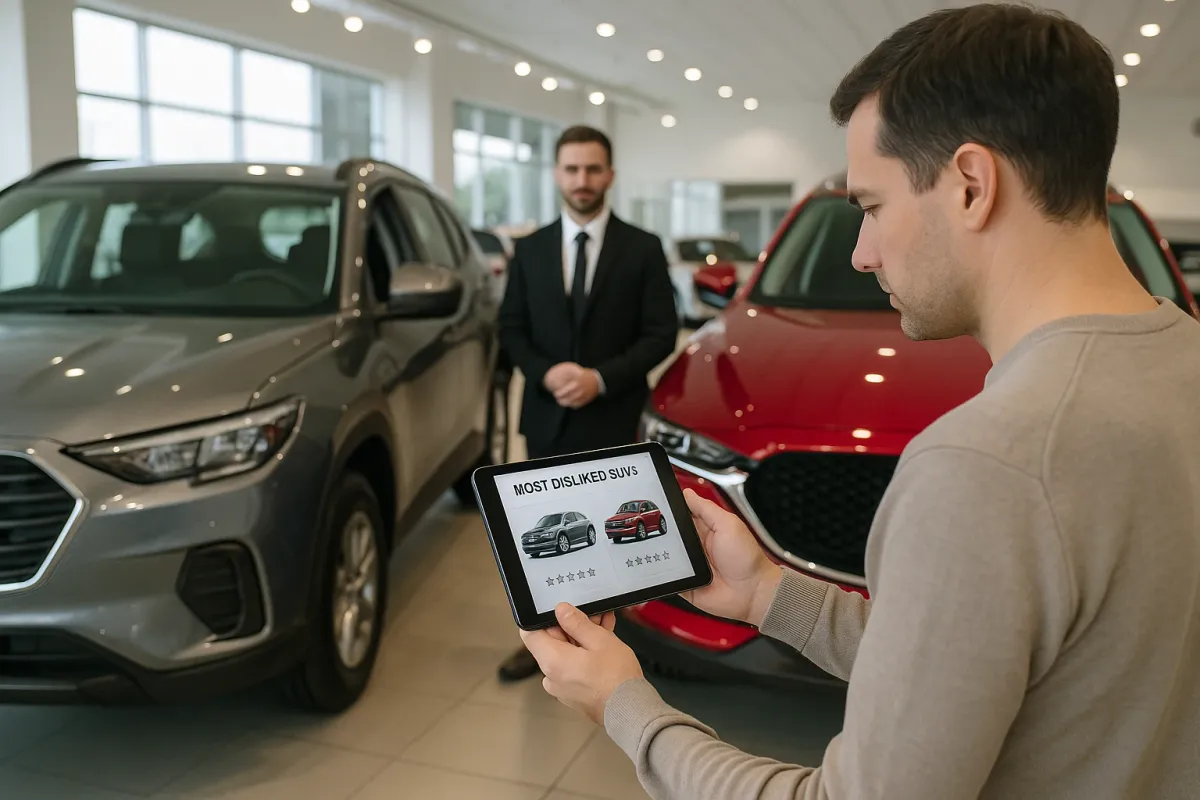
Every December, “most disliked celebrities of the year” lists explode across social media. Ranker’s latest rundown of the 47 most disliked stars has gone viral, with people passionately voting, debating, and dissecting what made each public figure fall out of favor. At first glance, this has nothing to do with SUVs—until you realize the same psychology that drives those rankings quietly shapes how many people choose (and regret) their next vehicle.
Fans turn on celebrities for broken trust, inauthentic behavior, or overhyped image that doesn’t match reality. The SUV market is going through a similar reckoning right now: oversold tech, confusing electrification strategies, and aggressive marketing that doesn’t always line up with long‑term ownership reality. If you’re shopping for a new SUV in late 2025 or planning for a 2026 model, understanding those parallels can keep you from ending up with your own “most disliked” purchase in the driveway.
Below are five concrete ways to use the same critical lens people are applying to celebrities on Ranker—and aim it squarely at your next SUV purchase.
1. Look Beyond “Fan Votes”: Why Popularity Metrics Can Mislead SUV Shoppers
The Ranker list of 47 most disliked stars is built on public votes—essentially, a massive popularity (or unpopularity) contest. The SUV world has its own version of this: TikTok views, Instagram reels, YouTube hype videos, and short‑form “first look” content that can send a model viral before anyone has lived with it for 50,000 miles.
To avoid being trapped by this effect, distinguish between popularity signals and ownership reality:
- Popularity signals: viral videos of new EV SUVs doing 0–60 launches, celebrities stepping out of a specific luxury crossover, or a particular trim that’s all over influencer feeds. These signals track attention, not reliability or cost of ownership.
- Ownership reality: long‑term reliability scores from J.D. Power Vehicle Dependability Studies, Consumer Reports member surveys, and NHTSA complaint data; real‑world fuel economy from EPA and Fuelly; and residual value projections from ALG or Kelley Blue Book.
In late 2025, we’re seeing this gap especially clearly in trendy compact crossovers and entry‑luxury SUVs. Models that exploded on social media for their ambient lighting, mega screens, or “couch‑like” rear seats are now quietly showing:
- Above‑average electronic glitch rates
- High out‑of‑warranty repair costs for complex infotainment systems
- Faster‑than‑expected depreciation, as used buyers gravitate back to simpler, proven platforms
When you build a shortlist, treat viral excitement the way you’d treat a star’s social‑media following: interesting, but not decisive. Cross‑check every SUV you like against three grounded data points:
- Three‑year reliability trends (not just initial quality).
- Five‑year total cost of ownership (insurance, depreciation, maintenance).
- Owner satisfaction scores that specifically break out ride comfort, noise, and infotainment usability.
If an SUV is “trending” but weak in those fundamentals, assume you’re looking at the automotive equivalent of a celebrity destined for next year’s “most disliked” list.
2. Separate Image From Substance: How Branding Can Hide Real Specs
A recurring theme in this year’s most disliked celebs: image inflation. Stars selling one persona publicly while their private actions or behind‑the‑scenes behavior tell a different story. Many SUV brands are currently doing the same via aggressive “lifestyle” marketing.
Some clear 2025 examples:
- Off‑road image vs. hardware reality: Crossovers with black cladding, aggressive names, and social ads filmed in Moab—but front‑wheel drive only, no dual‑range transfer case, no real underbody protection, and modest approach/departure angles.
- Performance image vs. chassis tuning: “Sport” packages that add larger wheels and stiffer springs but no real brake upgrade, limited‑slip differential, or meaningful power gain—resulting in worse ride quality without true performance upside.
- Luxury image vs. materials: Ambient lighting and massive screens paired with hard plastics at knee level, thin door glass, and minimal sound insulation.
To cut through the image and see the substance, interrogate an SUV the way you’d interrogate a public figure’s carefully groomed persona:
- For off‑road use, check:
- Ground clearance (8.5 in+ for light duty; 9.5 in+ for serious trails)
- Approach/breakover/departure angles (published in detailed spec sheets)
- Presence of hardware like skid plates, locking differentials, and all‑terrain tires
- Whether AWD is reactive (slip‑and‑grip) or proactive (torque‑vectoring, multi‑mode)
- For performance crossovers, look at:
- Power‑to‑weight ratio (hp per pound; under ~14 lb/hp is genuinely brisk)
- Brake rotor size and caliper configuration (single vs. multi‑piston)
- Tire sizing and compound (touring vs. max‑performance)
- Transmission tuning (gear ratios, shift logic modes, and whether it’s a traditional automatic, DCT, or CVT)
- For true luxury, focus on:
- Glass thickness (acoustic laminated front and side glass)
- Door sealing and body sealing points
- Seat construction (multi‑density foam, adjustable thigh support, lumbar in multiple directions)
- Measured cabin noise at 70 mph (independent tests often quote dBA)
If the marketing narrative feels loud but the spec sheet and independent tests are quiet, treat that SUV like a celebrity whose PR is doing too much work for not enough talent.
3. Watch for “Reputation Whiplash”: How Fast an SUV’s Perception Can Flip
One reason the Ranker “most disliked stars” list is getting so much attention this year is how fast some of these reputational collapses happened. A scandal, a string of tone‑deaf interviews, or a single viral clip can flip a fan base almost overnight.
SUVs can go through the same reputation whiplash—sometimes for good reasons, sometimes not:
- Quality‑control stumbles on first‑year models: With the 2024–2025 wave of entirely new platforms (especially EV and plug‑in hybrid SUVs), first‑year builds have seen higher‑than‑expected rates of software bugs, charging issues, and trim fit problems.
- Rapid policy shifts on EV support: Some automakers have recently changed course on software update support, charging network partnerships, or subscription features, leaving early adopters frustrated.
- Safety or recall surprises: A strong launch followed by repeated safety recalls (especially if related to braking, steering, or battery thermal management) can wipe out resale confidence.
In a late‑2025 buying decision, you want to identify which SUVs are reputationally stable versus which ones are in flux.
Practical steps:
- Check recall history and timing:
- Are recalls concentrated in the first 12–18 months and followed by clean model years? That can be a sign of problems addressed.
- Are new recalls still being issued for fundamental systems (steering, high‑voltage batteries, fuel systems)? That suggests a platform still maturing.
- Look for over‑the‑air (OTA) dependency:
- Many 2024–2026 SUVs rely heavily on OTA updates to fix bugs. That’s good—if the automaker is consistent and transparent.
- Research owner reports on how quickly critical issues were addressed, not just advertised.
- Track residual value trends:
- Vehicles with growing negative sentiment often show early depreciation acceleration in auction data and dealer trade‑in offers.
- If a model dropped significantly from MY2023 to MY2025 in retained value, understand why before you buy.
Think of this like watching a celebrity’s trajectory across multiple seasons of public life. A single controversy may be survivable—but a pattern tells you whether you’re buying into a stable long‑term bet or something destined for the “most disliked” pile.
4. Test Authenticity: Make Sure the SUV Fits Your Real Life, Not Your “Online Persona”
Many celebrities on the 47‑name list are there because audiences felt their public image didn’t match who they really are. SUV buyers fall into a parallel trap: choosing a vehicle that matches their aspirational lifestyle (or social‑media persona) instead of their actual, daily use.
In 2025, this mismatch is especially prominent in two hot segments:
- Three‑row “family adventure” SUVs that rarely carry more than two people and mostly do school runs and grocery duty.
- Urban EV crossovers bought for short commutes but occasionally pressed into long‑distance trips without adequately planning charging needs.
Before committing, run an “authenticity audit” on your own usage:
- Quantify your real passenger load:
- How often do you actually carry more than four people?
- If it’s a few holidays and an annual trip, a two‑row SUV with a roof box and occasional rental of a minivan might be more rational than owning a three‑row all year.
- Measure your true cargo needs:
- Look at cargo volume behind the second row, not just maximum with seats folded.
- If you routinely haul strollers, sports gear, or instruments, prioritize a flatter load floor and boxier roofline over sloping “coupe” styling.
- Analyze your daily driving pattern:
- Track your real‑world daily mileage for two to four weeks (apps or a simple log).
- Pair this with public charging infrastructure in your area if considering a plug‑in hybrid or full EV SUV. Consider winter range reduction of 20–40% for EVs in cold climates.
- Check functional ergonomics:
- How high is the liftover height for kids or pets?
- Are the rear doors opening wide enough for car seats?
- Can you comfortably access the third row (if you truly need it)?
Approach this like a casting director choosing a role for an actor: the perfect candidate isn’t the most famous or the flashiest—it’s the one that actually fits the script of your life.
5. Guard Against Overcorrection: Don’t Let Fear Turn You into an Overly Safe Buyer
The Ranker list also shows something else: once the internet turns on a celebrity, the dog‑pile effect can make people overcorrect, writing off anything slightly controversial as “cancelable.” SUV buyers can overcorrect the same way—retreating only to the safest, most conservative choices and missing out on meaningful advances in safety, efficiency, and performance.
In late 2025, where this matters most:
- Hybrids and plug‑in hybrids:
- Some shoppers, spooked by early EV growing pains, are lumping all electrified powertrains together and defaulting to pure gasoline engines. That’s a mistake.
- Modern hybrid SUVs in the 200–250 hp range routinely deliver 30–38 mpg combined while maintaining towing ratings in the 3,500–5,000 lb band—significantly improving operating cost and range stability.
- New safety tech:
- Frustration with over‑sensitive lane‑keep assists or false‑positive collision warnings is making some shoppers reject advanced driver‑assistance systems (ADAS) entirely.
- Instead, learn which systems can be individually adjusted or disabled and prioritize SUVs where ADAS calibration is known to be less intrusive, as confirmed in independent road tests.
- Alternative drivetrains:
- If your use case genuinely supports it (home charging, predictable routes, robust charging network nearby), don’t let headlines about EV policy fights or isolated high‑profile recalls push you entirely away from well‑engineered electric SUVs launched on mature platforms.
The right mindset is measured risk, not zero risk. When evaluating an SUV:
- Distinguish between systemic risk (e.g., an automaker with repeated battery fire issues across multiple models) and contained risk (e.g., one problematic software build that was patched quickly).
- Look for platform maturity: a drivetrain or chassis that has been in production for a few years, even if the body style is new.
- Balance innovation benefits (efficiency, safety, performance) against support infrastructure (dealer competence, parts availability, software update policy).
You don’t want to be the buyer who, spooked by a few viral horror stories, ends up overpaying to drive yesterday’s technology for the next decade.
Conclusion
The viral buzz around Ranker’s 47 most disliked stars is a reminder that public opinion can shift fast and that image will always be tested against reality. In the SUV world, those same dynamics play out in model launches, marketing campaigns, and ownership experiences every single year.
If you approach your next SUV the way a skeptical audience is now approaching celebrities—questioning hype, checking long‑term behavior, and demanding authenticity—you dramatically lower your risk of ending up with a vehicle you quietly resent after the first 24 months. Focus on hard data over social popularity, spec‑sheet substance over lifestyle imagery, real‑life fit over aspiration, and measured innovation over fear‑driven retreat.
In a market crowded with contenders vying for your attention, that disciplined mindset is the difference between parking a future “most disliked” mistake in your driveway… and owning an SUV that quietly earns your vote, year after year.
Key Takeaway
The most important thing to remember from this article is that this information can change how you think about Buying Guide.