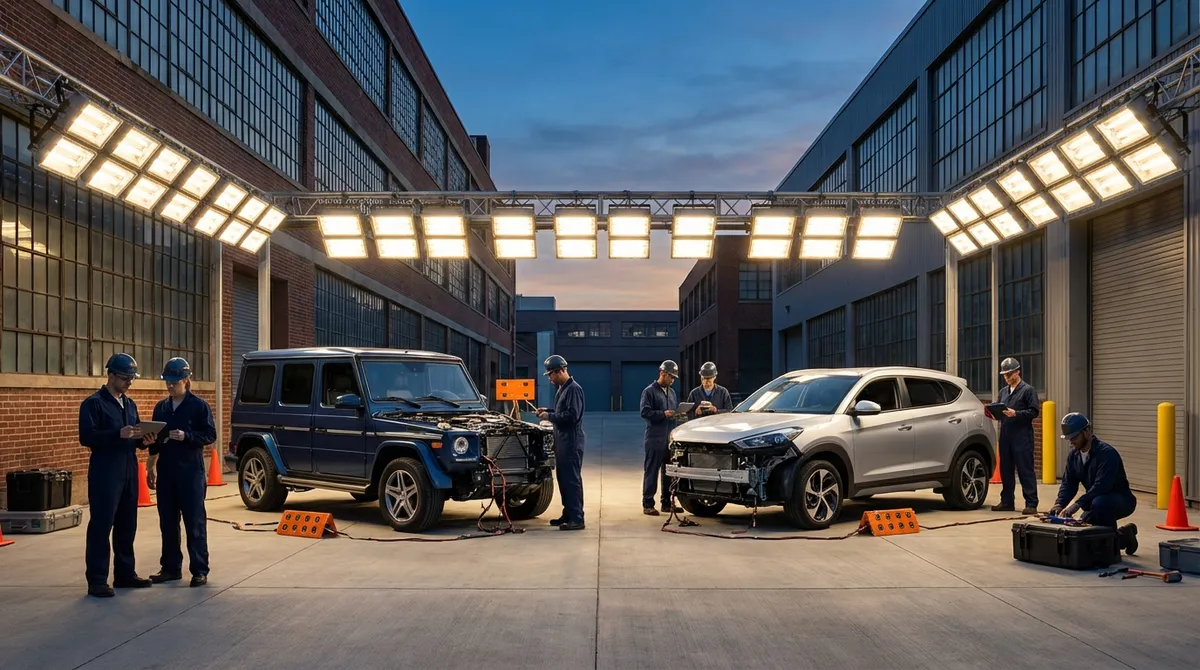
The SUV market is changing faster than most shoppers realize—and it’s not just about electrification or touchscreens. A wave of new safety regulations, crash-test protocols, and driver-assistance standards in the U.S., Europe, and key global markets is forcing automakers to redesign platforms, tweak powertrains, and rethink cabin tech. For SUV buyers and enthusiasts, this isn’t just policy talk; it directly affects price, performance, styling, and even resale value. Understanding what’s coming can help you time your purchase, pick the right features, and avoid getting stuck with yesterday’s tech.
Global Safety Standards Are Driving Platform Redesigns
Behind every new SUV launch, there’s a checklist of crash tests and safety assessments that determines how the vehicle is engineered from the ground up. Organizations like the U.S. National Highway Traffic Safety Administration (NHTSA), the Insurance Institute for Highway Safety (IIHS), and the European New Car Assessment Programme (Euro NCAP) are steadily tightening requirements, especially for larger, heavier vehicles such as SUVs.
For enthusiasts, this shows up in structural changes like stronger A- and B-pillars, reinforced rockers, and optimized load paths to handle more stringent frontal-offset and side-impact tests. Many new SUV platforms now integrate larger front crash structures and energy-absorbing zones to protect not only occupants, but also pedestrians and cyclists. That’s one reason front ends are becoming more sculpted, with active hood systems and radar-integrated grilles.
These changes add weight, and in some cases cost, which manufacturers offset with the increased use of ultra-high-strength steel, aluminum subframes, and tailored blanks in the body-in-white. Enthusiasts may notice that newer SUVs often have stiffer bodies, which can improve handling precision and NVH (noise, vibration, harshness), even as curb weights creep upward. Buyers, meanwhile, should pay attention to when a given model was last fully redesigned: a recent platform update usually means it’s been engineered with the latest crash and safety protocols in mind, giving you a longer window of regulatory “future-proofing.”
Advanced Driver Assistance Is Moving From Options to Obligation
Features once marketed as premium tech—automatic emergency braking (AEB), lane-keeping assist, and blind-spot monitoring—are quickly becoming baseline expectations, and in many markets, quasi-mandatory. The U.S. has moved toward making AEB standard on nearly all light vehicles, and Euro NCAP now ties its highest ratings to robust active-safety performance, not just passive crashworthiness.
This transition is directly influencing SUV engineering. To qualify for strong safety ratings and avoid regulatory friction, new SUVs are being designed around sensor suites that include forward radar, front cameras, side radars, and in some cases, lidar or high-resolution stereo cameras. Wiring harnesses, ECU architectures, and even front fascia design are being adapted to support these systems reliably over the long term.
For buyers, it means the gap between “base” and “fully loaded” trims is shrinking in terms of essential safety tech, but expanding in software sophistication. A mid-trim SUV may share the same hardware as a flagship variant but run different calibration, feature sets, or subscription-based enhancements. Enthusiasts should pay attention to whether a system uses camera-only, radar-plus-camera, or more advanced sensor fusion, as this can affect performance in bad weather, at night, and in complex traffic situations.
There’s also a shift from simple lane-keep “nudges” to more advanced lane-centering and adaptive cruise systems that can manage stop-and-go traffic. Many of these are now tuned to comply with new guidelines on driver monitoring, requiring hands on the wheel or active supervision. When cross-shopping, examine not just the feature list, but how systems behave in real-world reviews—nanny-like, smooth, or overly aggressive—and whether future over-the-air (OTA) updates are promised to refine them.
Pedestrian and Vulnerable Road User Protection Is Influencing SUV Shape
Regulators and safety organizations are increasingly focused on how SUVs interact with pedestrians, cyclists, and motorcyclists—collectively referred to as vulnerable road users (VRUs). This is especially relevant as SUVs have become taller, heavier, and more dominant in mixed traffic, raising concerns about crash severity and driver visibility.
In Europe and other regions, pedestrian-impact testing is now a core part of ratings, pushing automakers to adopt softer bumper designs, deformable energy absorbers, and active hood systems that pop up milliseconds before impact to create a larger crush space above the engine. Even in markets where rules are less explicit, global platforms mean many SUVs are pre-engineered with these features to streamline worldwide compliance.
From a design standpoint, this is why newer SUVs often have more sloped hoods, rounded leading edges, and higher headlight placements paired with narrower lamp signatures. Inside, higher seating positions and taller beltlines are being balanced with thinner A-pillars (using high-strength materials) and improved camera coverage to mitigate blind spots, especially close in front of the vehicle.
For shoppers, this shift means two things. First, the “blocky” SUV look is being refined not just for aerodynamics but for VRU safety. Second, front camera systems and 360-degree surround-view setups are becoming more than parking aids; they’re key tools for low-speed environments, urban driving, and off-roading near bystanders. When evaluating a new SUV, pay close attention to low-speed braking aids, pedestrian detection performance, and the actual visibility from the driver’s seat, particularly in dense urban settings.
New Crash Test Protocols Are Changing Size and Weight Trade-Offs
One of the most significant behind-the-scenes developments is the introduction of tougher crash tests that specifically consider the rising mass and ride height of SUVs and pickups. The IIHS, for example, has introduced updated side-impact tests with a heavier, faster-moving barrier to better represent real-world SUV-on-SUV or SUV-on-car collisions. Other organizations are exploring tests and ratings that focus on compatibility—how well a large vehicle protects occupants in the smaller vehicle it hits.
This creates a complex engineering puzzle. Traditionally, bigger SUVs benefitted from a “size and weight” advantage in many crashes. As test protocols evolve, that advantage is being tempered by requirements for better crash compatibility, crumple-zone alignment, and energy management. Automakers are redesigning frame rails, bumper beams, and under-ride protection to distribute crash forces more evenly across vehicles of different sizes.
For enthusiasts interested in performance, these safety-driven structural improvements can paradoxically improve handling when done correctly. Stiffer structures allow more precise suspension tuning and can better accommodate adaptive dampers and multi-link rear suspensions without unwanted flex. However, overall weight gains may require stronger brakes, more robust tires, and torque-rich powertrains just to maintain acceptable acceleration and stopping distances.
From a buying perspective, this means that the traditional assumption—“bigger equals automatically safer”—is no longer as straightforward. A smaller or midsize SUV on a state-of-the-art platform might perform better in new-generation tests than an older, larger model designed around previous standards. Reading detailed crash-test breakdowns, not just overall star ratings or simple “good”/“acceptable” grades, is becoming more important for safety-conscious shoppers.
Software, Connectivity, and Regulations Are Converging in Modern SUVs
As regulations move beyond hardware into the digital realm, SUVs are increasingly shaped by software compliance as much as mechanics. Cybersecurity rules in Europe and other regions, plus forthcoming requirements around event data recorders and driver-monitoring systems, are forcing brands to adopt more robust electronics architectures.
Modern SUVs now rely on centralized compute platforms, secure over-the-air update capability, and encrypted communication between control units. This enables continuous improvement of driver-assistance performance and bug fixes, but also adds complexity to long-term ownership. Automakers must ensure critical safety functions remain available and secure for years, even as infotainment services and app ecosystems evolve.
For tech-focused buyers, this opens new dimensions in configuration. Some brands are decoupling hardware and software: the vehicle may ship with all the necessary sensors and computing power, while advanced features—enhanced lane centering, automated parking, even future semi-autonomous functions—are unlocked via software packages or subscriptions. Regulatory scrutiny is mounting over which features can legally be paywalled, especially if they materially affect safety.
Enthusiasts should monitor whether a given SUV platform has been designed with a “zonal” or centralized electrical architecture, which tends to be more future-ready for OTA enhancements and additional safety features. Meanwhile, buyers concerned about long-term reliability should look for clear manufacturer commitments on software support duration, map updates (crucial for certain driver-assistance systems), and compliance with evolving data-privacy rules.
Conclusion
The SUV landscape is being reshaped by a complex but increasingly visible web of safety regulations and testing protocols. What might look like incremental styling tweaks or option-package reshuffles often reflects deep structural changes driven by crash tests, pedestrian-protection requirements, and advanced driver-assistance standards. For enthusiasts, these shifts bring stiffer platforms, more capable electronic systems, and sometimes surprising gains in real-world safety and performance. For shoppers, understanding these forces can help you spot which models are truly up to date, which safety features are must-haves, and how long your next SUV will remain aligned with tightening global standards. In a market where nearly every vehicle claims to be “safer than ever,” knowing the regulatory backdrop is becoming a real advantage.
Sources
- NHTSA – 5-Star Safety Ratings & Vehicle Safety Information - Explains U.S. government crash-test procedures, star ratings, and safety technologies that influence SUV design
- IIHS – Vehicle Ratings and Crash Test Protocols - Details updated side-impact tests, pedestrian safety evaluations, and how SUVs are assessed in modern crash scenarios
- Euro NCAP – Assessment Protocols and Regulatory Roadmap - Provides technical documentation on European test methods for occupant, pedestrian, and active safety, shaping global SUV platforms
- U.S. Department of Transportation – Automated Vehicles and Safety Technologies - Outlines federal perspectives on driver-assistance systems, automation, and associated regulatory frameworks
- UNECE – Vehicle Regulations for Safety and Cybersecurity - Covers international regulatory trends, including ADAS, pedestrian protection, and in-vehicle cybersecurity that affect SUV development worldwide
Key Takeaway
The most important thing to remember from this article is that this information can change how you think about Industry News.