The SUV market is being reshaped less by flashy marketing and more by the steady march of regulation, safety tech, and engineering updates that most buyers never see in a commercial. Behind every new model year are evolving crash-test protocols, pedestrian-impact rules, EV safety standards, and software-driven driver aids that are changing how SUVs are designed, built, and priced. For enthusiasts and serious shoppers, understanding these shifts is key to reading between the lines of spec sheets and press releases—and spotting which models are genuinely future-ready versus merely refreshed.
This industry news rundown highlights five under‑the‑radar safety and regulatory trends currently steering SUV development, and what they mean in practical terms for performance, usability, and long‑term ownership.
1. Stricter Crash Tests Are Forcing Heavier, Stiffer SUV Structures
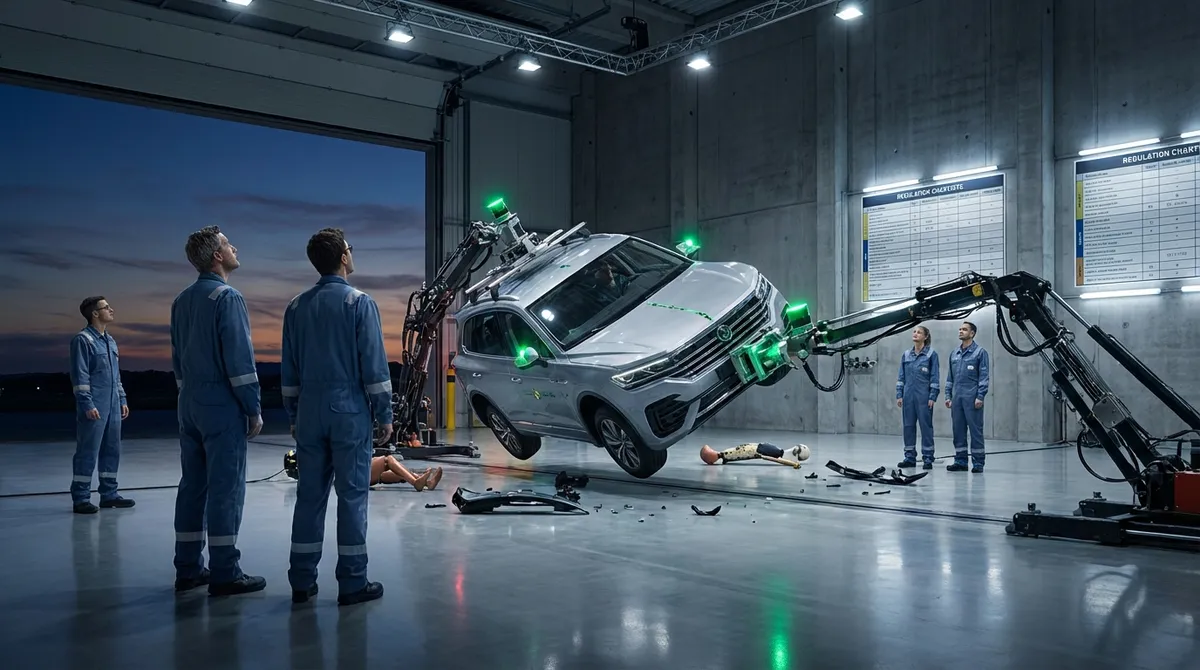
Over the last few years, global safety agencies have steadily raised the bar for crash performance, and SUVs are at the center of that pressure. In the U.S., the Insurance Institute for Highway Safety (IIHS) revised its side-impact test to use a heavier, faster barrier that better represents modern SUVs and pickups. At the same time, updated small-overlap and moderate-overlap frontal tests continue to reward vehicles that maintain cabin integrity while managing crash energy more effectively.
Automakers are responding with stronger body-in-white structures, more ultra-high-strength steel, and redesigned load paths that route impact forces around the passenger cell. In practical terms, this often adds weight—sometimes 50–150 pounds over a predecessor—despite parallel efforts to reduce mass elsewhere. For buyers, the trade-off is important: the safest modern SUVs may be slightly heavier but often deliver better real-world crash survivability and lower risk of serious injury.
Suspension tuning and tire selection are also being updated to account for these structural changes. Stiffer bodies allow engineers to fine‑tune spring rates, bushings, and anti-roll bars for both comfort and control, giving some newer SUVs a more composed ride despite increased curb weight. Enthusiasts should pay attention not only to horsepower and torque, but also to chassis details like the use of multi-link rear suspensions, structural adhesives, and cross-car beams—these are where a lot of safety-driven engineering gains are being made.
For shoppers comparing IIHS “Top Safety Pick” ratings or Euro NCAP scores across model years, this context matters: a 2025 SUV with a “good” rating under tougher criteria may be materially safer than an older model that also scored well but was tested under less demanding conditions.
2. Pedestrian Protection Rules Are Changing Front-End Design
Another quiet but powerful trend: global regulations and ratings are prioritizing pedestrian and cyclist safety, and SUV designers are being forced to respond. Agencies such as Euro NCAP and the U.S. National Highway Traffic Safety Administration (NHTSA) increasingly measure how a vehicle’s front end interacts with a person in a collision, grading factors such as leg injuries, upper-body impacts, and head contact with the hood or windshield.
This explains why some new SUVs feature more rounded front fascias, taller and more softly contoured hoods, and greater separation between the outer sheet metal and hard engine components beneath. Engineers are integrating deformable structures, active hood systems that pop up slightly in a collision to create crush space, and energy-absorbing materials around bumper beams and grille areas. These changes can sometimes conflict with traditional “tough” SUV styling cues like super-flat grilles and hard-edged hoods, so brands are getting more creative with lighting elements, grille textures, and cladding to maintain a strong visual identity.
For buyers, the key is to look beyond styling and examine pedestrian safety scores where available, especially if you live in dense urban areas or routinely drive in cyclist‑heavy environments. Tech features like pedestrian automatic emergency braking (PAEB) and cyclist detection are increasingly part of ratings systems, and not all implementations are equal. Some SUVs now offer improved low‑light detection, cross-traffic braking that recognizes pedestrians emerging from between parked cars, and map-integrated speed assistance that nudges drivers in high-risk zones such as school areas.
Enthusiasts who care about real-world safety should note that the “tall and imposing” stance many shoppers like in SUVs has a measurable downside: higher front ends can increase the likelihood of severe head and torso injuries in collisions with pedestrians. Automakers are trying to manage that risk through both hardware (front-end design) and software (detection and braking assist), and future regulations are likely to tighten further.
3. EV and Hybrid SUVs Are Driving a New Era of Battery Safety Standards
As electric and plug‑in hybrid SUVs gain market share, industry focus is shifting from pure range numbers to the safety and integrity of high-voltage systems. Regulators are issuing more detailed guidance on battery enclosure strength, thermal runaway mitigation, and post-crash electrical isolation, while independent organizations are beginning to differentiate models on the basis of fire risk and emergency response friendliness.
Manufacturers are responding with more robust battery packs, often using multi-layer protection: reinforced aluminum or steel housings, strategically placed crumple structures to deflect crash forces, and advanced cooling circuits to prevent localized overheating. Software plays an increasing role as well—battery management systems monitor cell temperatures, voltage imbalances, and charge rates in real time, sometimes limiting peak power or fast-charging speeds to protect pack longevity and safety.
One emerging trend is the use of cell-to-pack or cell-to-body architectures, which integrate batteries more deeply into the vehicle structure for better rigidity and efficiency. While beneficial for handling and packaging, these designs require extremely careful crash engineering, as any intrusion into the pack can carry serious risks. Regulatory bodies are testing for underbody impacts, side pole collisions, and immersion scenarios (such as flooding) with EVs in mind.
From a buyer’s perspective, questions about battery crash protection, high-voltage automatic shutoff, and fire-safety design are becoming as legitimate as questions about range and charging time. Prospective owners should look at official crash-test documentation for EV variants, not just the ICE version of a given SUV, because structural layouts, weight distribution, and pack location can materially change crash behavior.
4. Advanced Driver-Assistance Systems Are Moving From Options to Expectations
Within the industry, there’s a growing consensus that advanced driver-assistance systems (ADAS) are transitioning from “nice-to-have extras” to baseline expectations—especially for SUVs marketed as family vehicles or long-distance cruisers. Regulators are pushing in the same direction: the U.S. has moved to require automatic emergency braking as standard in coming model years, and European rules are adding layers of driver-monitoring and intelligent speed assistance.
For SUVs, this is reshaping electrical architectures and sensor suites. Engineers are standardizing front radar and camera systems, while many mid- to high-end models now bundle surround-view cameras, rear radars, and in some cases lidar into carefully integrated packages. The hardware itself is only half the story; the big differentiator is now software—how well lane-centering works in real-world curves, how confidently the system detects cut‑ins in heavy traffic, and how smoothly adaptive cruise-braking behaves in stop‑and‑go conditions.
These evolving systems are also nudging interior design. Driver-monitoring cameras, usually embedded in instrument clusters or steering columns, are quietly becoming more common as regulators look to ensure the driver remains engaged even when assist features are active. Some semi‑automated highway systems now rely on these cameras instead of steering-wheel torque sensors to verify driver attention, and future rules may standardize such monitoring.
For potential buyers, this shift means a few things. First, comparing trim levels purely on leather, sunroofs, and wheel size is outdated—software capabilities, sensor counts, and chipsets can make a far bigger difference in daily driving. Second, the regulatory environment may influence how long a given SUV remains up-to-date: models with over‑the‑air (OTA) update capability can receive safety feature improvements and new driver-assist logic long after purchase, while those without OTA may feel dated more quickly as standards advance.
Enthusiasts should also be aware that track modes and off-road modes sometimes limit or disable certain assist systems. Understanding when these features deactivate is critical, especially as more SUVs blend high performance or serious off-road capability with sophisticated ADAS stacks.
5. Emissions and Noise Rules Are Redefining Powertrain and Exhaust Tuning
While much attention goes to headline-grabbing EV announcements, conventional and hybrid SUVs are undergoing their own quiet revolution driven by emissions and noise regulations. Stricter fleet CO₂ targets in Europe, tighter U.S. greenhouse gas and fuel‑economy standards, and local noise ordinances in major cities are collectively forcing automakers to re-think engine calibration, transmission behavior, and even exhaust sound signatures.
Many new SUVs now rely on advanced combustion strategies (like Miller or Atkinson cycles in certain turbo engines), integrated exhaust manifolds, and gasoline particulate filters to meet emissions rules without sacrificing too much power. Gearboxes often have more ratios (8‑, 9‑, or 10‑speed automatics) not just for performance, but to keep engines operating in more efficient bands during routine driving. Stop‑start systems, coasting modes, and smarter thermal management—where coolant and oil temperatures are micro‑managed—are all part of this regulatory-driven tuning.
At the same time, exterior noise regulations are pushing manufacturers to rein in aggressive exhaust notes at specific speeds and loads. This has led to widespread use of active exhaust valves and sound symposers that attempt to preserve a sporty feel inside the cabin while remaining compliant outside. In performance-oriented SUVs, especially those with turbocharged six- or eight-cylinder engines, the balance between character and compliance is becoming a key engineering battleground.
For buyers, this means the “spec sheet story” doesn’t tell the whole truth. Two SUVs with similar power and torque numbers can feel very different on the road depending on how their drivetrains are mapped to satisfy both regulations and brand character goals. Those who care about engagement should pay attention to drive modes, transmission programming, and whether the vehicle offers manual control with meaningful engine-braking and consistent shift logic.
Long-term, the regulatory trajectory suggests more widespread mild-hybridization even for mainstream SUVs, not just high-end models. Belt-driven starter generators, 48‑volt architectures, and electric boost systems are being deployed to smooth stop‑start events, add low‑rpm torque, and further minimize emissions spikes—often in ways that most casual drivers barely notice but that enthusiasts will recognize in smoother launches and more responsive throttle behavior.
Conclusion
The SUV market is changing in ways that spec charts and advertising blurbs rarely capture. Tougher crash tests are driving stronger, heavier structures; pedestrian‑protection rules are reshaping front ends; EV growth is ushering in new battery safety engineering; ADAS is evolving from optional tech to regulated expectation; and emissions and noise limits are pushing powertrains toward ever more sophisticated calibrations.
For enthusiasts and serious buyers, understanding these trends is a competitive advantage. It helps explain why some all-new SUVs gain weight yet feel more composed, why front styling cues are softening even on rugged models, and why software capabilities now matter as much as cylinder counts. As regulations tighten and technology advances, the standout SUVs in the next few years will be those whose engineering teams can harmonize safety, performance, efficiency, and character—while still delivering the versatility that made SUVs dominant in the first place.
Sources
- [Insurance Institute for Highway Safety (IIHS) – Side impact ratings](https://www.iihs.org/ratings/side-test) - Details on the newer, more demanding side-impact test and how vehicles are evaluated
- [Euro NCAP – Pedestrian and Cyclist Protection Protocols](https://www.euroncap.com/en/vehicle-safety/the-ratings-explained/vulnerable-road-user-protection) - Explains how pedestrian and vulnerable road user safety is assessed in modern crash testing
- [NHTSA – Battery Safety for Electric Vehicles](https://www.nhtsa.gov/vehicle-safety/electric-vehicles-battery-safety) - U.S. government overview of EV battery safety, crash considerations, and fire risks
- [U.S. Department of Transportation – Fact Sheet on Automatic Emergency Braking Rulemaking](https://www.transportation.gov/briefing-room/us-dot-announces-proposed-rule-require-automatic-emergency-braking-passenger-cars-and) - Background on the move to make AEB mandatory in new vehicles
- [European Commission – CO₂ Emission Performance Standards for Cars and Vans](https://climate.ec.europa.eu/eu-action/transport/emissions-cars-and-vans_en) - Official summary of EU climate and emissions regulations impacting vehicle powertrain design
Key Takeaway
The most important thing to remember from this article is that this information can change how you think about Industry News.