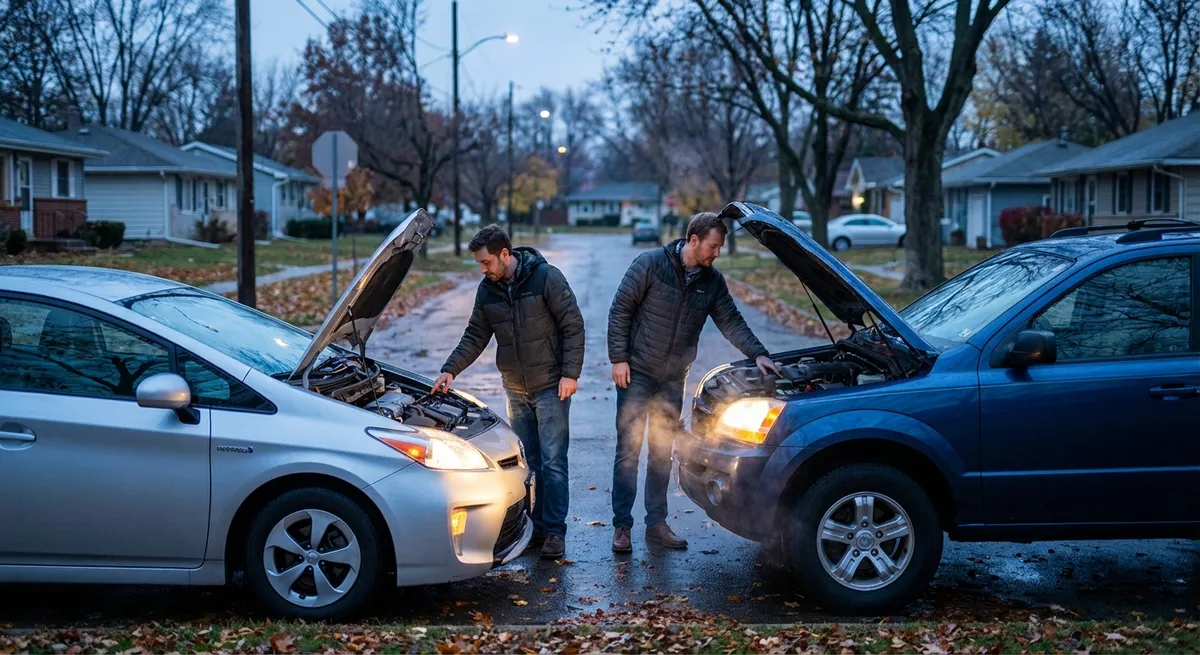
Choosing between a traditional gas-powered SUV and a modern hybrid is no longer a simple “fuel economy vs. power” decision. Today’s SUV market includes everything from mild hybrids that quietly assist the engine to full hybrids that can run on electric power alone at low speeds. For buyers and enthusiasts, understanding how these systems differ in performance, cost, and daily drivability is critical. This comparison breaks down the key factors that actually change your experience behind the wheel—and your total cost of ownership over years, not months.
Powertrains and Performance: How They Deliver Power
Under the hood, the biggest difference is how each SUV generates and delivers torque.
Conventional gas SUVs rely solely on an internal combustion engine (ICE). Power output is generally predictable: a 2.0L turbo four or 3.5L V6 delivers a fixed horsepower and torque curve, with performance heavily dependent on engine speed and transmission gearing. Acceleration is consistent, and response depends on how quickly the engine can rev and the transmission can downshift.
Hybrid SUVs pair an ICE with one or more electric motors and a traction battery. In a full hybrid (like the Toyota RAV4 Hybrid), the electric motor can drive the wheels directly at low speeds and assist the engine under load. Electric motors deliver peak torque from 0 rpm, which often makes hybrids feel more responsive in city and stop‑and‑go driving than comparable gas models. Many hybrids use e‑CVTs (electronically controlled continuously variable transmissions) that keep the engine in its most efficient range, which can feel different from traditional stepped automatics but yields smoother power delivery in steady driving.
In real-world performance testing, hybrid variants of mainstream SUVs frequently match or outperform their gas-only counterparts in 0–60 mph times due to that electric torque assist. However, sustained high-speed performance (such as on long highway grades) can still favor larger-displacement gas engines, especially in heavier three-row or body-on-frame SUVs. Enthusiasts should pay close attention to combined system output (hp and lb-ft), transmission type, and curb weight when comparing spec sheets.
Fuel Economy, Range, and Tank Strategy
Fuel consumption is where hybrids often deliver their clearest advantage—but the benefit depends heavily on how and where you drive.
Gas SUVs derive all of their energy from liquid fuel, so their efficiency is measured purely in miles per gallon (mpg). Turbocharged four-cylinder engines have allowed some compact and midsize SUVs to achieve highway ratings in the upper 20s to low 30s mpg. However, city driving—where idling and stop-and-go conditions dominate—typically drags those numbers down, sometimes into the low 20s or worse for larger models.
Hybrid SUVs use their batteries to capture and reuse energy that would otherwise be wasted as heat during braking (regenerative braking). In urban and suburban driving, this is transformative. Many compact and midsize hybrids deliver combined EPA ratings in the mid-30s to low-40s mpg, with particularly strong gains in city mileage. At low speeds, the engine may shut off completely, with the electric motor handling light loads, nearly eliminating fuel consumption in traffic.
Total driving range is a balancing act among tank size, fuel economy, and load. Some gas SUVs maintain large fuel tanks to ensure long highway legs, particularly in towing- or off-road-oriented models. Hybrids often pair smaller tanks with higher efficiency but still end up with comparable or greater range. For road trip planning, it’s worth checking not only mpg ratings but also tank capacity and whether the hybrid version sacrifices any volume to accommodate the battery pack.
Ownership Costs: Purchase Price, Maintenance, and Depreciation
Upfront cost is usually where buyers first feel the hybrid vs. gas tradeoff. Hybrids typically carry a price premium over their equivalent gas models due to added complexity in the powertrain, motor(s), and battery pack. Depending on segment and brand, this premium can range from modest (around $1,000–$2,000) to significant. Some automakers partially offset the premium by bundling efficiency-focused trims with additional features.
Over time, however, operating costs tell a different story. Hybrids consume less fuel, and in markets with higher gasoline prices, the fuel savings accumulate quickly. Heavy commuters, rideshare drivers, or families who log substantial mileage often see a shorter payback period on the hybrid premium. For low-mileage drivers, especially those doing mostly highway cruising, the financial advantage may be smaller and could take many years to fully materialize.
Maintenance profiles differ as well. Hybrids generally require similar routine service—oil changes, filters, brake fluid, coolant—but regenerative braking can significantly extend brake pad and rotor life because the electric motor does much of the deceleration work. On the other hand, hybrid systems add components (inverters, high-voltage battery, additional cooling loops) that can be expensive if they fail out of warranty. That said, most manufacturers offer extended warranties on hybrid components, and long-term reliability data has been encouraging for major hybrid players.
Depreciation trends continue to evolve. Historically, unfamiliar technology sometimes led to steeper depreciation, but strong demand for fuel-efficient SUVs and growing confidence in hybrid reliability have helped many models retain value as well as, or better than, their gas counterparts. Buyers who plan to keep an SUV for 8–10 years should factor not just sticker price but projected fuel savings, warranty coverage on hybrid components, and likely resale value based on current market trends.
Driving Experience: Noise, Ride, and Everyday Behavior
Beyond numbers, hybrids and gas SUVs can feel quite different to drive in everyday conditions.
Gas SUVs tend to have a more linear, mechanical driving character. Engine note rises and falls with throttle input, and shifts in stepped automatics are clearly perceptible. Enthusiast-tuned models may feature sportier exhaust notes and calibrations that prioritize responsiveness over maximum efficiency. In long highway cruising, a well-insulated gas SUV with a smooth V6 or turbocharged four can be quiet and refined, but idle and low-speed operation always involve some engine vibration and noise.
Hybrids often feel more isolated and smoother in low-speed environments. Because the engine can shut off completely at stops and frequently during gentle acceleration, urban driving is quieter, with less vibration transmitted into the cabin. Electric-only operation at parking-lot or neighborhood speeds can make hybrids feel almost EV-like. On the flip side, some drivers notice higher engine revs during hard acceleration with e‑CVTs or hybrid systems that hold the engine in a narrow rpm band, which can sound less “sporty” even if the vehicle is accelerating briskly.
Regenerative braking is another behavioral difference. Instead of relying solely on friction brakes, hybrids use their electric motor as a generator to slow the vehicle. This can change pedal feel—early hybrids were sometimes criticized for grabby or nonlinear brakes—but modern calibrations are much improved. Still, test drives are crucial: pay attention to low-speed brake modulation, the transition between electric and engine power, and how the vehicle behaves in stop-and-go traffic.
Cabin climate also interacts with the powertrain. Some hybrids keep the engine running more often in extreme heat or cold to support cabin heating and cooling or to maintain battery temperature, which can slightly reduce real-world fuel economy vs. the EPA label. Gas SUVs, by contrast, have a more straightforward relationship: if the engine is on, cabin climate is fully supported with no powertrain complexity.
Capability and Use Case: Towing, Space, and Terrain
For SUV shoppers, capability often matters as much as efficiency—and this is where the choice between hybrid and gas powertrains becomes highly context-dependent.
Towing capacity is a primary concern. Traditional gas SUVs, particularly those with larger-displacement engines or turbocharged V6s, often offer higher maximum tow ratings than their hybrid equivalents. This is partly due to cooling requirements and the added weight of hybrid systems, which can reduce allowable payload and tow ratings. Some hybrid SUVs still tow competitively, but if you routinely pull near the upper limits (boats, campers, enclosed trailers), specific tow ratings, transmission cooling, and rear-axle ratios should be carefully compared.
Cargo and passenger space may be slightly affected by hybrid packaging. Battery placement can intrude on underfloor storage or reduce third-row legroom or cargo volume in some designs. Many modern architectures now integrate the battery under the rear seats or along the floor to minimize impact, but not all models are equal. If you regularly use all three rows or load bulky cargo, verify whether the hybrid version preserves the same interior measurements as the gas model.
Off-road and all-weather performance also vary. Gas SUVs, especially those with traditional 4WD systems and low-range transfer cases, remain the benchmark for serious off-road use. Hybrids can be very capable in light to moderate off-road situations, especially when paired with advanced traction control and torque-vectoring systems. Some hybrid all-wheel-drive setups even use a dedicated rear electric motor to power the rear axle, providing fast-acting traction without a mechanical driveshaft. However, sustained high-load off-road driving can generate additional thermal stress on hybrid systems, so intended use should factor into the decision.
Finally, consider your primary environment. Urban and suburban drivers making frequent short trips, fighting congestion, and valuing quiet operation are often ideal candidates for hybrids. Rural or long-distance highway drivers, heavy towers, and those prioritizing maximum mechanical simplicity may still find a traditional gas SUV better aligned with their needs. Matching the powertrain to the use case is more important than chasing the highest headline mpg.
Conclusion
Hybrid and gas SUVs are no longer separated by a simple efficiency gap; they represent different engineering philosophies tailored to distinct driving realities. Hybrids leverage electric torque and energy recovery to excel in city and mixed use, often providing smoother, quieter operation and significantly lower fuel bills over time. Gas SUVs counter with straightforward mechanical setups, strong towing capability, and familiar driving behavior that still appeals to many enthusiasts and high-load users.
For potential buyers, the smartest comparison isn’t just between nameplates—it’s between your daily driving pattern, long-term ownership plans, and how you actually use your SUV. Look beyond brochure mpg to consider performance feel, range, maintenance, warranty coverage, towing and cargo needs, and how the vehicle behaves in your typical environment. A focused test drive of both hybrid and gas variants, under conditions that mirror your real-world usage, remains the most reliable way to turn spec sheets into a confident decision.
Sources
- U.S. Department of Energy – Fuel Economy: Gasoline vs. Hybrid Vehicles - Explains hybrid system operation, energy recovery, and efficiency differences compared with conventional gasoline vehicles
- U.S. Environmental Protection Agency – Find a Car - Official EPA fuel economy ratings and range data for specific SUV models, both gas and hybrid
- Toyota – Hybrid Technology Overview - Manufacturer-level explanation of full hybrid powertrains, regenerative braking, and warranty coverage
- Consumer Reports – Hybrid vs. Gasoline Cars: Which Save You More? - Independent analysis of purchase price, fuel savings, and long-term ownership costs
- Edmunds – Car Towing Capacity Guide - Detailed discussion of towing limits, ratings, and factors affecting SUV towing capability
Key Takeaway
The most important thing to remember from this article is that this information can change how you think about Comparisons.