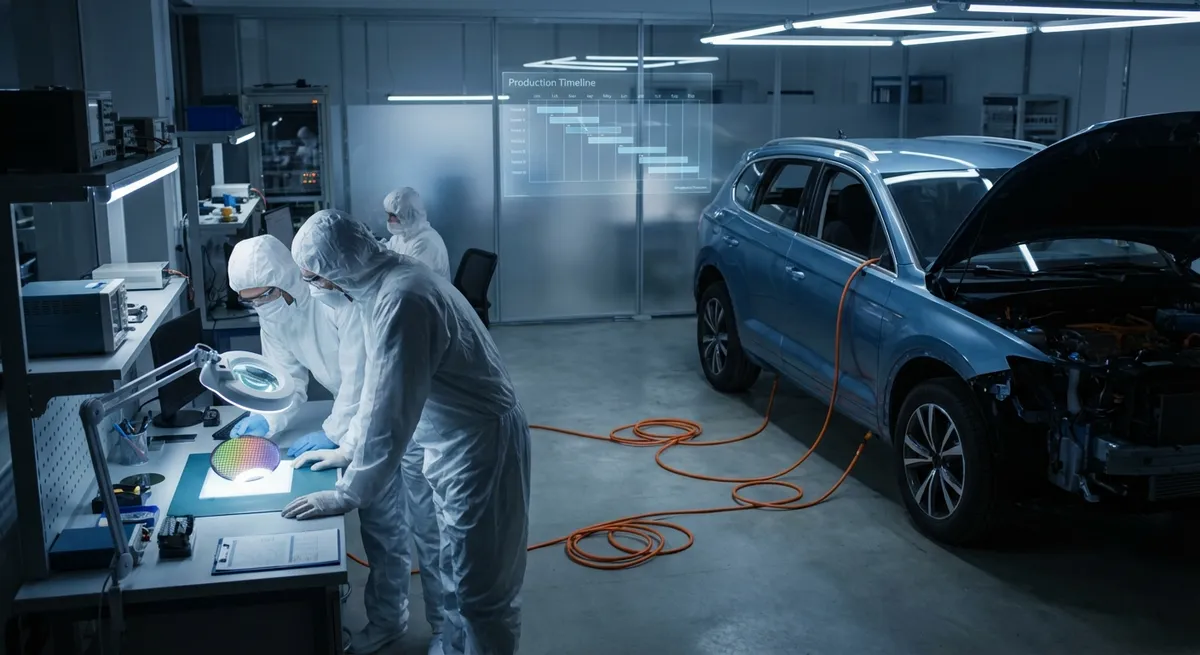
After several years of disrupted supply chains and erratic inventories, the SUV market is quietly entering a new phase—one driven less by marketing buzz and more by semiconductor strategy, software architecture, and manufacturing resilience. For buyers and enthusiasts, this isn’t abstract industry talk: the way automakers are rebuilding their electronics and production pipelines will directly influence which SUVs are available, what tech they include, how reliable they are, and how quickly they depreciate.
This industry shift is happening now, and it’s reshaping what “future‑proof” really means in an SUV purchase.
1. Semiconductor Shortages Are Easing, But Not All Chips Are Equal
The headline story is that the global chip shortage is gradually unwinding, but the details matter. Automakers rely on a mix of mature-node microcontrollers (often 28 nm and above) for basic control units and more advanced nodes for infotainment, driver assistance, and connectivity. While capacity for cutting‑edge chips has been ramping up, many SUV platforms still depend heavily on older, less profitable fabrication processes where investment has lagged.
This mismatch is why some 2024–2026 SUVs ship with full-featured infotainment and ADAS suites, while others quietly omit options like advanced parking assist, high-end audio, or rear-seat entertainment in certain trims or regions. Manufacturers are prioritizing high-margin models and flagship trims when allocating scarce chips, leaving entry and mid-level variants with longer lead times or simplified equipment.
Enthusiasts should pay close attention to production notes and dealer communications: some OEMs have used mid‑cycle running changes to reintroduce features that were deleted during the height of the chip crisis, sometimes under a “Job 2” or “2025.5” designation. That can affect resale value and feature parity within the same model year. In practical terms, a late‑build 2025 SUV may quietly be the one to buy if you care about having the full hardware set, especially for cameras, radar modules, and memory‑heavy infotainment units.
2. Centralized Electronic Architectures Are Redrawing the SUV Feature Map
A major structural shift is underway beneath the dashboards of new SUVs: the move from dozens of discrete ECUs (electronic control units) toward centralized or “zonal” architectures. Instead of a spaghetti of individual control modules for every function—windows, seats, HVAC, powertrain, chassis—new SUV platforms are consolidating processing into a smaller number of high-performance domain or central controllers.
For buyers, this has two big implications. First, it enables more sophisticated integration between systems. Chassis control can be tightly linked with ADAS sensors, allowing features like predictive suspension adjustments based on camera or map data, or more refined torque vectoring in all-wheel-drive systems. Second, it makes over‑the‑air (OTA) updates far more powerful. When a vehicle’s core functions are managed by a central compute platform, software revisions can meaningfully alter performance characteristics: throttle mapping, transmission shift logic, regenerative braking intensity, steering weighting, and even traction-control thresholds.
The catch is that this centralization also increases dependence on software quality and cybersecurity. A bug in a legacy window ECU might cause a nuisance; a bug in a consolidated body domain controller could impact multiple systems at once. Enthusiasts should look for SUVs based on the newest electronic architectures from each brand—these often arrive with more robust OTA support, clearer software update roadmaps, and better integration of ADAS and infotainment, but they may also have the most complex—and least DIY-friendly—hardware layouts.
3. ADAS Sensor Strategies Are Diverging Among SUV Makers
As advanced driver‑assistance systems become standard across more SUV segments, manufacturers are diverging in how they configure sensors and processing hardware. Some OEMs still rely on a “radar + camera” stack with ultrasonic sensors for low-speed maneuvers, while others are expanding to multiple front and rear radars, 360° camera arrays, and even limited lidar integration on higher-end trims.
This matters because the long-term utility and upgrade potential of ADAS depends on the sensor suite baked into the vehicle at the factory. Systems like adaptive cruise control with lane centering, blind-spot monitoring with cross-traffic assist, and automatic lane change all scale better when they’re supported by higher-resolution, wider‑field sensors and robust compute platforms. Cheap, minimally specced systems may meet regulatory requirements but offer little room for meaningful feature expansion later.
Current industry news suggests an emerging split: volume brands are standardizing a “good enough” ADAS baseline to manage cost and compliance, while premium SUV makers are investing in higher-bandwidth sensor networks that can handle more advanced functions via OTA over the vehicle’s lifespan. Buyers should look beyond the marketing names—“Pro Pilot,” “Drive Assist,” “Pilot Assist,” etc.—and evaluate the underlying sensors mentioned in technical specs and press materials. SUVs with multiple front and rear radar units, high-resolution forward cameras, and clearly stated processing hardware (e.g., dedicated ADAS SoC) are more likely to see substantive capability updates down the line.
4. Supply Chain Localization Is Changing Where Your SUV Is Built
The past few years have pushed automakers to rethink where they source components and assemble vehicles. Many manufacturers are moving toward “regionalization” of production: building SUVs closer to their primary markets and increasing the local content of critical parts such as batteries, electric drive units, and infotainment hardware. This is driven by a blend of logistics risk mitigation, government incentives, and geopolitical concerns.
For SUV buyers, production location is no longer just about national pride or import tariffs—it can influence delivery timelines, parts availability, and even long-term serviceability. Plant upgrades in North America and Europe are increasingly focused on flexible manufacturing systems that can build ICE, hybrid, and fully electric SUVs on the same line, allowing automakers to shift mix based on demand and regulation. That flexibility can stabilize supply and help reduce the wild swings in availability seen during the pandemic era.
However, localized supply chains also introduce variability in vendor quality and part revision histories. For example, an SUV assembled in one region may use a different battery supplier, wiring harness vendor, or infotainment module than the same model built elsewhere. Enthusiast buyers who care about specific drivetrains, batteries, or even seat designs should pay attention to VIN decoding data, build-plant codes, and official manufacturer statements outlining which factories produce which trims and powertrains. In some cases, certain plants become known for quicker rollout of technical updates or revised components (such as updated high-voltage battery chemistries or improved transmission calibrations).
5. Software‑Defined SUVs Are Turning Ownership Into a Long-Term Tech Bet
The most significant industry news—though less flashy than concept reveals—is the accelerating shift toward “software-defined vehicles.” Automakers and major suppliers are rolling out unified software stacks that span everything from power management to infotainment, voice assistants, and ADAS. This evolution turns an SUV into more of a long-term technology platform than a static hardware purchase.
The practical consequence is that the value of an SUV’s embedded compute hardware and connectivity contracts can be just as important as its engine output or fuel economy. Vehicles with powerful processors, generous onboard storage, and 4G/5G connectivity are better positioned to support multi‑year feature rollouts, security patches, and performance refinements. Some brands are already shipping SUVs with hardware-capable features (such as higher-level driver assistance, expanded camera views, or enhanced off‑road modes) that are initially locked pending software completion, regulatory approval, or paid activation.
This introduces a new decision layer for buyers: not just “which trim” but “which software and subscription roadmap.” Enthusiasts should review how long a manufacturer commits to providing OTA updates, what functions are subscription-gated versus permanently included, and how the brand has historically handled feature evolution on earlier connected models. An SUV with a robust, well-supported software ecosystem may hold its relevance—and resale value—longer than a competitor with similar specs but a weaker digital strategy. At the same time, those wary of long-term subscription costs may prefer models where core driving and comfort features are hard-coded into the base purchase, not metered via recurring fees.
Conclusion
The SUV market is no longer driven solely by displacement, ground clearance, or interior volume. Under the skin, the industry is being reshaped by semiconductor capacity, centralized electronics, diverging ADAS sensor philosophies, regionalized manufacturing, and software‑defined architectures. For enthusiasts and serious buyers, understanding these forces offers a quieter but more powerful edge than chasing headline horsepower or screen size.
As 2026 approaches, the smartest SUV decisions will come from treating each purchase as an intersection of hardware, software, and supply chain strategy. The models that age best are likely to be those built on modern electronic platforms, with robust sensor suites, transparent OTA support, and manufacturing footprints resilient enough to keep parts—and updates—flowing for years to come.
Sources
- McKinsey – The chip shortage: Automotive impact and path forward – Analysis of how semiconductor dynamics are reshaping automotive production and electronics strategy
- National Highway Traffic Safety Administration (NHTSA) – Vehicle Safety and ADAS Overview – Background on ADAS systems, safety implications, and regulatory context
- Georgia Institute of Technology – Zonal Architectures and Software-Defined Vehicles – Technical discussion of centralized electronic architectures and their impact on vehicle design
- U.S. Department of Energy – Electric Vehicle & Battery Supply Chain Reports – Insights into regionalization of EV-related manufacturing, relevant to SUV platforms and future production trends
- Volkswagen Group – Software-Defined Vehicle Strategy (Official Presentation) – Example of how a major OEM is implementing software-defined architectures and OTA capabilities across its vehicle lineup
Key Takeaway
The most important thing to remember from this article is that this information can change how you think about Industry News.