Choosing an SUV today isn’t just about picking a size and a badge. With electrification, advanced driver-assistance systems, and complex all-wheel-drive setups, the test drive has become your single most valuable tool to separate a merely “nice” SUV from one that will actually suit your life for the next 5–10 years. Done properly, it’s less of a quick spin around the block and more of a structured evaluation.
This guide focuses on how to use your test drive—what to look for, what to feel, and what to verify—so you can cut through marketing claims and confidently judge how an SUV will behave in the real world.
1. Powertrain Reality Check: Matching Engine, Transmission, and Use Case
Before you get distracted by screens and stitching, evaluate how the SUV delivers power in the situations you care about most.
For gasoline and diesel models, pay attention to how the engine and transmission work together. Turbocharged four‑cylinders may quote impressive horsepower and torque on paper, but lag, peaky power delivery, or an over‑eager 8–10‑speed automatic can make an SUV feel jumpy in city driving or sluggish when merging. On your test route, do at least one full‑throttle acceleration from 20–60 mph to see how quickly it responds, and one 40–70 mph pull to mimic a highway pass. Note downshift speed, engine noise quality, and whether the gearbox “hunts” for gears on gentle inclines.
Hybrid and plug‑in hybrid SUVs deserve special scrutiny. Ask how much of the rated system power is available on battery alone, and at what speeds the gas engine typically joins in. During the drive, monitor transitions between electric and combustion power—are they smooth or does the handoff feel abrupt? Try low‑speed parking maneuvers where some hybrids can feel grabby due to blended regenerative and friction braking. For plug‑in hybrids, verify how the EV mode behaves at highway speeds and in moderate acceleration; some systems will kick on the engine more often than the brochure suggests.
For fully electric SUVs, range and charging headlines are only part of the story. Pay attention to throttle mapping (is it progressive or twitchy?), one‑pedal driving behavior, and how the vehicle manages power at higher speeds, where efficiency can fall sharply. If possible, note energy consumption (kWh/100 miles or mi/kWh) over a mixed loop. Ask the salesperson for the battery’s usable capacity, DC fast‑charging peak rate, and the charging curve (whether it holds high power or quickly tapers). These details will matter more than the maximum advertised kW figure if you road‑trip frequently.
Finally, consider towing and payload in context. If you plan to tow, verify the real‑world combination of towing capacity, tongue weight limits, and gross vehicle weight rating (GVWR). Remember that a high tow rating is only useful if the SUV’s suspension, brakes, and cooling systems feel confident and stable under load, not just when it’s empty on a test loop.
2. Ride, Handling, and Braking: How the Chassis Talks to You
Modern SUVs span everything from softly sprung family haulers to sharp‑handling, performance‑tuned crossovers. The only way to know what’s underneath the styling is to pay careful attention to the chassis on varied roads.
Start by noting basic ride quality at low speeds over imperfections: expansion joints, patched asphalt, and speed bumps. Does the SUV thump and pogo, or does it absorb impacts with a single, controlled motion? Excessive vertical motion (bobbing) can fatigue passengers on long trips, while an overly stiff setup can become tiring on broken pavement, even if it feels “sporty” during a short demo.
On an open road, evaluate steering precision and effort. A good SUV should track straight with minimal correction, and steering weight should build naturally through a corner. Electric power steering systems are often tunable through drive modes; try at least two different settings (e.g., Comfort vs Sport) and decide whether any of them feels intuitive. If there’s too much play on center, highway driving will be more stressful than it needs to be.
Body control is critical in taller vehicles. Find a safe curve or highway on‑ramp and take it at a brisk but legal speed. Note how much the body leans, and whether the suspension settles quickly after you exit the turn. Excessive roll or a “floating” sensation can indicate a setup that will feel less secure in emergency maneuvers or with a full load of passengers and cargo.
Braking is often overlooked but just as vital. Perform a few moderate (not panic) stops from 45–50 mph. Judge pedal firmness, travel, and consistency from stop to stop. In hybrids and EVs, where regenerative braking is blended with conventional friction brakes, feel for nonlinear or “stepped” responses that could make smooth braking difficult. If the SUV is rated for substantial towing, the brake feel should inspire confidence, not require a long, mushy pedal travel.
If available, try adaptive or air suspension modes. An SUV that lets you adjust damping or ride height can be ideal if you mix city commuting with occasional rough roads, but make sure each setting actually changes the character in a useful way rather than being a barely noticeable gimmick.
3. Interior Ergonomics and Tech: Beyond Screens and Spec Sheets
The best SUV cabin is the one that disappears under you—everything is where it needs to be, with minimal distraction and strain. Use the test drive to stress‑test ergonomics, not just admire materials.
Start with basic driving position. Can you establish a comfortable “triangle” between the seat, pedals, and steering wheel? Check for sufficient tilt and telescopic range on the steering column and fine adjustment on the seat base, cushion tilt, and lumbar support. If you’re taller or shorter than average, pay special attention to thigh support, knee clearance around the center console, and headroom with a panoramic roof.
Next, work through your normal daily tasks before you even put the SUV in Drive. Set up Apple CarPlay or Android Auto, pair your phone via Bluetooth, and store at least one navigation destination. Adjust climate control, fan speed, and seat heaters/ventilation while looking at the road (or simulating it). If common functions are buried two or three menu layers deep in a touchscreen, expect that annoyance to multiply over years of ownership.
Critically evaluate driver‑information displays and HUDs. Ask whether you can customize what appears in the instrument cluster and if you can see critical data simultaneously: speed, navigation prompts, ADAS status, and power/charge information (for electrified models). Cluttered or poorly prioritized displays can be fatiguing, especially on long drives or at night.
For family or frequent‑passenger use, move to the second and third rows. Sit in every seating position you’re likely to use and assess legroom, toe room under the front seats, headroom, and shoulder width. Test how easy it is to enter and exit the third row, particularly with child seats installed in the second row. Practice folding and sliding the seats using one hand; latches and levers that feel fiddly in a showroom can be a daily irritation in the real world.
Finally, examine cabin noise and acoustics. On the test drive, turn off the audio system and listen at several speeds: 35 mph city, 55–65 mph highway. Note tire roar, wind noise around the mirrors and A‑pillars, and drivetrain sounds under load. The best SUVs strike a balance—quiet enough for conversation, but with enough feedback that you remain connected to what the vehicle is doing.
4. AWD Systems, Drive Modes, and Real‑World Traction
Many SUV buyers assume all‑wheel drive is just a “checkbox,” but hardware and calibration differences can dramatically change how an SUV behaves in snow, rain, or off‑pavement.
Ask what type of AWD system is fitted: part‑time, full‑time, or on‑demand. On‑demand systems, common in crossovers, typically run in front‑wheel drive and send torque rearward when slip is detected, often via an electronically controlled clutch. Full‑time systems may use a center differential or clutch pack to continuously split torque front‑to‑rear, sometimes with a default bias. If available, dig into whether there is a mechanical locking differential or torque‑vectoring capability at either axle.
On the road, you won’t test deep‑snow performance, but you can feel how quickly the system responds to low‑grip situations. In a safe, open space on a wet day, a moderately hard start from a stop can reveal whether the front wheels spin significantly before the rear axle contributes. In dry weather, you can at least evaluate traction out of tight corners and how stable the SUV feels during brisk acceleration.
Explore drive modes beyond “Normal.” Many SUVs now offer modes like Eco, Sport, Snow, Off‑Road, or Terrain, each altering throttle mapping, transmission strategy, AWD behavior, and sometimes suspension and steering. On your test loop, cycle through at least two of these modes in similar conditions. Note whether the differences are meaningful: Does Snow mode soften throttle response and start in higher gears? Does Off‑Road mode enable hill‑descent control or change ABS behavior on loose surfaces?
Ground clearance and approach/departure angles should match your actual needs. If you frequent unpaved roads, construction sites, or winter‑rutted streets, ask for measured ground clearance and whether there are vulnerable low‑hanging components (exhaust, battery packs, or aerodynamic shields). If the SUV has an air suspension with lift modes, verify how quickly it raises, the maximum speed at which you can use the raised setting, and whether it automatically lowers at highway speeds.
Lastly, confirm tire type and size. A sophisticated AWD system can be undermined by basic, low‑grip all‑season tires. If you live in a four‑season climate, budget for a proper winter tire set; if light off‑roading is on the agenda, consider whether the vehicle can accept a more aggressive all‑terrain tire without compromising ride or noise to an unacceptable degree.
5. Ownership Fit: Charging, Running Costs, and Long‑Term Practicality
An SUV can excel on a test drive yet disappoint over years if it doesn’t align with how—and where—you live. Before signing anything, use the evaluation drive to sanity‑check long‑term ownership.
For EVs and plug‑in hybrids, examine your real charging ecosystem rather than just manufacturer claims. Discuss onboard charger capacity (e.g., 7.2 kW vs 11 kW for AC charging) and how that matches typical home charging setups. If you have or plan to install a Level 2 charger, estimate overnight replenishment based on usable battery size. On DC fast charging, don’t just look at the maximum kW; ask how long the SUV can sustain near‑peak rates and what state of charge (SoC) window is recommended for regular use (e.g., 10–80%). Mapping this to your usual routes will tell you whether the vehicle is truly convenient or just theoretically capable.
Regardless of powertrain, dig into maintenance schedules and projected running costs. Ask for the official maintenance interval chart and note service frequency for oil changes (ICE and hybrids), coolant, transmission and differential fluids, and brake service. For EVs, inquire about recommended checks on cooling systems, reduction gear oil, and brake fluid, even if intervals are longer. Clarify warranty coverage for the powertrain and high‑voltage battery, as well as any roadside assistance or complimentary maintenance programs.
Fuel economy or energy efficiency should be considered under your real driving pattern. During the test drive, reset the trip computer and observe consumption over a representative route: city, suburban, and highway if possible. Compare your observed value to the official EPA (or local regulatory) ratings to gauge how the SUV might behave in your routine. If you commute heavily at high speed, expect more deviation from the lab figures, especially with boxier, higher‑drag SUV shapes and larger wheel/tire packages.
Cargo management and daily practicality often matter more than raw volume numbers. Open and close the tailgate several times—check its speed and height, especially if you have a low garage door. Fold every rear seat configuration available and verify you have a flat, usable load floor. Look for tie‑down points, under‑floor storage for charging cables or emergency gear, and space to store a retractable cargo cover when it’s not in use. If you travel with pets, consider load‑in height, rear opening shape, and whether there are 12‑V or 120‑V outlets for accessories.
Lastly, think about software and update policies. Many new SUVs rely heavily on over‑the‑air (OTA) updates for infotainment, navigation, and even drivetrain and ADAS refinements. Ask how often updates are provided, whether they require dealership visits, and what happens if you decline or delay them. Clarify any subscription‑based features (connected services, advanced navigation, or certain driver‑assistance functions) so the total long‑term cost doesn’t surprise you after year one.
Conclusion
A modern SUV test drive is no longer a five‑minute loop to see if you “like” the vehicle. It’s your best opportunity to interrogate the powertrain in real conditions, understand how the chassis communicates, verify that the cabin will work for your body and your passengers, and ensure the drivetrain and tech ecosystem align with your climate, roads, and daily demands.
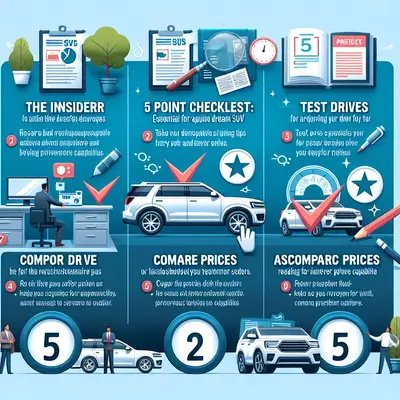
Approach the drive with a structured checklist—powertrain behavior, ride and handling, ergonomics and tech, traction systems, and long‑term ownership fit—and you’ll see past glossy brochures to how the SUV will actually live with you. The more deliberate and technical your evaluation, the more likely you are to choose an SUV that still feels like the right decision years after the showroom shine has faded.
Sources
- U.S. Department of Energy – Fueleconomy.gov - Detailed explanations of fuel economy, EV efficiency, and how driving conditions affect real‑world consumption
- EPA – Green Vehicle Guide - Official guidance on EV capabilities, range, and common misconceptions
- IIHS – Vehicle Ratings - Crash test results, safety ratings, and information on advanced driver‑assistance systems for SUVs
- NHTSA – 5‑Star Safety Ratings - Federal safety ratings, recall information, and data on vehicle safety performance
- SAE International - Technical overview of driving automation levels and advanced driver‑assistance features
Key Takeaway
The most important thing to remember from this article is that this information can change how you think about Buying Guide.