Shopping for an SUV can feel like learning a new language. Brochures are packed with numbers—horsepower, torque, cargo volume, departure angle, kilowatt-hours—but very few explain what actually matters in daily use. This guide cuts through the spec-sheet noise so you can interpret SUV data like an expert and understand how those numbers translate to real-world driving, comfort, and ownership costs.
Interpreting Power, Torque, and Performance Beyond the Headline Horsepower
Horsepower grabs attention, but it’s only part of the performance story—and often a misleading one if viewed in isolation.
Power (hp or kW) indicates how quickly an engine can do work, but torque (lb-ft or Nm) describes the twisting force that actually gets a heavy SUV moving, especially from a stop or when towing. For urban and family use, the shape of the torque curve and where peak torque arrives often matter more than the peak horsepower number.
Modern turbocharged engines frequently deliver peak torque at low RPM (e.g., 1,600–2,000 rpm). This provides strong, relaxed acceleration in real traffic, even if the top horsepower number looks modest versus a higher-revving naturally aspirated engine. Electric SUVs go a step further: they can deliver near-instant torque from zero rpm, which explains their brisk off-the-line feel even when their horsepower appears similar to gas models.
You should also examine 0–60 mph (0–100 km/h) times in context. A 7.5-second SUV can feel more than adequate for merging and overtaking, particularly if the transmission is well-tuned and the torque is available low in the rev range. A heavier three-row model with a small-displacement turbo engine might advertise strong horsepower but feel strained with a full load and cargo, because the power-to-weight ratio is marginal and the engine spends more time at high revs.
For buyers who tow, pay closer attention to torque and the Gross Combined Weight Rating (GCWR) than simple horsepower figures. A naturally aspirated V6 or diesel (where available) may provide more predictable performance under sustained load than a high-strung small turbo gasoline engine, even if peak figures look similar.
Transmission type is another performance variable. An 8–10 speed automatic can keep the engine in its optimal power band, but frequent shifting or hunting for gears may indicate mismatched tuning. CVTs (continuously variable transmissions) offer efficiency but may feel less engaging or responsive at highway speeds. Dual-clutch transmissions, common in some performance-oriented crossovers, can offer rapid shifts but occasionally feel jerky at low speeds if not calibrated well.
When reviewing specs, prioritize:
- Torque output and where it peaks in the rev range
- Power-to-weight ratio, not just raw horsepower
- Published acceleration times combined with owner or professional reviews of drivability
- Transmission type, gear count, and known behavior in real-world use
This deeper view usually gives a more accurate sense of how an SUV will feel than a single, bolded horsepower number.
Decoding Weight, Dimensions, and Ground Clearance for Everyday Usability
Physical dimensions and curb weight are more than parking-lot trivia—they directly influence maneuverability, efficiency, comfort, and capability.
Curb weight affects acceleration, braking distances, tire wear, and fuel or energy consumption. A 5,000+ lb (≈2,270+ kg) three-row SUV will inherently be more demanding on brakes and tires than a compact crossover under 3,700 lb. If you live in a hilly area or tow occasionally, choosing an SUV with a favorable power-to-weight ratio and robust braking hardware (larger rotors, multi-piston calipers on higher trims) is especially important.
Wheelbase—the distance between the front and rear axles—has a major impact on ride and stability. Longer wheelbases typically provide a smoother, more composed ride at highway speed, but can reduce maneuverability and increase the turning circle. Shorter wheelbases make tight city driving and parking easier but may ride more firmly over broken pavement. For families who regularly drive long distances, a slightly longer wheelbase with good suspension tuning often pays off in fatigue reduction.
Overall length and width should be checked against your actual parking environment. A mid-size SUV around 190 inches long may fit cleanly in most garages, whereas full-size models exceeding 200 inches can leave limited space for opening tailgates and doors. Wider vehicles may feel more stable at speed, but note that urban parking spaces and narrow streets can make large SUVs cumbersome to live with daily.
Ground clearance numbers—and whether they’re paired with underbody protection—matter for more than just off-road trips. Higher ground clearance can help with steep driveways, deep snow, and rough rural roads. However, increased ride height raises the center of gravity, which can affect handling and rollover risk if not controlled with a well-engineered suspension and stability systems. Adaptive or air suspension systems that can lower the vehicle at highway speeds and raise it off-road provide a useful compromise but add cost and complexity.
Approach, breakover, and departure angles are often highlighted on off-road-oriented SUVs. These angles indicate how steep an obstacle you can climb over or descend without scraping bumpers or underbody components. If your driving is mostly paved, these numbers are less important than:
- Overall length and width in relation to your daily parking and garage
- Turning radius for tight city maneuvers
- Step-in height for passengers (especially children, elderly, or those with mobility issues)
- Cargo load floor height (affecting how easy it is to lift in heavy items)
Don’t just glance at dimensions—consider how you’ll use the vehicle every day and how those numbers will feel in your driveway, neighborhood, and usual parking spots.
Understanding Drivetrain, AWD Systems, and Traction Tech in Practical Terms
The term “all-wheel drive” covers a wide spectrum of technologies, and brochure language often blurs meaningful differences. Knowing what’s behind those badges and acronyms helps you match an SUV’s drivetrain to your climate and driving style.
Basic on-demand AWD systems are front- or rear-biased setups that send power to the second axle only when slip is detected. These are cost-effective and improve traction in occasional slippery conditions but may react after wheels begin to lose grip. More advanced systems use predictive algorithms, steering input, throttle position, and sensor data to proactively apportion torque before slip occurs.
Full-time AWD (or 4WD in some marketing) keeps both axles engaged and is typically better for consistent traction on mixed surfaces. Mechanical center differentials or electronically controlled clutch packs can vary torque distribution front-to-rear. Some performance-oriented SUVs offer rear-biased AWD, which can improve handling feel and corner exit traction.
For buyers in snow-belt regions, pay attention to:
- Whether the system includes a selectable “Snow” or “Off-Road” mode that softens throttle response and adjusts traction control
- The presence of a mechanical or electronically controlled rear differential lock or torque-vectoring system
- Availability of all-weather tires or winter packages from the factory
Off-road-focused SUVs may offer low-range gearing (2-speed transfer case), hill descent control, and multiple terrain modes (mud, sand, rock). Low range is important for controlled, low-speed crawling and towing heavy loads on steep grades. If your off-pavement use will be limited to maintained dirt roads or light trails, a capable AWD crossover with decent ground clearance and appropriate tires is usually more than sufficient.
Electric SUVs introduce a different paradigm. Dual-motor setups often dedicate one motor per axle, allowing instant, precise torque distribution without a traditional driveshaft or differential. This can create exceptionally responsive traction control, especially on slippery surfaces. Still, firmware tuning and traction management strategies can differ widely between brands; real-world test drives and reviews remain valuable.
When comparing drivetrains, focus on:
- The system’s basic architecture (on-demand vs full-time, single vs dual motor)
- Presence of dedicated drive modes for weather and off-road conditions
- Availability of locking features or torque-vectoring for demanding use
- Tire type and rating, as tires often dictate more real-world traction than the drivetrain itself
This detail-oriented view gives a clearer picture of how an SUV will handle wet roads, snow, gravel, and emergency maneuvers—not just how it’s advertised.
Reading Cargo, Seating, and Interior Specs for Real Family and Gear Use
Interior and cargo figures can be among the most confusing specs because manufacturers measure and present them differently. Yet for many SUV buyers, this is the most important part of the purchase.
Passenger volume is typically expressed in cubic feet or liters, but how that space is shaped matters more than the raw number. Headroom, legroom, and shoulder room for each row should be compared not just in absolute terms, but also in how they’re distributed. A three-row SUV with a generous second row but cramped third row may be fine if the third row is for occasional use; if you routinely carry adults in all three rows, seek models with more legroom and easier third-row access (wide-opening doors, sliding second row, and accessible walk-through or tilt-and-slide mechanisms).
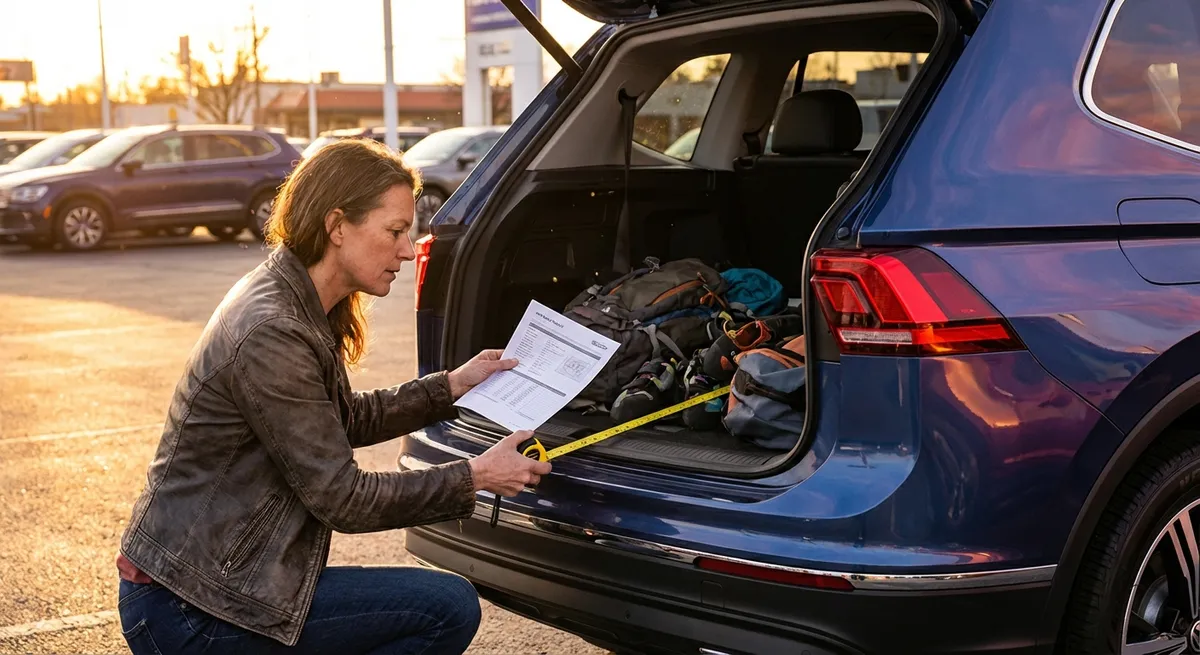
Cargo volume is often quoted “behind the second row” or “behind the third row.” Look for how much space remains usable with all seats up, especially if you frequently carry passengers and luggage simultaneously. Tall, boxy SUVs often offer more practical vertical loading space than sleek, coupe-like rooflines, even when the stated cargo volume is similar. Pay attention to whether measurements include underfloor storage, which may or may not be usable with a full load.
Split-folding seat configurations (60/40, 40/20/40, 50/50 for third rows) influence day-to-day flexibility. If you often carry long items like skis or boards plus passengers, a 40/20/40 rear seat with a fold-down center section is far more functional than a simple 60/40 split. Check whether second-row seats slide and recline independently to balance legroom and cargo needs.
Towing and payload ratings intersect directly with interior space usage. Payload (the maximum combined weight of passengers and cargo) can be surprisingly easy to exceed in large SUVs laden with people, luggage, and hitch-mounted gear. A model with a high tow rating but modest payload may technically pull a heavy trailer, but you’ll exceed specs once you add passengers and tongue weight. For serious towing or frequent long trips with a full cabin, scrutinize payload figures as closely as you would tow ratings.
Also consider cabin ergonomics through a practical lens:
- Number and placement of USB-C/USB-A ports and 12V outlets
- Availability of third-row climate controls and vents
- Fold-flat vs stepped cargo floor when seats are down
- Power tailgate opening height and speed (important in low garages or for shorter drivers)
Spec sheets give you numbers; your job is to translate them into scenarios: “Can I carry two child seats, a stroller, luggage for four, and still see out the rear window?” The answer often lies in how the space is configured, not just how big it is on paper.
Evaluating Efficiency, Range, and Cost of Ownership with a Long-Term Lens
Fuel economy and range figures are crucial, but they’re only one part of the long-term ownership equation. Understanding how they’re measured—and what they omit—helps you make more accurate comparisons.
For gasoline and diesel SUVs, look at EPA or WLTP combined ratings, but also at city vs highway splits. A heavy, boxy SUV may advertise a decent highway figure thanks to tall gearing and a modern powertrain, while its city rating reveals how much fuel it uses in stop-and-go conditions. If your commute is mostly urban, prioritize stronger city numbers and consider mild hybrids or full hybrids, which recapture energy during braking and reduce idling losses.
Plug-in hybrid (PHEV) SUVs list electric-only range and combined fuel economy once the battery is depleted. If you can charge regularly at home or work, a PHEV with 25–40 miles (≈40–64 km) of electric range can cover most daily driving on electricity alone, using the gas engine mainly for longer trips. The key is to realistically assess your charging habits; without regular charging, you’re carrying extra battery weight without reaping efficiency benefits.
Battery-electric SUVs list EPA-estimated or WLTP driving range alongside battery capacity (kWh). To evaluate real-world usability, consider:
- Efficiency (miles per kWh or kWh per 100 km) rather than just total range
- Climate impact: cold weather can significantly reduce effective range
- Charging curve: how quickly the SUV can charge from 10–80% at DC fast chargers, not just peak kW rating
Maintenance and durability also play into total cost of ownership. Traditional SUVs with complex multi-gear transmissions, turbocharging, and advanced 4WD hardware can be more maintenance-intensive over long time horizons, especially if used for heavy towing or off-roading. Hybrids add electrical components but often see reduced wear on brakes and engines due to regenerative braking and engine-off operation at low loads. EVs eliminate oil changes and transmission services, but tire wear and potential long-term battery health become key considerations.
Beyond the powertrain, study:
- Recommended maintenance intervals and estimated service costs from the manufacturer or dealers
- Warranty coverage for powertrain, hybrid/EV components, and corrosion
- Resale value trends for the specific model and drivetrain type
When you integrate efficiency, energy or fuel cost, maintenance, insurance, and depreciation, an SUV that seems more expensive upfront may turn out to be the more economical choice over 5–10 years—especially if its technology, build quality, and brand support remain strong.
Conclusion
Spec sheets are powerful tools, but only if you know how to read them with a critical, real-world mindset. Instead of chasing isolated headline numbers, focus on how power, torque, weight, dimensions, drivetrain, interior packaging, and efficiency interact to support your actual driving patterns. Cross-referencing paper specs with credible reviews and, crucially, your own test drive will help you find an SUV that not only looks impressive in a brochure but also delivers the comfort, performance, and utility you expect over years of ownership.
Sources
- [U.S. Department of Energy – Fuel Economy Guide](https://www.fueleconomy.gov/feg/findacar.shtml) - Official EPA fuel economy data and comparisons for SUVs and other vehicles
- [U.S. Environmental Protection Agency – Understanding Electric Vehicle Range](https://www.epa.gov/greenvehicles/electric-vehicle-myths) - Explains how EV range is measured and factors that affect real-world performance
- [NHTSA – Vehicle Size and Rollover Risk](https://www.nhtsa.gov/rollover) - Government information on how vehicle height and design influence stability and rollover characteristics
- [IIHS – SUV Safety and Vehicle Size](https://www.iihs.org/topics/vehicle-size-and-weight) - Research-based insights on how size and weight affect crash outcomes for SUVs
- [SAE International – Powertrain and Drivetrain Fundamentals](https://www.sae.org/news/2021/04/understanding-vehicle-powertrain) - Technical overview of power, torque, and drivetrain configurations used in modern vehicles
Key Takeaway
The most important thing to remember from this article is that following these steps can lead to great results.