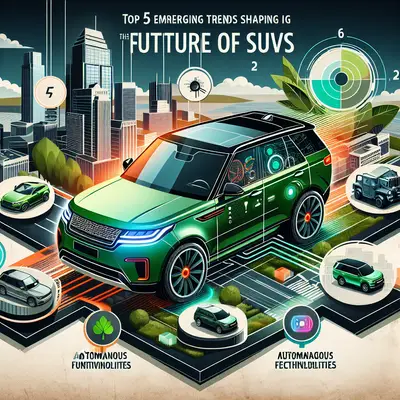
SUVs are no longer just rugged family haulers—they’re the center of gravity for the entire automotive industry. As regulations tighten, technology accelerates, and new competitors pile in, the SUV segment is undergoing its most dramatic shift in decades. For enthusiasts and serious shoppers, understanding why these changes are happening is now just as important as comparing horsepower and cargo volume.
This industry update breaks down five critical developments shaping SUVs right now—and what they actually mean for your next purchase or lease.
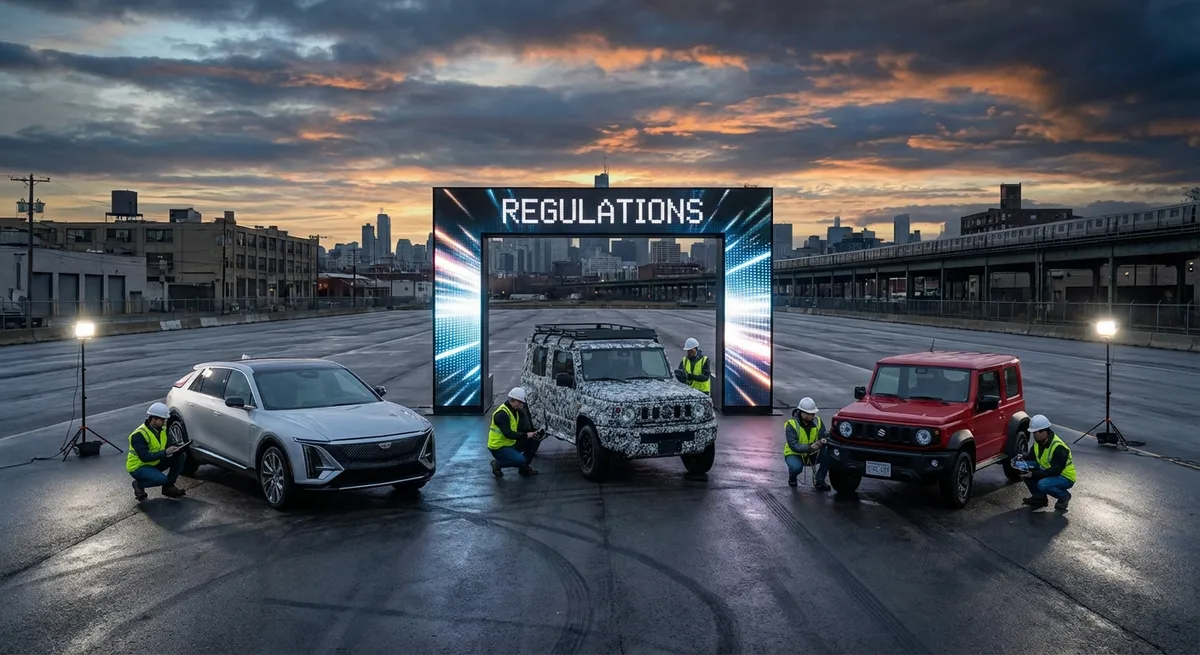
Regulatory Pressure Is Forcing a Rethink of SUV Size, Weight, and Powertrains
Global emissions and fuel-economy regulations are directly reshaping how SUVs are engineered and sold. In the U.S., the EPA’s finalized 2027–2032 light-duty vehicle standards will effectively push average fleet emissions significantly lower, making it harder for automakers to rely on large, thirsty SUVs without serious offsets.
In practical terms, this is accelerating three intertwined trends: downsized turbocharged engines, wider use of hybrid systems, and aggressive weight-reduction strategies. We’re already seeing 2.0–2.5L turbocharged four-cylinders replacing naturally aspirated V6s in mid-size SUVs, often paired with 48‑volt mild-hybrid systems or full hybrid architectures to smooth torque delivery and improve real-world efficiency. Aluminum-intensive body structures, high-strength steel, and composite materials are being used more strategically to cut curb weight while preserving crash performance.
Enthusiasts should note that these changes are not just about compliance. Tighter CO₂ limits in the EU and similar targets in China and other major markets create a global engineering baseline, which then trickles into North American-spec SUVs whether buyers demand it or not. Expect more “multi-energy” platforms—the same basic chassis engineered from day one to support gasoline, hybrid, and full EV variants—allowing manufacturers to flex their powertrain mix to meet regional rules.
For buyers, the key takeaway is that the traditional formula of “big displacement equals better performance” is being replaced by calibration sophistication and electrification. Evaluating an SUV now requires paying attention to thermal management, battery integration, and drivetrain software just as much as cylinder count.
Electrified SUVs Are Moving From Niche to Mainstream—With New Tradeoffs
Electric and plug-in hybrid SUVs are no longer fringe experiments; they’re becoming core products for nearly every global automaker. This transition is most visible in the sheer diversity of models: from compact urban crossovers with ~250 miles of range to three-row electric family haulers approaching or exceeding 300 miles, and performance-oriented e-SUVs targeting sub-4‑second 0–60 mph times.
Under the surface, the technical pivot is toward more efficient battery chemistries and high-voltage architectures. Many new electric SUVs are built around 800‑volt systems (or 400‑volt systems with advanced charging management), which enable faster DC fast-charging, lower cable thickness, and reduced heat losses. Cell-to-pack or cell-to-chassis integration is increasing energy density by eliminating traditional modules, allowing similar range from physically smaller, lighter packs.
However, this comes with distinct tradeoffs. Higher-voltage, fast-charge-capable SUVs depend heavily on charging infrastructure that can actually deliver 200 kW or more. Battery thermal management strategies (liquid cooling circuits, heat pumps, preconditioning algorithms) significantly influence not just charging speed but winter range and long-term degradation. For plug-in hybrid SUVs, the balance between electric-only range (often 25–50 miles) and fuel-tank size is a crucial design compromise: more battery means weight and cost; less battery can make the plug-in benefit marginal.
Enthusiasts evaluating electrified SUVs need to look beyond headline range and 0–60 times. DC fast-charging curves, on-board charger capacity (for home Level 2 charging), and software-update support (for drivetrain and battery management tweaks over time) now matter as much as traditional performance figures. A well-engineered 250‑mile SUV with a stable charging curve can be more usable than a 300‑mile model that tapers aggressively above 40% state of charge.
Software-Defined SUVs: From Infotainment Screens to Vehicle Architecture
SUVs are rapidly becoming “software-defined vehicles,” where core capabilities—from power delivery to active safety—are controlled by centralized computing platforms and continuously updated firmware. The shift away from dozens of discrete electronic control units (ECUs) toward domain or central controllers is a major architectural change that will shape reliability, feature sets, and resale value.
On the visible side, buyers are encountering ever-larger infotainment displays, digital instrument clusters, and head-up displays that aggregate navigation, ADAS (advanced driver-assistance systems) status, and drivetrain information. Many new SUVs support over-the-air (OTA) software updates not just for maps or apps, but also for traction-control tuning, adaptive damping profiles, and even steering calibration. Automakers are moving toward Linux or Android-based operating systems, with app ecosystems that can be updated independently of the vehicle hardware lifecycle.
Underneath, Ethernet-based in-vehicle networks, zonal architectures, and higher computing power enable more sophisticated data fusion for ADAS. Forward radar, camera arrays, ultrasonic sensors, and sometimes lidar are combined to support lane-centering, adaptive cruise control in stop-and-go traffic, automated lane changes, and increasingly advanced parking assistants. These systems are heavily software-dependent; how well they work depends on perception algorithms, object classification, and continuous training on real-world edge cases.
For enthusiasts, the upside is clear: SUVs can gain capabilities over time, and driving dynamics can be refined post-sale. The downside is greater reliance on subscription-locked features and brand-specific ecosystems. When shopping, it’s worth researching how long the manufacturer commits to OTA support, whether critical features depend on recurring payments, and how the automaker has handled past software rollouts (bug rates, update cadence, and transparency). A strong software roadmap is becoming as important as a strong mechanical platform.
New Entrants and Joint Ventures Are Disrupting Traditional SUV Development
The SUV market is no longer dominated solely by legacy automakers. Tech-forward startups and Chinese manufacturers are aggressively entering global markets, while traditional brands increasingly partner with electronics and battery specialists to accelerate development.
Many of these new entrants build SUVs around “skateboard” EV platforms—flat battery packs integrated into the floor, with drive units mounted between axles. This creates packaging efficiencies: longer wheelbases for a given footprint, flat floors for second- and third-row comfort, and larger cargo spaces. It also simplifies variant creation (single motor, dual motor, performance trim) without major structural changes. Some startups are experimenting with steer-by-wire and brake-by-wire systems to further modularize chassis components and open the door to more customizable driving modes.
At the same time, legacy brands are leveraging partnerships to share R&D costs on batteries, motors, and software stacks. Joint ventures on cell manufacturing, shared EV platforms, and common ADAS hardware can reduce time-to-market but may blur distinctions between brands. You may find two SUVs from different nameplates sharing underlying architectures, with differences primarily in tuning, design, and user interface.
For informed buyers, this fragmentation means badge loyalty is less predictive of what’s under the skin. It’s increasingly important to identify platform lineage and supplier relationships: whose battery cells are being used, which company provides the ADAS sensors and compute, and whether the platform has already been deployed in volume elsewhere. A “new” SUV built on a proven global architecture can sometimes offer more reliability than an early ground-up design from a young startup still ironing out manufacturing and software quality.
From a performance and durability standpoint, pay attention to factors like: battery supplier reputation, crash-test performance of platform siblings, and common issues reported in early-build vehicles. Enthusiasts who follow platform-level developments—rather than just model names—will have a significant advantage in predicting long-term ownership experiences.
Supply Chain Constraints Are Quietly Influencing Features, Pricing, and Availability
Beyond headline-grabbing tech, the SUV landscape is being shaped by something far less glamorous: supply chain volatility. Semiconductor availability, battery raw materials (lithium, nickel, cobalt), and even basic components like wiring harnesses and interior materials have all seen disruption and cost fluctuation in recent years. Automakers have responded with a combination of feature rationalization, strategic pricing, and order-configuration changes.
Feature rationalization means some SUVs may drop low-volume options or consolidate trim levels to reduce complexity. You might see formerly standard features (e.g., certain driver aids, premium audio, or power-adjust functions) become part of option packages or higher trims, as manufacturers prioritize the most profitable configurations. In some cases, hardware may be present but deactivated due to chip shortages or software readiness, with promises of enabling features later via OTA updates.
Battery supply constraints and commodity prices are also affecting how SUVs are positioned. Manufacturers may initially launch high-margin, long-range or performance variants of electric SUVs, delaying more affordable short-range or lower-power trims. Similarly, plug-in hybrid SUVs may be limited in volume due to pack availability, making them harder to find or keep near MSRP.
Pricing strategies increasingly reflect these pressures. Transaction prices can diverge sharply from base MSRPs, especially for high-demand SUV models configured with the most constrained components (advanced driver-assistance packages, high-capacity batteries, or premium interior electronics). Lead times for factory orders may stretch, and some dealers prioritize in-stock, profit-optimized builds over custom configurations.
For enthusiasts and serious shoppers, the industry lesson is to read equipment lists and production notes carefully. Two model years of the same SUV can differ in subtle but important ways—deleted switches, downgraded audio systems, or revised driver-assistance specs—due to temporary sourcing changes. It’s worth confirming not only what’s on the sticker, but also whether any “later activation” features depend on uncertain supply or regulatory approvals.
Conclusion
The SUV segment is in the midst of a structural transformation driven by regulation, electrification, software, new competitors, and supply-chain realities. What used to be a relatively straightforward comparison of size, engine, and price is now intertwined with charging architecture, compute platforms, battery chemistry, and global manufacturing strategy.
For enthusiasts, this is an opportunity as much as a challenge. The most compelling SUVs on the market today are advanced, highly integrated machines whose capabilities are defined as much by code and electrons as by metal and mechanicals. For buyers, understanding these shifts can turn a complex landscape into a strategic advantage—helping you identify which models are truly future-ready, which are transitional, and which may feel outdated sooner than their styling suggests.
Staying informed about these industry-level developments will help you look past surface-level specs and see the deeper engineering and business decisions shaping the SUVs you drive—or plan to drive—over the next decade.
Sources
- [EPA Finalizes Strongest-Ever Greenhouse Gas Standards for Cars and Light Trucks](https://www.epa.gov/newsreleases/epa-finalizes-strongest-ever-greenhouse-gas-standards-cars-and-light-trucks) - Official U.S. EPA overview of upcoming emissions and efficiency regulations impacting SUV design and powertrain choices
- [International Energy Agency – Global EV Outlook](https://www.iea.org/reports/global-ev-outlook-2024) - Data and analysis on the global shift to electrified vehicles, including SUVs, with details on battery trends and charging infrastructure
- [McKinsey & Company – The Software-Defined Vehicle](https://www.mckinsey.com/industries/automotive-and-assembly/our-insights/the-software-defined-vehicle-and-the-new-mobility) - In-depth discussion of how centralized computing and OTA updates are transforming modern vehicle platforms
- [National Highway Traffic Safety Administration (NHTSA) – New Car Assessment Program](https://www.nhtsa.gov/ncap) - Safety ratings and methodology relevant to assessing the impact of new SUV architectures and ADAS systems
- [U.S. Department of Energy – Alternative Fuels Data Center: Batteries](https://afdc.energy.gov/vehicles/electric_batteries.html) - Technical background on EV battery chemistries, energy density, and performance tradeoffs affecting electric and plug-in hybrid SUVs
Key Takeaway
The most important thing to remember from this article is that this information can change how you think about Industry News.