Choosing a family hauler in 2025 isn’t just “SUV or nothing” anymore. Crossovers blur into wagons, some minivans drive better than compact SUVs, and luxury brands quietly revive long-roof models that undercut similarly priced SUVs on ride, space, and efficiency. For shoppers who care about how a vehicle actually works in daily use—not just the marketing label—the more useful comparison is SUV vs wagon vs minivan.
Below, we break down five detailed comparison angles that matter to informed buyers and enthusiasts: packaging, driving dynamics, efficiency, usability, and ownership realities. The goal isn’t to crown a winner, but to help you match the right body style to your real-world needs.
1. Space and Packaging: How Each Body Style Uses Its Footprint
From the outside, a three-row SUV, a modern minivan, and a large wagon can be similar in length, but they package volume very differently.
Minivans (think Toyota Sienna, Honda Odyssey, Chrysler Pacifica) are packaging champs. Their boxier roofline and nearly vertical rear hatch create a more usable cargo box, especially behind the third row. Sliding doors eliminate the thick rear door structures found in SUVs, giving more lateral space for child seats and access. Floor height is typically lower because they’re not chasing the same off-road ground clearance as SUVs, which improves step-in ease for kids and older passengers. Third-row legroom and headroom are generally superior to similarly sized SUVs because minivans prioritize cabin length over a long hood.
SUVs—especially three-row crossovers like the Hyundai Palisade or Chevy Traverse—offer plenty of volume, but their higher floor and more tapered roofline reduce usable cubic feet, particularly for bulky items like strollers, folding tables, and large dogs. However, many buyers appreciate the vertical seating “theater” layout; the raised H-point (hip point) offers commanding visibility and a sense of safety, even if the raw numbers (crash test scores, crumple zones) may be comparable to some minivans.
Wagons (Subaru Outback, Volvo V60/V90 Cross Country, Audi A4/A6 allroad) optimize length for cargo behind the second row, not for a third row. While you usually don’t get seven seats, what you do get is a lower load floor, excellent cargo depth, and a roofline that doesn’t intrude as aggressively as some fastback-style SUVs. Enthusiast-oriented wagons also preserve trunk pass-throughs that are ideal for skis, bikes with wheels removed, or camera gear.
Packaging takeaway:
- Need three usable rows and kid-seat logistics? Minivan geometry is hard to beat.
- Prefer two rows, big cargo capacity, and a lower roof for loading bikes or gear? Wagon layout is surprisingly efficient.
- Want an “all-rounder” with higher seating and image appeal, even at some packaging cost? A crossover SUV remains the default choice.
2. Driving Dynamics: Center of Gravity, Chassis Behavior, and Feel
A lot of crossovers share platforms with sedans or minivans, but suspension tuning, ride height, and wheel/tire choices make them drive very differently.
Wagons are the driving-dynamics benchmark among these three. A long roof on a car-based platform with minimal lift preserves a low center of gravity. That means reduced body roll, more stable transient response in lane changes, and shorter stopping distances all else being equal. Wagons like the BMW 5 Series Touring (overseas) or Audi A6 allroad leverage multi-link rear suspensions and, in some trims, adaptive dampers or air suspension to balance comfort and cornering. Lower ride height also reduces weight transfer under hard braking, keeping the chassis composed and steering precise.
Minivans tend to prioritize comfort and predictability over sportiness, but they’ve improved dramatically. Modern models ride on stiff platforms with strut front and multi-link or torsion-beam rear suspensions tuned for loaded stability. The added height versus a wagon raises the center of gravity, but their long wheelbase and wide track deliver good straight-line stability. Steering feel is usually light and isolated, intentionally tuned for low-effort urban driving and highway cruising, not feedback.
SUVs cover the broadest spectrum. Lightweight compact crossovers (Mazda CX-5, VW Tiguan, Toyota RAV4) can feel fairly car-like, while off-road-leaning models (Jeep Wrangler, Ford Bronco) trade on-road refinement for articulation and durability. Taller ride heights and larger wheels can amplify body motions and impact harshness if suspension calibration and tire selection aren’t carefully matched. Higher trims with adaptive dampers, active anti-roll bars, or air suspension (found in luxury SUVs) can mitigate these compromises, but add complexity and cost.
Dynamics takeaway:
- Enthusiasts who value steering feel, lower body roll, and confident braking usually gravitate toward wagons.
- Families prioritizing comfort, straight-line stability, and low driver workload often find minivans more relaxing than similarly sized SUVs.
- SUVs offer the widest range—everything from soft, floaty crossovers to genuinely capable, but less refined, off-roaders.
3. Efficiency and Performance: Aerodynamics, Weight, and Powertrains
Body shape and ride height have real consequences for fuel economy and performance, even when engines and transmissions are similar.
Aerodynamics first: SUVs generally have higher frontal area and drag coefficients than wagons, especially boxier, upright designs. That means more energy is required to push them through the air at highway speeds. Minivans sit somewhere in between—taller than wagons but often more streamlined than the most upright SUVs. OEMs pay close attention to wind-cheating details like A-pillar rake, mirror shape, underbody panels, and active grille shutters, but physics still favors lower, sleeker shapes.
Weight is another key variable. All else equal, a three-row SUV often weighs more than a minivan because of ladder-like subframes, additional bracing for towing and off-road marketing claims, and larger wheel/tire packages. Minivans, focused purely on people and cargo, can sometimes undercut SUVs of comparable size by 100–300 pounds. Wagons, with fewer vertical body reinforcements and no third row, are usually the lightest of the three.
Powertrain options now blur the lines:
- Many SUVs and minivans share 2.5–3.5L four-cylinder turbos, V6s, or hybrid systems across brands’ lineups.
- Hybrid minivans (e.g., Chrysler Pacifica Hybrid; Toyota Sienna’s standard hybrid system) deliver efficiency on par with or better than many compact crossovers, especially in city driving where regenerative braking shines.
- Wagon variants sometimes get more powerful engines than their sedan counterparts in Europe and Asia, reflecting their dual role as family haulers and grand touring machines.
The EV and plug-in hybrid wave adds another layer. Electric SUVs (Hyundai Ioniq 5, Kia EV9, Tesla Model Y) dominate headlines, but electric wagons and minivans remain rare. When they do exist, they often benefit from the wagon’s lower, more aerodynamic profile, translating to improved range on a given battery pack size. Plug-in hybrid SUVs are increasingly common; plug-in minivans remain niche but are compelling for families with predictable daily mileage and access to overnight charging.
Efficiency takeaway:
- For pure fuel economy with multiple rows of seating, hybrid minivans are often the unsung choice.
- For highway efficiency with strong performance, long-roof wagons usually outclass similar-size SUVs due to better aero and lower mass.
- SUVs offer the widest array of powertrains, including more EV and off-road-tuned options, but aerodynamic and mass penalties are real.
4. Usability, Access, and Real-World Family Duty
How easy a vehicle is to live with daily often matters more than any brochure spec.
Door design is critical. Sliding doors on minivans are a daily revelation for anyone dealing with tight parking spaces, daycare drop-off lanes, and rear-facing child seats. You can open them fully without worrying about door dings, and kids can load/unload without swinging a heavy hinged door. Low floors help toddlers climb in without lifting. Power sliding and hands-free operating systems further cut hassle.
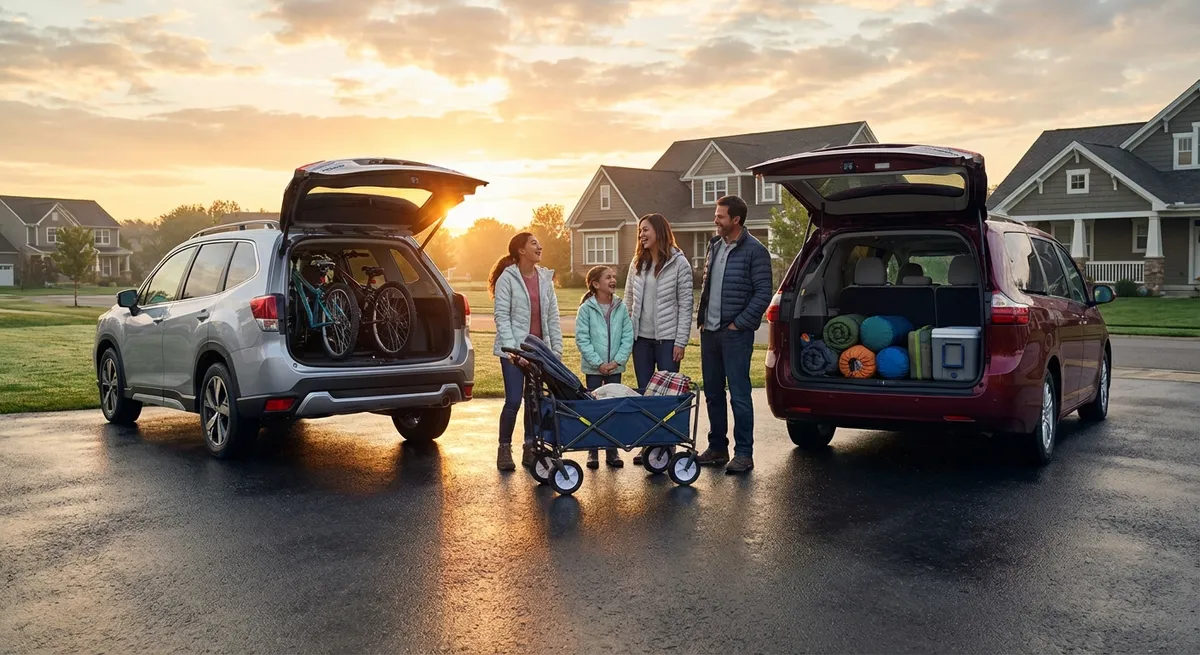
SUVs and wagons use conventional hinged doors. Wagons benefit from lower floor height and roofline, making it easier to lift items like bikes and boxes up and into the cargo area or onto a roof rack. SUVs, especially mid-size and larger, often require a higher lift to place a child in a car seat or load a heavy stroller. That said, the higher hip point in SUVs can be easier for adults with back or knee issues: you slide in laterally rather than stepping down.
Cargo management differs too. Minivans typically offer deep wells behind the third row, fold-flat or removable second-row seats, and multiple under-floor storage cubbies. This allows you to convert from people-mover to cargo van with minimal compromise. Many three-row SUVs fold seats flat, but the cargo floor can end up higher and less flexible for really bulky loads. Wagons lack third-row seats but often integrate clever tie-down points, rails, and partition nets, plus long, flat cargo floors ideal for outdoor gear and pets.
Weather and terrain considerations matter. SUVs with available all-wheel drive and added ground clearance are better suited to gravel roads, mild off-roading, and deep snow, though many wagons and minivans also offer AWD now. However, approach, departure, and breakover angles generally favor SUVs if you regularly encounter unpaved or rutted routes. Roof height also affects rooftop cargo-box usability; tall SUVs make cargo boxes harder to reach without a step stool, while wagon roofs are more accessible.
Usability takeaway:
- For frequent kid-hauling, car-seat juggling, and tight parking, minivan sliding doors and low floors are unmatched.
- For active-lifestyle users loading bikes, skis, or camera rigs, a wagon’s low load height and flat cargo floor are genuinely convenient.
- For mixed use including poor roads, snow, or light off-pavement driving, an AWD SUV still offers the most forgiving configuration.
5. Image, Cost of Ownership, and Long-Term Value
The decision isn’t purely rational; perception and long-term economics also shape what’s parked in driveways.
Image and stigma are powerful. SUVs have become the default aspirational choice in many markets, projecting versatility, status, and “readiness for anything,” even when most see only city streets. Minivans, by contrast, continue to fight a lingering “uncool” image despite being objectively better at family hauling. Wagons live at an intersection of niche enthusiasm and understated practicality; in some markets (Europe, parts of Asia), they are mainstream company cars, while in North America they remain somewhat cultish, especially performance-oriented variants.
Insurance costs, maintenance, and tire replacement can all skew higher for SUVs. Taller vehicles may use larger-diameter tires with lower profiles on upscale trims, increasing replacement cost and susceptibility to pothole damage. Complex AWD systems, adjustable suspensions, and off-road kits add components that must be maintained or can fail out of warranty. Minivans, built on high-volume platforms with fewer off-road pretensions, often have simpler suspension and drivetrain layouts that can lower running costs over time. Wagons tend to reflect the brand: a Subaru Outback’s ownership profile differs from, say, a high-end Audi allroad with adaptive air suspension and advanced driver assistance systems.
Depreciation patterns vary by region and brand. In the U.S., popular mainstream SUVs traditionally hold value well due to demand, but minivans from reliable brands also retain strong resale because there are fewer of them and they serve a clear purpose. Performance-oriented and luxury wagons may depreciate faster initially (as with many premium vehicles), but can become sought-after in enthusiast circles if they offer unique powertrains or unmatched long-roof practicality.
Safety perception vs. reality is another factor. While many buyers assume “bigger SUV equals safer,” modern minivans and wagons frequently achieve top safety scores from agencies like NHTSA and IIHS, including advanced crash-avoidance ratings. The real differentiator is often driver behavior; taller vehicles can encourage a false sense of invulnerability, while the best safety advantages come from properly used seatbelts, child-seat installations, and active safety tech, regardless of body style.
Ownership takeaway:
- If you value social image and mainstream appeal, an SUV will feel most aligned with market trends.
- If you prize rational value, low stress in family use, and potentially lower operating costs, minivans are compelling.
- If you’re an enthusiast who wants driving engagement plus practical long-haul cargo space, wagons remain the connoisseur’s choice.
Conclusion
SUVs dominate sales charts, but when you strip away badges and marketing language, the real question is: how do you use your vehicle day to day, and what trade-offs matter most?
- Choose a minivan if your top priorities are kid-friendly access, maximum usable space, and rational efficiency with three rows.
- Choose a wagon if you want car-like dynamics, better efficiency, and a low, long cargo area for gear—without needing seven seats or off-road branding.
- Choose an SUV if you need all-weather traction, extra ground clearance, broad powertrain choice (including rugged and EV options), and resonate with its image and versatility.
Understanding these differences will help you look past the “SUV by default” mindset and focus on the configuration that truly fits your family, driving style, and long-term ownership goals.
Sources
- IIHS – Vehicle Size and Safety – Explains how vehicle size, weight, and design affect crash outcomes and perceived safety.
- U.S. Department of Energy – Fuel Economy Guide – Official fuel economy data by vehicle class, useful for comparing SUVs, minivans, and wagons.
- NHTSA – 5-Star Safety Ratings – Federal crash-test ratings for specific models across different body styles.
- Toyota – 2024 Sienna Specifications – Real-world example of packaging, hybrid powertrain, and seating configuration in a modern minivan.
- Subaru – Outback Features & Specifications – Illustrates how a contemporary wagon/crossover hybrid packages cargo space, ground clearance, and AWD.
Key Takeaway
The most important thing to remember from this article is that this information can change how you think about Comparisons.