Whether you’re stepping up from a sedan or downsizing from a full-size truck, buying an SUV today is a high-stakes decision. Trims, tech packages, powertrains, and safety suites can quickly blur together, and a “good deal” on paper can turn into an expensive mistake once fuel, insurance, and depreciation show up in your monthly budget. This guide walks through the buying process with a focus on real-world ownership: how the vehicle will drive, cost, and hold up over the next 5–10 years, not just how it looks in a showroom or spec sheet.
1. Start With Use-Case Engineering, Not Just Lifestyle Marketing
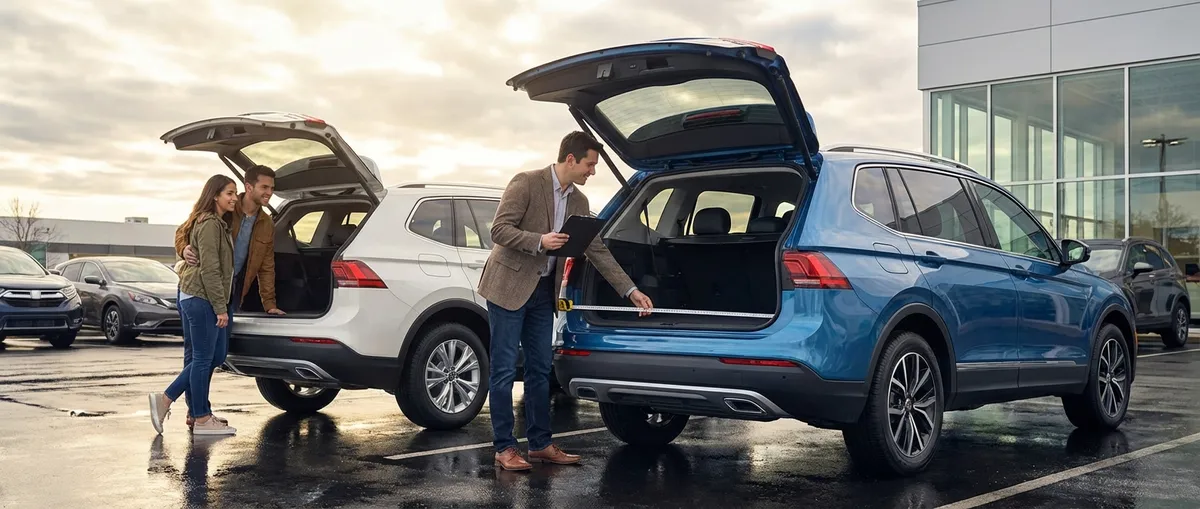
Before you look at badges or brochure photos, define what the SUV actually needs to do in measurable terms. Marketing language—“rugged,” “urban,” “family-focused”—is vague; use numbers instead. How many passengers must you seat regularly, and how tall are they? What’s the minimum cargo volume you need with seats up and down? How much weight will you tow, and how often? Clarifying the duty cycle (daily commute, weekend trail runs, cross-country road trips, towing, or mixed use) drives smarter choices than fixating on brand or styling from the start.
Translate this into hard constraints. For example, three across in the second row often demands wider midsize or full-size SUVs; families with rear-facing child seats need generous rear-seat legroom and door opening angles. Occasional light towing (a small trailer or pair of jet skis) may be fine with a 2,000–3,500 lb rated compact SUV; frequent towing near 5,000 lb or above calls for more robust platforms, upgraded cooling, and often rear- or four-wheel-drive architectures. Don’t forget your environment: steep grades, extreme heat or cold, unpaved roads, and frequent snow all place different demands on brakes, tires, and drivetrain.
From a practical standpoint, list your “non-negotiables” (e.g., all-wheel drive, top-tier crash-test scores, Apple CarPlay/Android Auto, heated seats in cold climates) separately from your “nice-to-haves” (panoramic roof, premium audio, ambient lighting). This matrix will help you eliminate otherwise attractive options that simply cannot meet key requirements, reducing the time you spend comparing SUVs that were never suitable in the first place. When you start filtering search results by objective needs rather than vibes, a far smaller set of vehicles emerges—and they tend to be the ones you’ll still like in five years.
2. Decode Platforms, Powertrains, and Drivetrain Layouts
Under the sheet metal, SUVs differ more than many buyers realize. The core architecture—unibody vs. body-on-frame, transverse vs. longitudinal engine layout, front- vs. rear-biased all-wheel drive—shapes everything from handling and ride quality to durability and towing capability. Understanding these fundamentals helps you avoid paying for capabilities you don’t need (like heavy off-road hardware for a commuter car) or underbuying in ways that limit what you can safely do (like towing near rated limits with a marginal powertrain).
Compact and midsize crossovers are typically unibody designs sharing platforms with cars, favoring ride comfort, fuel efficiency, and lighter weight. They often use transverse-mounted engines with front-wheel drive as standard and an on-demand all-wheel drive system that sends power to the rear only when needed. These systems are efficient and suitable for rain, light snow, and gravel roads, but generally have less ground clearance and weaker low-speed torque distribution compared with more truck-like setups. For serious off-road use, look for features like a two-speed transfer case, locking differentials, and robust underbody protection—capabilities more often found in body-on-frame SUVs and certain off-road-focused unibody models.
Powertrain choice has increasingly become a balancing act between complexity, performance, and efficiency. Turbocharged four-cylinders can deliver strong torque at low rpm, improving drivability and towing for their size, but they may run hotter under heavy loads and can be more sensitive to maintenance. Naturally aspirated V6 engines often offer smoother power delivery and less turbo lag, though at the cost of lower fuel economy. Hybrid and plug-in hybrid systems add electric torque that can dramatically improve city efficiency and low-speed drivability but introduce additional components—high-voltage batteries, inverters, dual-motor setups—that can affect long-term maintenance strategies and resale. Match engine and transmission selection to your most demanding regular use case, not the average day; a powertrain that feels only “adequate” when unloaded can feel overmatched when fully packed or towing uphill in hot weather.
3. Evaluate Safety and Driver-Assistance Systems With a Critical Eye
Most modern SUVs advertise advanced driver-assistance systems (ADAS), but the presence of features like adaptive cruise control or lane-keeping assist says nothing about their tuning quality or reliability in real traffic. Focus first on core crashworthiness, then on active safety tech layers that complement, not replace, an attentive human driver. Independent crash-test data from organizations like the Insurance Institute for Highway Safety (IIHS) and the National Highway Traffic Safety Administration (NHTSA) provides a much more objective safety baseline than brand marketing language.
Look for comprehensive ratings: frontal offset, side impact, roof strength, head restraints, and updated side-impact tests that better represent collisions with taller, heavier vehicles. Pay attention to pedestrian impact scores and headlight performance tests as well—good headlights and automatic emergency braking (AEB) with pedestrian detection can be particularly valuable in urban and suburban environments. If you routinely drive at night on unlit roads, high-beam assist and top-rated headlight systems can materially reduce fatigue and improve visibility.
For ADAS, test how the systems behave in your typical driving environment. Some adaptive cruise control setups brake and accelerate smoothly, while others feel abrupt, especially in stop-and-go traffic. Lane-centering can be helpful on highways but may ping-pong within the lane or misinterpret faded markings. Check whether important safety features are standard or locked behind higher trims and costly packages; relying on optional safety features can complicate your search and negotiation. Prioritize systems that have demonstrable safety benefits—AEB, blind-spot monitoring, rear cross-traffic alert, and robust airbag coverage—over more gimmicky features that add complexity without clear risk reduction. Ultimately, the best safety system is one that works unobtrusively in the background, enhancing rather than distracting from your driving attention.
4. Look Beyond MSRP: Total Cost of Ownership and Long-Term Durability
The sticker price is only the first chapter of what you’ll actually pay to own an SUV. Maintenance intervals, reliability history, fuel (or electricity) usage, insurance premiums, and depreciation all factor into the true total cost of ownership (TCO). Two vehicles with similar MSRPs can differ by thousands of dollars over 5–10 years once you account for repair frequency, parts pricing, and resale value. Long-term costs become especially critical if you plan to keep the SUV outside warranty coverage or drive high annual mileages.
Start with fuel or energy consumption. Use EPA ratings (where applicable) as a benchmarking tool, but interpret them as comparative rather than absolute—they’re performed under standardized conditions that may not mirror your driving style or climate. A small efficiency difference on paper between two SUVs can translate into hundreds of dollars per year at high mileages or high fuel prices. For plug-in hybrids or EV-based SUVs, factor in your local electricity rates, possible time-of-use pricing, and your access to home charging vs. reliance on faster but often more expensive public fast charging. Ownership cost calculators from trusted sources can help estimate fuel or energy costs over time based on your driving profile.
Reliability and maintenance are harder to see on a window sticker. Research common issues, recall history, and average repair costs for brand and model families from multiple sources. Pay attention to manufacturer schedules for items like timing belts, transmission fluid, spark plugs, and hybrid system components; longer intervals can reduce service visits but may carry larger single-visit costs if items are bundled. Consider warranty coverage and whether extended warranties or prepaid maintenance plans are priced fairly relative to the expected risk profile of the model. Depreciation, influenced by brand reputation, fleet sales, and market demand, can be one of the biggest hidden costs; SUVs with strong reputations for durability and demand often retain value far better, which matters whether you trade in after a few years or sell privately down the line.
5. Assess Cabin Ergonomics, Technology, and Build Quality in Person
Spec sheets rarely communicate how an SUV actually feels to live with day-to-day. Cabin ergonomics, visibility, noise levels, and control layouts directly affect fatigue and satisfaction, especially on longer trips. Once you’ve narrowed your shortlist using objective criteria, spend time inside each candidate with a critical checklist that mirrors real life: how you enter and exit, how you install child seats, how you load cargo, and how easily you can operate controls without looking away from the road.
Start with driving position and visibility. Can you achieve a comfortable, natural posture with sufficient adjustment range in the seat and steering wheel? Are crucial instruments visible without obstruction? Look for blind spots at the rear quarters and over-the-shoulder areas, and evaluate how well mirrors and camera systems compensate. Roof pillars have become thicker for safety reasons, which can hamper outward visibility; good camera resolution and intelligent sensor placement can help, but they shouldn’t be used as excuses for poor basic sightlines. Evaluate the second and third rows with all intended occupants, not just a quick sit—longer seat cushions, adequate thigh support, and realistic legroom matter on actual trips.
Infotainment and climate controls deserve equally close attention. Large touchscreens look impressive in press images but can be slow, confusing, or overly menu-driven in practice. Physical knobs and buttons for fundamental functions (volume, tuning, temperature, defrost) remain safer and more intuitive for many drivers. Test smartphone integration thoroughly: connect your phone, run your usual navigation and music apps, and check for lag, dropouts, and how the system handles calls and notifications. Observe material quality in high-touch areas (steering wheel, armrests, shifter, door pulls) and listen for squeaks, rattles, or wind noise during the test drive; these can be early indicators of build quality and aging behavior. Ultimately, the best SUV for you will be the one whose ergonomics, interface, and refinement disappear into the background, allowing you to focus on driving and passengers rather than wrestling with the technology.
Conclusion
Choosing the right SUV today demands more than scanning discounts or chasing the latest styling update. By starting with a clear, numbers-based use case, understanding foundational engineering choices, prioritizing proven safety performance, analyzing total cost of ownership, and rigorously evaluating real-world ergonomics and technology, you transform a complicated market into a structured decision. The goal is not just to buy an SUV that looks impressive on delivery day, but to select a vehicle that fits your life, budget, and driving demands for years to come. With a disciplined approach and credible data, you’ll be in a far better position to sign for an SUV that remains satisfying long after the new-car smell fades.
Sources
- Insurance Institute for Highway Safety (IIHS) – Ratings & Research – Detailed crash-test ratings, headlight evaluations, and safety technology assessments for SUVs and other vehicles.
- U.S. Environmental Protection Agency – Fuel Economy Guide – Official fuel economy, energy consumption, and annual fuel cost estimates for gasoline, hybrid, plug-in hybrid, and electric SUVs.
- National Highway Traffic Safety Administration (NHTSA) – 5-Star Safety Ratings – Government crash-test scores, recall information, and safety complaint data for current SUV models.
- Consumer Reports – Car Reliability & Owner Satisfaction – Long-term reliability trends, owner-reported problem areas, and satisfaction data across brands and segments.
- Kelley Blue Book – 5-Year Cost to Own – Comparative total ownership cost estimates, including depreciation, fuel, insurance, and maintenance for a wide range of SUVs.
Key Takeaway
The most important thing to remember from this article is that this information can change how you think about Buying Guide.