Choosing the right SUV today is less about picking what looks good in the showroom and more about making a strategic decision that fits your driving, your budget, your tech expectations, and your long‑term ownership plan. With dozens of models, powertrains, and trim combinations, guessing your way through the process is a fast track to buyer’s remorse.
This guide is built for SUV shoppers who want to think like pros: understanding the hardware, the software, the real‑world costs, and the timing that separates a good purchase from a great one.
1. Start With Use-Case Engineering, Not Just Size and Style
Before you look at badges or brochures, define the “job” your SUV must do in engineering terms. That means translating your lifestyle into measurable requirements instead of vague preferences.
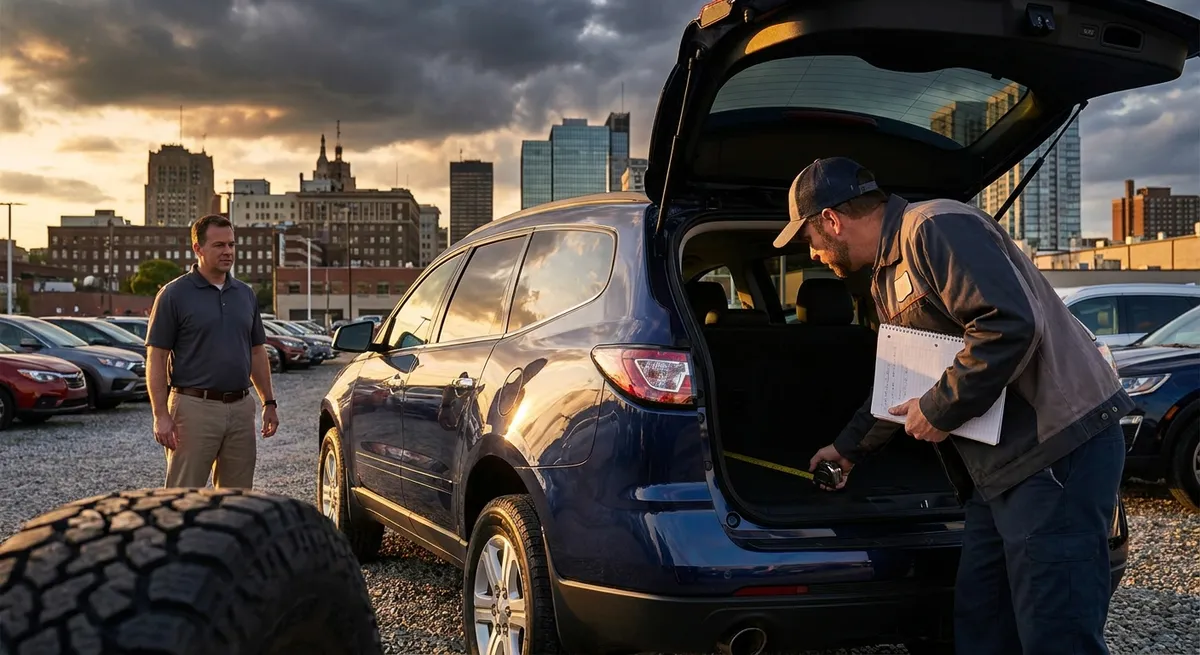
Begin with payload and passenger requirements. Count regular occupants, then add realistic cargo: strollers, pets, camera gear, sports equipment, or tools. Check the vehicle’s maximum payload rating (often between 1,000–1,600 lbs for many crossovers and midsize SUVs). A family of four plus luggage, bikes, or a cargo box can easily push a vehicle with a low payload rating toward its limit—especially on long trips.
Next, be honest about driving environment:
- Mostly city: Prioritize compact footprint, turning radius, visibility aids, and efficient powertrains (hybrid or downsized turbo).
- Mixed suburb/highway: Look for highway stability, sound insulation quality, adaptive cruise control, and lane-centering that actually works smoothly.
- Rural/off-pavement: Ground clearance (aim for 8+ inches for rougher tracks), underbody protection, approach/departure angles, and a real AWD system with a locking center coupling or rear locker if available.
Towing is another critical variable. Don’t just look at the headline tow rating—study gross combined weight rating (GCWR), tongue weight limits, and whether the manufacturer requires a factory tow package (upgraded cooling, wiring, hitch receiver) for maximum ratings. A 3,500 lb “rated” SUV may struggle with a 2,500 lb boat and gear in summer heat if it lacks the right package.
Finally, map these needs against body architecture:
- Unibody crossovers (most modern SUVs) offer better ride comfort, efficiency, and handling.
- Body-on-frame SUVs (traditional truck-based) excel in towing, durability, and severe use but usually ride firmer and use more fuel.
Defining these constraints first narrows your shopping list to vehicles that are technically capable of doing what you need—before style, brand, or features sway you.
2. Decode Powertrains and Drivetrains Like a Pro
Under the hood, modern SUVs offer a spectrum of technologies—naturally aspirated engines, small displacement turbos, plug‑in hybrids (PHEVs), full EVs, and sophisticated AWD systems. Understanding trade-offs here can save thousands over the life of the vehicle.
Naturally aspirated vs. turbocharged engines:
- Naturally aspirated engines often deliver smoother, more linear throttle response and can be less complex, which may correlate with fewer long‑term repair variables.
- Turbocharged engines provide more torque at lower RPM and often better official fuel economy. However, they can be more sensitive to maintenance (oil quality, heat cycling) and driving style. Real-world fuel economy may be worse than EPA numbers if you frequently use boost.
Hybrid and plug-in hybrid SUVs:
- Conventional hybrids: Best for heavy city driving and stop‑and‑go traffic. They recapture braking energy, and their engines spend more time in efficient operating ranges.
- Plug‑in hybrids (PHEVs): Ideal for those who can charge at home and have daily driving within the electric range (often 20–40 miles). If you mostly drive within that window, you can drastically reduce fuel use. If you don’t plug in regularly, you’re mainly hauling extra battery weight for limited benefit.
Evaluate battery and electric motor specs for PHEVs and EVs:
- Battery capacity (kWh) directly impacts electric range.
- Motor output (kW) influences performance and towing capabilities.
- Check whether the towing rating is reduced or prohibited in EV or EV‑only mode for PHEVs.
AWD/4WD systems vary significantly:
- On-demand AWD (often with a front-biased system): Typically uses an electronically controlled clutch to send torque rearward when slip is detected. Good for light snow and rain, less ideal for sustained off‑road use.
- Full-time AWD with center differential: More robust, often with better torque distribution and stability in varying conditions.
- Part-time 4WD with low range: Found in more serious off‑road SUVs; includes a dedicated low gear for crawling and rough-terrain control.
If you live in a snow belt or drive on unpaved roads, look for systems with multiple terrain modes, hill descent control, and, where available, rear or center locking differentials. These features provide tangible benefits beyond marketing terms like “intelligent” or “dynamic” AWD.
3. Evaluate Chassis, Suspension, and Braking Beyond the Brochure
Once you’re confident in powertrain choice, turn your attention to what actually keeps the SUV composed on real roads: chassis architecture, suspension tuning, and braking hardware.
Wheelbase and track width influence stability and comfort. A longer wheelbase generally improves highway ride but can hurt maneuverability in tight city streets or parking garages. Wide track width improves lateral stability but may make narrow trails or older urban streets challenging.
Look closely at suspension design:
- MacPherson struts in front / torsion beam in rear: Common in smaller, cost‑sensitive crossovers. Simpler and cheaper, but may compromise ride and handling when loaded.
- Multi-link rear suspension: Usually found on more sophisticated platforms—improves comfort, grip, and composure over uneven surfaces.
- Adaptive dampers and air suspension: Offer variable ride height and stiffness. Great for balancing comfort and dynamics, but they introduce higher complexity and potentially more expensive out-of-warranty repairs.
Pay attention to brake sizing and configuration:
- For heavier SUVs, especially those used for towing or mountain driving, look for larger brake rotors and, ideally, ventilated discs on both axles.
- Vehicles that share hardware with heavier pickups or performance models may have more robust braking systems.
- If possible, check whether the model offers an upgraded tow or performance brake package—these can improve safety significantly on long descents or with trailers.
During test drives, evaluate:
- Brake pedal feel: Is initial bite predictable? Does the pedal feel spongy when hot?
- Body control: How much does the SUV pitch under acceleration/braking or roll in corners? Does it recover quickly, or feel “boaty”?
- Noise, vibration, and harshness (NVH): Listen for wind noise around mirrors and pillars, tire roar on coarse pavement, and resonance from the rear cargo area.
This is where the difference between a budget-focused and a well-engineered SUV often becomes very obvious—especially after an extended test drive over rough surfaces and highways, not just a short loop around the dealer.
4. Audit Technology, Safety, and Connectivity With a Future-Proof Lens
Modern SUVs are rolling software platforms. A rushed decision here can lock you into outdated interfaces, limited updates, or half-baked driver assistance systems for a decade.
Start by mapping the advanced driver assistance systems (ADAS):
- Verify that the SUV offers automatic emergency braking, lane keep assist, blind-spot monitoring, rear cross-traffic alert, and adaptive cruise control at the trim level you’re considering—not just on the top-spec model.
- Distinguish between lane departure warning (beeps/shakes) and lane centering (actively keeps you centered in the lane). The latter is far more valuable for long drives, but implementations vary widely in smoothness and reliability.
Ask whether the vehicle supports over-the-air (OTA) updates. This can significantly extend the life and capabilities of the infotainment and even some driver assistance features, correcting bugs and occasionally adding functionality without a dealer visit.
Connectivity and interface considerations:
- Check for wireless Apple CarPlay and Android Auto, not just wired.
- Test UI responsiveness: Does the screen lag? Are menus logical? Physical knobs for volume and climate are still critical for usability while driving.
- Look at instrument cluster flexibility (digital vs. analog) and how clearly it presents navigation, ADAS status, and energy/fuel information.
For EVs and PHEVs, scrutinize charging ecosystem and software:
- Can you plan charging routes in the native navigation?
- Does the vehicle integrate with major charging networks?
- Is there an app that shows charging status, allows preconditioning, and remote lock/unlock?
From a safety standpoint, verify whether the SUV has been tested by NHTSA and IIHS (in the U.S.) or equivalent agencies in your region. Seek models with:
- Top crash-test ratings
- Good or better headlight ratings
- Strong performance in updated, more stringent tests (like small overlap frontal, pedestrian collision avoidance, and side-impact revisions)
Treat the tech and safety suite as a long-term platform decision, not a gadget checklist. What feels like a “nice to have” today—like lane centering or OTA updates—can be a must‑have five years into ownership.
5. Master Total Cost, Timing, and Negotiation Strategy
The right SUV at the wrong price or on the wrong terms is still a bad deal. Approach the financial side with the same strategic rigor.
First, build a realistic total cost of ownership (TCO) model, not just a monthly payment target:
- Depreciation: Some brands, trims, and powertrains hold value better than others. Models with strong resale history, fleet demand, or loyal enthusiast followings tend to depreciate more slowly.
- Insurance: Request quotes on 2–3 finalists; safety scores, repair costs, and theft rates can make a meaningful difference.
- Maintenance and repairs: Compare recommended service intervals, transmission fluid changes, and hybrid/EV-specific maintenance. Check whether the brand includes complimentary scheduled maintenance for a set period.
- Fuel or energy costs: Use EPA or equivalent ratings and your local fuel/electricity prices to estimate annual spend based on your mileage.
Timing your purchase can also influence pricing and selection:
- Model-year changeovers: Dealers may discount outgoing models, but confirm whether the new model year adds safety tech or structural changes you care about.
- Quarter-end or year-end: Sales targets can create additional room for negotiation, especially on in-stock inventory.
- New competitor launches: When a rival introduces a compelling SUV, incentives sometimes appear on existing segment players.
When it’s time to negotiate, separate the deal into clear components:
- Vehicle price: Know invoice pricing, market trends, and any factory incentives. Tools that track real transaction prices in your region are invaluable here.
- Trade-in value: Get multiple independent offers (online buyers, local used dealers) before stepping into a showroom. Use the best written offer as leverage or a fallback.
- Financing/lease terms: Pre-arrange financing with your bank or credit union. This gives you a benchmark and prevents the dealer from hiding price concessions inside a longer term or higher rate.
Scrutinize the F&I (finance and insurance) office add-ons:
- Extended warranties, paint protection, and “appearance packages” are high-margin products for dealerships. Evaluate extended coverage only after understanding the brand’s reliability record, typical repair costs, and your planned ownership duration.
- For complex systems (air suspension, high-voltage batteries, advanced infotainment), a manufacturer-backed extended warranty can be worth considering if priced fairly—but avoid third-party plans of unclear reputation.
By the time you sign, you should be confident not just in the SUV’s capabilities, but in the long‑term financial framework of owning it.
Conclusion
Buying an SUV today demands more than comparing cargo space and sticker prices. The smartest buyers start by engineering their needs, then dissect powertrains, chassis tuning, and tech platforms with an eye toward real-world use and future relevance. They back that up with a disciplined look at total cost and timing, treating the purchase as a long‑term system decision rather than an impulse upgrade.
Approach your next SUV like a strategic project: define the mission, evaluate the hardware and software, and negotiate from a position of knowledge. The result isn’t just the right vehicle in your driveway—it’s years of confident driving with far fewer surprises along the way.
Sources
- [U.S. Department of Energy – Fuel Economy Guide](https://www.fueleconomy.gov/feg/findacar.shtml) - Official EPA fuel economy data for comparing gasoline, hybrid, plug‑in hybrid, and electric SUVs
- [National Highway Traffic Safety Administration (NHTSA)](https://www.nhtsa.gov/ratings) - Crash-test ratings, safety recalls, and defect investigations for SUVs and other vehicles
- [Insurance Institute for Highway Safety (IIHS)](https://www.iihs.org/ratings) - Independent crashworthiness, crash avoidance, and headlight evaluations, plus detailed test methodologies
- [Consumer Reports – Car Reliability & Owner Satisfaction](https://www.consumerreports.org/cars/car-reliability-owner-satisfaction-guide/) - Long-term reliability trends, owner satisfaction data, and maintenance considerations across SUV brands and models
- [Edmunds – True Cost to Own](https://www.edmunds.com/tco.html) - Breaks down depreciation, insurance, fuel, maintenance, and financing to estimate total cost of ownership for specific SUV models
Key Takeaway
The most important thing to remember from this article is that this information can change how you think about Buying Guide.