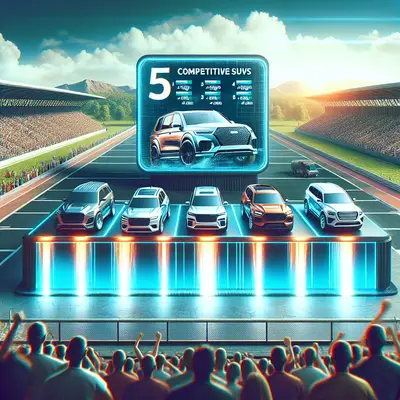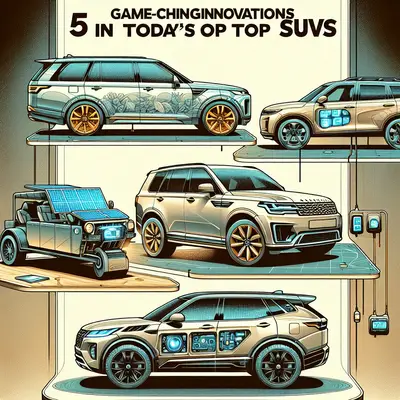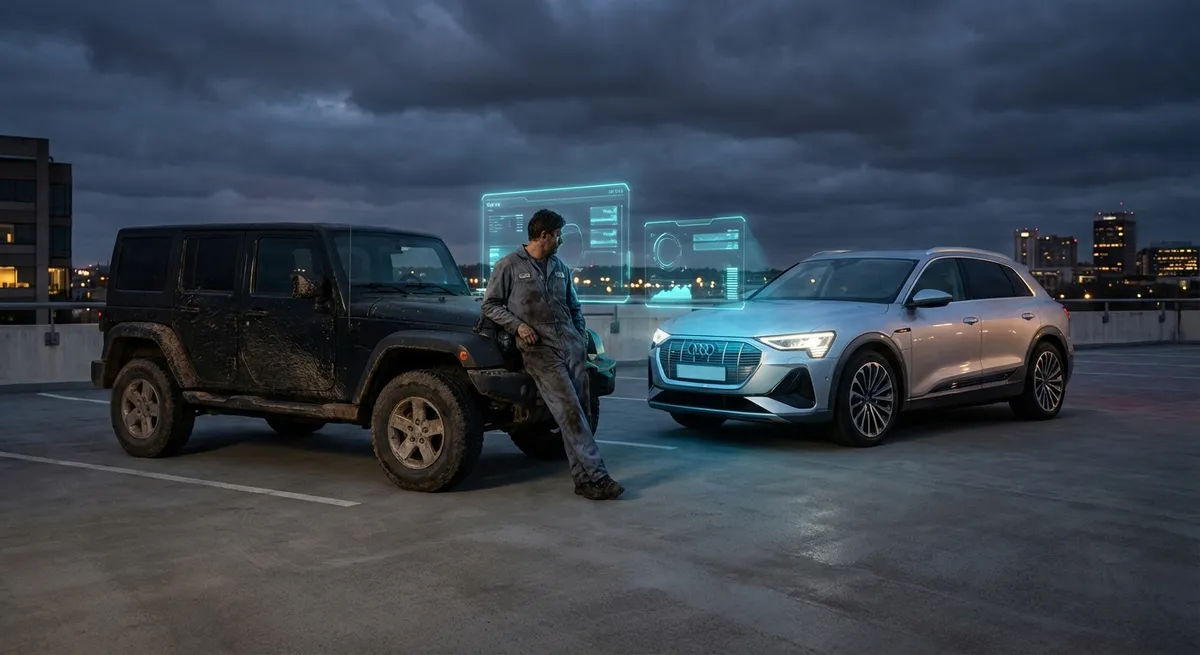
The SUV market has split into two clear camps: models built primarily for driving enthusiasts and models built as rolling technology platforms. Both can be comfortable, safe, and practical—but the priorities under the sheet metal are very different. For shoppers comparing two or three contenders, understanding whether an SUV is tuned for “torque” (performance, dynamics, powertrain feel) or “tech” (screens, software, automation) is crucial to making the right choice for how you actually drive and live.
This comparison framework focuses on five key areas that separate driver‑focused SUVs from tech‑centric SUVs so you can line up your shortlist and see which side of the spectrum each model truly belongs to.
1. Powertrain Character: Real-World Performance vs. Spec Sheet Bragging Rights
When comparing SUVs, it’s tempting to go straight to peak horsepower and 0–60 mph times. For an enthusiast, those numbers matter—but only in context. The way an SUV delivers its power, its usable torque band, and its thermal management strategy can matter more in daily driving than the absolute top figure.
Driver‑oriented SUVs typically prioritize throttle response and linear torque delivery. Turbocharged gasoline engines may be tuned for quick spool and a broad torque plateau, often starting as low as 1,600–2,000 rpm. Performance hybrids and plug‑in hybrids may blend an electric motor’s immediate torque with an engine tuned for higher‑rpm power, yielding strong mid‑range acceleration for highway merging and passing.
Tech‑centric SUVs, especially heavier battery‑electric SUVs, often deliver huge torque numbers but rely on software to smooth or limit that torque for comfort and efficiency. You’ll see features like multi‑stage drive modes, “one‑pedal” driving calibrations, and aggressive torque vectoring by software replacing traditional mechanical differentiation. For some buyers, the smooth, silent surge is ideal; for others, the lack of engine personality is a drawback.
When you compare contenders, go beyond peak horsepower and ask:
- At what rpm is peak torque available, and how flat is the curve?
- Does the transmission use a traditional torque‑converter automatic, dual‑clutch, CVT, or direct drive (EV)? Each changes the feel.
- How does the SUV behave with a full cabin, cargo, or a trailer? Pay attention to sustained power output and cooling capacity, not just short bursts.
- Is the powertrain tuned for high efficiency, high performance, or a middle ground—with what trade‑offs in noise, vibration, and harshness?
Understanding these nuances helps differentiate an “SUV that feels alive” from an “SUV that looks quick on paper but filters everything through software.”
2. Chassis Dynamics: Ride Quality, Handling, and the Weight Penalty
Modern SUVs span a huge range of curb weights—from under 3,700 pounds for compact ICE crossovers to well over 6,000 pounds for three‑row electric or plug‑in hybrid models. How that mass is managed is where driver‑focused vs. tech‑focused philosophies really diverge.
Driver’s SUVs typically prioritize chassis tuning and suspension hardware. Expect firmer springs, more aggressive damper calibration, and often performance‑oriented options like adaptive dampers, active anti‑roll bars, rear‑wheel steering, or mechanical limited‑slip differentials. Steering will usually be more direct, with faster ratios and less isolation, even if it allows some road texture to reach the wheel.
Tech‑centric SUVs often prioritize ride isolation and quietness, using adaptive air suspension, softer bushings, and active noise cancellation to create a “cocooned” experience. Battery‑electric SUVs have a low center of gravity due to underfloor battery packs, aiding cornering stability, but they still carry large amounts of inertia. To compensate, manufacturers may use complex software‑controlled dampers and brake‑based torque vectoring instead of more communicative mechanical solutions.
When comparing two SUVs, focus on:
- Suspension layout (MacPherson strut vs. double wishbone vs. multi‑link) and whether it offers adaptive dampers or air springs.
- Tire choice and wheel size; low‑profile tires deliver sharper response but more impact harshness and road noise.
- Brake hardware (rotor size, multi‑piston calipers, cooling design) and brake‑by‑wire systems, especially in hybrids and EVs where regenerative braking tuning can change pedal feel.
- Real curb weight and weight distribution; similar power on a lighter, better‑balanced chassis often feels more engaging and controllable.
If you enjoy spirited driving on back roads, prioritize transparent steering feel and controlled body motions. If you prioritize long‑distance comfort, seek out SUVs that emphasize isolation and low noise with well‑tuned adaptive suspensions.
3. Cabin Experience: Analog Controls vs. Screen‑Dominated Interfaces
Side‑by‑side interior comparisons quickly reveal whether an SUV was conceived for people who love driving or people who love digital interfaces. Automakers are aggressively consolidating functions into central touchscreens, but their execution varies dramatically.
Driver‑centric cabins usually retain more physical controls for core tasks: climate control, drive modes, volume, and frequently used driver‑assistance features. Gauge clusters may blend analog‑style layouts with digital displays, prioritizing speed, engine/motor status, and navigation prompts. Seat design emphasizes lateral support, proper thigh bolstering, and a driving position that provides a clear view of the hood and road without forcing you to rely on cameras.
Tech‑heavy cabins lean on large, often portrait‑oriented central displays, minimal physical buttons, and multiple secondary screens (passenger displays, rear‑seat entertainment, or extended instrument clusters). Haptic sliders, touch‑sensitive steering wheel controls, and deep menu hierarchies allow more features but can increase cognitive load. Over‑the‑air (OTA) update capability is a key differentiator here; tech‑focused SUVs treat the cabin as a software platform that can change significantly over time.
Key comparison points:
- Screen size, resolution, and brightness—especially under direct sunlight.
- Presence (or absence) of key physical controls for HVAC, seat heaters, defrost, drive modes, and audio.
- Input methods: rotary controller, touch, voice, steering‑wheel buttons, or a combination.
- Support for Apple CarPlay/Android Auto (wired or wireless) versus a proprietary ecosystem.
- OTA update support for both infotainment and vehicle systems—and whether updates can be deferred or scheduled.
For enthusiasts who want to keep eyes on the road, a simpler, more tactile interface may win out over the flashiest screen count. For tech‑oriented buyers, deep integration with digital services, high‑bandwidth connectivity, and OTA upgrades may be the decisive factors.
4. Driver Assistance and Safety Systems: Co‑Pilot vs. Driving Coach
Advanced driver‑assistance systems (ADAS) are now a major comparison point, but the philosophy behind them differs between driver’s SUVs and digital flagships. Both prioritize safety, yet the intent—augmenting the driver vs. partially replacing them—feels distinct.
Driver‑focused SUVs often implement ADAS as a “driving coach.” Lane‑keeping assist, adaptive cruise control, blind‑spot monitoring, and forward collision warning are tuned to be supportive but relatively unobtrusive. Systems may default to modest intervention, allowing more driver control over lane positioning and following distance. Performance‑oriented trims sometimes offer configurable stability control and traction modes that permit a degree of slip while still providing a safety net.
Tech‑centric SUVs present ADAS as a “co‑pilot” or even a proto‑autonomous system. Expect more sophisticated sensors (high‑resolution radar, LiDAR in some cases, driver‑monitoring cameras, and high‑definition maps) and features like hands‑free highway assist, automated lane changes, and traffic jam assist with stop‑and‑go. These systems can reduce fatigue, but they rely heavily on driver understanding of operational limits—something many owners underestimate.
Elements to evaluate closely:
- Sensor suite: radar only, radar + camera, LiDAR, ultrasonic, and where they’re located.
- Whether the system is SAE Level 2 (driver must supervise) and under what conditions it’s designed to operate (highways only, divided roads, low‑speed traffic).
- How the vehicle communicates system status and hand‑off requests (instrument graphics, steering‑wheel lights, haptic feedback).
- Frequency and intrusiveness of warnings; oversensitive lane‑keeping systems can become a daily annoyance.
- The extent to which features are locked behind subscription fees or tiered packages, which impacts long‑term value.
Buyers should test these features during extended test drives, not just brief dealership loops, to see whether the assistance aligns with their driving style or feels like a constant override.
5. Long-Term Ownership: Battery, Software, and Mechanical Durability
Enthusiasts and informed buyers increasingly compare SUVs not just as they leave the showroom but as they’ll feel at 80,000 miles. Here again, “torque” vs. “tech” priorities drive very different ownership profiles.
Driver’s SUVs, especially those with more traditional powertrains, may emphasize robust mechanical components: proven engines, conservative boost pressures, heavy‑duty transmissions, and cooling systems designed for towing or track use. Service intervals, access to parts, and independent repairability are important comparison points. Performance‑oriented models can come with higher‑cost consumables—tires, brakes, and synthetic fluids—but the underlying platforms may be more tolerant of long‑term wear and spirited use.
Tech‑centric SUVs pivot the conversation toward battery longevity, electronics robustness, and software support. For EVs and PHEVs, examine battery chemistry (e.g., NMC vs. LFP), thermal management (liquid‑cooled vs. air‑cooled packs), and DC fast‑charging profiles—sustained fast‑charge rates vs. initial peaks that quickly taper. OTA capabilities can extend feature life and fix bugs, but they also mean your SUV’s behavior may change with updates, sometimes impacting range, performance, or interface logic.
Important comparison factors:
- Warranty coverage gaps between powertrain, high‑voltage components, and electronics (infotainment, ADAS hardware).
- Documented battery degradation rates (from owner data where available) and manufacturer guidance on DC fast‑charging frequency.
- Availability and cost of hardware upgrades (e.g., replacement packs, infotainment modules, sensor recalibration) outside warranty.
- Software support horizon: how long the manufacturer commits to security patches, map updates, and app compatibility.
- Towing, off‑road use, and severe‑duty limitations that can affect warranty coverage for both mechanical and high‑voltage components.
If you plan to keep your SUV for a decade or more, bias your comparison toward platforms with strong evidence of mechanical or electro‑mechanical durability, transparent battery‑care guidance, and a clear software‑support roadmap.
Conclusion
Comparing SUVs today isn’t simply about size, price, and fuel type. It’s about deciding where you want to fall on the spectrum between a “driver’s SUV” that emphasizes powertrain character, chassis feel, and mechanical engagement, and a “digital SUV” that leans into screens, connectivity, and semi‑automated driving.
By evaluating powertrain character, chassis dynamics, cabin interface design, driver‑assistance philosophy, and long‑term durability through this lens, you can see past marketing tags and spec‑sheet noise. Line up your candidates, decide whether torque or tech matters more to you, and choose the SUV whose underlying priorities truly match the way you drive—and the way you want to live with your vehicle for years to come.
Sources
- U.S. Department of Energy – Fuel Economy & Emissions Data - Official efficiency, range, and powertrain data for comparing gasoline, hybrid, PHEV, and EV SUVs
- National Highway Traffic Safety Administration (NHTSA) – 5‑Star Safety Ratings - Crash test results and safety ratings to compare structural safety and ADAS performance
- Insurance Institute for Highway Safety (IIHS) – Ratings & Research - Independent crashworthiness, crash‑avoidance, and headlight performance evaluations for SUVs
- SAE International – Levels of Driving Automation - Authoritative explanation of ADAS/automation levels used by SUV manufacturers
- U.S. Department of Energy – Battery Technology and Thermal Management - Technical background on EV/PHEV battery chemistries, cooling strategies, and durability considerations
Key Takeaway
The most important thing to remember from this article is that this information can change how you think about Comparisons.