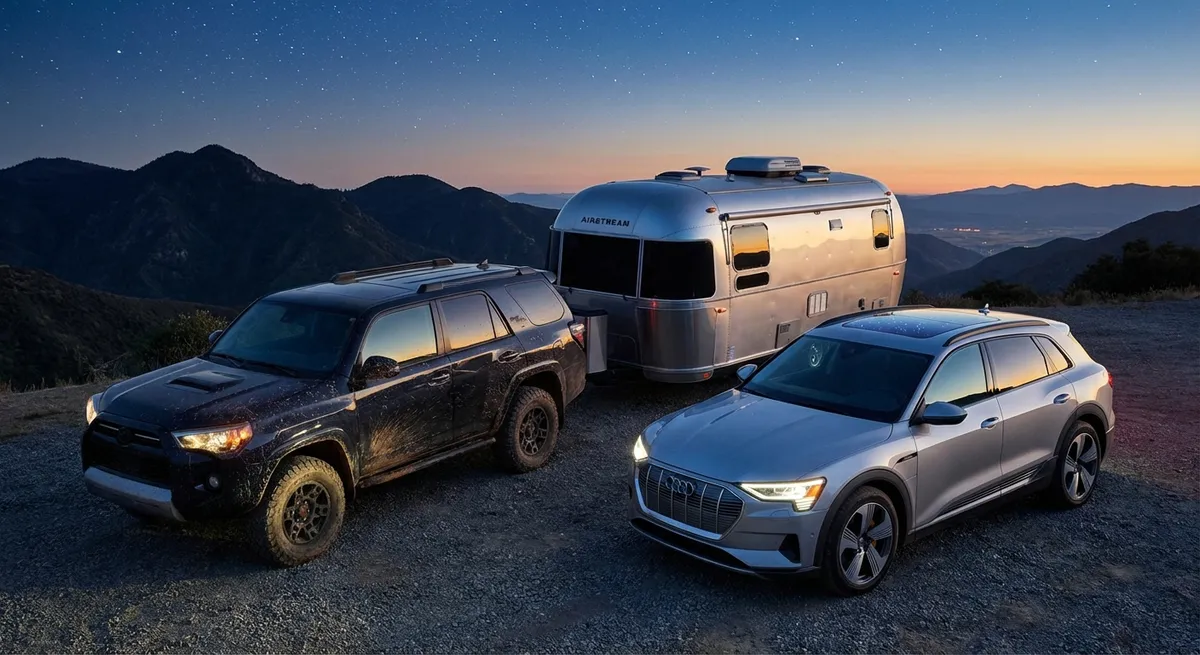
SUVs are no longer a single, catch‑all category. Under the same “utility vehicle” label, you’ll find machines engineered to haul 7,000-pound trailers and others optimized to operate as rolling, software-rich lounges. For shoppers and enthusiasts, that split is critical: choosing between a towing-focused SUV and a tech-lux, comfort-oriented model has major implications for performance, costs, and daily usability.
This comparison doesn’t crown a universal winner. Instead, it breaks down how these two SUV philosophies differ in engineering, capability, and ownership experience so you can align your next purchase with how you actually drive and what you need to tow, carry, or connect.
Performance Character: Torque Curves vs Seamless Power Delivery
Towing-focused SUVs (think body-on-frame designs like Chevrolet Tahoe, Ford Expedition, or Toyota Sequoia) are tuned around accessible torque and thermal robustness. You’ll typically find:
- High-displacement engines or boosted V6s engineered to deliver peak torque low in the rev range (often 2,000–3,000 rpm), ideal for getting a loaded trailer moving uphill.
- Transmission calibrations with more aggressive torque-converter lockup, shorter lower gears, and tow/haul modes that hold gears longer to limit hunting on grades.
- Larger cooling systems (radiators, transmission coolers, sometimes separate engine-oil coolers) to sustain power delivery at high loads in hot conditions.
Tech-lux focused SUVs (common among premium crossovers from BMW, Mercedes-Benz, Audi, Lexus, and Genesis) tilt the engineering in a different direction:
- Turbocharged four- and six-cylinder engines, and increasingly hybridized or fully electric powertrains, prioritize smooth, quiet power and in-gear responsiveness rather than sheer tow capacity.
- Multi-mode drivetrains with adaptive throttle mapping and adjustable dampers that optimize for comfort, efficiency, or sportiness rather than heavy hauling.
- Electric SUVs offer instantaneous torque and strong passing power, but their tow ratings and sustained high-load performance are limited by battery thermal management and range constraints.
For drivers who rarely tow but appreciate brisk, refined acceleration and handling, a tech-lux crossover often feels more agile, quieter, and more composed in everyday driving than a heavier, ladder-frame tow rig. Enthusiasts will notice differences in steering feel, body control, and willingness to change direction, particularly on winding roads.
Chassis & Drivetrain: Body-on-Frame Strength vs Unibody Precision
The fundamental architecture of the SUV determines not only refinement but also how it handles load, impacts, and long-term durability.
Towing-oriented SUVs typically use:
- Body-on-frame construction, where the body sits on a separate ladder or boxed frame. This design isolates road and trailer impacts from the cabin and is well-suited to distributing hitch and payload loads.
- Solid rear axles or heavy-duty independent rear suspensions engineered for higher gross axle weight ratings (GAWR) and higher gross vehicle weight ratings (GVWR), often with stout coil or leaf springs.
- Rear-wheel-drive-based platforms with available two-speed transfer cases (4HI/4LO) to manage off-road or low-speed, high-load conditions like boat ramps or steep driveways.
Tech-lux SUVs are typically:
- Unibody crossovers, where the body and frame are a single structure, enhancing rigidity and precision. This allows for more sophisticated crumple zones and often lower curb weights for equivalent interior space.
- Equipped with independent suspensions at all four corners, frequently with multi-link rear designs and optional air springs or adaptive dampers for enhanced comfort and handling.
- Built on front-wheel-drive-based or dedicated EV platforms with advanced stability control and torque vectoring, tuned more for on-road dynamics than extreme utility.
For enthusiasts, the distinction shows up in feel: body-on-frame SUVs may exhibit more secondary motions and less sharp turn-in but feel unflappable with a load attached. Unibody, tech-lux models respond more crisply, with less flex and more sports-sedan-like behavior—but will reach structural and suspension limits sooner when heavily loaded.
Cabin Technology & Driver Assistance: Trailering Tools vs Connected Cockpits
In-cabin technology has diverged alongside these engineering paths. Towing-focused SUVs increasingly integrate trailering support tools, while tech-lux SUVs push boundaries in connectivity, automation, and infotainment.
Trailering-focused tech commonly includes:
- Integrated trailer brake controllers and selectable trailer profiles that manage gain and braking distribution.
- Multiple camera views (hitch view, surround view, bed/trunk view, and “transparent trailer” modes) that improve hitching accuracy and situational awareness.
- Tow/haul drive modes that interact with adaptive cruise control and downshift strategies to maintain safe speeds on descents and when passing.
- Trailer sway control that uses braking and engine torque reduction (coordinated with stability control) to damp oscillations when crosswinds or sudden maneuvers destabilize the trailer.
Tech-lux SUVs emphasize a different set of priorities:
- Large, high-resolution central touchscreens and configurable digital instrument clusters, often with augmented-reality navigation overlays and head-up displays.
- Expansive driver-assistance suites—adaptive cruise with lane-centering, automatic lane-change systems, and hands-free highway driving in some models—targeting long-distance comfort.
- Deep smartphone integration (Apple CarPlay/Android Auto, wireless charging, multiple USB-C ports), premium audio systems, and subscription-based connected services for remote control, diagnostics, and over-the-air updates.
For buyers, the key is deciding whether advanced towing visualization and control features matter more than, say, a leading-edge semi-automated driving suite. If you plan to haul a camper across states, hitch cameras and trailer sway mitigation may be more valuable than a curved OLED display and gesture controls. Conversely, if your daily grind is urban commuting and highway road trips with no trailer in sight, the tech-lux cockpit will feel far more rewarding.
Utility Metrics: Towing, Payload, and Cargo vs Range, Comfort, and Efficiency
On paper specs can quickly reveal which SUV philosophy you’re looking at. Utility-centric and tech-lux SUVs prioritize very different metrics.
Towing-centric SUVs usually deliver:
- Higher tow ratings, commonly in the 7,000–9,000+ lb range, supported by corresponding GCWR (gross combined weight rating) and cooling systems.
- Strong payload ratings, often 1,500–2,000+ lb, to handle passengers, cargo, and tongue weight without exceeding GVWR.
- Squarer cargo areas and higher rooflines, making them better suited for bulky gear, large dog kennels, and vertically stacked cargo.
- Available heavy-duty options—max tow packages, load-leveling suspensions, off-road packages—that further enhance their capability envelope.
Tech-lux SUVs tilt toward:
- Moderate tow capacity, typically 3,500–5,000 lb for many crossovers, with some high-performance or hybrid models rated even lower or not rated at all for towing.
- Lower payload ratings, especially in EVs where heavy battery packs eat into gross weight allowances. This becomes critical when loading multiple adults, luggage, and (if towing is allowed) trailer tongue weight.
- More sculpted interiors, lower cargo floors, and power-operated features (hands-free liftgates, power-folding seats), favoring convenience and comfort over maximum volume.
- Stronger emphasis on fuel economy or energy efficiency, often with advanced powertrains and aerodynamic optimization that benefit commuters more than haulers.
Enthusiasts should pay close attention to the full spectrum of ratings: not just maximum tow numbers, but GVWR, GCWR, GAWR, tongue-weight limits, battery thermal limits (for EVs), and, crucially, how much capacity remains once passengers and gear are on board. If you like to pack heavy or modify your vehicle, these margins matter.
Ownership Economics: Upfront Price, Running Costs, and Long-Term Use Cases
Choosing between a towing-focused SUV and a tech-lux model also means committing to different cost structures and long-term usage profiles.
Towing-oriented SUVs generally involve:
- Higher fuel consumption, especially with larger displacement engines and less aerodynamic profiles. Regular heavy towing can dramatically reduce real-world mpg compared with EPA ratings.
- Potentially higher maintenance loads for components like brakes, transmissions, and tires if you tow at or near max capacity regularly, as these systems work harder under load.
- Strong value retention in markets where towing and off-road capability are prized, especially for models with proven reliability reputations and fleet or commercial appeal.
- More straightforward upgrade paths—heavy-duty hitches, brake controllers, suspension enhancements—often supported by OEM accessories and a well-developed aftermarket.
Tech-lux SUVs come with a different balance:
- Higher base prices driven by premium materials, complex electronics, and advanced driver assistance systems. However, day-to-day running costs can be lower if you value fuel/energy savings and mostly drive unladen.
- Potential for software-defined ownership, where features (enhanced navigation, advanced autonomy, performance modes) may be unlocked via subscriptions, affecting long-term cost of ownership.
- More sensitivity to technological obsolescence; infotainment and driver-assist features can date quickly, although over-the-air updates mitigate this for some brands.
- In the case of EVs and hybrids, lower routine maintenance (fewer moving parts, regenerative braking) but higher out-of-warranty exposure for battery or complex electronics if issues arise.
Matching the vehicle to your realistic use patterns is the most cost-effective strategy. If you tow several times a month or haul heavy loads for work or recreation, the fuel penalty of a towing-focused SUV is often outweighed by its capability and durability. If towing is a once-a-year event and your life is mostly urban or suburban, a tech-lux crossover—or even an EV SUV with modest tow capacity—will likely feel better to drive and cheaper to live with over time.
Conclusion
Today’s SUV market is defined less by size labels and more by engineering intent. On one side stand towing and utility specialists built around body-on-frame strength, cooling capacity, and robust drivetrains. On the other are tech-lux crossovers and EVs optimized for comfort, connectivity, and efficient performance rather than brute hauling power.
Car enthusiasts and serious shoppers should start the comparison by asking a few hard questions: How often will I tow, and how heavy? Do I value steering precision and cabin tech over maximum trailer stability? How much am I willing to spend on fuel or electricity, and what does my real-world use look like? Once those priorities are clear, the specs and engineering choices behind each SUV quickly reveal which camp truly fits your driveway—and your driving life.
Sources
- U.S. Department of Transportation – Towing a Trailer Safely - Explains key concepts like GVWR, GCWR, tongue weight, and safe towing practices relevant to evaluating SUV capability
- SAE International – J2807 Trailer Weight Rating Standards - Technical overview of the industry standard many manufacturers use to rate SUV towing capacity
- U.S. Department of Energy – Fuel Economy Guide - Provides fuel-economy data for SUVs, useful for comparing towing-focused models vs tech-lux crossovers and EVs
- Chevrolet – Trailering and Towing Guide - Example of how a major OEM structures towing packages, ratings, and trailering technologies on SUV-based platforms
- BMW – Driving Assistance and ConnectedDrive Overview - Illustrates the type of advanced driver assistance and connectivity features common in tech-lux SUV segments
Key Takeaway
The most important thing to remember from this article is that this information can change how you think about Comparisons.