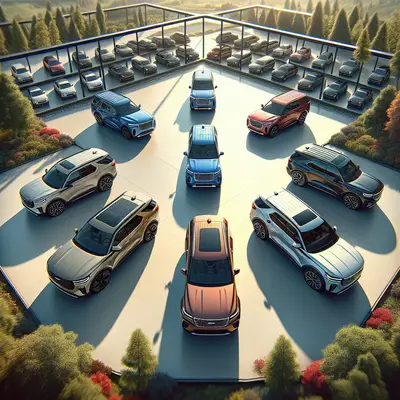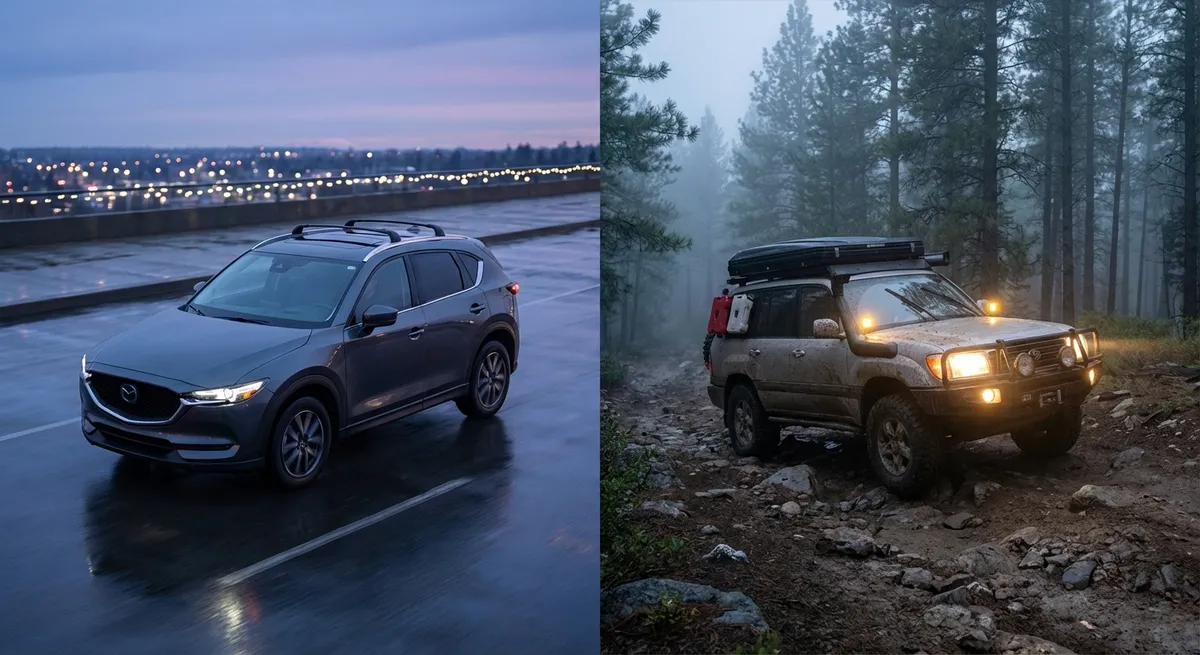
Picking an SUV today is less about size and more about purpose. Two buyers can spend the same money and end up with completely different vehicles: one optimized for city commuting and school runs, the other built to chase trailheads and remote campsites. Understanding these “mission profiles” — urban-focused vs. adventure-oriented SUVs — is critical if you want performance, comfort, and value that actually match how you drive.
This comparison breaks down five core areas where these two SUV philosophies diverge, with enough technical detail to help enthusiasts and buyers look beyond brochures and marketing buzzwords.
1. Platform and Chassis: Unibody Comfort vs. Body-on-Frame Strength
Under the styling and tech, the basic architecture of an SUV heavily influences how it behaves on the road and off it. Most urban-focused SUVs ride on unibody platforms, often shared with passenger cars or crossovers. The body and frame are a single structural unit, which allows for a lower curb weight, better rigidity for handling, and improved crash energy management. For daily use, this translates to more controlled body motions, sharper steering response, and a generally quieter, smoother ride.
Adventure SUVs, especially those serious about off-road capability, more often employ a body-on-frame design. The body is bolted to a separate ladder or boxed frame, similar to a pickup truck. This architecture handles twisting loads, heavy towing, and impacts from off-road use better, because the frame absorbs and distributes stress independently from the passenger shell. The trade-off is extra mass, higher step-in height, and more flex, which can blunt on-road handling.
Some of the most capable modern off-roaders combine body-on-frame construction with long-travel suspension, skid plate protection, and reinforced mounting points for accessories like winches and steel bumpers. Meanwhile, high-end urban SUVs lean into aluminum-intensive unibodies, multi-link rear suspensions, and extensive sound-deadening to elevate refinement.
When comparing candidates, check the manufacturer’s specifications for platform details, curb weight, and intended use. If your driving is 95% pavement, a well-engineered unibody platform will feel more precise, efficient, and premium. If you routinely tow, carry heavy loads, or drive on broken terrain, a body-on-frame SUV can withstand that abuse longer with fewer structural compromises.
2. Drivetrain Strategy: On-Demand Traction vs. Full-Time Control
Urban SUVs typically prioritize efficiency and ease of use in their drivetrains. Many come standard with front-wheel drive (FWD) and offer optional on-demand all-wheel drive (AWD). These systems often use an electronically controlled clutch to send power to the rear wheels only when slip is detected or preemptively during acceleration. The benefit is reduced parasitic loss and better fuel economy in normal driving, as the vehicle can essentially behave like a FWD platform most of the time.
Adventure-oriented SUVs generally move toward rear-wheel drive (RWD) or full-time four-wheel drive (4WD) layouts. Rear-biased systems can handle higher torque loads, which is valuable for towing and off-road climbing. Serious 4WD setups incorporate a two-speed transfer case with low-range gearing, allowing the vehicle to multiply torque at very low speeds for crawling over rocks, ruts, or steep inclines. These systems often include mechanical or electronically locking differentials to prevent wheelspin when traction is uneven.
Another distinction lies in the traction control and drive mode calibration. Urban AWD configurations emphasize all-weather safety—tuning stability control, ABS, and throttle response for wet pavement and snow. Adventure SUVs add modes for sand, mud, rocks, and deep snow, which adjust torque distribution, transmission shift points, throttle mapping, and sometimes suspension height to maintain traction in challenging conditions.
For buyers, the key questions are: Do you actually need a low-range transfer case? Will you be towing near the upper limits of the vehicle? If your world is mostly highways, suburban streets, and the occasional dirt road, a sophisticated AWD system is more than enough and will be cheaper to run. But if you plan to push into technical terrain, the robustness and low-speed control of a true 4WD drivetrain become more than just a spec sheet detail—they become your safety margin.
3. Suspension and Tires: Road Manners vs. Terrain Versatility
Suspension tuning is where the contrast between urban and adventure SUVs often feels the most obvious from the driver’s seat. City-oriented models favor independent suspension setups at both ends—MacPherson struts or double wishbones in front and multi-link designs in the rear. These are calibrated for body control in quick maneuvers, reduced dive and squat under braking and acceleration, and a planted feel at highway speeds. Spring and damper rates are chosen to balance comfort with agility, and bushings are typically softer to filter out road harshness.
Adventure SUVs, in pursuit of ground clearance, articulation, and durability, often use longer-travel suspension and sometimes solid rear axles. A solid axle is better at maintaining traction across uneven surfaces because both wheels are linked mechanically, though it can feel less refined over small bumps at speed. Long-travel shocks, progressive bump stops, and heavy-duty bushings are designed to handle repeated impacts and suspension cycling without fading or overheating.
Tire choice further amplifies these differences. Urban SUVs usually ship with all-season or touring tires focused on low rolling resistance, wet grip, and quiet operation. Their sidewalls are relatively low-profile on larger wheels to improve steering response and aesthetics, but this also makes them more vulnerable to damage on rough surfaces.
Adventure SUVs lean into taller sidewall all-terrain tires with more aggressive tread blocks and reinforced construction. These absorb impacts better, provide bite on loose surfaces, and resist punctures, but they add noise, reduce fuel efficiency, and can dull steering precision. Some models even accommodate downsized wheel options to allow for more sidewall height, which is crucial off-road.
To compare realistically, look at published ground clearance, approach/departure/breakover angles, and wheel/tire specifications. If you daily-drive in dense traffic and park tightly, the firmer, more responsive suspension and lower-profile tires of an urban SUV will feel more composed. If your weekends involve washboard roads, ruts, or rocky trails, the compliance, travel, and tire robustness of an adventure SUV pay off in both performance and reduced damage risk.
4. Interior Packaging: Cargo Flexibility vs. Rugged Utility
Cabin design reveals a lot about what an SUV is meant to do. Urban-focused SUVs maximize passenger comfort, tech integration, and quietness. Thicker acoustic glass, multiple layers of insulation, and active noise cancellation are common. Dash layouts prioritize large infotainment screens, ambient lighting, and premium materials like soft-touch plastics, leather, and metal accents. Second-row comfort, USB-C ports, and rear climate vents receive as much attention as the driver’s seat because these vehicles often double as family shuttles.
Adventure SUVs still provide comfort—modern buyers demand it—but their interiors typically incorporate more hard-wearing surfaces and modular storage. You’ll see rubberized flooring in cargo areas, tie-down points, 12V or 120V power outlets, and sometimes embedded rails or latches designed for securing gear, coolers, and recovery equipment. Seat upholstery may be chosen for durability and cleanability rather than pure luxury, with options like synthetic leather or water-resistant textiles. Switchgear for locking differentials, hill descent control, and terrain modes is often grouped in a dedicated off-road control panel for quick access.
Cargo strategy differs as well. Urban SUVs often split their priorities between maximum passenger space and a relatively flat cargo floor for strollers, luggage, and shopping. Third-row seating, when available, is usually intended for occasional use and packaged to fold flat electrically for convenience. Adventure SUVs, by contrast, pay more attention to load length, roof load limits, and accessory mounting points. Some offer factory upfitter support for roof racks, awnings, and overlanding gear, or integrated mounting provisions for cargo barriers and drawer systems.
When comparing models, examine not just total cargo volume but also the shape of the space, the presence of lashing points, and the payload rating. A high-luxury urban SUV might offer a beautiful cabin that wears quickly under camping and hauling duty. A more utilitarian adventure SUV may feel less plush but will be easier to hose out, retrofit, and live with when loaded with dirty equipment.
5. Ownership Profile: Operating Costs, Reliability, and Resale
Beyond performance and comfort, the long-term costs and behavior of these SUV types diverge in meaningful ways. Urban SUVs, with lighter unibody construction, generally deliver better fuel economy, especially in hybrid or downsized turbocharged configurations. Their drivetrains are optimized for stop-and-go efficiency, with features like automatic stop-start, aggressive cylinder deactivation, and smart alternator control. Scheduled maintenance often focuses on fluid changes and software updates rather than heavy-duty mechanical service.
Adventure-oriented SUVs, by nature of their design and mission, can be more resource-intensive to own. Body-on-frame construction, low-range transfer cases, locking differentials, and heavier axles mean more components that require inspection and lubrication, especially after off-road use. Aggressive all-terrain tires wear faster and cost more to replace. Additional weight and less aerodynamic shapes also increase fuel consumption. However, if you truly use their capabilities—towing a camper, tackling trails, or operating in regions with poor roads—they can be more reliable in those conditions than a lighter-duty crossover pushed beyond its design envelope.
Resale values also track with how closely owners match use cases. Urban SUVs from reputable brands with strong dealer networks and proven reliability records tend to hold value in metro markets, particularly hybrids and fuel-efficient models as fuel prices fluctuate. Adventure SUVs from brands with a deep off-road heritage often command strong resale even with higher mileage, as their buyer base values durability and capability and is more tolerant of cosmetic wear.
For potential buyers, comparing the total cost of ownership means considering insurance (larger, more powerful SUVs can cost more to insure), expected mileage, fuel type, and maintenance intervals. Study warranty coverage closely: some manufacturers specifically address off-road use, corrosion protection, and drivetrain components in ways that reflect the intended mission of the vehicle.
Matching your choice to your reality is where the real “comparison” pays off. An adventure SUV used only for urban commuting can feel like overkill—more cost, less comfort. An urban SUV forced into frequent heavy towing or serious off-road duty can age prematurely and cost more in repairs. Align the platform, drivetrain, and interior with the daily and occasional demands you genuinely expect.
Conclusion
Choosing between an urban-focused and an adventure-oriented SUV is less about image and more about physics, engineering, and honest self-assessment. Platform design, drivetrain configuration, suspension tuning, interior packaging, and long-term ownership costs all reflect a vehicle’s true mission profile. Enthusiasts and careful buyers who look beyond marketing labels like “crossover” or “off-road package” and instead evaluate the underlying hardware will end up with a vehicle that feels right every time they turn the key—or press the start button.
Whether your world is defined by tight parking garages and long commutes or gravel roads and trailheads, understanding these foundational differences will help you select an SUV that performs as advertised, protects your budget, and remains satisfying to drive for years to come.
Sources
- [U.S. Department of Energy – Fuel Economy: Vehicle Types](https://www.fueleconomy.gov/feg/findacarhelp.shtml#vehicleTypes) - Explains differences in vehicle categories, including SUVs and crossovers, and how design affects efficiency
- [NHTSA – Vehicle Types and Structural Design](https://www.nhtsa.gov/vehicle-safety) - Provides safety and structural information relevant to unibody vs. body-on-frame designs
- [Car and Driver – AWD vs. 4WD Explained](https://www.caranddriver.com/research/a31875109/awd-vs-4wd/) - Technical breakdown of all-wheel drive and four-wheel drive systems and their intended use
- [Consumer Reports – SUV Reliability and Ownership Costs](https://www.consumerreports.org/cars/suvs/) - Data-driven assessments of SUV reliability, maintenance, and total cost of ownership
- [SAE International – Fundamentals of Automotive Design](https://www.sae.org/publications/books/content/r-548/) - Engineering-focused resource on vehicle architecture, including chassis and suspension principles
Key Takeaway
The most important thing to remember from this article is that following these steps can lead to great results.