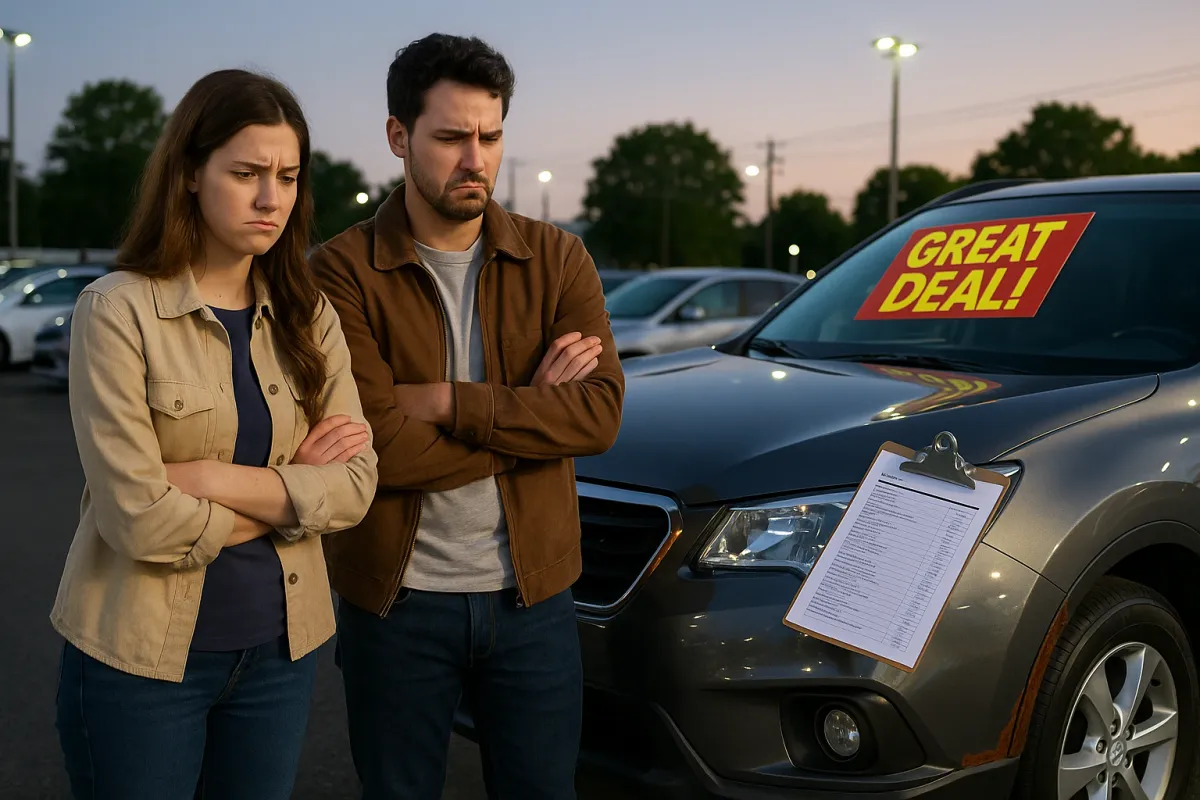
Scrolling through the viral “Real Estate Listings From Hell” gallery, it’s hard not to wince: bizarre layouts, hidden structural problems, and listing photos that feel like red flags wrapped in bad lighting. But those same patterns of “this looked fine online, then wow, absolutely not” show up every day in the used SUV market—just with higher stakes and bigger repair bills.
If you’re hunting for a pre-owned SUV right now, the same instincts that help you spot a nightmare house online can help you avoid a money pit in your driveway. With used prices still elevated in many markets and inventory tight in popular segments, buyers are tempted to move fast and overlook the details. That’s exactly how you end up with a vehicle that looked like a deal on Autotrader or Facebook Marketplace but becomes your personal version of a “listing from hell.”
Below are five detailed, technically grounded checkpoints—directly inspired by the chaos people are sharing from nightmare real estate listings—that you should apply before signing for any used SUV.
1. “Listing Photos From Hell”: Read the Ad Like a Forensic Inspector
In the same way those viral real estate posts show cluttered rooms, odd camera angles, and suspiciously cropped photos, many used SUV listings are telling you what the seller doesn’t want you to see.
Start by dissecting the photos and the description:
- Watch for strategic cropping. If the rear bumper, lower door sills, or underbody are never shown, assume there may be rust, impact damage, or poorly repaired accident damage. On body-on-frame SUVs (e.g., Toyota 4Runner, Chevy Tahoe, Ford Expedition), frame rust in the rear can be a four-figure fix—or a deal-breaker.
- Look for panel color mismatch and reflections. Different shades between doors and fenders, or wavy reflections in the paint, can indicate body filler under the surface. On unibody crossovers (Honda CR‑V, Toyota RAV4, Hyundai Tucson), bad repairs in structural areas can compromise crash safety.
- Note “too dark” or over-edited photos. Just like a dimly lit bathroom listing screams “what are you hiding?”, SUV photos taken at dusk, indoors with poor lighting, or with heavy filters might be concealing interior wear, cracked dashboards, or headliner stains from past leaks.
- Compare the description to the odometer. A 7-year-old SUV with 120,000 miles and the words “like new” should raise an eyebrow. At this mileage, you should expect visible wear on the driver’s seat bolsters, steering wheel, and pedal pads—and major maintenance (spark plugs, transmission or differential fluids, maybe suspension components) should be documented.
- Be skeptical of vague language. Phrases such as “just needs a little TLC,” “runs and drives,” or “AC probably just needs a recharge” are listing-hell equivalents of “unique fixer-upper with potential.” AC systems often need compressors, condensers, or evaporators—not a $60 recharge.
Treat the listing like a negotiation preview. If the ad is honest and detailed—maintenance records, VIN, number of keys, tire brand and age, list of recent work—that’s the “well-photographed, clean, logically laid-out home” of SUV ads. If it feels chaotic or evasive, walk away or lower your expectations (and your offer).
2. “Bad Bones vs. Cosmetic Fixes”: Learn Which SUV Problems Matter Most
Viral real estate nightmares are often about bad “bones”: foundation cracks, mold behind the walls, or electrical horror shows. In SUVs, the same idea applies. Distinguish between problems that are mostly cosmetic, and those that say “this thing is structurally or mechanically tired.”
Cosmetic issues that are usually manageable:
- Curb rash on alloy wheels
- Light door dings and normal paint chips
- Minor seat wear or headliner marks
- Old but functional infotainment (no CarPlay/Android Auto, etc.)
- Worn but still-safe tires (you can budget for replacements)
These can be leveraged for negotiation. Parts like interior trim, seat covers, and even upgraded head units are widely available, especially for popular models (RAV4, CR‑V, Rogue, Highlander, Explorer).
“Bad bones” issues you should treat like a cracked foundation:
- Rust in structural areas.
- Look at the rear subframe, suspension mounting points, rocker panels, and frame rails. Surface rust is normal in snowy climates; flaking, bubbling, or perforation is not.
- On older unibody crossovers (e.g., first-gen Nissan Rogue, some older Mazda CX‑5s in rust belt states), heavy subframe rust can require replacement and intensive labor.
- Transmission problems.
- Delay engaging when shifting from Park to Drive or Reverse, harsh or “flaring” shifts under light acceleration, or slipping at highway speeds all suggest internal wear.
- CVT-equipped SUVs (older Nissan Rogue, Murano, some Mitsubishi Outlander trims) are especially costly if neglected. A used CVT without fluid-change history should be approached with caution.
- Cooling and oil issues.
- Overheating, sweet smells from the engine bay, or coolant “mayo” in the oil cap can signal head gasket or internal corrosion issues.
- Blue smoke from the exhaust, especially at startup or after idling, means you’re entering engine-rebuild territory.
- Electrical gremlins.
- Modern SUVs are packed with control modules for AWD systems, ADAS (lane-keep, adaptive cruise), power liftgates, and digital dashboards. Multiple warning lights (ABS, AWD, airbag, check engine) lighting up together during a test drive can signify network or module problems—not just a bad sensor.
If you’re on a tight budget, prioritize strong mechanicals over appearance. A mechanically sound SUV with dated wheels and a few scratches is equivalent to a house with an ugly kitchen but perfect structure: you can live with it, improve it over time, and it won’t collapse on you.
3. “Layout Nightmares”: Match the SUV’s Packaging to Your Actual Life
Real estate “listings from hell” often feature baffling layouts—bathrooms opening into kitchens, bedrooms with no windows, or stairs to nowhere. SUVs have their own version of bad layout: seating and cargo configurations that simply don’t work in real life, even if they looked fine on paper.
Before you commit to any used SUV, pressure-test its layout against how you truly live:
- Third-row usability vs. marketing.
- Many 3-row crossovers (Toyota Highlander, Kia Sorento, VW Tiguan with 3rd row) offer seats that are technically there but realistically for kids only. If you routinely carry adults, test the third-row legroom and headroom yourself.
- Pay attention to how you access that third row—do second-row seats tilt and slide easily with child seats installed? Some designs make it nearly impossible.
- Cargo floor height and shape.
- If you haul strollers, bikes, or dogs, a high cargo floor (common in plug-in hybrid SUVs with battery under the rear) or strongly sloped rear glass can be a daily frustration.
- Fold the rear seats yourself; check if the floor is flat or stepped. Boxy SUVs like Honda Pilot, Subaru Forester, and Toyota 4Runner often win here.
- Seat ergonomics and driving position.
- Some sporty crossovers (Mazda CX‑5, Hyundai Tucson N Line) have more bolstered seats and lower seating positions. Great for enthusiasts, less so for tall drivers with back issues or frequent highway trips. Test lumbar support and thigh support over at least a 20–30 minute drive.
- Child-seat and family logistics.
- Look for full LATCH positions and top-tether anchors across the bench. Many SUVs offer only two full LATCH setups, which complicates three-kid setups.
- Test door opening angles and how easy it is to help a child in a car seat without contorting yourself.
- Tech layout and distraction.
- Older infotainment systems might rely more on buttons and knobs—often a good thing for ease of use. Some newer systems moved climate controls into touchscreens, which can be annoying and distracting on the move. Try adjusting temp, fan speed, and nav while driving at low speed in a safe area.
Shopping used means you can’t change the fundamental layout later. Just as you can’t easily move the kitchen in a townhouse, you can’t magically create third-row legroom or a deeper cargo well in a compact SUV. Get hands-on and treat a test sit like a walk-through of a house: imagine a week in your life and rehearse it in the vehicle.
4. “Hidden History”: Use Data Tools Like You’d Pull Permit Records on a House
People sharing real estate horror listings often dig up old listing photos, permit records, and satellite images to uncover what happened to a property over time. You should bring the same investigative mindset to a used SUV’s past.
Don’t stop at a single vehicle history report:
- Run multiple VIN checks when possible.
- A Carfax or AutoCheck report is a minimum, but they’re not omniscient. Not all body shops or small insurers report repairs. Look for patterns: multiple owners in a short time, repeated emission test failures, or frequent auction appearances are warning signs.
- Pull service history from brand dealers.
- Many brands (Toyota, Honda, Hyundai, Subaru, Ford) can print or show service history tied to the VIN if the vehicle has been serviced at franchised dealerships. This can reveal critical items:
- Timing belt or chain-related work
- Transmission and differential fluid changes
- Hybrid battery or inverter work
- Recalls and TSB (Technical Service Bulletin) completions
- Check for open recalls.
- Use the NHTSA VIN lookup (U.S.) or your country’s equivalent. Some recalls—airbags, fuel pump, rear-view camera failures—still await completion on older SUVs and can be repaired for free at a dealer.
- Decode the build sheet.
- Many manufacturers provide a build sheet or window-sticker archive by VIN. This helps you confirm trim level (important for resale), safety packages (blind-spot monitoring, ACC, lane-keep assist), and towing package contents (aux transmission cooler, hitch rating, upgraded radiator).
- Inspect for evidence of flood or severe accident damage.
- Look for silt under seats, corrosion on seat brackets, moisture in headlamps and taillights, and mismatched interior hardware. Flooded SUVs often land far from their original titled regions after major storms, with “clean” titles but long-term electrical nightmares.
Treat the SUV’s history like pulling blueprints and permits on a home. You’re not just buying what you can see today—you’re inheriting years of use, maintenance choices, and sometimes neglect. The more you can verify on paper, the less you’re rolling the dice.
5. “Inspection Day”: Bring a Pro, Not Just a Flashlight
The real estate listings that go most viral are the ones where a professional inspection would have saved a buyer incredible pain: load-bearing walls cut, DIY wiring, or structural rot cleverly concealed. A pre-purchase inspection (PPI) is the automotive equivalent, and it’s non-negotiable for any used SUV that isn’t still under strong factory warranty.
What a proper PPI for an SUV should include:
- Lift inspection:
- Undercarriage rust, oil leaks, transmission leaks, differential seepage, and exhaust system condition.
- Suspension play at the control arms, ball joints, tie rods, and bushings. Many crossovers need new struts/shocks and bushings around 80–120k miles.
- Brake and tire health:
- Measure pad thickness and rotor condition. A full brake job (pads, rotors, possibly calipers) on a larger SUV can easily approach $800–$1,500.
- Check tire brand, tread depth, age (DOT date), and pattern. Uneven wear patterns can indicate bad alignment, worn suspension, or accident repairs.
- Powertrain diagnostics:
- Scan for stored or pending fault codes in engine, transmission, ABS, and chassis systems. Some issues don’t light the dashboard yet.
- Evaluate cold start behavior, idle quality, and performance under load. Hesitation, misfires, or vibrations under acceleration warrant deeper diagnosis.
- AWD/4WD system function:
- Verify transfer case and rear differential operation on AWD and 4WD SUVs. Binding, clunking, or warning lights when engaging different modes (Auto, 4H, 4L, Lock) can lead to expensive repairs.
- On crossovers with electronic coupling rear axles (RAV4, CR‑V, many others), listen for rear-end noises and check for leaks.
- ADAS and electrical testing:
- Confirm that adaptive cruise, lane-keep assist, blind-spot monitoring, parking sensors, and cameras all function correctly. Modern driver-assistance calibration after a minor fender-bender can cost hundreds.
- Test every window, door lock, interior light, HVAC mode, rear wiper, and liftgate. Electrical troubleshooting on a feature-heavy SUV can quickly spiral in labor cost.
Budget $150–$300 for a thorough inspection by an independent shop that understands your specific brand. That’s far cheaper than discovering you need a $3,000 transmission or $2,500 rust repair a month after purchase. Just as you wouldn’t close on a 30-year mortgage without a home inspection, don’t finance or pay cash for a used SUV based purely on a quick test drive and a friendly seller.
Conclusion
The exploding popularity of “Real Estate Listings From Hell” isn’t just entertaining—it’s instructive. Every shocking photo and horror-story caption is a reminder that big purchases demand ruthless attention to detail. The used SUV market in 2025–2026 is exactly the same: plenty of genuinely good vehicles out there, but also a surprising number of polished disasters waiting for a rushed buyer.
If you read listings skeptically, separate cosmetic flaws from structural problems, test the layout against your real life, dig into the vehicle’s history, and invest in a professional inspection, you dramatically lower your risk of buying a rolling money pit. In a market where clean, well-maintained SUVs still hold strong value, those habits are your best protection—and the difference between a smart long-term purchase and your own personal “listing from hell” parked in the driveway.
Key Takeaway
The most important thing to remember from this article is that this information can change how you think about Buying Guide.