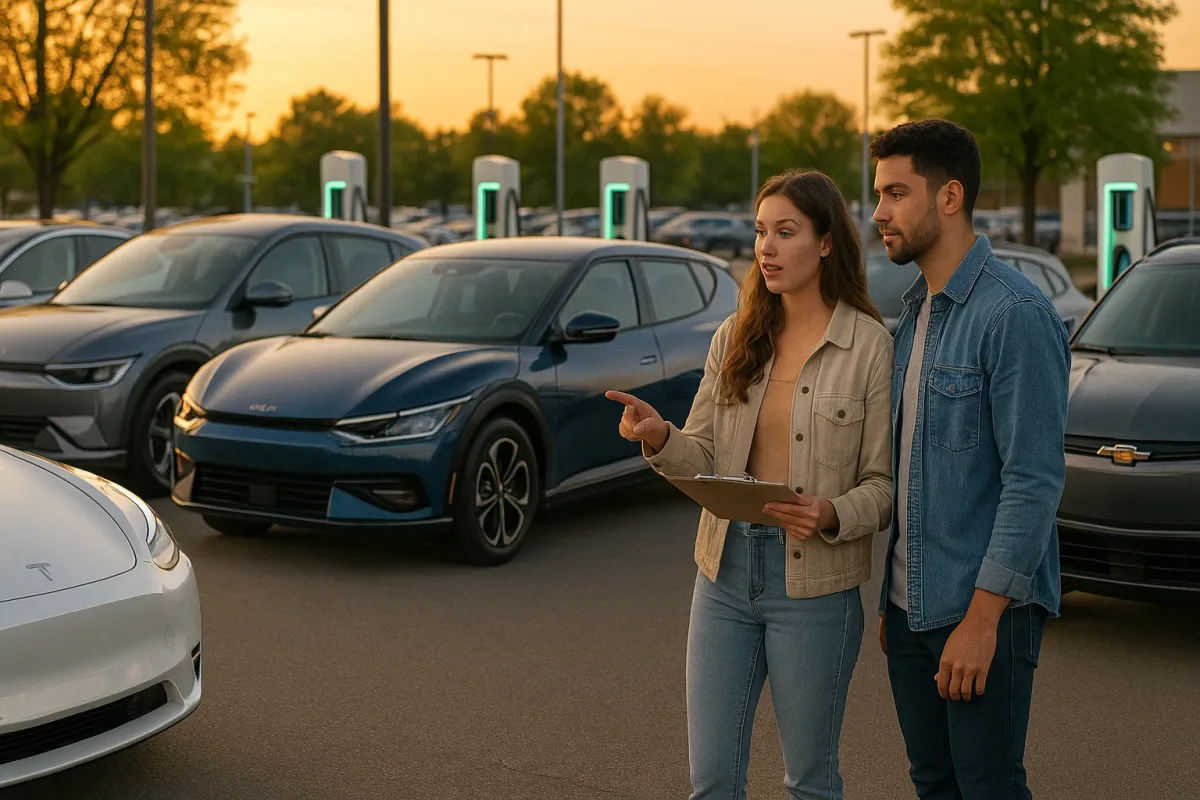
The EV SUV race just intensified. With Tesla updating the Model Y, Hyundai’s Ioniq 5 N grabbing headlines for its performance, Ford continuing to tweak the Mustang Mach-E, and GM rolling out its Ultium-based SUVs like the Chevy Blazer EV and Cadillac Lyriq, shoppers are facing a very different comparison landscape than even a year ago. What used to be a “Tesla vs. everyone else” question has become a genuinely competitive segment with real trade-offs in range, charging, tech, and value.
If you’re trying to decide which electric SUV deserves your deposit today—not in some undefined future—this breakdown aligns what’s in the headlines right now with what actually matters in your driveway. Below, we compare key players on five critical fronts: real-world range, charging speed, driving dynamics, interior tech, and price/value.
Real-World Range: How Far You Really Go Between Charges
Range still drives most EV purchase decisions, and the current news cycle shows why. Tesla continues to lead in efficiency, and despite ongoing speculation about a deeper Model Y refresh, its existing lineup remains a benchmark. A dual-motor Model Y Long Range is EPA-rated around 330 miles, but in mixed real-world driving many owners report 270–300 miles if you’re not constantly at 80+ mph or in sub-freezing weather. Tesla’s advantage comes from an efficient motor/inverter package, low drag coefficient, and tight integration of software with thermal management.
Hyundai’s Ioniq 5 and Kia’s EV6—often mentioned together because they share the E-GMP platform—typically offer 250–310 miles depending on battery and drive configuration. The upcoming performance-oriented Ioniq 5 N, heavily covered in recent auto news, sacrifices some range (expect closer to 230–250 miles in spirited driving) for power and track capability. These Korean EVs are less efficient than Tesla at highway speeds but still competitive, with the added benefit of ultra-fast charging to compensate.
Ford’s Mustang Mach-E sits in the middle of the pack. Depending on trim, the extended-range RWD model hovers around 300 EPA miles, while dual-motor versions drop somewhat. Recent software updates and incremental tweaks have focused on improving drivability and charging curve more than outright EPA range. Expect roughly 230–280 realistic miles for most trims under normal conditions.
GM’s latest Ultium-based SUVs—Chevrolet Blazer EV, Equinox EV (as it rolls out), and Cadillac Lyriq—are designed to hit strong range numbers but are still ramping up availability. Early Lyriq models are rated in the 300-mile ballpark, with the Blazer EV variably targeting around 247–324 miles depending on configuration. Initial media drives indicate they are competitive but not class-leading in efficiency, especially at higher speeds where weight and aero start to show.
Takeaway:
- Prioritize range above all else? Tesla Model Y and Cadillac Lyriq are strong contenders.
- Need “good enough” range with performance or style? Ioniq 5 N, EV6 GT, and Blazer EV can be compelling if your daily use is under 200 miles and you have home charging.
Charging Speed And Network: Where Hyundai/Kia Can Beat Tesla (On Plugs, Not Stations)
A key theme in current EV coverage is that raw charging speed (kW) now matters almost as much as range, especially for road trippers—yet infrastructure differences remain huge.
Hyundai Ioniq 5 and Kia EV6 have become poster children for 800-volt architectures in mainstream EVs. Under ideal conditions, these SUVs can recharge from about 10–80% in roughly 18–20 minutes on a sufficiently powerful DC fast charger. Peak charging rates approach 230–240 kW, but the real win is the flat, consistent charging curve that keeps high power flowing for much of the session. This makes them feel extremely road-trip-friendly if you have reliable access to high-speed stations.
Tesla’s Model Y cannot match that peak rate on paper (it typically tops out around 230 kW as well but on a 400-volt system and with a different curve), yet it still wins in practice for many drivers because of the Supercharger network. Tesla’s stations remain the gold standard for reliability, density, and plug-and-charge simplicity—something widely reflected in owner satisfaction surveys and ongoing news coverage about non-Tesla drivers seeking Supercharger access. As more brands adopt the NACS (North American Charging Standard) plug and sign deals for Supercharger access, this equation is shifting, but in late 2025 full integration is still emerging model by model.
Ford’s Mustang Mach-E and GM’s Ultium SUVs support DC fast charging typically in the 150–190 kW range depending on trim and conditions. Recent software updates have improved charge curves, but they still lag the 800V Hyundai/Kia products in time spent at the plug. The bigger issue, however, is charging network stability. Ford has announced and expanded partnerships, and GM has highlighted collaborations with major charging providers, but news reports continue to document mixed reliability among non-Tesla public chargers in North America.
Takeaway:
- For fastest session times: Hyundai Ioniq 5 / Kia EV6 (and performance variants like Ioniq 5 N, EV6 GT) stand out technically.
- For most reliable road-trip experience right now: Tesla Model Y plus the Supercharger network remains the benchmark, though 2025–2026 will be pivotal as NACS access widens for other brands.
Driving Dynamics: Comfort, Performance, And Character
Today’s coverage of the Ioniq 5 N in particular underscores a trend: electric SUVs are no longer just about quietness and instant torque—they’re developing distinct personalities.
Tesla Model Y prioritizes efficiency and responsiveness over outright refinement. Acceleration is strong in all trims, with the Performance model delivering 0–60 mph times in the low-3-second range. Steering is quick but not particularly communicative, and suspension tuning has historically been on the firmer side, though Tesla has made running updates to improve ride comfort. Noise isolation is decent but not luxury-grade. For most buyers, the Model Y feels quick, light on its feet, and tech-forward, if a bit clinical.
Hyundai Ioniq 5 / Ioniq 5 N split the difference between comfort and engagement. The standard Ioniq 5 is tuned for relaxed cruising, with a soft, almost premium-like ride, especially on smaller wheels. The new Ioniq 5 N, currently grabbing performance headlines, flips that script completely. It adds adaptive suspension, more aggressive damping, rear e-LSD, and sophisticated torque-vectoring. Hyundai’s N engineering even simulates gearshifts and engine sounds for drivers who miss ICE drama. It’s one of the first electric SUVs that genuinely invites back-road and track use without feeling like a science experiment.
Kia EV6 / EV6 GT offer a lower, more coupe-like stance than the Ioniq 5, translating into a sportier feel. The EV6 GT, in particular, is brutally quick and noticeably firm, with upgraded brakes, adaptive dampers, and a more aggressive tire setup. It sacrifices some daily comfort for excitement—something enthusiasts will appreciate but commuters may find tiring on poor pavement.
Ford Mustang Mach-E has been steadily refined via software, particularly in terms of throttle mapping and stability control behavior. It aims to carry some of the Mustang’s character into the EV world, with slightly heavier steering, playful rear-bias behavior in certain modes, and a chassis that strikes a balance between comfort and agility. Recent model-year updates and performance packages highlight Ford’s intent to keep the Mach-E feeling “alive” rather than purely utilitarian.
GM’s Ultium SUVs like the Cadillac Lyriq prioritize quietness, linear power delivery, and a premium ride over raw aggression. Reviews emphasize their isolation and composure, with the Lyriq in particular being praised for its rear-wheel-drive balance and optional adaptive damping. Chevy Blazer EV trims vary: some focus more on everyday civility, while performance-tuned versions (like the SS where available) sharpen responses with stiffer suspension and more power, but still feel less “edgy” than the N/GT variants from Hyundai and Kia.
Takeaway:
- Daily comfort first: Cadillac Lyriq, standard Ioniq 5, mainstream Blazer EV variants.
- Balanced family performance: Mach-E dual-motor, Model Y Long Range/Performance, EV6 GT-Line.
- Enthusiast edge: Ioniq 5 N and EV6 GT are currently setting the benchmark for “fun” in this space.
Interior Tech And UX: Minimalism vs. Screens vs. Luxury
Interior tech has rapidly become a battlefield, and recent updates, over-the-air (OTA) news, and software controversies are shaping this comparison as much as horsepower or range.
Tesla Model Y continues with its polarizing minimalist approach. Almost everything is controlled through a 15-inch central touchscreen, from climate to wipers to driving settings. You gain a clean, uncluttered cabin and frequent OTA updates that can meaningfully change features over ownership. However, the lack of traditional controls and a separate gauge cluster remains a common criticism. Voice control and intuitive UI design soften the blow for many users, but Tesla’s interior still feels more like a tech product than a classic automotive cockpit.
Hyundai Ioniq 5 / Kia EV6 use a dual-screen layout (typically 12.3-inch instrument cluster + 12.3-inch infotainment), more conventional than Tesla but still thoroughly modern. Physical controls remain for key functions like climate and drive modes. Hyundai/Kia’s latest software has improved responsiveness and graphics, and ongoing coverage of the Ioniq 5 N highlights added performance pages, telemetry, and configurable drive modes that go beyond simple “Eco/Normal/Sport.” These cabins feel airy and practical, with useful storage and a blend of digital and analog that many buyers find more approachable than Tesla’s extremes.
Ford Mustang Mach-E runs a large vertical touchscreen paired with a smaller digital cluster behind the steering wheel. Ford has heavily promoted OTA capability and continues to roll out updates to improve the interface, refine driver-assist systems, and unlock new features. The Mach-E’s interior theme leans modern but familiar, with physical volume knob and some conventional buttons to reduce touch-screen dependency for basic tasks.
GM Ultium SUVs like the Cadillac Lyriq are aiming for a “tech luxury” feel. The Lyriq’s sweeping curved display and rich graphics set it apart visually, with haptic feedback controls and premium materials that justify its positioning. Chevy’s Blazer EV offers a sportier, more youthful cabin with a large central display and configurable digital gauges. GM has emphasized Google built-in integration (Google Maps, Assistant, Play Store) and increasingly relies on Ultium-based software architecture to push OTA updates, though the ecosystem is still maturing compared with Tesla’s.
Across all these models, advanced driver-assistance systems (ADAS) play a significant role in the tech story. Tesla’s Autopilot and FSD (Full Self-Driving) headlines continue to fuel debate about naming, capability, and regulatory scrutiny. Ford’s BlueCruise and GM’s Super Cruise (on certain trims) offer hands-free driving on mapped highways and are often rated more consistently in terms of lane-centering and driver-monitoring rigor. Hyundai/Kia’s Highway Driving Assist provides strong lane-keeping and adaptive cruise but stops short of full hands-free on most trims.
Takeaway:
- Love minimalism and constant software evolution: Tesla Model Y.
- Prefer a mix of screens and real buttons: Ioniq 5, EV6, and Mach-E strike a strong balance.
- Want upscale, tech-focused luxury: Cadillac Lyriq currently leads that conversation in this group.
Price, Incentives, And Total Ownership Value
Today’s news about incentives, manufacturing locations, and shifting EV mandates has made pricing more complex—and more important—than ever. Many of these SUVs now dance around U.S. federal tax credit eligibility and regional incentives, which can significantly change their real-world cost.
Tesla Model Y has seen frequent price adjustments, often covered widely in financial and auto media. Depending on configuration and production location, certain trims have qualified for U.S. federal tax credits at various times—something Tesla leverages aggressively in marketing cycles. Factoring in potential incentives, the Model Y often undercuts many rivals on a performance-per-dollar basis while holding strong resale value thanks to brand recognition and demand.
Hyundai Ioniq 5 and Kia EV6 face a more complicated picture in the U.S. because of final assembly locations and battery sourcing rules tied to tax credits. Both brands have invested in U.S.-based EV plants that are coming online, aiming to improve eligibility over time. In the short term, some buyers may still access incentives via leasing structures, even when direct purchase credits are restricted. Hyundai and Kia frequently offer competitive lease rates and dealer incentives to stay price-competitive with Tesla despite the tax-credit disadvantage.
Ford Mustang Mach-E has also seen price revisions and periodic incentives as Ford responds to market conditions and evolving EV demand. Certain trims may qualify for tax credits depending on final assembly and battery rules at the time of purchase. Ford’s large dealer network can be an advantage for shoppers who prefer in-person negotiation and service availability, though pricing transparency varies by region.
GM Ultium SUVs span a wide price spectrum. The Equinox EV targets a more affordable entry point, while the Blazer EV occupies a mid-tier and the Lyriq sits firmly in the premium space. GM has been vocal about positioning the Equinox EV as a “mainstream” EV SUV option, hoping to bring transaction prices closer to ICE crossovers once tax credits and incentives are applied. As Ultium volume ramps up, expect more aggressive pricing and lease deals to appear in headlines, especially if GM pushes to hit ambitious EV sales targets under regulatory pressure.
When comparing total ownership cost, you need to factor in:
- Home charging installation (which varies widely by house and region)
- Electricity vs. fuel costs, including time-of-use rates
- Insurance (some EVs have higher premiums due to repair costs)
- Depreciation, which currently favors brands with strong demand and positive media coverage (Tesla, Hyundai/Kia performance variants, and Lyriq in particular)
- Maintenance, which is generally lower than ICE but can be sharply higher for collision repair on some EV platforms
- Best mix of performance and cost today: Model Y and Mach-E often come out ahead once incentives and current discounts are applied.
- Value with premium feel: Lyriq if you’re shopping higher-end, Equinox EV (as availability grows) if you’re aiming more mainstream.
- Watch Hyundai/Kia closely: As U.S. plants come online and incentives stabilize, Ioniq 5 and EV6 could become some of the strongest value propositions in this segment.
Takeaway:
Conclusion
With performance-oriented launches like the Hyundai Ioniq 5 N making waves, ongoing updates to Tesla’s Model Y, and fresh Ultium-based SUVs from GM entering showrooms, choosing an electric SUV in late 2025 is less about “Is an EV right for me?” and more about “Which EV philosophy matches how I live and drive?”
If you’re a long-distance driver who prioritizes network reliability and efficiency, Tesla’s Model Y still sets the practical benchmark. If you want cutting-edge charging tech, expressive design, and increasingly serious performance credentials, Hyundai’s Ioniq 5 (especially the N) and Kia’s EV6 family are hard to ignore. For buyers seeking an American badge, strong driving character, and a familiar dealership experience, Ford’s Mustang Mach-E remains compelling. And if luxury, quiet composure, and future-focused tech matter most, GM’s Cadillac Lyriq and related Ultium SUVs deserve a close look as they expand their lineup.
The best choice isn’t about a single spec sheet headline—it’s about aligning range, charging, dynamics, tech, and budget with how you’ll actually use your SUV in 2026 and beyond. As the headlines keep evolving, so will this comparison, but right now, shoppers have something the early EV market never did: real, meaningful options.
Key Takeaway
The most important thing to remember from this article is that this information can change how you think about Comparisons.