The latest SUV news isn’t about bigger grilles or more screens—it’s about smaller, smarter powertrains. Across the industry, manufacturers are phasing out large-displacement engines in favor of downsized, turbocharged, hybrid, and even range‑extended electric setups. For enthusiasts and buyers, this shift changes how performance, efficiency, and longevity should be evaluated. Understanding what’s happening under the hood is now critical to making an informed SUV purchase.
Emissions Rules Are Driving a New Powertrain Playbook
Behind nearly every engine change in a new SUV lineup is a regulation, not a marketing slogan. Stricter CO₂ and pollutant limits in North America, Europe, and Asia are forcing automakers to extract more performance from less displacement.
In the U.S., the EPA’s tightening greenhouse gas standards and the upcoming 2027–2032 rules are pushing manufacturers to drastically cut fleet emissions. In the EU, Euro 6d and the planned Euro 7 standards are making it even harder for large, thirsty engines to survive without heavy after‑treatment and mild‑hybrid support. Similar frameworks exist in China with its China 6b standards and in many other markets, all converging on the same outcome: fewer cylinders, more complexity, and more electrification.
For SUVs—already weight‑ and drag‑penalized compared with sedans and hatchbacks—this pressure is especially intense. Automakers are responding by replacing naturally aspirated V6s and V8s with turbocharged inline‑4s, 48‑volt mild hybrids, plug‑in hybrids (PHEVs), and full battery‑electric platforms. Even performance‑oriented models are being pushed into hybridization to keep their power while meeting CO₂ and noise regulations.
For buyers, the key takeaway is that the traditional correlation between displacement and capability no longer holds. A 2.0‑liter turbo hybrid SUV can now equal or exceed the real‑world performance of an older 3.5‑liter V6, while emitting significantly less CO₂—provided it is driven, fueled, and maintained as engineered.
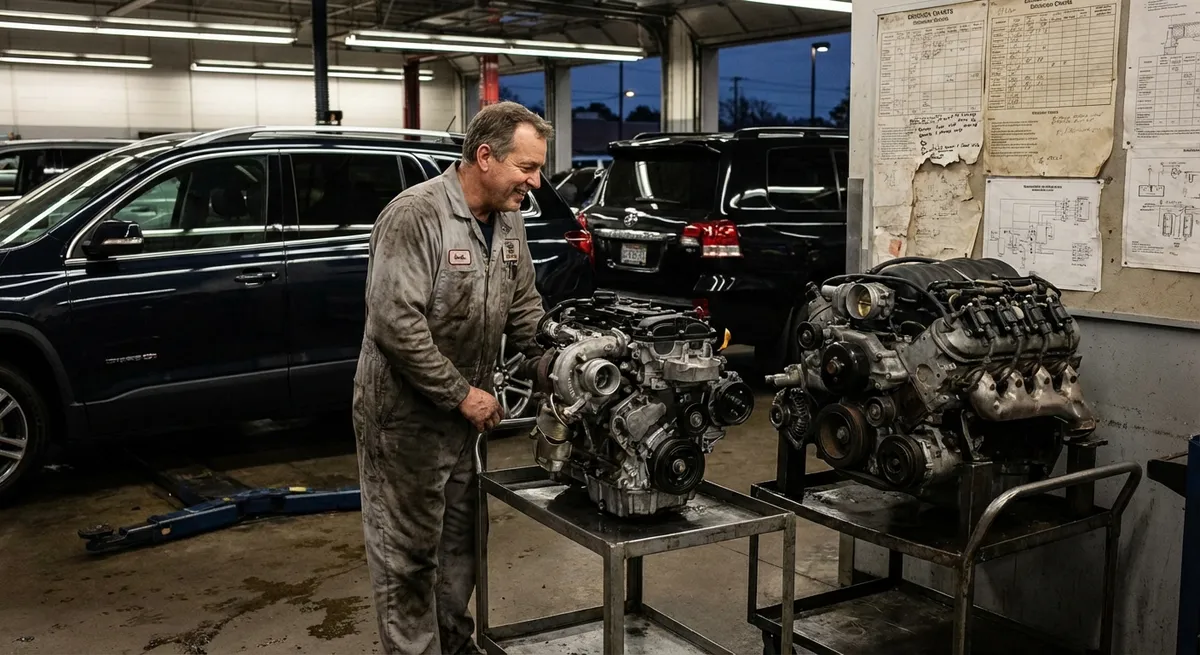
Turbocharged Four-Cylinders Are Replacing V6s: Pros and Tradeoffs
The most visible industry shift is the replacement of naturally aspirated V6 engines with turbocharged four‑cylinders across compact and midsize SUVs. On paper, this swap often looks like a win: similar or higher horsepower, more torque at lower rpm, and better official fuel economy numbers.
Modern small turbos rely on high boost pressure, direct injection, and sophisticated engine management to deliver strong torque from 1,500–2,000 rpm, which suits heavy SUVs crawling through traffic or merging onto highways. In real‑world driving, that flatter torque curve can make a turbo‑four feel quicker and more responsive than the older, peaky V6s that needed revs to wake up.
The tradeoffs are nuanced. Turbocharged engines can be more sensitive to thermal stress, oil quality, and fuel octane. Direct injection can increase the risk of intake valve carbon buildup over time, especially in engines that lack port injection to keep valves clean. Turbo spin‑up, intercooler heat soak, and small displacement can also affect towing consistency under sustained heavy loads, even if peak torque figures look impressive.
For enthusiasts, this means evaluating more than just the brochure numbers. Pay attention to torque curves, recommended fuel type, cooling system design, and tow ratings under sustained grades. For long‑term owners, it’s wise to plan for meticulous maintenance—regular oil changes with the correct specification, adherence to spark plug intervals, and, where applicable, valve cleaning or fuel system services.
Hybrids and Plug-In Hybrids Are Becoming the Default “Performance Upgrade”
Not long ago, “hybrid SUV” implied slow, frugal, and unexciting. Industry news now points in the opposite direction: hybrids and plug‑in hybrids are increasingly the performance variants, particularly in premium and performance‑oriented SUVs.
Two trends stand out. First, conventional (non‑plug‑in) hybrids are being engineered for both efficiency and responsiveness. Electric motors fill in torque at low speeds, allowing smaller combustion engines to operate in their most efficient load ranges. In urban driving, this can translate to brisk launches and smooth transitions, while highway cruising benefits from optimized engine mapping and regeneration.
Second, PHEV SUVs are being positioned as “bridge tech” between pure ICE models and full EVs. The typical modern PHEV SUV combines a relatively small turbo engine with one or more high‑output electric motors and a battery pack in the 10–25 kWh range. This allows 20–50 miles of EV‑only driving in many cases, but more importantly, it offers sustained high torque for overtakes and towing when the battery is adequately charged.
However, buyers should note several subtleties. A plug‑in’s efficiency gains are heavily dependent on charging behavior; driven without regular charging, a PHEV can consume more fuel than a lighter non‑hybrid SUV due to the added battery and motor mass. Thermal management of the battery and power electronics is also critical for consistent performance on long grades or track use. Additionally, real‑world EV range can fall significantly in cold climates or at highway speeds.
For enthusiasts and informed buyers, the questions to ask are: Does the hybrid system use a traditional stepped automatic, a planetary eCVT, or a dual‑clutch? Is the rear axle electrically driven (e‑AWD) or mechanically linked? How is towing performance specified when the battery is depleted? The answers directly influence driving character, capability, and long‑term satisfaction.
Towing, Payload, and Real-World Capability Are Being Rebalanced
As engines shrink and hybrid systems proliferate, SUV capability metrics are being recalibrated. The label rating for towing and payload is now more heavily influenced by thermal management, cooling capacity, and battery behavior than by engine displacement alone.
Downsized turbo engines can provide strong peak torque, but sustaining that torque while towing a trailer up a long grade in summer heat is a different challenge. Many manufacturers are therefore engineering larger radiators, transmission coolers, and sometimes even dedicated hybrid system coolers to maintain consistent performance. Some hybrids and PHEVs derate power under sustained load to protect battery life and power electronics, which can noticeably affect hill‑climb speed and passing performance.
Electric and plug‑in hybrid SUVs also raise new questions about usable range under tow. A BEV SUV that claims 300 miles of range might see that figure halved—or worse—when pulling a high‑drag camper at highway speeds. Similarly, a PHEV used for towing may quickly deplete its battery, after which it must rely heavily on a relatively small combustion engine working near its limits, often at higher fuel burn rates.
Payload considerations are being reshaped as well. Heavy battery packs, electric motors, and added structural reinforcement to handle them all consume weight budget that would otherwise be available for passengers and cargo. As a result, some electrified SUVs have surprisingly modest payload ratings compared with their ICE counterparts.
For buyers who tow boats, campers, or enclosed trailers, it’s prudent to look beyond headline tow figures. Check gross combined weight rating (GCWR), cooling and towing packages, and whether the manufacturer provides derated towing guidelines for steep grades, high temperatures, or EV/HEV modes. Realistically matching your trailer, cargo, and passenger loads to the SUV’s engineered limits is more important than ever as powertrains become more complex.
New Transmission and AWD Architectures Are Redefining Driving Feel
Engine downsizing isn’t happening in isolation. It is tightly linked with new transmission and all‑wheel‑drive (AWD) architectures designed to extract maximum efficiency and performance from smaller engines and electrified drivetrains.
Traditional torque‑converter automatics are evolving with more gears (8‑, 9‑, and 10‑speed units are now common) and refined lock‑up strategies to keep engines in narrow, efficient rpm bands. Dual‑clutch transmissions (DCTs) are being paired with performance‑oriented hybrids to balance rapid shifts with electric torque fill during gear changes. Meanwhile, several brands use electronic continuously variable transmissions (eCVTs) that blend engine and motor power without discrete gear steps, prioritizing smoothness and efficiency over “mechanical” feel.
AWD systems are changing just as rapidly. Many hybrid and PHEV SUVs now use “through‑the‑road” e‑AWD, where the front wheels are driven by the engine (and sometimes a motor) and the rear axle is powered solely by an electric motor with no mechanical driveshaft. This configuration improves packaging and allows fine‑grained torque vectoring, but its capability is partially dependent on battery state of charge and thermal conditions. In some models, AWD performance can diminish if the battery is low or the system overheats.
Electric SUVs take this further with dual‑ or tri‑motor layouts capable of extremely fast, software‑controlled torque distribution. Stability, traction, and launch performance can be outstanding, but the character is different from traditional mechanical locking differentials or clutch‑based systems. Over‑the‑air updates can even alter how an SUV’s AWD system behaves over its lifetime, adding another variable for enthusiasts to track.
When test‑driving modern SUVs, it’s worth focusing on how these systems behave: the smoothness and predictability of shifts, the response time of the AWD system on loose or wet surfaces, and whether drive modes (sport, off‑road, tow/haul, snow) meaningfully change the powertrain’s character. In the downsized era, software calibration is often as important as hardware.
Conclusion
SUV engine downsizing is not simply about making powertrains smaller; it is about re‑engineering the entire vehicle ecosystem—from emissions compliance and thermal management to towing performance and AWD behavior. For enthusiasts and serious buyers, the specs sheet now demands deeper reading: boost strategies, hybrid architectures, cooling systems, battery management, and software calibration all matter as much as displacement once did.
As regulations tighten and electrification expands, the most capable SUVs will be those where engineering teams have harmonized compact engines, advanced transmissions, hybrid systems, and intelligent AWD into a coherent whole. Understanding the industry forces behind these changes—and the technical implications for real‑world use—will help you choose an SUV that not only meets today’s expectations, but remains satisfying and relevant as the market continues to evolve.
Sources
- [U.S. Environmental Protection Agency – Regulations for Greenhouse Gas Emissions from Passenger Cars and Trucks](https://www.epa.gov/regulations-emissions-vehicles-and-engines/regulations-greenhouse-gas-emissions-passenger-cars-and) - Overview of current and upcoming U.S. light‑duty vehicle GHG standards influencing powertrain design
- [European Commission – Reducing CO₂ emissions from passenger cars](https://climate.ec.europa.eu/eu-action/transport/reducing-co2-emissions-road-transport/vehicles/co2-emission-performance-standards-cars-and-vans_en) - Details on EU CO₂ fleet targets that are accelerating engine downsizing and electrification
- [U.S. Department of Energy – FuelEconomy.gov](https://www.fueleconomy.gov/feg/hybrids.jsp) - Technical explanations and real‑world data on hybrid and plug‑in hybrid vehicle efficiency
- [International Council on Clean Transportation (ICCT) – Downsizing and Turbocharging Study](https://theicct.org/publication/downscaling-turbocharging-engine-technology-review-jul2014/) - Research analysis of engine downsizing, turbocharging, and emissions/efficiency impacts
- [Society of Automotive Engineers (SAE) – Electrified Powertrain and AWD Trends](https://www.sae.org/news/2022/04/electrified-powertrain-trends) - Industry perspective on hybrid, plug‑in, and electric powertrain architectures and their influence on driveline design
Key Takeaway
The most important thing to remember from this article is that this information can change how you think about Industry News.