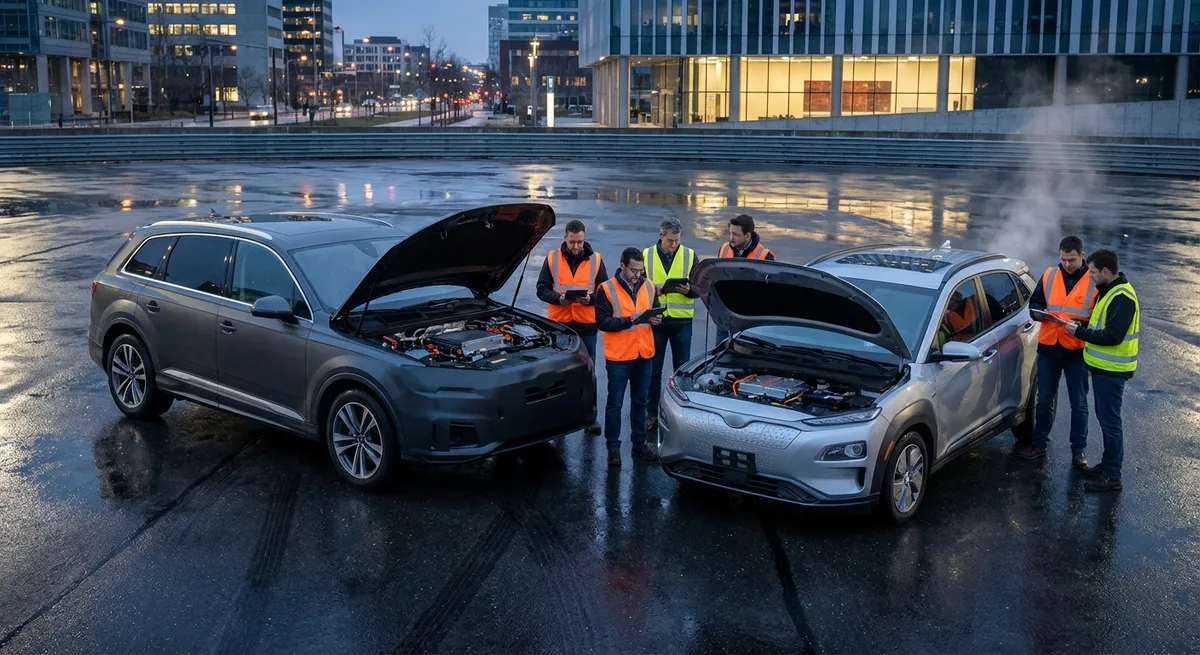
The SUV market is entering a new phase: not just electric, not just high-tech, but physically and strategically re‑sized. Automakers are quietly reshaping their lineups around “right-sized” SUVs—vehicles that promise full-size usability in smaller, more efficient packages. Behind the marketing slogans is a complex mix of regulation, engineering, and shifting consumer expectations. For enthusiasts and serious shoppers, understanding what’s driving this downsizing trend can help you separate smart innovation from simple cost-cutting.
Regulation Is Forcing Smarter Packaging, Not Just Smaller Engines
Global emissions and efficiency rules are reshaping how SUVs are designed from the ground up. In the U.S., the EPA’s upcoming greenhouse gas standards through 2032 push automakers toward lower fleet emissions, while Europe’s Euro 7 and CO₂ fleet targets aggressively penalize larger, inefficient models.
Instead of just dropping in smaller engines, manufacturers are re‑engineering platforms. Shorter overhangs, more aerodynamic rooflines, and carefully tuned active grille shutters are now common in new SUV generations. Upright, brick‑shaped profiles are quietly disappearing in favor of smoother silhouettes that cheat the wind—key for hitting CO₂ and fuel-economy targets.
Wheelbase‑to‑overall‑length ratios are also changing. Automakers are stretching wheelbases while trimming bumpers, preserving interior volume with a smaller external footprint. This means a modern midsize SUV can match or even exceed the cabin space of older, full-size models, but with less weight and better efficiency. The regulatory pressure is clear: if an SUV’s footprint is big, its powertrain and aerodynamics now have to be exceptionally optimized—or the model’s economics stop making sense.
Platform Sharing Is Making Compact and Midsize SUVs Surprisingly Capable
The industry’s move to flexible, shared platforms is one of the biggest reasons downsized SUVs are so capable. Modular architectures like Hyundai-Kia’s N3 platform, Stellantis’s STLA family, and VW’s MQB/MEB families allow multiple SUV sizes to be built from the same basic engineering toolkit.
From an enthusiast’s perspective, this has several side effects:
- Chassis rigidity and dynamics improve. A shared, heavily invested platform can be stiffer and better engineered than low-volume, bespoke frames of the past, improving handling even in smaller SUVs. Torsional rigidity increases allow more precise suspension tuning and better NVH (noise, vibration, harshness) control.
- Powertrains are right-sized, not underpowered. Modern turbocharged 4‑cylinders and higher-voltage hybrid systems deliver torque curves that would have embarrassed old V6s. Because the same engine families must power multiple global models, they’re often over‑engineered relative to any one vehicle’s needs.
- Advanced suspensions and AWD systems trickle down. Torque‑vectoring differentials, dual‑clutch rear drive units, and adaptive dampers, once reserved for halo models, are now amortized across entire SUV ranges. A “compact” performance SUV may share drivetrain hardware with the brand’s flagship, just packaged more tightly.
For buyers who still equate “bigger” with “better,” this new generation of shared-platform SUVs can be a surprise: footprint and curb weight are shrinking, but benchmark features like towing capacity, payload, and trailering stability often match the previous generation—or improve.
Battery Packaging Is Quietly Redrawing SUV Dimensions
Electrification isn’t just about plugging in; it’s reshaping SUV architecture in ways that affect real-world usability. EV-based or heavily electrified SUVs must accommodate large battery packs, and how those are packaged is driving a new “right-size” design philosophy.
On dedicated EV platforms, the battery is typically a flat pack between the axles, resulting in a long wheelbase and short overhangs. This has several consequences:
- Cabin space improves despite shorter bodies. A flat floor and no bulky transmission tunnel give EV SUVs interior volume that often rivals a larger ICE SUV on an older platform.
- Ride and handling change. The low, concentrated mass improves center of gravity and roll behavior. Downsized EV SUVs can feel more planted than their taller, heavier predecessors.
- Front and rear compartments evolve. Shorter noses and the absence of large engines create room for frunks or advanced crash structures. The frontal area can be more compact without sacrificing safety.
Plug-in hybrid SUVs (PHEVs) face a different constraint: they must package both a full ICE powertrain and a battery of meaningful size. This is incentivizing more efficient use of space—tighter component packaging, smaller fuel tanks, and strategic battery placement under rear seats or cargo floors.
For shoppers, the key takeaway is that a slightly smaller exterior no longer maps cleanly to less usable space. In many 2024–2026 SUVs, legroom, headroom, and cargo length with seats folded are on par with, or better than, the larger models they replace, even though the vehicles look and measure “smaller” from the outside.
Aerodynamics and Weight Reduction Are Replacing Raw Displacement
The engineering battle is no longer just about horsepower. With both fuel economy and EV range under scrutiny, aerodynamics and mass reduction have become central to how SUVs are resized and reshaped.
Modern SUVs are seeing:
- Lower drag coefficients (Cd). Where Cd values around 0.35–0.40 used to be typical for SUVs, many current-gen models target 0.28–0.32 through sculpted rear ends, careful mirror and wheel design, and active aero components.
- Reduced frontal area. Even small changes in height and width significantly impact aerodynamic drag at highway speeds. Slightly lower rooflines and more tapered shoulders let a “downsized” SUV cut through the air more efficiently.
- Strategic material use. More aluminum, high-strength steels, and in some cases composite panels allow manufacturers to keep or increase rigidity while removing tens to hundreds of pounds compared with previous generations.
For performance-minded drivers, the benefit is clear: smaller, lighter SUVs with improved aero don’t just save fuel—they maintain acceleration and high-speed stability with less power. A turbocharged 2.0‑liter in a lighter, slipperier SUV can match the real-world punch of an older, heavier V6 model while consuming far less fuel or battery energy.
As a buyer, curb weight, Cd (if published), and frontal area are now worth paying attention to alongside engine specs. They explain why some “downsized” SUVs feel effortlessly quick and efficient, while others with similar power figures feel strained.
Urban Realities and Ownership Costs Are Rewriting the Brief for “Family SUVs”
Away from the engineering lab, real-world living is influencing how big SUVs can be. Urban congestion, shrinking parking spaces, and rising operating costs are pushing demand toward SUVs that offer three rows or generous cargo space in a more city-friendly footprint.
Manufacturers are responding with:
- Shorter, more maneuverable bodies with advanced parking tech. Tight turning circles, rear-axle steering in some premium models, and increasingly sophisticated parking assist systems make it possible to drive a “family-size” SUV in dense cities without the traditional size penalty.
- Configurable interiors over sheer volume. Sliding second rows, fold-flat third rows, and multi-position load floors can make a midsize SUV feel more versatile than an older full-size with fixed seating. Storage solutions—underfloor bins, modular cargo dividers, and power-folding rows—are becoming differentiators.
- Cost-of-ownership optimization. Smaller external dimensions can mean lower weight, which cascades down to reduced tire wear, less brake stress, and sometimes lower insurance classes. Combined with more efficient powertrains, the lifetime cost gap between “compact/midsize” and “full-size” SUVs is widening.
For enthusiasts, this doesn’t have to mean the end of serious hardware. Off-road-focused trims on smaller SUVs still offer locking differentials, multiple terrain modes, and robust underbody protection. For buyers, the strategic question is shifting from “How big can I go?” to “Which SUV size gives me the capability I need with the lowest long-term penalty in fuel, running costs, and daily usability?”
Conclusion
The downsizing of SUVs is not a simple story of cost-cutting or regulatory compliance. It’s a structural realignment of the segment—driven by emissions standards, flexible platforms, electrification, aero and mass engineering, and the realities of urban life. Today’s “smaller” SUVs are often more capable, more efficient, and more liveable than the larger models they replace.
For car enthusiasts and serious shoppers, the old rule that bigger equals more practical is rapidly becoming outdated. Understanding how footprint, weight, aerodynamics, and platform design work together will help you see past badge hierarchy and focus on what matters: real interior space, usable capability, and how well a vehicle fits your actual driving environment. In the new era of SUVs, right-sized may prove to be the new full-size.
Sources
- U.S. EPA – Multi-Pollutant Emissions Standards for Model Years 2027 and Later Light-Duty and Medium-Duty Vehicles - Details upcoming U.S. regulations affecting SUV emissions and efficiency targets
- European Commission – Reducing CO₂ Emissions from Passenger Cars - Explains EU fleet CO₂ rules that shape SUV size and powertrain strategies
- Hyundai Motor Group – Third-Generation Vehicle Platform Overview - Outlines modular platform benefits that influence packaging and capability across SUV sizes
- U.S. Department of Energy – Fuel Economy and Why It Matters - Provides technical background on the relationship between vehicle size, aerodynamics, and efficiency
- International Energy Agency – Global EV Outlook - Discusses how EV packaging and platform strategies are reshaping vehicle dimensions, including SUVs
Key Takeaway
The most important thing to remember from this article is that this information can change how you think about Industry News.