The SUV market is undergoing a quiet but significant shift: mainstream, family-focused models are now being engineered with serious off-road capability and rugged styling. What started as a niche trend with a few adventure-oriented trims has turned into a broader movement that’s reshaping what “family SUV” actually means. For buyers, this brings new choices, new tech, and new trade-offs that go beyond simple power and fuel economy.
This industry update breaks down the key forces driving the rugged-SUV wave, what’s changing beneath the sheet metal, and what it means if you’re shopping for a family hauler that can also tackle more than a gravel driveway.
From Pavement-Only to “Soft-Roader” to Real Trail Capability
For years, crossovers and family SUVs were designed primarily for pavement: front-wheel drive layouts, modest ground clearance, and all-wheel-drive systems tuned for wet-weather confidence rather than rock-strewn trails. That’s changing quickly.
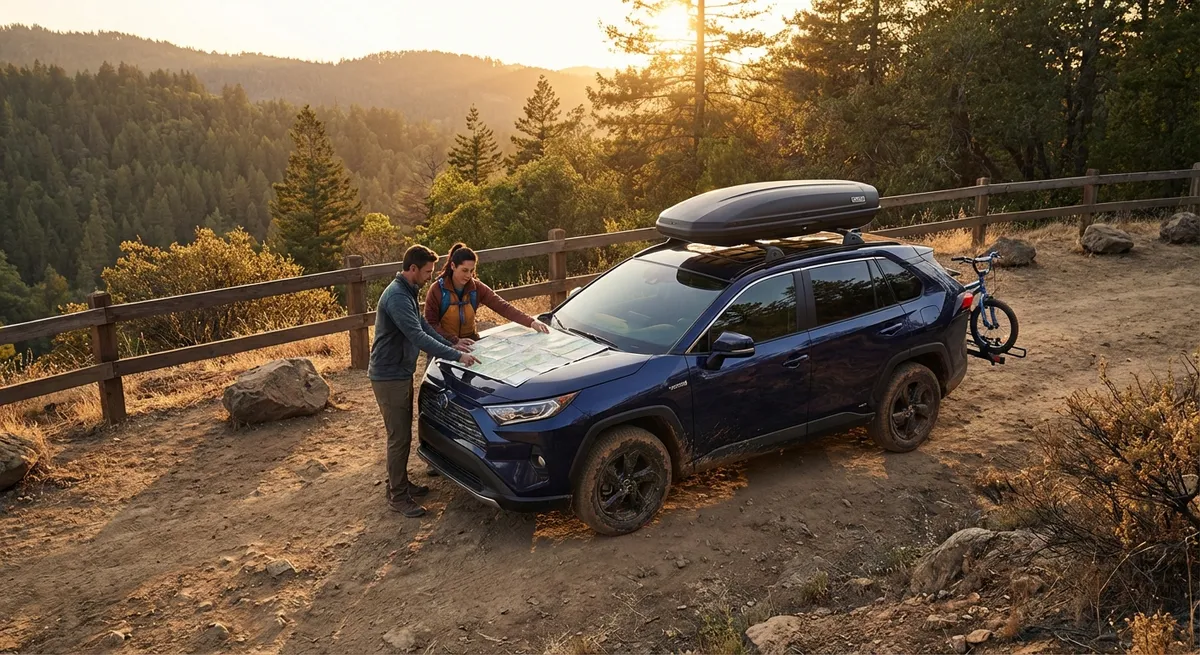
Manufacturers are now building “trail-ready” variants on existing platforms instead of reserving capability for body-on-frame trucks and traditional off-roaders. Trail-focused trims like “Wilderness,” “Timberline,” “X-Line,” “Trailhunter,” and “Active” typically bring:
- Increased ground clearance (often +0.5–1.0 inches vs. base models)
- Unique bumpers to improve approach and departure angles
- All-terrain (A/T) or all-weather tires with more aggressive tread
- Redesigned front fascias to improve airflow and cooling in low-speed, high-load driving
- Protective cladding and skid plates for the engine, fuel tank, and sometimes rear differential
The industry takeaway: instead of building a separate, hardcore off-roader, automakers are using modular platforms and shared components to create compelling, profitable “adventure” trims that plug directly into the crossover and family-SUV space.
Technical Upgrades: Suspension, AWD Logic, and Traction Tools
The rugged styling on these SUVs is not just cosmetic. Key hardware and software changes distinguish adventure trims from their mainstream siblings, and understanding them helps buyers separate real capability from marketing.
Common technical upgrades include:
Suspension Tuning and Components
- Longer-travel dampers and revised springs to better absorb ruts and washboard surfaces - Retuned damping curves for more compliance at low speeds while preserving on-road stability - Sometimes reinforced control arms or additional bracing to handle repeated off-pavement impacts
All-Wheel-Drive (AWD) System Calibration
- More aggressive torque transfer to the rear wheels to maintain momentum on loose surfaces - Revised traction and stability-control thresholds to allow more wheel slip before intervention - Dedicated drive modes (e.g., “Mud & Ruts,” “Sand,” “Snow/Dirt”) altering throttle mapping, transmission shift points, and AWD clutch behavior
Traction Enhancements and “Virtual Lockers”
- Brake-based torque vectoring that can mimic a locking differential by clamping a spinning wheel and sending torque to the one with grip - Hill descent control (HDC) with more precise low-speed modulation, often adjustable in 1–2 mph increments - Off-road cruise control or “trail control” systems that maintain a set crawl speed so the driver can focus on steering
Tires and Wheels
- All-terrain tires with stiffer sidewalls and more aggressive tread blocks for better bite in dirt, mud, and light rock - Downsized wheel diameters (e.g., 17" instead of 20") to allow taller sidewalls, improving ride comfort and puncture resistance off-road
These upgrades don’t magically turn a unibody crossover into a rock-crawling SUV, but they dramatically widen the usable envelope for camping, forest roads, and seasonal trails—areas where many families now actively want to go.
Design and Cabin: Rugged Aesthetic Meets Daily-Driver Practicality
Rugged SUVs are also evolving in how they look and feel, blurring lines between lifestyle statement and functional hardware.
On the exterior, trends include:
- Squared-off, “adventure” styling: chunkier fender flares, upright grilles, exposed tow hooks, and roof-rail systems rated for heavier static loads (e.g., rooftop tents).
- Functional lighting: LED fog lamps optimized for low-visibility conditions, cornering lamps for tight trail turns, and auxiliary light provisions on some off-road packages.
- Protected surfaces: thick lower cladding, textured surfaces that hide scratches, and skid plates that are both structural and visual cues of capability.
Inside, automakers are making design choices that recognize how these SUVs are used:
- Easy-clean materials: synthetic leather or robust cloth with water-resistant treatments, rubberized cargo floors, and removable cargo mats with raised edges.
- Adventure-focused storage: tie-down points, under-floor compartments sized for recovery gear or compact air compressors, and seatback-mounted MOLLE-style panels for accessories.
- Trail-friendly tech: front and surround-view camera systems with off-road views, inclinometer and pitch/roll displays, and integrated navigation with trail or unpaved-road databases in some models.
At the same time, buyers still expect refined road manners, advanced driver-assistance systems (ADAS), and family conveniences: tri-zone climate, rear USB-C ports, and quiet cabins. The development challenge—and where manufacturers differentiate themselves—is balancing true ruggedness with the refinement that makes an SUV livable on a 60-minute commute and a 6-hour highway road trip.
Regulatory and Efficiency Pressures Behind “Smarter” Rugged SUVs
One of the subtle drivers behind this rugged trend is regulatory. Governments in major markets are tightening emissions and fuel economy standards, yet buyer demand for SUVs and crossovers remains strong. Automakers respond by making SUVs more versatile rather than simply bigger or more powerful.
Key industry-level pressures and responses:
- Fuel Economy and CO₂ Targets
- Corporate Average Fuel Economy (CAFE) rules in the U.S. and EU CO₂ regulations push automakers to squeeze efficiency out of every platform.
- Adventure trims increasingly pair all-terrain capability with efficiency boosters: downsized turbocharged engines, high-efficiency automatic transmissions (8–10 speeds), and mild-hybrid systems to recuperate energy during braking.
- Electrified Powertrains in Rugged Wrapping
- Hybrid and plug-in hybrid SUVs are gaining trail-focused variants, combining instant electric torque (useful for low-speed crawling) with lower tailpipe emissions.
- Thermal management is critical: off-road driving is low-speed but high-load, demanding robust cooling strategies for batteries, motors, and inverters in electrified SUVs.
- Weight and Safety Requirements
- Added off-road hardware, underbody protection, and roof racks add mass; engineers counterweight penalties with aluminum and high-strength steel.
- Advanced driver-assistance systems (adaptive cruise, lane-keeping, automatic emergency braking) must be carefully calibrated for varied traction conditions and sometimes deactivated or modified in off-road modes to avoid intrusive interventions.
The result is a new generation of SUVs that can operate efficiently under increasingly strict rules—but still deliver credible off-pavement performance for owners who actually use it.
What Enthusiasts and Buyers Should Watch in the Next Product Cycle
Over the next few model years, several trends are worth tracking if you’re an SUV enthusiast or in the market for a “do-everything” family vehicle:
Factory Lift and Overland Packages from OEMs and Dealers
Expect more factory or dealer-installed packages with mild suspension lifts, integrated off-road cameras, upgraded underbody armor, and pre-wired electrical systems for winches, light bars, and fridges. Automakers are moving to capture dollars that previously went straight to the aftermarket.
Standardization of Advanced Trail Tech
Features once exclusive to high-end off-roaders—like low-speed trail cruise control, one-pedal off-road driving in EVs, and front underbody cameras—are going mainstream in mid-priced SUVs. Tech packages will become as important as trim levels for serious weekend adventurers.
Growth of Electrified Adventure SUVs
Plug-in hybrid and fully electric SUVs will increasingly be marketed specifically for outdoor lifestyles. Watch for: - Bidirectional power (vehicle-to-load) to run campsite equipment - Heat-pump systems for efficient cabin climate control during overnight stays - Off-road-specific drive modes that optimize battery and motor output in low-speed, high-load situations
Tire Technology and OEM-Approved All-Terrain Options
The old trade-off—road comfort vs. trail capability—is narrowing as all-terrain tire designs improve. Expect more OEM fitments with snow-rated A/T tires, and detailed guidance from manufacturers on compatible sizes that preserve ADAS calibration and fuel efficiency.
Real-World Data Driving Design Updates
Connected-vehicle telemetry allows automakers to understand how owners actually use “rugged” SUVs: how often they leave pavement, what drive modes are engaged, and which climates they operate in. That data will quietly drive the next generation’s ground clearance, tire choice, and software tuning. Enthusiast feedback, captured from online communities and owner surveys, will also influence how far brands push the off-road envelope on their family platforms.
For buyers, the message is clear: don’t assume every “rugged” badge means the same level of capability. Look beyond the branding to the specifics—angles, clearance, tires, AWD logic, and cooling capacity—especially if you plan to tow, overland, or regularly explore challenging unpaved roads.
Conclusion
Family SUVs are no longer locked into a simple city-and-suburb formula. Driven by consumer demand, lifestyle marketing, and regulatory pressure for smarter efficiency, automakers are building crossovers and three-row SUVs that can credibly step off the pavement while remaining comfortable and safe daily drivers.
For enthusiasts, this is a compelling moment: capability and usability are converging. For shoppers, the opportunity—and the challenge—is to decode the spec sheets and understand which rugged touches are real engineering advantages and which are just design theater. As the next wave of models arrives, the most versatile SUVs will be those that combine honest off-road hardware and intelligent software with the refinement, safety, and efficiency today’s buyers rightly expect.
Sources
- [U.S. Department of Energy – Fuel Economy & Emissions Data](https://www.fueleconomy.gov/feg/suv.jsp) – Overview of SUV fuel economy trends and regulatory context
- [U.S. NHTSA – Corporate Average Fuel Economy (CAFE)](https://www.nhtsa.gov/laws-regulations/corporate-average-fuel-economy) – Details on CAFE standards influencing SUV design and efficiency strategies
- [European Commission – CO₂ Emission Performance Standards for Cars and Vans](https://climate.ec.europa.eu/eu-action/transport-emissions/road-transport-reducing-co2-emissions-vehicles/co2-emission-performance-standards-cars-and-vans_en) – Explains EU emissions rules shaping SUV powertrain choices
- [Society of Automotive Engineers (SAE) – Ground Vehicle Dynamics Resources](https://www.sae.org/attend/ground-vehicle-dynamics-symposium) – Technical background on suspension, dynamics, and off-road vehicle behavior
- [Ford Motor Company – Off-Road Driving Technology Overview](https://media.ford.com/content/fordmedia/fna/us/en/news/2021/06/23/how-ford-uses-technology-to-improve-off-road-driving.html) – Example of how major manufacturers deploy trail control, drive modes, and off-road tech in modern SUVs
Key Takeaway
The most important thing to remember from this article is that this information can change how you think about Industry News.