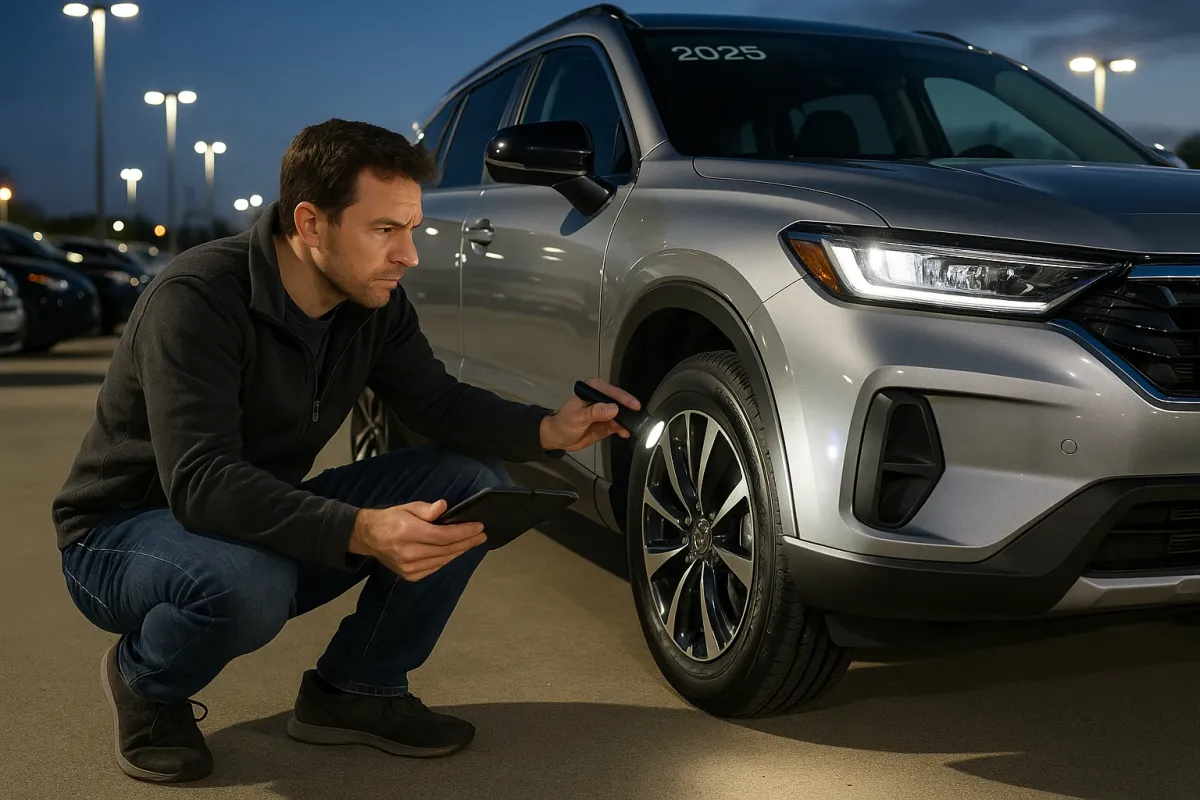
SUV reviews in 2025 are starting to look a lot like those viral deep-dive posts about “hidden movie details only super‑observant people catch.” One of today’s trending entertainment headlines celebrates fans who notice tiny visual clues in Pixar’s Ratatouille—and the same mindset is now reshaping how serious shoppers and reviewers look at modern SUVs.
Instead of just asking “Is it fast?” or “Is it comfortable?”, enthusiasts are drilling into stitching patterns, pixel density in digital clusters, battery thermal management, lane-centering behavior in specific weather, and dozens of other micro‑details that never used to make it into mainstream reviews. In a market dominated by highly polished crossovers from Toyota, Hyundai, Kia, Ford, Tesla, and a wave of new Chinese brands, those hidden details are where the real story lives.
Below, we break down how to read (and write) SUV reviews in 2025 like a true “hidden-details” expert—so you can separate marketing gloss from meaningful engineering and ownership realities.
1. Interior Quality: Look Past the First Touch
Most SUV reviews still start with the same phrase: “The cabin feels upscale.” In 2025, that’s not enough. Every major automaker—from Hyundai with the latest Santa Fe and Ioniq 7 previews to Toyota with its just-updated Highlander and the new Land Cruiser 250—is chasing the same “premium on a budget” sweet spot. The key difference is in the execution details reviewers are finally learning to highlight.
Pay attention to how reviewers describe transition points: where soft-touch tops meet hard plastics below the beltline, how the door panel feels where your knee actually rests, how stable the floating center console is when pushed laterally, and whether the piano black trim shows swirls and micro-scratches even on early test cars. For example, many early reviews of recent mainstream SUVs have called out high-gloss black around shifters and infotainment controls that look great in photos but show fingerprints instantly and scratch easily in real life.
Material consistency is another hidden tell. A thorough review should note whether the second and third rows get the same soft materials, real stitching, and padded armrests as the front, or if cost-cutting suddenly appears beyond the B‑pillar. Enthusiast reviewers are also beginning to comment on tactile feedback: the weight of climate control knobs, the detent precision of drive mode selectors, and how solid the column stalks feel. These details don’t just affect perceived quality—they’re strong predictors of how the cabin will age over 80,000+ miles.
2. Infotainment & Driver Screens: Beneath the Big Numbers
Automakers are in a size race with screens—14.5‑inch, 15‑inch, 17‑inch displays are becoming common talking points in 2025 launches. But just as Ratatouille fans care more about the animation nuance than just resolution, SUV shoppers need reviewers who look beyond diagonal inches. The best reviews now focus on latency, interface logic, and critical redundancy.
When you read or watch a review, look for mentions of UI response time (does the system lag when switching from maps to camera?), frame rate smoothness in the digital instrument cluster, and whether the vehicle’s core functions still work quickly when wireless Apple CarPlay or Android Auto is active. Reviewers are increasingly spotlighting issues like aggressive screen dimming with polarized sunglasses, limited split-screen flexibility, or map rendering that stutters at highway speeds—problems that don’t show up in a spec sheet.
Equally important in 2025 is control redundancy. Many new EV‑leaning SUVs and crossovers are removing physical climate buttons and adopting Tesla‑style touch-only interfaces. High-quality reviews now call out whether there are at least fixed on-screen climate tiles, a small temperature rocker, or a dedicated defog/defrost button. Safety regulators and user-experience researchers have been vocal recently about menu-diving while driving; strong reviews will note the number of taps needed to adjust cabin temperature, change drive mode, or disable overly intrusive lane-keeping aids.
Finally, map the tech stack to your ecosystem. If you’re an Android user and a review notes that a new SUV still only supports Apple CarPlay wirelessly but forces wired Android Auto—or omits it entirely, as some Chinese-brand systems have done in early European reviews—that’s a very real ownership pain point buried in what used to be a throwaway “connectivity” paragraph.
3. Ride, Handling, and NVH: The Micro-Behaviors Reviewers Just Started Covering
With crossovers converging on similar layouts—turbocharged four-cylinders or hybrid systems, unibody architecture, multi-link rear suspensions—headline performance numbers tell less of the story. That’s why the best 2025 SUV reviews increasingly read like fine-grained test reports instead of brochure summaries, focusing on nuanced behaviors in specific scenarios.
Start with ride calibration. A serious review should differentiate between low-speed compliance (how the SUV handles broken city pavement, expansion joints, speed humps) and high-speed body control (how it behaves over large undulations at 70–80 mph). For example, European-oriented models like the latest BMW X3 and Mercedes GLC often trade a bit of sharpness around town for superb highway composure, while many North American‑focused models from Chevrolet or Honda aim for softness in city driving but can feel floaty and underdamped when fully loaded on the interstate. If a review compresses this into “rides well,” they’re missing crucial context.
Noise, vibration, and harshness (NVH) is another area where reviewers are getting more forensic. Listen for mentions of source and frequency: Is there a low-frequency boom from around the rear wheel wells on coarse concrete? Is wind noise concentrated around the A‑pillars or mirrors at 70 mph? With more SUVs adopting larger wheels and low-profile tires, tire roar on cheap asphalt has become a major differentiator that often only shows up in the most detailed reviews.
Chassis tuning also now includes the impact of driver-assistance interventions. Many 2025 SUVs use subtle brake applications to mimic torque vectoring and stability management; good reviewers note whether these interventions feel natural or intrusive when cornering briskly on-ramps or descending long grades. Likewise, the smoothness and predictability of adaptive dampers or air suspension across drive modes (Comfort, Sport, Off-Road) can make or break the ownership experience but often hides under a generic “it handles well” line unless you’re reading a review that cares about the hidden details.
4. Powertrain and Efficiency: Dig Into Calibration, Not Just Power Figures
Horsepower and torque figures still dominate spec sheets, but today’s SUV powertrains—especially hybrids and EVs—are defined just as much by calibration as raw output. This is where reviewers are finally starting to behave like those fans who pause movie frames to spot tiny Easter eggs: they’re paying attention to how power arrives, how systems blend, and how the SUV behaves in edge cases.
For hybrids and plug-in hybrids, look for commentary on engine start/stop smoothness and EV‑to‑ICE transitions. Toyota’s latest hybrid SUVs, Hyundai’s turbo-hybrids, and Ford’s plug-in systems each have distinct personalities: some favor EV running until the last moment, others keep the engine warm and ready. A quality review should mention whether the engine cut-in is noticeable under light throttle, how the system behaves in cold weather, and whether there’s a “rubber-band” CVT sensation or a more direct stepped-gear feel.
For battery-electric SUVs—which are proliferating rapidly across every price segment in 2025—range and 0–60 mph times are table stakes. What matters now is thermal management and charging curve behavior. Reviews from independent testers and long-range road trips are increasingly exposing EV SUVs that advertise high DC fast-charge peak rates (e.g., 200–350 kW) but can’t sustain them due to battery temperature limits or conservative charge profiles. A review that includes a real-world 10–80% charging session, with time and kW data, is far more valuable than one that parrots the factory figure.
In ICE-only SUVs, small refinements matter too. Reviewers are starting to note engine NVH at specific rev bands, shift mapping in Eco vs Sport, and downshift logic on highway passes. Turbocharged engines from multiple brands can suffer from low-RPM hesitation followed by an aggressive torque spike; good reviews will describe how predictable throttle response feels when merging or making tight left turns across traffic—precisely the kind of scenario where calibration quality is far more important than brochure horsepower.
5. Driver Assistance, Safety Tech, and Over-the-Air Reality
As advanced driver-assistance systems (ADAS) become standard across mainstream SUVs—lane keeping, adaptive cruise, automated parking, and in some markets, limited hands-free driving—reviews in 2025 are finally scrutinizing these features with the same attention fans give to hidden movie callbacks. The difference between an SUV you trust and one you constantly fight on the highway often hides in the fine print of ADAS performance.
Look for reviews that test lane-centering on curved highways, in mild crosswinds, and at night. Many systems from different brands now use similar hardware (camera + radar or camera + radar + lidar), but their software behavior can vary dramatically: some ping-pong between lane markings, some aggressively tug the wheel on gentle bends, while the best systems feel almost like a calm co-pilot. A review that simply lists “lane keep assist standard” is missing 90% of the ownership story.
Adaptive cruise control (ACC) behavior under cut-ins is another hidden-detail benchmark. In-depth reviewers describe whether the SUV slams the brakes when another car moves into your lane, how smoothly it re-accelerates, and how well it maintains speed on long descents. In 2025, regulators in multiple regions are placing more scrutiny on overpromising semi-autonomous capability, so expect more reviewers to stress real-world behavior over marketing names like “Pro,” “Pilot,” or “Assist.”
The last frontier is software support. Over-the-air (OTA) updates are now common among EV-heavy brands such as Tesla, Hyundai/Kia, Ford, and several Chinese entrants expanding globally. Strong reviews reference not only that OTA is available, but what type of updates are historically delivered: bug fixes only, or meaningful feature additions like improved range estimation, revised drive-mode calibrations, or new ADAS behaviors. With recent headlines full of owners frustrated by post-purchase feature changes or subscription locks, the long-term software roadmap has become a critical but often subtle factor. Reviews that track an SUV’s software evolution over months are providing some of the most valuable “hidden detail” insights in the market.
Conclusion
SUVs in 2025 have never looked more similar on paper—similar sizes, similar power outputs, similar tech checklists. That’s why the most useful reviews now resemble those fan-favorite “hidden detail” breakdowns: they focus on the subtle, easy-to-miss elements that transform daily use, long-term durability, and driver confidence.
If you’re shopping for a new SUV, seek out reviews that go beyond top-line specs and star ratings to examine interior consistency, UI latency, ride and NVH micro‑behaviors, powertrain calibration nuances, and the real-world performance of driver-assistance and software updates. Those are the details that will define how your SUV feels on your commute, on a 500‑mile road trip, or during a sudden highway maneuver years from now—and they’re exactly where the best reviewers are finally pointing the camera.
Key Takeaway
The most important thing to remember from this article is that this information can change how you think about Reviews.