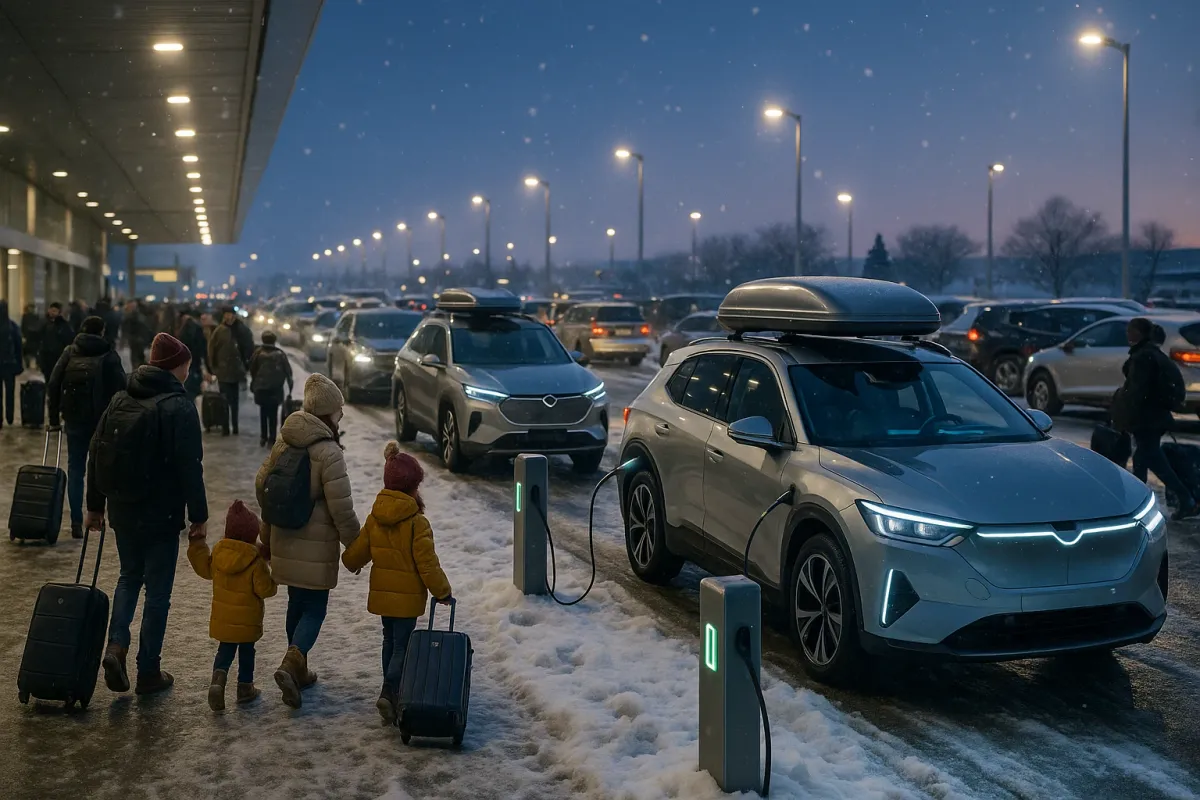
Every December, social media fills up with the same images: gridlocked highways, jammed airport drop-off lanes, and SUVs packed to the roof with luggage, strollers, gifts, and tired passengers. That yearly chaos isn’t just a meme—it’s become a powerful data stream that automakers are mining in real time. The way families and frequent travelers actually use their vehicles during peak holiday stress is now feeding directly into how the next wave of SUVs is engineered, packaged, and marketed.
This year’s surge in travel tech coverage—like Bored Panda’s feature on gadgets for surviving holiday airport lines—mirrors a broader shift inside the auto industry. OEMs and suppliers are watching these same trends: power-hungry devices, rolling “home offices” on wheels, and demand for serious comfort and versatility under maximum load. What they learn in December increasingly shapes the SUV products you’ll see on dealer lots in late 2025 and 2026.
Below are five concrete ways that holiday travel behavior and tech adoption are influencing SUV design, features, and positioning right now.
1. Cabin Layouts Are Being Engineered Around Peak-Load Family Travel
Automakers have always advertised three-row SUVs as “family-friendly,” but holiday travel is exposing where that claim breaks down. When vehicles are fully loaded—with all three rows occupied, cargo areas jammed, and child seats installed—many current layouts simply don’t work as advertised. That’s why major brands are quietly re-thinking packaging with peak-load use cases as the baseline, not the exception.
Ford’s latest Explorer and Expedition development programs, for example, have leaned heavily on connected-vehicle data and owner surveys that capture when and how all three rows are occupied during long trips. Engineers are reporting increased focus on “ingress/egress under stress”: how easy it is for a grandparent to reach the third row without unloading half the vehicle, or for parents to access kids’ seats without contorting. Expect more second-row benches with slide-and-tilt mechanisms that work even with child seats installed, a feature already seen in higher-end imports.
Toyota and Hyundai product planners have similarly flagged “holiday luggage plus people” as a design requirement, not an edge case. This is pushing boxier rooflines for better third-row headroom, deeper under-floor storage behind the third row, and clever hidden compartments for shoes, snacks, and small bags. For shoppers, this means spec sheets and showroom demos will increasingly highlight third-row usability under real-world conditions instead of generic seat counts.
2. Power Management Is Moving From “Nice-to-Have” To Critical Infrastructure
The modern holiday SUV isn’t just a people-mover; it’s a rolling power hub. With travelers relying on multiple phones, tablets, laptops, Nintendo Switches, rear-seat entertainment, coolers, and portable gadgets, power demand inside the cabin has spiked. The viral popularity of “must-have” travel tech in 2024–2025 has not gone unnoticed by automakers and Tier 1 suppliers.
In response, many 2026-bound SUV programs are increasing onboard power capacity and distribution. Expect to see more:
- High-wattage USB-C PD ports (45–65 W and beyond) in all three rows
- 110V/230V inverters with higher continuous output, targeted around 400–800 W
- Dedicated power circuits isolated from critical vehicle systems to prevent brownouts
- Improved battery management strategies that allow extended accessory use with the engine off
Electric SUVs and plug-in hybrids will push this even further. Following the consumer response to “vehicle-to-load” (V2L) features in models like the Hyundai Ioniq 5 and Kia EV9, several OEMs are working on travel-specific software modes that prioritize cabin power, rear cargo sockets, and even tent or campsite support for a set number of hours. Expect marketing language to shift from generic “household outlets” to clear, scenario-based claims: “Power four laptops, two tablets, and a mini-fridge for six hours without starting the engine.”
For buyers, this means looking beyond simple port counts. Pay attention to listed wattage, inverter ratings, and whether the vehicle offers power management profiles tailored to road trips or camping.
3. Connectivity and UX Are Being Tuned for Long-Distance Stress, Not Just Daily Commutes
Holiday travel exposes every weakness in an SUV’s connectivity and infotainment system. When navigation, streaming, and in-car apps all run simultaneously, some current systems lag or crash, especially in dead-cell zones or congested areas. Automakers are using this seasonal stress test to guide major software and hardware overhauls.
Industry insiders report three key shifts aimed at 2026 models:
Redundant Navigation Paths
OEMs are pushing for richer offline mapping and predictive routing. Instead of relying solely on live data, systems pre-cache high-traffic corridors and holiday routes—similar to how your favorite travel apps prep offline maps. Expect more SUVs to maintain full-function routing even when signal drops for more than an hour.
Multi-User Media Management
With multiple occupants wanting different things—front-row navigation and calls, second-row streaming, third-row gaming—infotainment architectures are being redesigned around “zoned” experience management. Hardware like multi-core SoCs and separate audio domains will support independent content streams per row, while software UIs will make it easier to allocate bandwidth and audio focus.
Connected Telematics for Trip Support
OEMs and telematics providers are increasingly layering in real-time alerts around heavy holiday traffic, storms, and service availability. In the short term, this means improved route recommendations. Longer term, automakers are looking at tying this into subscription-based concierge services: reserving charging slots for EVs, pre-booking hotel rooms along a route, or identifying large-vehicle-friendly rest stops that can handle a fully loaded SUV with a trailer.
For shoppers, the lesson is clear: The infotainment chip, memory specs, and connected services aren’t just tech buzzwords anymore—they determine how usable your SUV is during the most stressful drives of the year.
4. Ride Comfort and Noise Control Are Being Benchmarked at Max Weight
Peak holiday loads reveal another hidden truth: Many SUVs ride acceptably when lightly loaded, but become harsh, floaty, or noisy when fully packed with passengers and cargo. OEMs know holiday travel is one of the few times customers run their vehicles at or near gross vehicle weight rating (GVWR), and they’re now using that scenario as a core benchmark rather than a fringe test.
Chassis and suspension teams across the industry are recalibrating damping curves, spring rates, and bushings to perform predictably at high load. This may lead to more widespread adoption of:
- Frequency-selective dampers that adapt to road irregularities differently at various loads
- Dual-path suspension mounts that separate road shock from body noise and vibration
- Load-leveling rear suspensions (air or self-leveling shocks) being offered further down the trim ladder
Noise, vibration, and harshness (NVH) engineers are also paying closer attention to cargo-related sound paths: loose luggage, plastic containers, and hard-shell suitcases can create reverberation and rattles that customers associate with “cheapness,” even when the underlying chassis is solid. Expect improved cargo-area trim materials, additional damping under the load floor, and better integration of cargo management systems that lock items in place.
Here’s the practical implication: Look for test drives and reviews that mention fully loaded performance and comfort, not just solo or two-person evaluations. The industry is moving in that direction, and it’s a much better predictor of how your SUV will feel during real-world family trips.
5. Safety and Driver-Assistance Are Being Refined Specifically for Fatigue and Congestion
Holiday travel combines three risk factors: fatigue, congestion, and adverse weather. This is exactly the environment where advanced driver-assistance systems (ADAS) like adaptive cruise control, lane-centring, and automated emergency braking should shine—but also where their current limitations are most exposed. Automakers and suppliers are using this seasonal feedback loop to prioritize ADAS tuning and sensor upgrades for crowded, stressful conditions.
Radar and camera suppliers (think Bosch, Continental, Mobileye, and others) are working with OEMs to better handle dense traffic with frequent cut-ins, variable speeds, and unclear lane markings—situations common on packed holiday interstates. Partial-automation systems like GM’s Super Cruise, Ford’s BlueCruise, and upcoming rivals from Stellantis and Toyota are being trained and validated on exactly these scenarios, with more divided highways and long-distance corridors mapped and approved for hands-free operation.
Driver-monitoring systems (DMS), which track eye movement and head position, are also evolving. The next generation of SUVs will more intelligently distinguish between a briefly distracted driver and one who is genuinely fatigued over several hours, potentially adjusting alerts, suggesting rest stops, or temporarily limiting hands-free features. Some manufacturers are exploring integration with trip-planning algorithms that recognize extended seat time and proactively build in rest recommendations.
For buyers, the key is to evaluate ADAS not as a list of acronyms, but in terms of how well it manages heavy traffic and long-distance fatigue. Does adaptive cruise maintain smooth following distances when traffic constantly accordion-brakes? Can lane-keeping handle worn lines and reflective glare? The industry knows these are the true tests, and 2026 models are being tuned accordingly.
Conclusion
The same chaos that fills social feeds every December—overstuffed SUVs, restless kids, endless lines, and tech-dependent travelers—is quietly pushing the SUV industry into its next phase. From cabin layouts and power distribution to software, suspension tuning, and safety systems, product teams are treating peak holiday use as a design starting point, not an edge case.
For enthusiasts and shoppers, the takeaway is simple: When evaluating your next SUV, think like an automaker in December. Ask how the vehicle behaves when every seat is filled, every device is plugged in, every cubic inch of cargo space is used, and every assist system is working overtime in heavy traffic. The models that feel composed in that scenario are the ones that truly reflect where the industry is headed—and they’re the ones most likely to keep you comfortable, connected, and safe when the next holiday rush arrives.
Key Takeaway
The most important thing to remember from this article is that this information can change how you think about Industry News.